

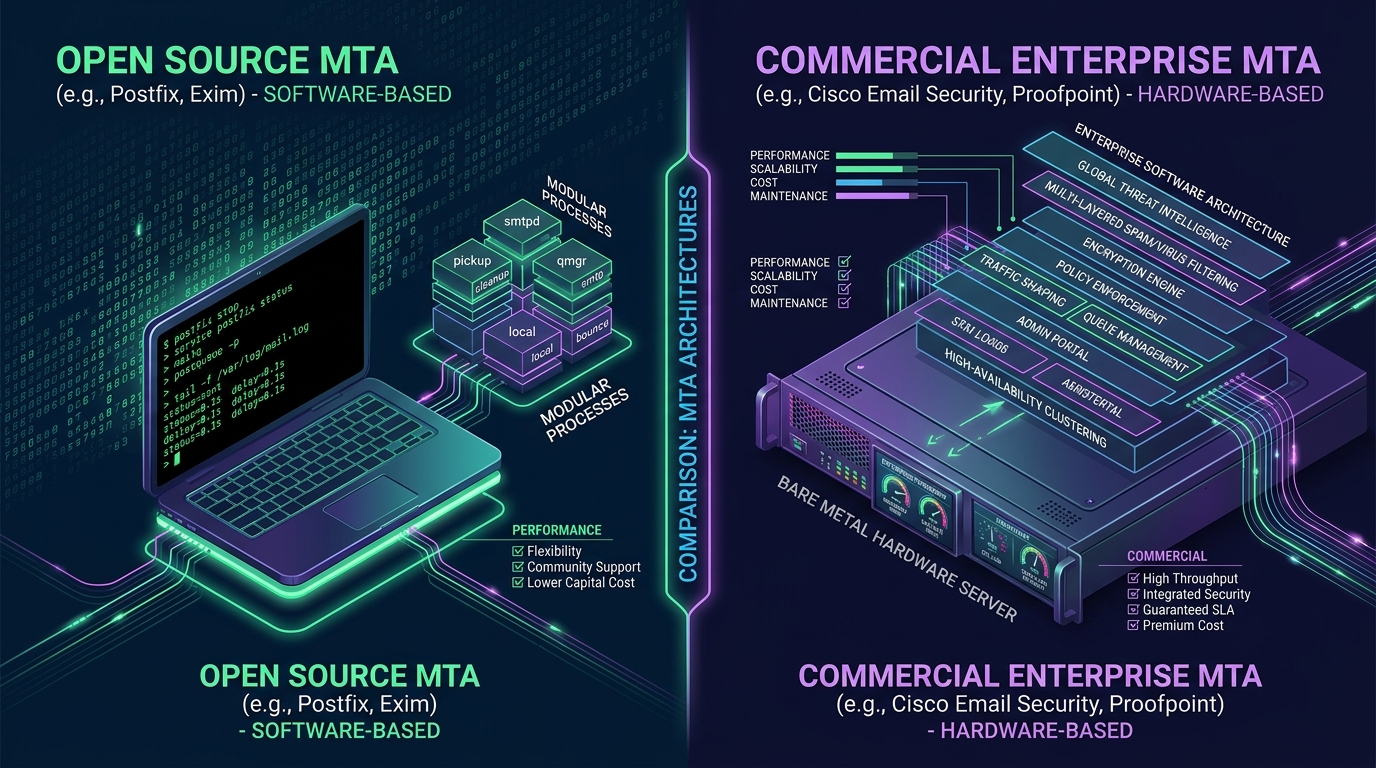
Open Source MTA vs Commercial MTA: 2027 Postfix/KumoMTA vs PowerMTA/MailerQ Comparison
Selecting the Mail Transfer Agent (MTA) layer for high-volume email infrastructure centers on a critical strategic choice: community-driven open source vs. vendor-licensed commercial software. For over two decades, commercial MTAs—most notably Port25 PowerMTA (now owned by MessageBird) and MailerQ (Copernica)—dominated enterprise deliverability. Their proprietary rate-limiting algorithms, Virtual MTA (VMTA) abstractions, automated bounce parsing, and multi-IP pooling capabilities justified recurring annual license fees of $3,000 to $10,000+ per instance.
However, the MTA landscape has undergone a tectonic shift. While general-purpose open-source daemons like Postfix and Exim continue serving standard Linux workloads (up to ~500K daily sends), the emergence of KumoMTA (an open-source Rust-based MTA designed by former OmniTI and MessageSystems architects) has shattered the commercial monopoly. KumoMTA delivers native per-ISP rate-limiting, dynamic Lua egress routing, and multi-million message throughput without annual license fees. This comprehensive 2027 comparative analysis dissects architecture, cost economics, vendor lock-in, support SLAs, and migration paths between open-source and commercial MTAs.
- 1. Two Licensing Models: Open Source Community vs Commercial Enterprise
- 2. The Open Source MTA Landscape: Postfix, Exim & Postal
- 3. The Commercial MTA Landscape: PowerMTA, MailerQ & Halon
- 4. The KumoMTA Disruption: Redefining Open-Source Parity
- 5. Configuration Comparison: Postfix vs PowerMTA vs KumoMTA
- 6. Total Cost of Ownership (TCO) & Economic Breakdown
- 7. Support Models: Community Forum vs 24/7 Enterprise SLAs
- 8. 12-Dimension Technical Capability Comparison Matrix
- 9. 2027 Migration Patterns: The Enterprise Open-Source Pivot
- 10. Enterprise Field Study: Migrating 35M Monthly Sends to KumoMTA
- 11. Operator Decision Framework
- 12. The AutoSMTP Hybrid Infrastructure Advantage
1. Two Licensing Models: Open Source Community vs Commercial Enterprise
The distinction between open-source and commercial MTAs extends far beyond source code accessibility. It fundamentally dictates an organization’s operational overhead, licensing liabilities, vendor lock-in, and architectural adaptability:
- Open Source Model (GPL, Apache 2.0, IBM Public License): Zero license fees, complete source-code auditability, and independence from corporate acquisitions or unilateral price hikes. However, operators shoulder full responsibility for bug fixes, kernel tuning, and security patches without formal vendor warranty.
- Commercial Enterprise Model: Proprietary binaries protected by hardware-locked license keys. Vendors provide contractual uptime warranties, dedicated support engineers, and rapid proprietary patches for emerging ISP compliance shifts (e.g., Yahoo/Google bulk sender mandates). The cost is substantial: high capital expense, annual recurring fees, and restricted deployment topologies.
2. The Open Source MTA Landscape: Postfix, Exim & Postal
The traditional open-source MTA ecosystem was developed primarily for general-purpose internet mail routing, not high-velocity marketing broadcasts:
| MTA | License | Implementation | Core Strengths | Primary Limitations |
|---|---|---|---|---|
| Postfix | IBM Public License | C (1998) | Rock-solid stability, modular daemon architecture, universal Linux support | Lacks native dynamic IP pools and fine-grained per-ISP connection throttling |
| Exim | GPL | C (1995) | Extremely flexible routing language, default cPanel mailer | Monolithic codebase, frequent historic CVE security patches, sluggish bulk performance |
| Haraka | MIT License | Node.js (2012) | Event-driven async I/O, rich JavaScript plugin system | High RAM consumption under heavy queues, weak out-of-the-box spool persistence |
| Postal | MIT License | Ruby / Rust (2016) | Full web dashboard, API-first design, built-in click/open tracking | Heavy database dependency (MySQL), high infrastructure resource footprint |
3. The Commercial MTA Landscape: PowerMTA, MailerQ & Halon
Commercial MTAs were engineered specifically to maximize deliverability through high-speed outbound socket scheduling and granular ISP connection control:
| MTA | Vendor / Owner | Architecture | Annual License Pricing | Target Market |
|---|---|---|---|---|
| Port25 PowerMTA | MessageBird | High-Performance C Engine | $3,000 – $10,000+ / node / yr | Enterprise ESPs, bulk marketing, tier-1 senders |
| MailerQ | Copernica | C++ with RabbitMQ & Web UI | €2,400 – €8,400+ / node / yr | Modern transactional senders, European hosting |
| Halon | Halon Security | C++ Engine with Halon script (HSL) | $3,000 – $12,000+ / yr | Telecommunications, large ISPs, anti-abuse edge |
| GreenArrow Engine | GreenArrow | Proprietary MTA + Web Studio | $600 – $1,500+ / month | Mid-market marketing platforms and agencies |
4. The KumoMTA Disruption: Redefining Open-Source Parity
The Next-Generation Open-Source Powerhouse
Launched in 2023 and reaching mature enterprise adoption in 2026–2027, KumoMTA fundamentally changed the MTA equation. Designed by the original architects behind OmniTI and MessageSystems (the creators of Momentum), KumoMTA combines memory-safe Rust with an embedded Lua runtime. It matches PowerMTA’s throughput (millions of dispatches per hour), implements native per-domain connection pacing, integrates with Prometheus/OpenTelemetry, and provides automated traffic shaping—all under the permissive Apache 2.0 open-source license.
5. Configuration Comparison: Postfix vs PowerMTA vs KumoMTA
Compare how the three primary MTAs configure per-ISP throttling for Yahoo (limiting to 20 concurrent connections and 10,000 messages per hour):
# Postfix requires dedicated transport instances in master.cf
yahoo_throttle  unix  -       -       n       -       20      smtp
  -o smtp_destination_concurrency_limit=20
  -o smtp_destination_rate_delay=1s

# /etc/postfix/transport
yahoo.com       yahoo_throttle:
aol.com         yahoo_throttle:
# Native declarative domain throttling in PowerMTA
<domain yahoo.com, aol.com>
    max-smtp-out 20
    max-msg-rate 10000/h
    retry-after 10m
    use-starttls yes
    backoff-to-normal-after 2h
</domain>
-- Dynamic programmatic traffic shaping in KumoMTA
kumo.on('get_egress_path_config', function(domain, egress_source, site_name)
  if site_name:find('yahoo') or site_name:find('aol') then
    return kumo.make_egress_path {
      max_connection_rate = '10000/h',
      max_deliveries_per_connection = 20,
      connection_limit = 20,
      enable_tls = 'Opportunistic',
    }
  end
  return kumo.make_egress_path {}
end)
6. Total Cost of Ownership (TCO) & Economic Breakdown
| Monthly Sending Scale | Open Source Cost (KumoMTA/Postfix) | Commercial MTA Cost (PowerMTA) | Annual Cost Variance |
|---|---|---|---|
| Small Scale (100K – 500K / mo) | $600 / yr ($50/mo server host) | $4,600 / yr ($4K license + $50/mo host) | Commercial is 7.6x more expensive |
| Medium Scale (1M – 5M / mo) | $2,400 / yr ($200/mo bare-metal node) | $8,400 / yr ($6K license + $200/mo host) | Commercial is 3.5x more expensive |
| Enterprise Fleet (25M – 50M+ / mo) | $9,600 / yr (4x bare-metal cluster) | $33,600 / yr (4x $6K licenses + cluster) | Commercial adds $24,000/year license overhead |
7. Support Models: Community Forum vs 24/7 Enterprise SLAs
Open Source Support Dynamics
- GitHub Issue Transparency: Direct interaction with lead maintainers and core developers.
- No Contractual SLA: Bug resolution depends on community priority or internal engineering capacity.
- Commercial Professional Services: Specialized consultants (or AutoSMTP managed services) fill the support vacuum.
Commercial Enterprise Support
- Guaranteed Response Times: 1-hour critical response SLAs for production outages.
- Direct Telemetry Escalation: Vendor engineers debug proprietary core dumps and kernel interactions.
- Deliverability Advisory: Vendors share proprietary ISP feedback and rate-limit heuristics.
8. 12-Dimension Technical Capability Comparison Matrix
| Capability Dimension | Postfix (Open Source) | KumoMTA (Open Source) | PowerMTA (Commercial) |
|---|---|---|---|
| High-Volume Burst Sending | Moderate (~500K daily) | Exceptional (Millions/hour) | Exceptional (Millions/hour) |
| Per-ISP Throttling Rules | Complex transport map hacks | Native dynamic Lua routing | Native declarative syntax |
| Virtual MTA / IP Pools | Requires multi-instance Postfix | Native dynamic egress pools | Native Virtual MTAs |
| Automated Backoff Suspension | Requires external scripts | Native automated backoff | Native automated backoff |
| HTTP REST Injection API | None (SMTP only) | Native high-speed HTTP API | Add-on module or SMTP submission |
| Telemetry & Metrics Export | Syslog text parsing | Native Prometheus & OpenTelemetry | Status web UI & XML accounting logs |
| Memory Safety & Language | C (Prone to memory bugs) | Rust (100% Memory Safe) | C (Proprietary compiled binary) |
| Cloud-Native / Containerization | Awkward daemon init | First-class Docker & Kubernetes | Requires custom hardware licensing bypass |
| License Cost per Node | $0.00 | $0.00 | $3,000 – $10,000+ / yr |
| Vendor Lock-in Risk | Zero | Zero | High (Hardware license keys) |
9. 2027 Migration Patterns: The Enterprise Open-Source Pivot
In 2026 and 2027, enterprise email infrastructure has experienced an unprecedented migration trend: large email service providers, media conglomerates, and high-growth SaaS platforms are actively migrating from PowerMTA to KumoMTA. Three structural forces drive this transition:
- Unpredictable Licensing Increases: Corporate acquisitions of legacy MTA vendors have led to aggressive price restructuring and complex VM licensing audits.
- Cloud-Native Infrastructure: Legacy commercial MTAs rely on static MAC address and hardware-locked license keys that clash with dynamic AWS/GCP auto-scaling and Kubernetes ephemeral pods. KumoMTA deploys natively in containers with zero licensing friction.
- Developer Extensibility: KumoMTA’s embedded Lua runtime allows engineering teams to implement real-time message modification, tenant rate limiting, and custom webhook callbacks without writing C milters.
10. Enterprise Field Study: Migrating 35M Monthly Sends to KumoMTA
Publishing Network: Reclaiming $38,000 in Annual License Fees
Initial Environment: A global digital media company transmitted 35 million monthly newsletters across a 4-node PowerMTA bare-metal cluster. Their annual software licensing and maintenance renewal approached $38,000.
The Migration: Over a 6-week phased migration, the engineering team deployed AutoSMTP managed KumoMTA nodes alongside the existing cluster. Traffic was shifted incrementally via DNS load balancing: 10% in Week 1, 50% in Week 3, and 100% cutover in Week 5.
The Results: Delivery throughput increased by 18% due to KumoMTA’s asynchronous Rust runtime. Postmaster reputation scores remained unchanged (99% inbox placement across Gmail and Yahoo), and the organization eliminated $38,000 in annual recurring vendor license fees.
11. Operator Decision Framework
Choose Open Source (KumoMTA / Postfix) When:
- You want to eliminate expensive recurring software licenses ($0 vs $5,000+/yr).
- Your infrastructure deploys on modern cloud environments, Docker containers, or Kubernetes clusters.
- Your engineering team values source-code transparency, programmatic Lua customization, and Prometheus metrics.
- You partner with a managed infrastructure provider like AutoSMTP to handle server-level operations and maintenance.
Choose Commercial MTAs (PowerMTA / MailerQ) When:
- Your enterprise corporate governance mandates formal vendor contracts with documented support SLAs.
- Your internal operations team possesses 10+ years of deep institutional knowledge in PowerMTA configuration syntax.
- Your legacy campaign submission systems depend strictly on proprietary PowerMTA XML accounting log parsers.
The AutoSMTP Hybrid MTA Advantage
Whether you require the battle-tested legacy mastery of PowerMTA or the modern high-velocity economics of KumoMTA, AutoSMTP provisions and operates turnkey bare-metal MTA clusters tailored to your precise sending requirements.
Provisions fully licensed PowerMTA or optimized KumoMTA clusters on enterprise bare-metal with dedicated IPv4 subnets and predictable flat pricing.
Monitors Google Postmaster spam ratios (<0.1%) and real-time ISP deferrals with algorithmic volume scaling across your entire IP pool.
RFC 5321 in-band 550 bounce suppression, automated Yahoo/Outlook Complaint Feedback Loops (CFL), and instant bad-IP eviction.
Pre-configured forward and reverse DNS (PTR) per IP, SPF CIDR alignment, 2048-bit DKIM rotation, and strict DMARC enforcement.
Deploy Enterprise MTA Infrastructure Without Licensing Headaches
Eliminate costly commercial markups or complex open-source setup. Deploy a managed high-performance AutoSMTP bare-metal cluster today.
Deploy Managed MTA Cluster →