

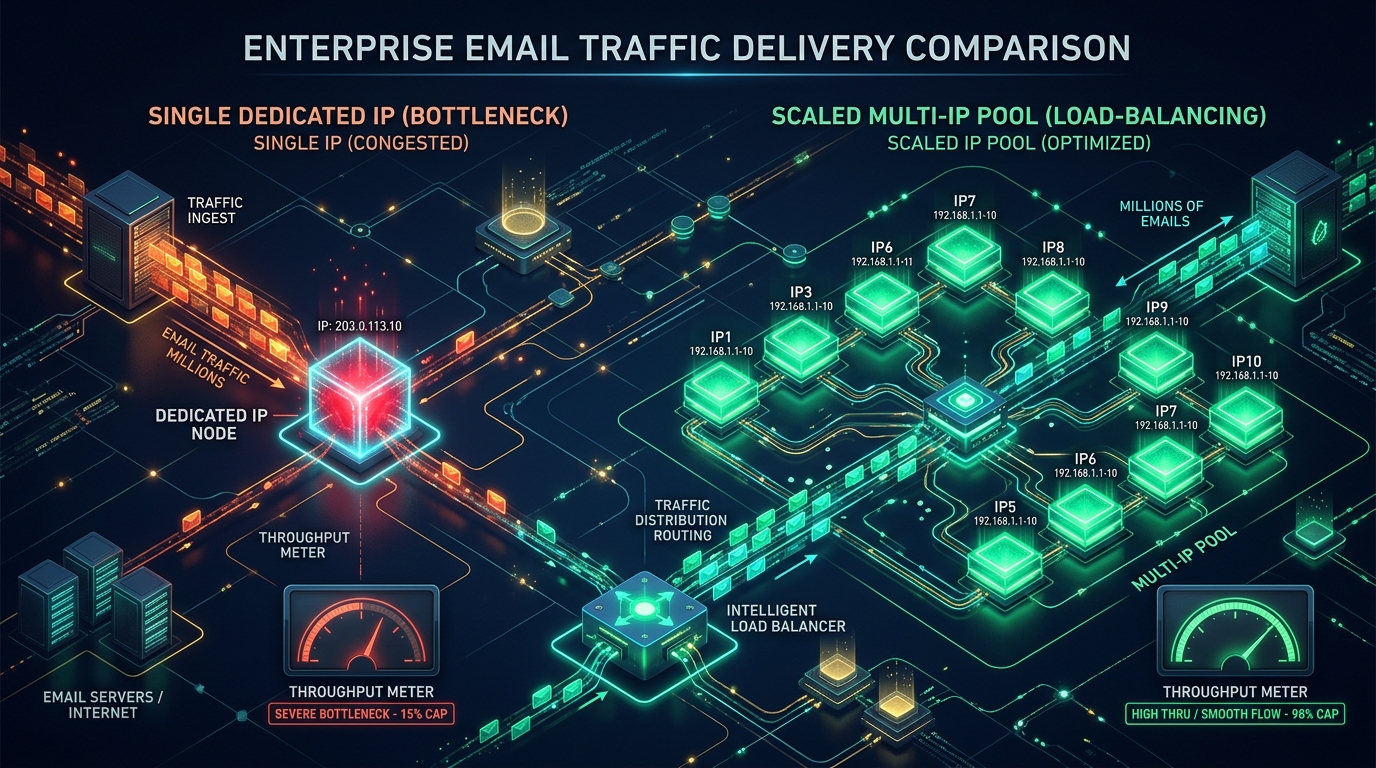
Single Dedicated IP vs Multi-IP Pool: 2027 Volume Thresholds, Pool Architecture & Deliverability Mechanics
Every scaling email programme confronts a defining operational crossroads: relying on a single dedicated IPv4 address versus architecting a multi-IP pool. A single dedicated IP represents total concentration: one IP, one reputation score, and minimal configuration complexity. However, a single IP operates within narrow volume corridors. Below 50,000 emails per week (roughly 200,000 monthly), sending volume is insufficient to maintain active reputation models with Google and Microsoft, leaving the IP vulnerable to cold-start deferrals. Above 250,000 messages per month, recipient-side ISP rate limits, concurrency ceilings, and single-point-of-failure risks create severe delivery bottlenecks.
A multi-IP pool architecture solves these physical concurrency limits by distributing outbound connections across multiple dedicated interfaces (e.g., Virtual MTAs in PowerMTA or egress pools in KumoMTA). Yet multi-IP architectures introduce non-trivial operational complexity: each IP in the pool requires independent 30-day warm-up curves, strict volume floors, coordinated TLS certificates, reverse DNS (PTR) alignment, and round-robin scheduling algorithms. This authoritative technical guide establishes the exact volume thresholds, ISP throttling mechanics, PowerMTA VMTA pool configs, and KumoMTA egress policies governing enterprise mail infrastructure in 2027.
- 1. Concentrated vs Distributed Reputation: Core Paradigm
- 2. The Volume Thresholds: 50K Floor to 250K Ceiling
- 3. Single Dedicated IP Mechanics & Failure Modes
- 4. Multi-IP Pool Mechanics & Traffic Segmentation
- 5. PowerMTA Virtual MTA & Pool Configuration
- 6. KumoMTA Lua Egress Pools & Traffic Shaping
- 7. Per-ISP Throttling & Per-Domain Concurrency Limits
- 8. AWS SES Managed IPs vs Self-Hosted Bare-Metal Pools
- 9. Operational Complexity: Single IP vs Multi-IP Pools
- 10. 10-Dimension Architectural Comparison Matrix
- 11. Enterprise Field Study: Scaling from 1 IP to 6-IP Pool
- 12. Operator Decision Framework by Volume Tier
- 13. The AutoSMTP Dedicated Advantage
1. Concentrated vs Distributed Reputation: Core Paradigm
The distinction between single dedicated IP and multi-IP pool architectures is fundamentally an architectural trade-off between reputation concentration and reputation distribution. In email delivery, mailbox providers (MBPs) evaluate incoming SMTP handshakes through statistical models that score the originating IPv4 address alongside domain authentication tokens (DKIM/SPF/DMARC).
On a single dedicated IP, all sending history, engagement metrics, bounce ratios, and user spam complaints converge onto a single 32-bit address. When sending volume is steady and recipients engage enthusiastically, this concentration builds an impenetrable reputation moat. However, it also creates an absolute single point of failure: an accidental list contamination, a sudden surge in spam trap hits, or an aggressive DNSBL listing (such as Spamhaus SBL or Invaluement) brings your entire outbound pipeline to an abrupt, screeching halt.
A multi-IP pool disperses this risk across an array of independent IP addresses. If IP 198.51.100.12 receives temporary 421 4.7.0 deferrals from Microsoft due to an unexpected spike in user complaints on a newsletter blast, the remaining IPs in the pool (198.51.100.13, 198.51.100.14, and 198.51.100.15) continue dispatching transactional receipts, password resets, and high-priority alerts with zero latency.
Single Dedicated IP Strengths
- Reputation Concentration: Every open, click, and reply consolidates into a single IP reputation vector.
- Minimal Management Overhead: Only 1 reverse DNS (PTR), 1 A record, and 1 SPF
ip4:mechanism required. - Simplified Warm-up: Single 30-day ramp schedule without coordinating multi-IP round-robin state.
- Predictable Diagnostics: Easy log aggregation and zero risk of uneven pool utilization.
Single Dedicated IP Vulnerabilities
- Zero Blast-Radius Isolation: A single blacklisting freezes marketing, billing, and transactional mail simultaneously.
- Hard Throughput Caps: Recipient ISPs cap concurrent connections per IP (e.g., 20-30 connections for Yahoo).
- Peak Volume Latency: Large batch campaigns cause extensive queue backlogs and delayed deliveries.
- No Traffic Segmentation: Difficult to isolate experimental streams or lower-reputation segments.
2. The Volume Thresholds: 50K Floor to 250K Ceiling
The decision to deploy or expand dedicated IP addresses is governed by two strict physical boundaries: the minimum reputation maintenance floor and the maximum concurrency throughput ceiling.
The 50,000/Week Dedicated IP Floor
Major ESPs and deliverability authorities (including Customer.io, Postmark, and Mailflow Authority) establish a strict floor: 50,000 messages per week (approx. 200,000 monthly). Below this volume, mailbox provider spam-filtering algorithms (especially Google’s Spam Brain and Microsoft SmartScreen) treat the IP as a “cold” or intermittent sender. Inconsistent volume patterns cause mailbox providers to reset rolling reputation scores, resulting in erratic inbox placement and severe deferrals whenever a campaign is launched.
Conversely, the 250,000/month ceiling represents the practical operational limit for a single dedicated IP running mixed commercial workloads. While a single IP can theoretically transmit millions of emails monthly over a continuous 24/7 stream, real-world marketing campaigns are bursting. When an operator attempts to blast 100,000 marketing messages across a 2-hour window on a single IP, recipient ISPs throttle the connection:
- Google (Gmail): Limits outbound burst concurrency per IP. Exceeding threshold triggers
452-4.2.2 The email account that you tried to reach is over quotaor421-4.7.0 Try again later. - Microsoft (Hotmail/Outlook): Enforces strict per-IP hourly limits. Exceeding rates produces
451 4.7.650 The mail server [IP] has exceeded maximum rate limit. - Yahoo / AOL: Enforces connection caps of 20–30 concurrent SMTP sessions per IP, rejecting excess handshakes with
421 4.7.0 [TS01] Messages from IP temporarily deferred.
3. Single Dedicated IP Mechanics & Failure Modes
Operating on a single dedicated IP requires rigorous operational discipline because any failure is catastrophic. In a single-IP architecture, the sending MTA binds all outgoing TCP sockets to a single local interface (e.g., eth0: 198.51.100.10).
# Postfix single IP outbound transport binding
smtp      unix  -       -       n       -       -       smtp
  -o smtp_bind_address=198.51.100.10
  -o smtp_helo_name=mail1.example.com
  -o smtp_connection_cache_on_demand=yes
When this single IP encounters an operational crisis—such as a third-party abuse complaint, an unverified list upload, or a compromised user account sending phishing emails—the consequences cascade across the entire organization:
- DNSBL Blacklisting: Listing on Spamhaus ZEN, Barracuda, or Spamcop blocks delivery across 80%+ of B2B corporate gateways instantly.
- Google Postmaster Demotion: Postmaster reputation drops from “High” to “Low” or “Bad”, routing 100% of marketing and transactional mail to the Gmail spam folder for 14 to 30 days.
- Queue Backpressure: Aggressive recipient deferrals fill local MTA spool disks, causing memory exhaustion and message timeouts.
4. Multi-IP Pool Mechanics & Traffic Segmentation
A multi-IP pool operates as an orchestrated cluster of dedicated IP addresses managed by intelligent routing software. The pool can be organized horizontally (distributing load evenly across all IPs) or vertically (segmenting IPs by engagement level and message priority).
Engaged vs Broad Pool Segmentation
Assigning your highest-reputation IPs to recipients who opened or clicked within the last 30 days ensures pristine inbox placement, while broader re-engagement campaigns utilize secondary IPs with conservative throttling.
Strict Transactional Isolation
Reserving 1–2 dedicated IPs exclusively for password resets, order confirmations, and multi-factor authentication (MFA) codes guarantees 99.9% inbox placement under sub-second latency, regardless of marketing volume.
5. PowerMTA Virtual MTA & Pool Configuration
In enterprise on-premise and bare-metal environments, Port25 PowerMTA represents the industry benchmark for multi-IP pool management through its Virtual MTA (VMTA) and Virtual MTA Pool abstractions. Each physical IP is configured as a discrete <virtual-mta>, and multiple VMTAs are combined into a <virtual-mta-pool> that handles automated round-robin rotation, outbound IP load balancing, and failure failover.
# Discrete Virtual MTAs mapped to physical IPv4 interfaces
<virtual-mta vmta-mkt-01>
    smtp-source-host 198.51.100.10 mail1.example.com
    max-smtp-out 30
    max-msg-rate 10000/h
    domain-key default,example.com,/etc/pmta/keys/dkim.pem
</virtual-mta>

<virtual-mta vmta-mkt-02>
    smtp-source-host 198.51.100.11 mail2.example.com
    max-smtp-out 30
    max-msg-rate 10000/h
    domain-key default,example.com,/etc/pmta/keys/dkim.pem
</virtual-mta>

<virtual-mta vmta-mkt-03>
    smtp-source-host 198.51.100.12 mail3.example.com
    max-smtp-out 30
    max-msg-rate 10000/h
    domain-key default,example.com,/etc/pmta/keys/dkim.pem
</virtual-mta>

# High-Capacity Round-Robin Marketing Pool
<virtual-mta-pool pool-marketing-broadcast>
    virtual-mta vmta-mkt-01
    virtual-mta vmta-mkt-02
    virtual-mta vmta-mkt-03
</virtual-mta-pool>

# Isolated Transactional Virtual MTA
<virtual-mta vmta-transactional-p1>
    smtp-source-host 198.51.100.20 auth.example.com
    max-smtp-out 50
    domain-key auth,example.com,/etc/pmta/keys/auth.pem
</virtual-mta>
6. KumoMTA Lua Egress Pools & Traffic Shaping
The modern open-source Rust-based MTA, KumoMTA, provides programmatic multi-IP routing via native Lua event hooks. Rather than static configuration blocks, KumoMTA allows operators to define dynamic egress_pools and bind messages based on headers, recipient domains, or tenant metadata.
local kumo = require 'kumo'

-- Define Egress Sources (IP interfaces)
kumo.define_egress_source {
  name = 'mkt-ip-1',
  source_address = '198.51.100.10',
  ehlo_domain = 'mail1.example.com',
}

kumo.define_egress_source {
  name = 'mkt-ip-2',
  source_address = '198.51.100.11',
  ehlo_domain = 'mail2.example.com',
}

kumo.define_egress_source {
  name = 'tx-ip-1',
  source_address = '198.51.100.20',
  ehlo_domain = 'auth.example.com',
}

-- Define Egress Pools
kumo.define_egress_pool {
  name = 'pool-marketing',
  entries = {
    { name = 'mkt-ip-1', weight = 1 },
    { name = 'mkt-ip-2', weight = 1 },
  },
}

kumo.define_egress_pool {
  name = 'pool-transactional',
  entries = {
    { name = 'tx-ip-1', weight = 1 },
  },
}

-- Message Routing Hook
kumo.on('smtp_server_message_received', function(msg)
  local stream_type = msg:get_meta('stream') or 'marketing'
  if stream_type == 'transactional' then
    msg:set_meta('routing_pool', 'pool-transactional')
  else
    msg:set_meta('routing_pool', 'pool-marketing')
  end
end)
7. Per-ISP Throttling & Per-Domain Concurrency Limits
Mailbox providers enforce rigid concurrent connection and delivery throughput rate limits per sending IPv4 address. Understanding these limits explains why a single dedicated IP cannot achieve high-throughput campaign dispatch.
| Mailbox Provider | Max Outbound Connections / IP | Max Messages / Connection | Max Hourly Rate / IP | Failure Response Code |
|---|---|---|---|---|
| Google (Gmail/Workspace) | 30 – 50 concurrent | 100 messages | 50,000 – 80,000 / hr | 421 4.7.0 Rate limit exceeded |
| Microsoft (Outlook/Hotmail) | 10 – 20 concurrent | 50 messages | 10,000 – 25,000 / hr | 451 4.7.650 Exceeded maximum rate |
| Yahoo / AOL | 20 – 30 concurrent | 20 messages | 15,000 – 30,000 / hr | 421 4.7.0 [TS01] Temporary deferral |
| Apple iCloud | 10 concurrent | 25 messages | 5,000 – 15,000 / hr | 421 4.7.1 Service unavailable |
| Comcast / Cox | 5 – 10 concurrent | 50 messages | 5,000 – 10,000 / hr | 421 4.7.0 Throttled by receiver |
As demonstrated in the table, delivering 300,000 marketing messages to Outlook on a single IP requires a minimum of 12 to 15 hours under Microsoft’s conservative connection pacing. Expanding to a 6-IP pool divides this volume, enabling full delivery within 2 to 2.5 hours without triggering rate-limit deferrals.
8. AWS SES Managed IPs vs Self-Hosted Bare-Metal Pools
Modern operators evaluate between cloud-managed IP pooling (such as AWS SES Dedicated IPs Managed) and self-hosted bare-metal clusters (AutoSMTP, PowerMTA, KumoMTA):
- AWS SES Managed Dedicated IPs: Automatically provisions and scales IP pool counts based on outbound traffic velocity. It implements automated warm-up algorithms per ISP. However, AWS SES charges $24.95/month per IP, charges per-thousand message bandwidth fees, imposes rigid sending quotas, and offers limited low-level socket diagnostic visibility.
- Self-Hosted Bare-Metal Pools: Bare-metal clusters (such as AutoSMTP’s managed nodes) assign clean, dedicated IPv4 subnets (/29, /28, or /24) directly to dedicated MTA instances. Operators achieve 100% control over kernel TCP buffers, custom bounce classification rules, in-band feedback loop handling, and zero per-message egress markups.
9. Operational Complexity: Single IP vs Multi-IP Pools
Operating a multi-IP pool requires significant infrastructure engineering discipline compared to a single IP:
| Operational Discipline | Single Dedicated IP | Multi-IP Pool (4 – 16 IPs) |
|---|---|---|
| DNS & Reverse DNS (PTR) | 1 A record + 1 PTR record | Distinct A + PTR for every IP (mail1, mail2…) |
| SPF Syntax Complexity | v=spf1 ip4:198.51.100.10 ~all |
v=spf1 ip4:198.51.100.0/28 ~all (Subnet CIDR) |
| Warm-up Management | 1 linear 30-day schedule | Parallel per-IP warm-up curves with traffic balancing |
| Postmaster Tooling | Single IP telemetry tracking | Aggregate monitoring across entire IP range |
| DNSBL Monitoring | 1 IP lookup against 34 DNSBLs | Continuous multi-IP automated fleet polling |
| Hardware & NIC Configuration | Single virtual interface | Multiple alias IP addresses bound to network interface |
10. 10-Dimension Architectural Comparison Matrix
| Architectural Dimension | Single Dedicated IP | Multi-IP Pool Architecture |
|---|---|---|
| Monthly Volume Range | 50,000 – 250,000 / month | 500,000 – 50,000,000+ / month |
| Throughput Concurrency | Limited by single ISP connection caps | Multiplied linearly by number of active pool IPs |
| Reputation Blast Radius | Global failure; 1 incident freezes all mail | Isolated; bad IP throttled while others deliver |
| Traffic Stream Isolation | Impossible; all streams share same IP | Dedicated IPs for Transactional, Marketing & Re-engagement |
| Warm-up Duration & Effort | 30 days; simple linear volume ramp | 30–45 days; coordinated round-robin ramp |
| ISP Rate-Limit Deferrals | High risk during peak burst marketing | Low risk; outbound connections distributed |
| Infrastructure Setup Cost | Low ($25 – $50 / month IP allocation) | Moderate ($100 – $400+ / month IP block) |
| MTA Complexity | Standard Postfix/Exim out-of-the-box | PowerMTA Virtual MTAs or KumoMTA Lua hooks |
| Spamhaus / DNSBL Risk | Single listing causes complete blackout | Defective IP dropped from pool; business continues |
| Failover Resilience | None; static routing | Automated pool degradation and fallback routing |
11. Enterprise Field Study: Scaling from 1 IP to 6-IP Pool
SaaS Platform Scaling: Overcoming Peak Campaign Deferrals
Initial Environment: A high-growth B2B fintech SaaS platform transmitted 220,000 transactional emails and monthly statements using a single dedicated IPv4 address on Amazon SES.
The Operational Crisis: Upon launching a weekly product newsletter to 180,000 subscribers, Microsoft Outlook and Yahoo deferred 42% of outgoing messages with 451 4.7.650 Maximum rate limit exceeded and 421 4.7.0 Temporary deferral. Critical multi-factor authentication (MFA) codes and password reset emails sat trapped in the local queue for up to 90 minutes, triggering severe customer support escalations.
The Solution Architecture: The infrastructure team transitioned to an AutoSMTP bare-metal cluster with a 6-IP dedicated pool:
- IP 1 & IP 2 (Transactional VMTA Pool): Reserved strictly for MFA codes, billing receipts, and password resets. Average delivery time dropped to 420 milliseconds.
- IP 3 & IP 4 (High-Engagement Marketing): Dedicated to users active in the last 30 days. Sender score maintained at 99/100.
- IP 5 & IP 6 (Broad Marketing & Re-engagement): Handled monthly newsletters and batch announcements with automated per-ISP connection throttling.
Outcome: Campaign dispatch time collapsed from 9 hours to 48 minutes. Microsoft deferrals fell to 0.02%, and transactional delivery SLA reached 99.98% inbox placement within 2 seconds.
12. Operator Decision Framework by Volume Tier
Tier 1: Under 50,000 Messages / Month → Shared SMTP Infrastructure
At under 50K monthly sends, sending volume is insufficient to warm or maintain a dedicated IP address. Mailbox providers will treat your IP as intermittent, destroying deliverability. Rely on enterprise shared pools (e.g., Postmark or Mailgun shared tiers).
Tier 2: 50,000 to 250,000 Messages / Month → Single Dedicated IP
This is the optimal corridor for a single dedicated IP. You generate sufficient volume to establish a solid sender reputation with Google and Microsoft without exceeding recipient connection concurrency caps. Ensure strict list hygiene to prevent blacklisting.
Tier 3: 250,000 to 1,000,000 Messages / Month → 2 to 4 IP Segmented Pool
You have outgrown single IP concurrency limits. Deploy a multi-IP pool isolating transactional traffic (1 IP) from promotional marketing campaigns (2–3 IPs in a round-robin pool).
Tier 4: 1,000,000 to 10,000,000+ Messages / Month → 4 to 16+ IP Enterprise Pool
Enterprise scale mandates full multi-IP pools organized by engagement tiers and ISP routing policies. Deploy bare-metal PowerMTA or KumoMTA clusters with automated warmup throttling and continuous DNSBL telemetry.
The AutoSMTP Multi-IP Dedicated Advantage
Whether deploying a single pristine dedicated IP or orchestrating a complex 32-IP virtual MTA pool, AutoSMTP delivers turnkey bare-metal server infrastructure engineered for maximum inbox placement and wire-speed delivery.
Provisions fully licensed PowerMTA and KumoMTA clusters on enterprise bare-metal with dedicated IPv4 subnets and predictable flat pricing.
Monitors Google Postmaster spam ratios (<0.1%) and real-time ISP deferrals with algorithmic volume scaling across your entire IP pool.
RFC 5321 in-band 550 bounce suppression, automated Yahoo/Outlook Complaint Feedback Loops (CFL), and instant bad-IP eviction.
Pre-configured forward and reverse DNS (PTR) per IP, SPF CIDR alignment, 2048-bit DKIM rotation, and strict DMARC enforcement.
Scale Your Outbound Deliverability with Dedicated IP Pools
Stop risking your transactional delivery on shared pools or overloaded single IPs. Deploy an enterprise bare-metal AutoSMTP cluster with dedicated multi-IP routing today.
Deploy Multi-IP Infrastructure →