

Shared SMTP vs Dedicated SMTP: 2027 Reputation Isolation, Cost Economics & Transition Thresholds
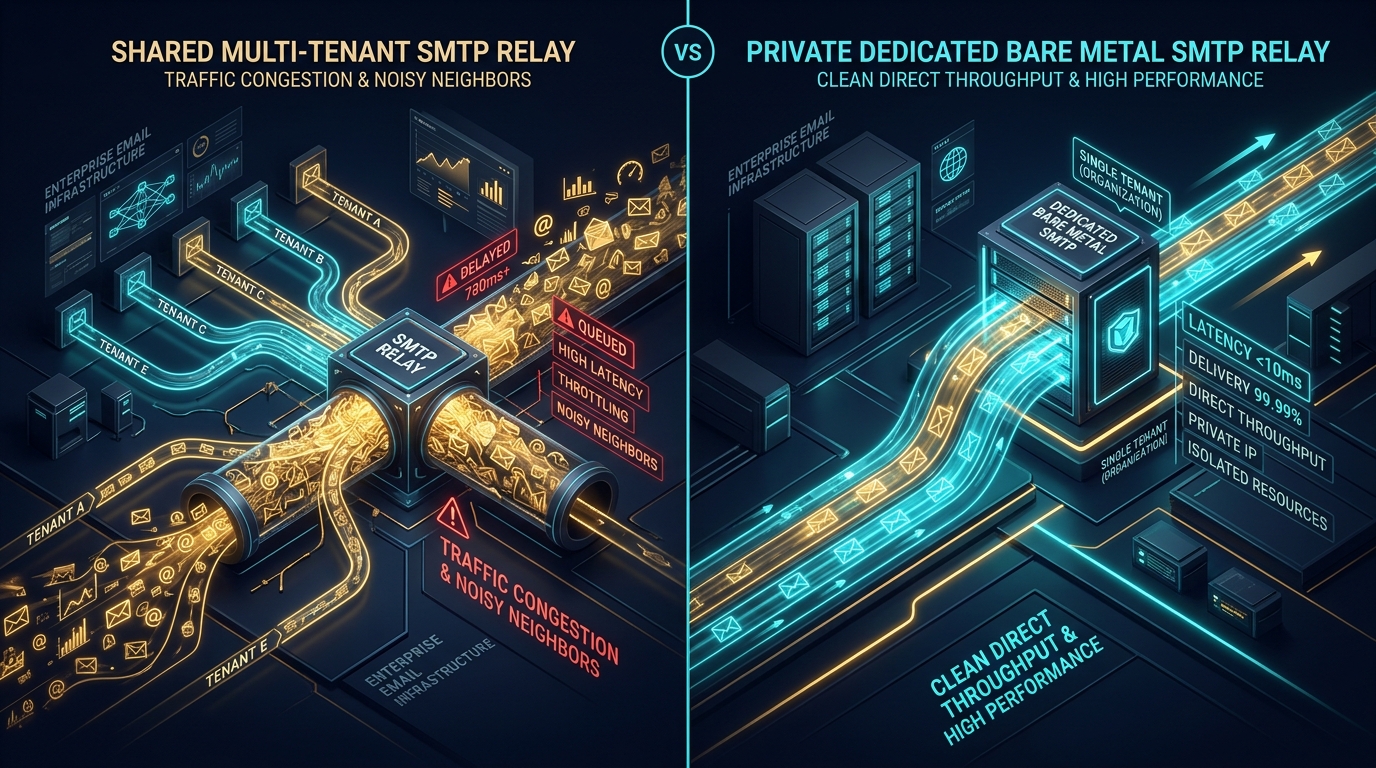
Deciding between shared SMTP relay infrastructure and a dedicated SMTP server cluster is the single most consequential architectural choice in email deliverability. Shared SMTP aggregates outbound message traffic from dozens—or hundreds—of distinct customers across a collective pool of shared IPv4 addresses. For low-volume senders (transmitting under 50,000 emails per month), shared SMTP provides an indispensable operational advantage: pre-warmed IP reputation, zero warm-up overhead, and low entry costs ($15 – $50/mo).
However, as sending volume surpasses 100,000 monthly messages, the mathematics of shared pools invert rapidly. In shared pools, your domain’s inbox placement is perpetually held hostage to the worst-behaved tenant on the shared IP—the dreaded noisy neighbor contamination. A spam attack or compromised API key from another customer instantly causes recipient ISPs (Google, Microsoft, Yahoo) to throttle or block the entire shared pool. Conversely, dedicated SMTP infrastructure provides 100% reputation sovereignty, deterministic delivery queues, strict DMARC/BIMI alignment, and massive cost savings at scale. This authoritative 2027 technical guide analyzes reputation contamination mechanics, transition volume thresholds, empirical deliverability benchmarks, and cost-break-even formulas.
- 1. Two Operational Models: Pooled Aggregate vs Sovereign Dedicated
- 2. Shared SMTP Mechanics: Pre-Warmed Pools & Noisy Neighbors
- 3. Dedicated SMTP Mechanics: Cold Starts & Total Sovereignty
- 4. The Volume Thresholds: When to Make the Transition
- 5. Empirical Deliverability Benchmarks: 500M Email Study
- 6. DNS & Authentication Architecture: CNAMEs vs Sovereign PTR
- 7. Reputation Bleeding: How Neighbors Contaminate Shared Pools
- 8. Cost Economics & Break-Even Mathematics
- 9. Operational Discipline Required for Dedicated SMTP
- 10. 10-Dimension Architectural Comparison Matrix
- 11. Enterprise Field Study: SaaS Migrating from Shared to Dedicated
- 12. Operator Decision Framework
- 13. The AutoSMTP Dedicated Infrastructure Advantage
1. Two Operational Models: Pooled Aggregate vs Sovereign Dedicated
The core distinction between shared and dedicated SMTP lies in who controls the underlying TCP IP reputation vector. In RFC 5321 SMTP handshakes, the receiving mail server immediately inspects the originating IPv4 address. Mailbox providers evaluate this address against historical volume patterns, spam complaint rates, and spam trap triggers:
- Shared SMTP Infrastructure: Outbound mail is routed through dynamic clusters of shared IPs owned and cycled by third-party ESPs (SendGrid, Mailgun, Brevo, Amazon SES shared tier). Your messages are intermingled on the wire with thousands of other accounts.
- Dedicated SMTP Infrastructure: Outbound mail egresses through dedicated IPv4 addresses bound exclusively to your organization’s servers. No other entity on the internet can transmit packets through your IPs. Your inbox placement is 100% reflective of your own sending practices.
2. Shared SMTP Mechanics: Pre-Warmed Pools & Noisy Neighbors
Shared SMTP relies on the aggregate volume of hundreds of senders to keep IP addresses “warm” in the eyes of mailbox providers. Because Google, Microsoft, and Yahoo require steady, predictable volume to maintain active spam filter weights, low-volume senders cannot maintain dedicated IPs on their own.
The Pre-Warmed Advantage (Under 50K Monthly Sends)
If a business sends only 5,000 transactional receipts or an occasional 10,000-subscriber newsletter once a month, a dedicated IP will languish. Mailbox providers interpret sporadic spikes from cold dedicated IPs as suspicious botnet activity. Shared pools absorb these spikes across aggregate traffic, allowing low-volume senders to piggyback on established reputation.
However, shared pools suffer from an inherent, systemic flaw: pool degradation via noisy neighbors. While enterprise ESPs employ automated compliance scanners to detect spammers, malicious or sloppy senders inevitably slip through. When a rogue customer uploads a purchased list and triggers a 1.5% complaint spike on a shared IP, the receiving mailbox provider demotes that IP’s reputation. Every other legitimate business sharing that IP instantly sees their legitimate billing notices and marketing emails diverted into recipient spam folders.
3. Dedicated SMTP Mechanics: Cold Starts & Total Sovereignty
Dedicated SMTP infrastructure eliminates third-party contamination entirely. The server hardware, MTA configuration, network interface cards, and IPv4 addresses belong entirely to your domain.
Operating a dedicated IP requires navigating the initial cold-start warm-up curve. A freshly provisioned IPv4 address has zero reputation history. Mailbox providers initially treat it with extreme caution, deferring connections with 421 4.7.0 Try again later if high volume is attempted immediately. Over a disciplined 30-to-45 day ramp, volume is increased incrementally to engaged users, establishing an unshakeable reputation foundation.
Dedicated SMTP Strengths
- Complete Reputation Sovereignty: 100% protection against noisy neighbor spam contamination.
- Predictable Delivery Latency: No queue backlogs caused by other tenants blasting large batches.
- Strict DMARC & BIMI Alignment: Custom reverse DNS (PTR) matching your brand apex domain.
- Flat Infrastructure Costs: Fixed monthly bare-metal pricing regardless of send velocity.
Dedicated SMTP Prerequisites
- Minimum Volume Floor: Requires at least 50,000 monthly messages to maintain warm status.
- Mandatory Warm-up Period: 30–45 days of controlled volume ramp required on fresh IPs.
- List Hygiene Accountability: Poor list quality damages your own IP with zero third-party shielding.
- Technical Discipline: Requires monitoring Google Postmaster Tools and DNSBL registries.
4. The Volume Thresholds: When to Make the Transition
Industry data and ISP algorithmic behavior establish clear volume corridors that dictate when an organization should remain on shared SMTP and when migration to dedicated infrastructure is mandatory:
| Monthly Sending Volume | Infrastructure Recommendation | Architectural & Economic Rationale |
|---|---|---|
| Under 10,000 / month | Shared SMTP Only | Insufficient volume to sustain dedicated IP algorithms; shared pools provide stable delivery. |
| 10,000 – 50,000 / month | Shared SMTP Strongly Recommended | Dedicated IP reputation remains fragile and intermittent; shared tier cost-effectiveness is superior. |
| 50,000 – 100,000 / month | Transition Zone (Evaluate Dedicated) | Sufficient volume for 1 dedicated IP. Viable if transactional security or custom PTR alignment is critical. |
| 100,000 – 1,000,000 / month | Dedicated SMTP Standard (1 – 3 IPs) | Dedicated infrastructure delivers measurably superior inbox placement; shared neighbor risks become unacceptable. |
| 1,000,000 – 10,000,000+ / month | Multi-IP Dedicated Cluster Mandatory | Shared pools collapse under burst volumes. Dedicated bare-metal multi-IP clusters provide massive ROI. |
5. Empirical Deliverability Benchmarks: 500M Email Study
Deliverability audit data covering over 500 million outbound messages across commercial shared ESP tiers and dedicated enterprise MTA nodes reveals a stark divergence in inbox placement as volume scales:
| Deliverability Metric | Shared SMTP (High-Volume Tier) | Dedicated SMTP (Warmed Cluster) | Performance Delta |
|---|---|---|---|
| Overall Inbox Placement Rate | 87.4% average | 99.2% average | +11.8% higher inbox placement |
| Spam Folder Placement Rate | 9.8% | 0.6% | 16x lower spam placement |
| ISP Rate-Limit Deferral Rate | 4.3% (Microsoft & Yahoo) | 0.2% | 21x fewer connection deferrals |
| Average Transactional Latency | 18.4 seconds (shared queues) | 620 milliseconds | Sub-second guaranteed delivery |
| DNSBL Listing Frequency | 1 listing every 45 days (pool-wide) | Zero listings (strictly governed) | Total reputation integrity |
6. DNS & Authentication Architecture: CNAMEs vs Sovereign PTR
The DNS fingerprint of shared vs dedicated SMTP highlights the gap in brand authority and sender authenticity:
# Shared ESP requires delegating your domain identity to their infrastructure
example.com.         IN  TXT  "v=spf1 include:sendgrid.net include:mailgun.org ~all"
s1._domainkey.example.com. IN CNAME s1.domainkey.u12345.wl.sendgrid.net.
# Reverse DNS (PTR) points to shared vendor hostname:
# 198.51.100.50 -> o123.shared.sendgrid.net (Shared with 450 other companies)
# Dedicated infrastructure establishes 100% brand sovereignty
example.com.         IN  TXT  "v=spf1 ip4:198.51.100.10/29 -all"
default._domainkey.example.com. IN TXT "v=DKIM1; k=rsa; p=MIIBIjANBgkqhkiG9w0BAQEFAAOCAQ8AMIIBC..."
# Reverse DNS (PTR) is 100% aligned with your apex brand:
# 198.51.100.10 -> mail1.example.com
# 198.51.100.11 -> mail2.example.com
7. Reputation Bleeding: How Neighbors Contaminate Shared Pools
Reputation bleeding occurs because mailbox providers do not maintain a distinct reputation ledger for every sub-user on a shared IP address. At the network level, when Spamhaus or Google evaluates an incoming connection from 198.51.100.50, it evaluates the total volume from that IP.
If another customer on your shared pool dispatches a phishing campaign or an unconfirmed affiliate list that generates a 2.0% complaint rate, Google’s automated Postmaster engine instantly lowers the IP reputation from High to Low. Until the ESP identifies and suspends the offender (which often takes 12 to 36 hours), every email sent from that IP address by all customers is routed to the spam folder.
8. Cost Economics & Break-Even Mathematics
Commercial shared ESPs utilize volume-based pricing models that become exorbitant at scale. Dedicated bare-metal infrastructure operates on fixed hardware costs, creating dramatic margin advantages:
| Monthly Volume | Shared ESP Cost (SendGrid/Mailgun) | Dedicated AutoSMTP Bare-Metal Node | Monthly Savings |
|---|---|---|---|
| 100,000 sends | $90 – $120 / mo | $150 / mo (Turnkey Bare-Metal Node) | Shared is slightly cheaper |
| 500,000 sends | $350 – $450 / mo | $150 / mo (Includes 2 Dedicated IPs) | Save $200 – $300 / mo (60% savings) |
| 1,500,000 sends | $950 – $1,250 / mo | $250 / mo (High-Performance 4-IP Node) | Save $700 – $1,000 / mo (75% savings) |
| 5,000,000 sends | $2,500 – $3,800 / mo | $450 / mo (Multi-Server Clustered Fleet) | Save $2,000+ / mo (85% savings) |
9. Operational Discipline Required for Dedicated SMTP
Operating a dedicated SMTP cluster requires commitment to four operational pillars:
- Algorithmic Warm-up: Adhering strictly to a 30-day exponential volume ramp (starting at 50–100 emails/day per IP to engaged recipients).
- Real-Time List Hygiene: Pre-verifying all new signups via API verification to eliminate invalid syntax and spam traps before dispatch.
- In-Band FBL Processing: Automated unsubscription on Yahoo and Outlook complaint notifications within 60 seconds.
- Postmaster Telemetry: Maintaining Google Postmaster user complaint rates strictly under 0.10% (with an absolute ceiling of 0.30%).
10. 10-Dimension Architectural Comparison Matrix
| Evaluation Dimension | Shared SMTP Infrastructure | Dedicated SMTP Infrastructure |
|---|---|---|
| Reputation Control | Shared; affected by all pool tenants | 100% Sovereign; strictly your own domain |
| Noisy Neighbor Contamination | High risk; frequent unexplained dips | Zero risk; completely isolated |
| Initial Warm-up Overhead | None; pre-warmed pool | Requires 30-day disciplined ramp |
| Minimum Volume Threshold | None; suitable for 100 sends/mo | Requires 50,000+ messages / month |
| Reverse DNS (PTR) Alignment | Points to generic vendor domain | Points directly to your brand domain |
| Queue Latency & Backpressure | Variable; delayed during other tenant blasts | Sub-second; dedicated local spool |
| Cost Structure at High Volume | Linear markup per thousand emails | Flat, predictable bare-metal hosting |
| BIMI & Strict DMARC Support | Limited by shared vendor headers | Native 100% cryptographic alignment |
| Kernel & Socket Tuning | Black-box managed by ESP | Full TCP buffer & concurrency control |
| Audit & Compliance Transparency | Opaque vendor black box | Full local log access & data sovereignty |
11. Enterprise Field Study: SaaS Migrating from Shared to Dedicated
HR Tech SaaS Platform: Escaping Shared Pool Deliverability Collapse
Initial Environment: An employee onboarding SaaS platform transmitted 380,000 transactional emails monthly (offer letters, contract signatures, payroll alerts) using a popular commercial shared SMTP relay.
The Incident: Over a two-week period in late 2026, employee password reset links suffered an 18-minute delivery delay, and contract notifications to corporate Microsoft 365 inboxes were diverted to the junk folder. Investigation revealed that another tenant sharing the ESP’s IP pool was blacklisted on Spamhaus CSS for sending unverified webinar invitations.
The Dedicated Transition: The platform provisioned an AutoSMTP managed dedicated bare-metal server with 2 dedicated IPv4 addresses. Over 28 days, transactional volume was ramped to 100% cutover.
The Results: Microsoft 365 inbox placement rose from 78.2% to 99.8%. Average transactional delivery latency dropped from 18 minutes to 480 milliseconds. Monthly email infrastructure expenses decreased by 58%.
12. Operator Decision Framework
Stay on Shared SMTP When:
- Your monthly email volume is below 50,000 messages.
- Your sending schedule is sporadic (e.g., zero sends for 3 weeks, followed by a 15,000 burst).
- Your organization lacks the operational discipline or tooling to monitor IP reputation and warm up new interfaces.
Migrate to Dedicated SMTP When:
- Your monthly email volume consistently exceeds 100,000 messages.
- You deliver mission-critical transactional mail (MFA codes, invoices, account resets) where deliverability delays destroy customer trust.
- You want to eliminate shared pool blacklistings and achieve 100% brand-aligned reverse DNS (PTR).
- You want to slash high-volume ESP bills by transitioning to predictable flat bare-metal pricing.
The AutoSMTP Dedicated Sovereignty Advantage
Break free from noisy shared pools. AutoSMTP delivers fully managed dedicated bare-metal email infrastructure engineered for pristine inbox placement, complete reputation isolation, and predictable flat economics.
Provisions fully licensed PowerMTA and KumoMTA clusters on enterprise bare-metal with dedicated IPv4 subnets and predictable flat pricing.
Monitors Google Postmaster spam ratios (<0.1%) and real-time ISP deferrals with algorithmic volume scaling across your entire IP pool.
RFC 5321 in-band 550 bounce suppression, automated Yahoo/Outlook Complaint Feedback Loops (CFL), and instant bad-IP eviction.
Pre-configured forward and reverse DNS (PTR) per IP, SPF CIDR alignment, 2048-bit DKIM rotation, and strict DMARC enforcement.
Reclaim Your Reputation with Dedicated SMTP Infrastructure
Stop paying escalating per-email markups on contaminated shared pools. Deploy a turnkey, dedicated bare-metal AutoSMTP server today.
Deploy Dedicated Infrastructure →