

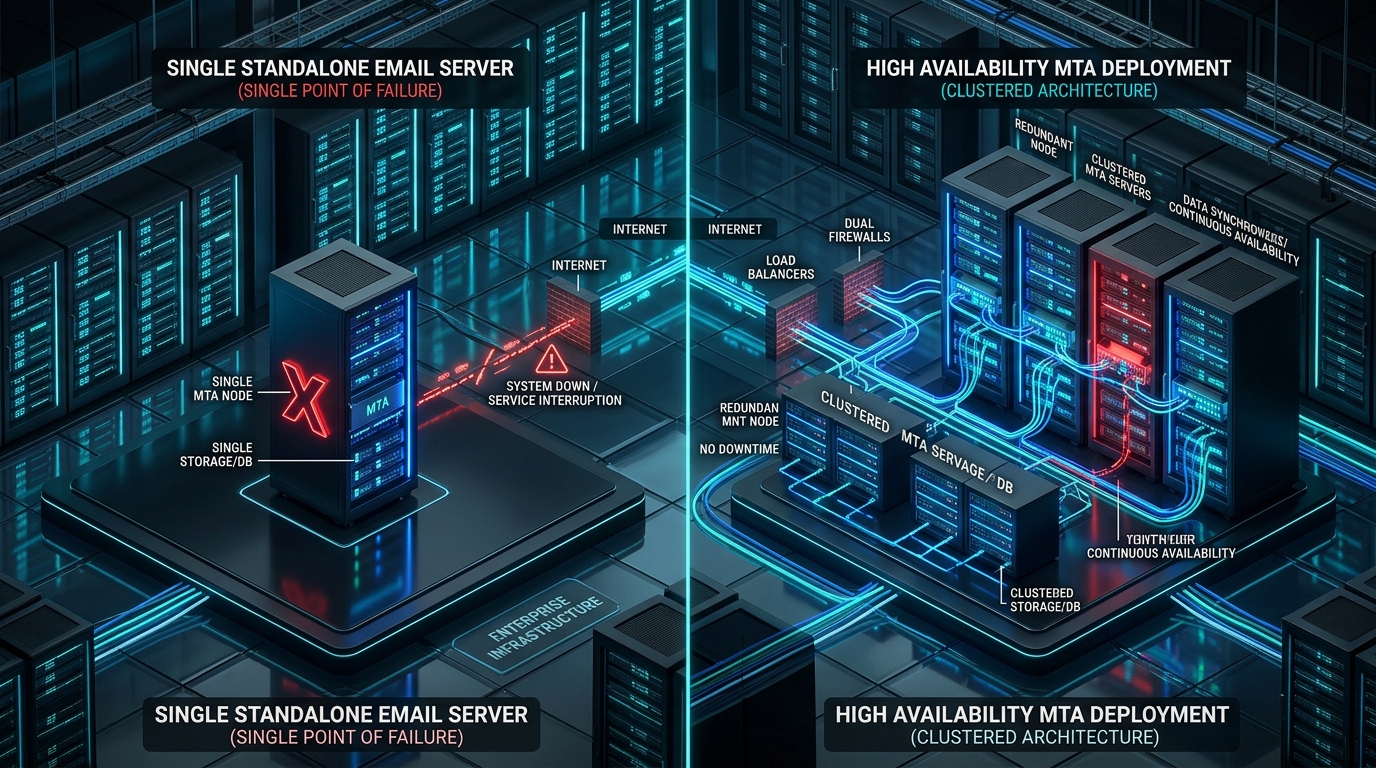
Single Server vs Multi-Server Email Infrastructure: 2027 Scaling, Failover Patterns & Queue Sharding
Modern email architecture is defined by three competing operational forces: throughput velocity, high availability (99.99% uptime), and engineering complexity. A single-server architecture consolidates all mail delivery layers—MTA submission, local disk spooling, DKIM signing, authentication checks, and outbound transport—onto a single physical bare-metal host or virtual machine. When tuned properly, modern MTAs (Postfix, KumoMTA, PowerMTA) on a single high-performance server can easily sustain 200,000 to 500,000 daily messages at negligible operating cost. However, a single server represents an absolute single point of failure: any kernel panic, network card failure, disk saturation, or hypervisor reboot results in immediate, 100% email downtime.
A multi-server email infrastructure eliminates downtime by distributing duties across specialized server nodes: Layer 4 HAProxy load balancers with PROXY Protocol v2, dedicated edge submission MTAs, distributed spool storage, and tiered outbound delivery clusters. However, multi-server architectures introduce distributed system challenges: split-brain queue states, DNS MX priority failover nuances, complex TLS certificate synchronization, and distributed log aggregation. This authoritative 2027 architectural guide evaluates single vs multi-server scaling trigger points, Layer 4 vs Layer 7 load balancing, active-active failover patterns, and production HAProxy/MTA configurations.
- 1. The Scaling Question: Throughput, Availability & Complexity
- 2. Single-Server Architecture: Anatomy, Bottlenecks & Limits
- 3. Multi-Server Topologies: Functional Separation & Clustering
- 4. DNS MX Priority Routing: Inbound Failover & Load Balancing
- 5. Layer 4 vs Layer 7 Load Balancing: HAProxy with PROXY Protocol
- 6. Queue Sharding Strategies: Round-Robin vs Stream Partitioning
- 7. High-Availability Failover Patterns: Active-Active vs Standby
- 8. Scaling Trigger Points Across Volume Tiers
- 9. 10-Dimension Architectural Comparison Matrix
- 10. Production Configurations: HAProxy L4 + Postfix Multi-Instance
- 11. Enterprise Field Study: Scaling to a 4-Node 15M/Month Cluster
- 12. Operator Decision Framework
- 13. The AutoSMTP Clustered Fleet Advantage
1. The Scaling Question: Throughput, Availability & Complexity
The progression from a monolithic single server to a distributed multi-server email topology is rarely driven solely by CPU or RAM utilization. Modern Linux servers equipped with high-core AMD EPYC processors and NVMe storage can handle immense message generation rates. Instead, the scaling trigger is almost always dictated by two non-negotiable operational requirements:
- Availability SLA (Zero-Downtime Resilience): In transactional environments (password resets, payment receipts, two-factor authentication), an unannounced 45-minute server outage during database maintenance or hardware failure directly destroys revenue and breaks user trust.
- Blast-Radius & Queue Isolation: When high-volume marketing batches fill the local mail queue with 300,000 delayed messages, single-server systems experience queue starvation. Time-critical transactional notifications become stuck behind bulk campaigns, causing unacceptable latency.
Single-Server Advantages
- Frictionless Simplicity: No load balancers, no distributed file locking, and zero network routing hops.
- Unified Logging: All SMTP transactions, bounces, and auth attempts reside in
/var/log/maillog. - Minimal Infrastructure Cost: Single compute instance with dedicated IPv4 address ($40 – $150/mo).
- Immediate Troubleshooting: Simple process inspection via
systemctland native queue commands.
Single-Server Critical Vulnerabilities
- Zero Redundancy: Hardware fault, kernel panic, or disk corruption causes immediate total system failure.
- Maintenance Downtime: OS kernel upgrades and MTA restarts require scheduled service disruption.
- Disk I/O Contention: Heavy batch injection saturates spool disk write operations, slowing delivery.
- Queue Starvation: Promotional blasts delay critical transactional and authentication alerts.
2. Single-Server Architecture: Anatomy, Bottlenecks & Limits
In a standard single-server deployment, all mail subsystems coexist on a single operating system environment. A submission daemon receives mail over port 587/465, passes the payload to an in-memory or on-disk spool (e.g., /var/spool/postfix), passes the message through local DKIM milters (e.g., OpenDKIM or Rspamd), and finally spawns outbound SMTP client worker processes to negotiate TLS handshakes over port 25.
The primary architectural bottleneck of a single server is synchronous disk I/O under queuing pressure. Every RFC 5321 transaction requires writing the message header, envelope, and body to the spool partition before issuing the 250 2.0.0 Ok: queued as ... acknowledgment. Under heavy promotional bursts (500+ messages per second), file descriptor exhaustion and disk write latency cascade into SMTP connection timeouts.
3. Multi-Server Topologies: Functional Separation & Clustering
Multi-server email infrastructure decomposes the mail processing pipeline into independent, specialized tiers that scale horizontally:
- Edge Submission Tier (Port 587/465): Lightweight front-end MTAs dedicated solely to authenticating API/SMTP clients, applying rate limits, and spooling messages into high-speed buffers (Kafka, Redis, or RabbitMQ).
- Outbound Delivery Tier (Port 25): Specialized delivery nodes (PowerMTA, KumoMTA, or tuned Postfix instances) bound to dedicated IP subnets. These nodes pull messages from the ingestion queue and focus 100% of their CPU on remote DNS lookups, TLS negotiation, and ISP throttling rules.
- Inbound MX Gateway Tier: Dedicated MX receivers that inspect incoming mail for spam, malware, and MX loop detection before routing to storage backends or webhook parsers.
4. DNS MX Priority Routing: Inbound Failover & Load Balancing
For inbound email routing, the Domain Name System provides native load balancing and failover mechanisms via the MX Preference (Priority) metric. Unlike outbound traffic which requires network-level load balancing, inbound MTAs are governed by receiving sender behavior.
# Pattern 1: Equal Priority (Round-Robin Active-Active Inbound Distribution)
example.com.    IN    MX    10    mx1.example.com.
example.com.    IN    MX    10    mx2.example.com.
example.com.    IN    MX    10    mx3.example.com.

# Pattern 2: Primary with Secondary Disaster-Recovery Standby (Active-Passive)
example.com.    IN    MX    10    mx1.example.com.    ; Primary Ingestion Gateway
example.com.    IN    MX    20    mx-backup.example.com. ; Backup Spooling Node (Holds Queue 5 Days)
When remote senders encounter equal preference MX records (Priority 10), they randomly select an MX target, achieving distributed load balancing. If mx1 fails to accept TCP connections on port 25, remote MTAs automatically retry delivery to mx2 or mx3 without dropping messages.
5. Layer 4 vs Layer 7 Load Balancing: HAProxy with PROXY Protocol
Distributing outbound SMTP submissions across a pool of internal MTA workers requires careful selection of load-balancing architecture. While HTTP traffic thrives on Layer 7 reverse proxies (Nginx, Envoy), SMTP requires Layer 4 TCP pass-through with PROXY Protocol v2.
| Architecture Metric | Layer 4 (L4) TCP Load Balancing | Layer 7 (L7) Application Proxy |
|---|---|---|
| Protocol Level | Raw TCP Socket Routing | Full SMTP State Machine Protocol Parsing |
| Client IP Preservation | Requires PROXY Protocol (v1/v2) | Inserts X-Forwarded-For or parses headers |
| TLS Termination | Pass-through to MTA (MTA handles STARTTLS) | Terminates TLS at proxy; plain TCP backend |
| Throughput & Latency | Near zero overhead (Kernel eBPF/TCP) | Higher CPU overhead; dual SMTP handshakes |
| Production Standard | Recommended: HAProxy TCP Mode | Specialized enterprise appliances only |
6. Queue Sharding Strategies: Round-Robin vs Stream Partitioning
In a multi-server outbound cluster, outbound messages must be partitioned across delivery nodes to prevent duplicate delivery and balance queue depth. Three dominant sharding models exist in production:
- Stream-Based Sharding (Recommended): Transactional notifications are routed to Node A (high priority, minimal queue depth), while promotional broadcasts are routed to Nodes B, C, and D. This guarantees zero latency for user authentication emails.
- Recipient Domain Sharding: Outbound messages to
gmail.comare routed exclusively through Node 1, while messages tooutlook.comare routed through Node 2. This centralizes per-ISP connection tracking and eliminates rate-limit conflicts. - Round-Robin / Hash Sharding: Messages are hashed by recipient email address or campaign ID and distributed evenly across all active delivery nodes.
7. High-Availability Failover Patterns: Active-Active vs Standby
Active-Active Redundancy
All servers actively participate in processing traffic. A Layer 4 load balancer monitors node health via periodic SMTP checks (HELO + QUIT). If Node 2 fails, HAProxy removes it from the pool within 3 seconds, redistributing traffic to surviving nodes.
Active-Passive Hot Standby
A primary server handles 100% of production traffic, while a replicated secondary server remains synchronized via shared storage or database replication. Failover is triggered automatically via floating virtual IPs (Keepalived / VRRP).
8. Scaling Trigger Points Across Volume Tiers
| Workload / Use Case | Single-Server Practical Limit | Scaling Trigger Event | Multi-Server Target Architecture |
|---|---|---|---|
| Small Business / B2B SaaS | Under 50,000 / day | 99.99% availability SLA or hardware failure tolerance | 2-Node Active-Passive pair with floating IP |
| High-Velocity Transactional | Under 250,000 / day | Sub-second delivery requirement & zero queue delay | 2 Submission MTAs + 2 Outbound MTAs behind HAProxy |
| Enterprise Marketing / Newsletters | Under 500,000 / day | Queue backpressure & ISP concurrency connection caps | 3 to 6 Outbound MTA Nodes with multi-IP pool arrays |
| Tier-1 Senders / ESP Platforms | Not Recommended | Massive concurrency, regional isolation, multi-tenant | Full KumoMTA / PowerMTA distributed bare-metal cluster |
9. 10-Dimension Architectural Comparison Matrix
| Evaluation Dimension | Single-Server Architecture | Multi-Server Infrastructure |
|---|---|---|
| High Availability & Uptime | 99.0% – 99.5% (Downtime during host maintenance) | 99.99%+ (Zero-downtime rolling upgrades) |
| Throughput Capacity | Up to 500K messages/day | Virtually Unlimited (Horizontal scaling) |
| Spool Disk Bottlenecks | Single disk partition I/O limits injection | Distributed across independent local spool drives |
| Stream Blast Isolation | Marketing bursts stall transactional queues | Physical node isolation for transactional traffic |
| Failure Blast Radius | Complete outage; all mail halts | Node failure absorbed automatically by cluster |
| Operational Complexity | Low; single server administration | High; requires orchestration, telemetry & HAProxy |
| Configuration Management | Manual or simple shell scripts | Automated via Ansible, Puppet, or Terraform |
| Logging & Observability | Local /var/log/maillog |
Centralized OpenSearch, ClickHouse, or ELK stack |
| Network Requirements | Single public IP or small subnet | Internal private network + distributed public IPs |
| Cost Profile | $40 – $150 / month | $400 – $2,500+ / month (Enterprise Bare-Metal) |
10. Production Configurations: HAProxy L4 + Postfix Multi-Instance
To implement zero-overhead Layer 4 load balancing for SMTP submission with full client IP preservation, HAProxy is configured in TCP mode with PROXY Protocol support:
global
    log /dev/log local0
    maxconn 20000

frontend smtp_submission_front
    bind *:587
    mode tcp
    option tcplog
    default_backend mta_submission_cluster

backend mta_submission_cluster
    mode tcp
    balance roundrobin
    option tcp-check
    # Send PROXY protocol v2 header so backends see original client IP
    server mta-node-01 10.0.1.10:587 check send-proxy-v2
    server mta-node-02 10.0.1.11:587 check send-proxy-v2
    server mta-node-03 10.0.1.12:587 check send-proxy-v2
On the backend MTA nodes, Postfix is configured to parse the PROXY protocol header via postscreen or smtpd:
# Enable PROXY Protocol ingestion on internal port 587
submission inet n       -       n       -       -       smtpd
  -o smtpd_upstream_proxy_protocol=haproxy
  -o smtpd_tls_security_level=encrypt
  -o smtpd_sasl_auth_enable=yes
  -o smtpd_client_restrictions=permit_sasl_authenticated,reject
11. Enterprise Field Study: Scaling to a 4-Node 15M/Month Cluster
E-Commerce Platform: Eliminating Black Friday Queue Collapse
Initial Environment: An international e-commerce marketplace operated a single monolithic bare-metal server running Postfix and Dovecot, handling approximately 3.8 million monthly notifications and marketing promotions.
The Incident: During a major Black Friday promotional blitz, marketing launched a 450,000-message blast. The local spool disk IOPS hit 100% saturation. Postfix delivery workers were throttled by Yahoo and Microsoft, filling the active queue with 180,000 pending deferred messages. Critical order confirmation emails and password reset links suffered an average delay of 114 minutes, leading to thousands of abandoned checkouts.
The Multi-Server Redesign: The platform transitioned to a distributed AutoSMTP multi-node bare-metal architecture:
- 2x Edge Submission Load Balancers: Redundant HAProxy nodes handling client TLS termination, rate limiting, and round-robin dispatch.
- 1x Dedicated Transactional MTA Node: High-priority instance with isolated queues and dedicated IP addresses, completely untouched by marketing broadcasts. Transactional latency plummeted to under 600 milliseconds.
- 3x Outbound Delivery MTAs (PowerMTA): Clustered nodes utilizing multi-IP pools to dispatch promotional batches across segmented IP pools.
Results: The subsequent Cyber Monday campaign dispatched 1.2 million emails in under 45 minutes with zero impact on transactional delivery latency. Cluster availability maintained 100.00% uptime with zero queue backlogs.
12. Operator Decision Framework
Deploy Single-Server Infrastructure When:
- Monthly volume is under 3,000,000 messages (roughly under 100,000/day).
- Your business SLA can tolerate 1–2 hours of occasional downtime during scheduled maintenance.
- The engineering team is small and prioritizes zero-overhead administration over horizontal redundancy.
Migrate to Multi-Server Infrastructure When:
- Daily volume exceeds 250,000 messages or promotional spikes cause severe queue delays.
- You deliver revenue-critical transactional mail (OTPs, MFA, order receipts) that cannot be queued behind bulk campaigns.
- Your customer contracts mandate a 99.99% availability SLA with zero single points of failure.
The AutoSMTP Multi-Server Enterprise Advantage
Eliminate single points of failure and scale effortlessly. AutoSMTP deploys fully operated, enterprise-grade multi-server MTA clusters engineered for 99.99% uptime and uncompromising deliverability.
Provisions multi-node PowerMTA and KumoMTA clusters across enterprise bare-metal with dedicated IPv4 subnets, high-speed private networking, and flat predictable pricing.
Pre-configured Layer 4 HAProxy load balancers with PROXY Protocol v2 and health-checking daemons ensuring instantaneous zero-downtime failover.
Physical node segregation guarantees high-priority authentication receipts and OTPs bypass promotional queues with sub-second delivery SLAs.
Automated forward and reverse DNS (PTR) provisioning, SPF CIDR integration, 2048-bit DKIM synchronization across nodes, and strict DMARC enforcement.
Upgrade to Redundant Clustered Email Infrastructure
Protect your transactional delivery from single-server outages and queue collapse. Deploy an enterprise AutoSMTP multi-server cluster today.
Deploy Multi-Server Cluster →