

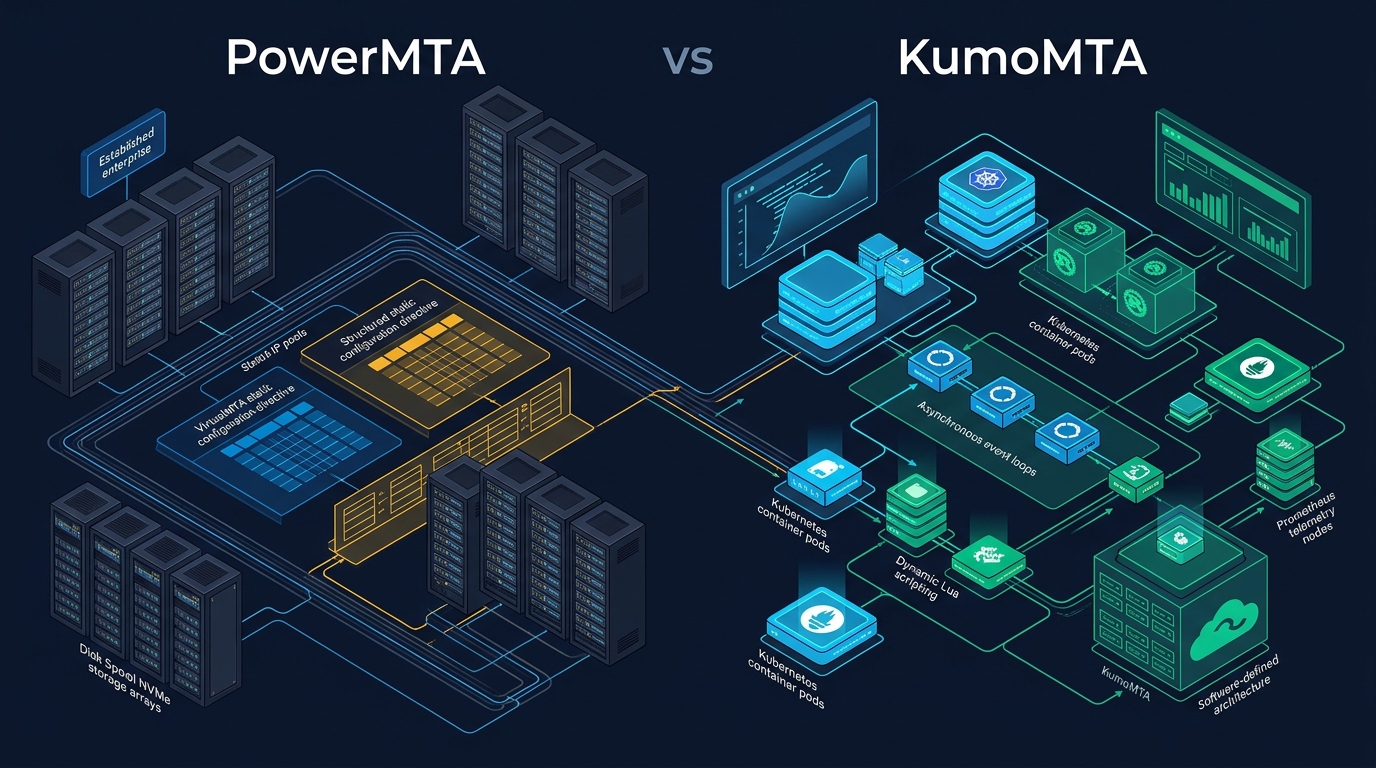
PowerMTA and KumoMTA are high-volume Mail Transfer Agents designed to push hundreds of millions of outbound emails with surgical IP management, backoff automation, and granular ISP traffic shaping. However, they represent two fundamentally conflicting eras of systems engineering.
PowerMTA (MessageBird, originally Port25 / SparkPost) is the battle-hardened commercial standard written in C during the early 2000s. It features static pmta.conf directive syntax, disk-based spool arrays, VirtualMTAs (VMTAs), and an annual commercial license barrier of $3,000 to $10,000+ per node. KumoMTA is a next-generation open-source MTA launched by Wez Furlong (former Chief Architect of Message Systems / Momentum). Written in Rust under the Apache 2.0 license with zero licensing fees, KumoMTA replaces static directive files with an event-driven Lua scripting runtime designed natively for Kubernetes, Docker, and distributed cloud-native horizontal scaling.
In 2027, the choice between PowerMTA and KumoMTA represents the defining crossroads for high-volume email operations: paying a commercial license for 20 years of legacy stability, or embracing memory-safe Rust with programmable Lua logic at zero software cost.
- 1. Two Eras of High-Volume MTA Architecture
- 2. PowerMTA Deep Dive: The Established Commercial Heavyweight
- 3. KumoMTA Deep Dive: The Cloud-Native Open-Source Disruptor
- 4. Configuration Showdown: pmta.conf Directives vs Lua Event Scripts
- 5. Architectural & Behavioral Comparison Matrix
- 6. Scaling & Spooling: Vertical Bare-Metal vs Horizontal Kubernetes
- 7. Total Cost of Ownership (TCO) & License Multiplier Analysis
- 8. Step-by-Step Migration Roadmap: Moving from PowerMTA to KumoMTA
- 9. Production Case Study: Scaling Outbound from 40M to 250M Emails/Month
- 10. Strategic Decision Framework & 2027 Recommendations
- 11. The AutoSMTP Solution
1. Two Eras of High-Volume MTA Architecture
PowerMTA and KumoMTA solve the exact same mission-critical challenge: reliably delivering tens of millions of outbound messages through restrictive ISP filters (Google Workspace, Yahoo/AOL, Microsoft 365, iCloud). However, the engineering decades in which they were created dictate how they scale, deploy, and fail.
The 20-Year Evolution: From Bare-Metal Daemons to Cloud-Native Runtimes
PowerMTA’s Era (Early 2000s): Designed in C during an era of expensive dedicated rackmount servers. High availability meant buying dual power supplies, RAID-10 SCSI disk arrays, and vertical scaling. Configuration was standardized as declarative, human-readable text files parsed on daemon startup. Every additional server required an expensive commercial license key validated against machine hardware IDs.
KumoMTA’s Era (2023–Present): Conceived by Wez Furlong after a decade architecting Message Systems’ Momentum MTA. Engineered in Rust with an asynchronous non-blocking event loop (tokio) and embedded LuaJIT runtime. It treats servers as ephemeral compute nodes in Docker and Kubernetes clusters. It eliminates commercial licensing entirely, integrating natively with OpenTelemetry, Prometheus, Grafana, HashiCorp Vault, and Kafka.
This generational divide manifests across four fundamental operational vectors:
- Concurrency & Memory Safety: PowerMTA achieves high speed through mature procedural C with manual memory allocation. KumoMTA leverages Rust’s borrow checker, ensuring zero data races, zero buffer overflows, and deterministic memory efficiency under intense multi-thread saturation.
- Runtime Dynamism: Modifying PowerMTA routing requires editing
pmta.confand issuingpmta reload, or setting temporary overrides via the command line. KumoMTA evaluates Lua script event hooks in real time; policies can query external Redis clusters, HTTP endpoints, or SQL databases on every outbound message without daemon restarts. - Cluster Topology: PowerMTA clusters are collections of independent silos. Each server manages its own disk spool and requires its own license. KumoMTA is designed for horizontal scaling across cloud nodes where message queues and state can be managed programmatically.
2. PowerMTA Deep Dive: The Established Commercial Heavyweight
PowerMTA by MessageBird has served as the backbone of the commercial email industry for over twenty years. Its dominance created immense network effects: standard configuration playbooks, universal recognition among deliverability consultants, and direct ISP escalation support.
- Uncompromising Production Track Record: Two decades of validated reliability delivering billions of monthly emails across top-tier ESPs.
- VirtualMTA (VMTA) Pools: Flawless logical segmentation of IP addresses, hostnames, and outbound traffic streams on a single machine.
- Native Accounting & Logging: Battle-tested CSV/pipe delivery, bounce, and transient logs that integrate seamlessly with legacy billing pipelines.
- Established Knowledge Base: Countless production-tested configuration templates for Gmail, Yahoo, and Outlook readily available.
- Commercial Vendor SLA: Direct access to enterprise technical support and ISP relations teams backed by guaranteed response contracts.
- Severe Financial Barrier: Annual subscription costs of $3,000 to $10,000+ per server instance create massive licensing taxes when scaling horizontally.
- Static Directive Ceiling: Declarative configuration syntax cannot natively execute complex conditional routing without external wrapper scripts.
- Proprietary Binary Black Box: Zero access to source code; bug fixes and feature enhancements are strictly controlled by MessageBird.
- Vertical Scaling Bias: Clustered deployments multiply licensing costs linearly, discouraging resilient, ephemeral microservice architectures.
3. KumoMTA Deep Dive: The Cloud-Native Open-Source Disruptor
KumoMTA emerged to break the commercial licensing monopoly in high-volume outbound email. By synthesizing the architectural lessons of enterprise MTAs with the performance and safety of modern Rust, KumoMTA provides telecom-grade delivery power under an Apache 2.0 open-source license.
- 100% Free & Open Source (Apache 2.0): Zero software licensing fees forever. Scale from 1 to 50 nodes without paying a single dollar in license tax.
- Memory-Safe Rust Core: Async tokio runtime delivering blisteringly fast message handling (5M+ messages/hour per bare-metal node) with zero memory leaks.
- Programmable Lua Scripting: Dynamic, programmatic control over every phase of the SMTP lifecycle (message receipt, queue assignment, throttling, bounce handling).
- Cloud-Native Observability: First-class native support for Prometheus metrics, Grafana dashboards, OpenTelemetry distributed tracing, and JSON event streams.
- Native Container Architecture: Built specifically for Docker, Kubernetes Helm deployments, and modern GitOps CI/CD pipelines.
- Steeper Engineering Learning Curve: Configuration requires writing and maintaining Lua code rather than editing simple key-value config text files.
- Younger Ecosystem (Launched 2023): While authored by industry veterans, KumoMTA has a shorter historical track record than PowerMTA’s 20-year footprint.
- Self-Reliant Operational Model: Default support relies on the GitHub open-source community unless purchasing enterprise support from the KumoMTA company.
- Disk I/O Sensitivity: High-speed disk persistence requires fast NVMe storage arrays to achieve peak multi-million throughput benchmarks.
4. Configuration Showdown: pmta.conf Directives vs Lua Event Scripts
The difference between PowerMTA and KumoMTA is most dramatic in their configuration syntax. PowerMTA uses declarative static directives; KumoMTA uses programmable event callbacks in Lua.
PowerMTA: Declarative pmta.conf Directives
In PowerMTA, parameters are declared statically. Traffic shaping for major ISPs is defined using nested domain tags:
# Define Outbound VirtualMTA Pool
<virtual-mta vmta-outbound-pool1>
    smtp-source-host 192.0.2.20 mail20.example.com
    smtp-source-host 192.0.2.21 mail21.example.com
</virtual-mta>

# Granular Traffic Shaping for Google Workspace / Gmail
<domain gmail.com>
    max-smtp-out           30          # Maximum concurrent outbound TCP sockets
    max-msg-per-connection 100         # Maximum messages delivered per socket
    max-msg-rate           60/m        # Strict rate limit: 60 emails per minute
    retry-after            15m         # Deferral backoff timer
    use-starttls           yes         # Enforce TLS 1.3/1.2 encryption
</domain>

# Hard and Soft Bounce Pattern Classifications
pattern hard-bounce: "550 5.1.1"       # User unknown
pattern soft-bounce: "421 4.7.0"       # IP rate limited or deferred
KumoMTA: Event-Driven Lua Configuration (policy.lua)
In KumoMTA, configuration is executable code. Operators hook into lifecycle events such as init, get_egress_pool, and smtp_server_message_received:
local kumo = require 'kumo'

-- Initialize ESMTP Listeners and Observability
kumo.on('init', function()
    kumo.start_esmtp_listener {
        listen = '0.0.0.0:25',
        relay_hosts = { '127.0.0.1/32', '10.0.0.0/8' },
    }
    kumo.configure_local_logs {
        log_dir = '/var/log/kumomta',
    }

    -- Define Egress Sources (Equivalent to PowerMTA VirtualMTAs)
    kumo.define_egress_source {
        name = 'pool1-ip1',
        source_address = '192.0.2.20',
        ehlo_domain = 'mail20.example.com',
    }
    kumo.define_egress_source {
        name = 'pool1-ip2',
        source_address = '192.0.2.21',
        ehlo_domain = 'mail21.example.com',
    }
end)

-- Dynamic Egress Pool Assignment with Round-Robin Rotation
kumo.on('get_egress_pool', function(pool_name)
    if pool_name == 'marketing-pool' then
        return {
            name = 'marketing-pool',
            entries = {
                { name = 'pool1-ip1', weight = 1 },
                { name = 'pool1-ip2', weight = 1 },
            },
        }
    end
end)

-- Real-Time Recipient Domain Routing & Throttling
kumo.on('smtp_server_message_received', function(msg)
    local domain = msg:recipient():domain()
    if domain == 'gmail.com' then
        msg:set_meta('egress_pool', 'marketing-pool')
        msg:set_meta('throttle_profile', 'gmail-conservative')
    end
end)
5. Architectural & Behavioral Comparison Matrix
The table below provides a detailed technical comparison of PowerMTA and KumoMTA across 10 critical infrastructure criteria.
| Evaluation Vector | PowerMTA (MessageBird) | KumoMTA (Open Source) |
|---|---|---|
| Creation & Core Architect | Early 2000s (Port25 / SparkPost / MessageBird) | 2023 (Wez Furlong, former Chief Architect Momentum) |
| Implementation Language | C (Procedural systems programming) | Rust (Async, memory-safe, tokio runtime) |
| Licensing & Cost | Commercial ($3,000–$10,000+/year per node) | 100% Free & Open Source (Apache 2.0 license) |
| Configuration Engine | Static directive text files (pmta.conf) |
Programmable Lua scripts with event lifecycle hooks |
| Scaling Philosophy | Vertical scaling (multi-socket bare metal servers) | Horizontal cloud-native scaling (Docker & Kubernetes) |
| Throughput Benchmark | 1,000,000 – 3,000,000 msgs/hr per server node | 3,000,000 – 5,000,000+ msgs/hr per modern NVMe node |
| Observability & Metrics | Text accounting logs (CSV) + optional web console | Native Prometheus, Grafana, OpenTelemetry, JSON logs |
| Spool Storage Model | Custom disk file spool hierarchy | Disk-persistent queues with async multi-threaded I/O |
| Dynamic Data Integration | Requires external scripts or PMTA API wrappers | Native Lua bindings to Redis, HTTP REST APIs, and SQL |
| Operating System Support | Linux (RHEL, Rocky, Alma, Ubuntu) & Windows | Linux only (Engineered for modern Linux kernel epoll) |
6. Scaling & Spooling: Vertical Bare-Metal vs Horizontal Kubernetes
The difference in cost structure between PowerMTA and KumoMTA directly impacts how you design your server architecture:
Vertical Lock-In vs Horizontal Freedom
PowerMTA’s Vertical Trap: Because PowerMTA charges per instance, operations teams are economically incentivized to build massive, single-point-of-failure bare-metal monoliths (e.g., dual AMD EPYC 64-core servers with 256GB RAM hosting 200 VirtualMTAs). If that single server crashes or requires maintenance, all 200 IPs go offline, and delivery grinds to a halt.
KumoMTA’s Distributed Fleet: Because KumoMTA has zero licensing fees, teams can deploy 10 smaller, containerized nodes across multiple availability zones. If one node encounters a network partition or hardware failure, the remaining 9 nodes absorb the queue instantly without licensing penalties.
7. Total Cost of Ownership (TCO) & License Multiplier Analysis
To understand the financial impact of selecting PowerMTA vs KumoMTA, consider the 3-year TCO for an enterprise sending 100 million emails per month across a 4-node cluster with dedicated IP pools:
| Cost Component (3-Year Horizon) | PowerMTA Deployment | KumoMTA Deployment |
|---|---|---|
| Software Licensing (4 Nodes) | $72,000 ($6,000/node/year × 4 nodes × 3 yrs) | $0 (Free Apache 2.0 open-source license) |
| Management Console Add-on | $9,000 ($3,000/year license fee) | $0 (Native open-source Prometheus/Grafana) |
| Enterprise Bare-Metal Hardware | $21,600 ($600/month across 4 high-spec nodes) | $14,400 ($400/month across 4 cloud/metal nodes) |
| Vendor Support Contracts | Included in annual commercial license | $0 (Self-managed) or optional enterprise SLA |
| Total 3-Year Infrastructure Cost | $102,600 | $14,400 |
*KumoMTA saves over $88,000 every 3 years on a standard 4-node enterprise cluster, freeing up substantial budget for dedicated deliverability engineering and clean IP subnets.
8. Step-by-Step Migration Roadmap: Moving from PowerMTA to KumoMTA
Migrating from PowerMTA to KumoMTA is straightforward because KumoMTA was specifically designed to map directly to PowerMTA operational concepts:
- Concept Mapping:
- PowerMTA
<virtual-mta>directives map directly to KumoMTAkumo.define_egress_sourceandkumo.define_egress_pooldefinitions. - PowerMTA
<domain>directives (max-msg-rate,max-smtp-out) translate into KumoMTA traffic shaping policy functions. - PowerMTA accounting CSV log formats can be matched using KumoMTA’s customizable JSON logging module.
- PowerMTA
- Dual-Running Phase (Shadow Deployment):
Deploy a single KumoMTA node alongside your existing PowerMTA fleet. Route 5% to 10% of non-critical transactional traffic through KumoMTA to validate throughput, DKIM signing, and ISP deferral handling.
- Metrics & Observability Parity:
Point Prometheus scrapers to KumoMTA’s native metrics endpoint. Validate that connection rates, queue depths, and bounce classifications match PowerMTA telemetry in real time.
- Traffic Shift & Cutover:
Gradually increase traffic to KumoMTA in 25% increments over 14 days. Once all traffic is migrated, decommission the licensed PowerMTA instances to immediately recapture licensing capital.
9. Production Case Study: Scaling Outbound from 40M to 250M Emails/Month
Fintech SaaS Slashes MTA Licensing Costs by 100% with KumoMTA
A global financial notifications SaaS platform processing 40 million critical transactional alerts per month faced explosive user growth projecting outbound volume to reach 250 million emails monthly. Their existing architecture relied on two licensed PowerMTA servers.
The Scaling Dilemma:
To safely handle 250 million emails per month with peak morning spikes, their infrastructure team required expanding from 2 to 6 server nodes across multiple European datacenters. Under PowerMTA’s licensing model, their annual software renewal was quoted at $48,000/year. Furthermore, integrating PowerMTA with their Kubernetes container infrastructure required complex custom tooling.
The KumoMTA Implementation:
The engineering team deployed a 6-node KumoMTA cluster using official Docker containers orchestrated on Kubernetes. They converted their 400-line pmta.conf directive file into a modular Lua script repository managed under Git version control. Delivery receipts were streamed directly into Kafka topics for real-time alerting.
Results: The platform achieved an average throughput of 4.2 million emails per hour during peak dispatch windows. Annual licensing dropped from $48,000 to $0, and overall message delivery latency was reduced by 30% due to Rust’s high-speed async network engine.
10. Strategic Decision Framework & 2027 Recommendations
Strategic Selection Blueprint
Choose PowerMTA When:
- You operate an established sending infrastructure with decades of accumulated
pmta.confplaybooks and your team has zero Lua scripting background. - Corporate procurement mandates vendor SLA contracts, formal enterprise liability coverage, and telephone support.
- You rely strictly on SparkPost Signals analytics or legacy third-party accounting log parsers built specifically for PowerMTA CSV logs.
- Your delivery volumes are stable and fit easily on 1–2 dedicated bare-metal servers where licensing costs are predictable.
Choose KumoMTA When:
- You want enterprise-grade MTA throughput without paying $3,000 to $10,000+ per server in annual commercial software license fees.
- Your engineering team embraces modern DevOps, Docker containers, Kubernetes orchestration, and GitOps CI/CD pipelines.
- You require dynamic, programmable delivery policies where routing decisions, IP selections, and throttles can be calculated in Lua via real-time Redis or API lookups.
- You are designing greenfield high-volume bulk or transactional email infrastructure engineered to scale horizontally without financial penalties.
Deploying and managing commercial MTAs like PowerMTA or configuring complex Lua event loops in KumoMTA requires continuous deliverability engineering, server administration, and IP reputation management. AutoSMTP eliminates the operational friction by delivering turnkey, carrier-grade outbound email clusters at flat predictable pricing.
Provisions fully licensed PowerMTA and KumoMTA clusters on enterprise bare-metal hardware with dedicated NVMe storage, isolated memory pools, and flat predictable pricing.
Autonomous warm-up algorithms dynamically monitor Google Postmaster spam ratios (<0.1%) and real-time deferrals across clean IPv4 subnets, safely scaling volume without human error.
Real-time RFC 5321 in-band 550 bounce suppression combined with automated Yahoo/Outlook Complaint Feedback Loop (CFL) ingestion to safeguard sender reputation 24/7.
Complete end-to-end DNS automation including pristine rDNS/PTR records, aligned SPF includes, rotating 2048-bit DKIM keys, strict DMARC enforcement, and custom BIMI integration.
Ready for High-Velocity Dedicated Outbound Delivery?
Deploy enterprise-grade PowerMTA and KumoMTA clusters with clean IP subnets, automated warming schedules, and expert deliverability management.
Explore Dedicated SMTP Infrastructure →