

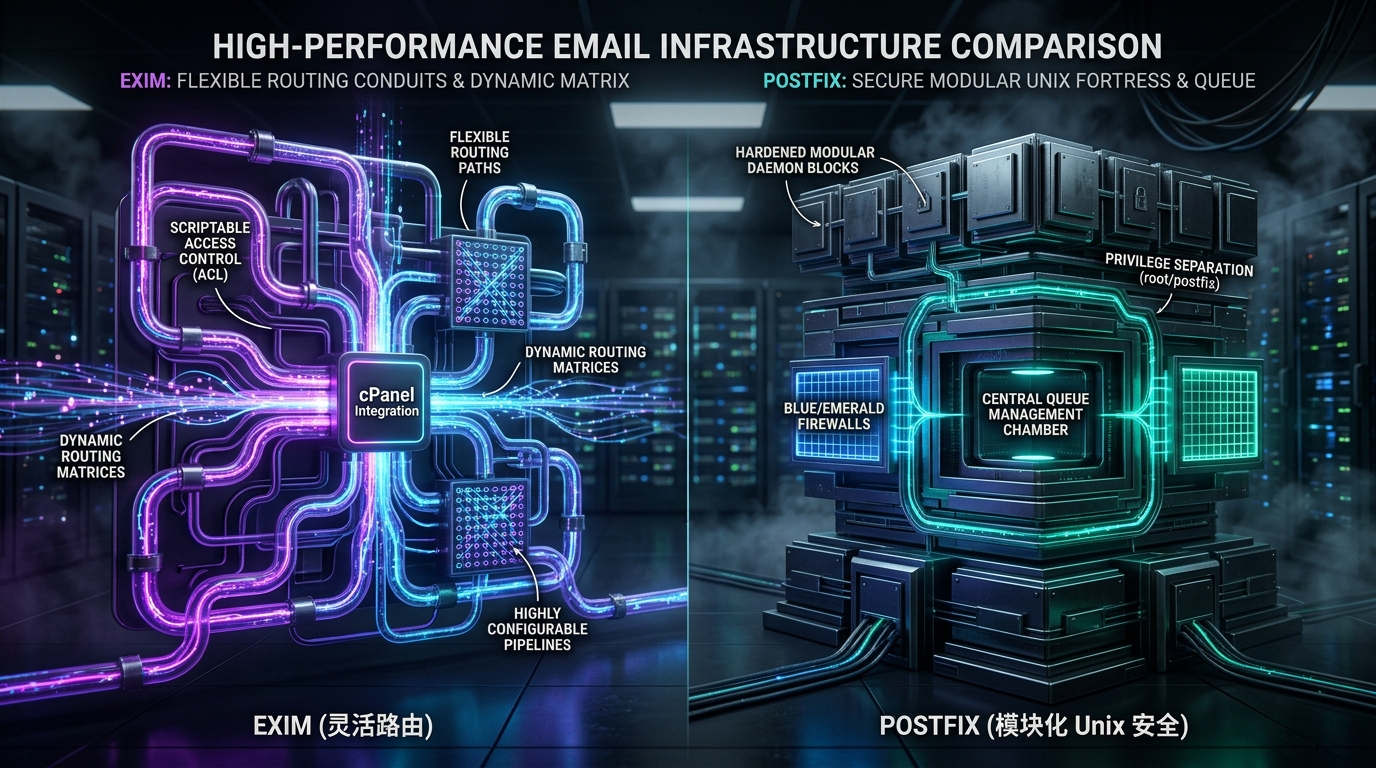
Exim vs Postfix: 2027 Routing Flexibility vs Hardened Unix Security Architecture
qmgr), making it the default mail server across major Linux distributions including Ubuntu, Debian, and RHEL. Exim (University of Cambridge 1995, GNU GPL) is a monolithic single-binary MTA renowned for unparalleled configuration scripting, embedded Perl, and expressive Access Control Lists (ACLs) that dominate cPanel, WHM, and shared hosting environments. In 2027, high-volume senders outgrow both traditional engines and deploy dedicated bare-metal clusters like AutoSMTP (powered by PowerMTA or KumoMTA) to eliminate queue lock contention and gain automated gas-pedal IP warming.
This technical guide provides an exhaustive engineering comparison of Postfix and Exim in 2027: their philosophical origins; architectural security through privilege separation versus monolithic execution; configuration models (declarative parameters versus string expansion scripts); historic vulnerability exposure (including the landmark CVE-2019-10149 RCE analysis); queue throughput behavior under load; use case mapping; modern alternatives like KumoMTA and Mailcow; and an operational decision framework for production environments.
1. Two mature Linux MTAs: Different design philosophies
Same protocol. Same RFC 5321 foundation. Completely different architectural priorities.
Postfix and Exim both move Internet email, but their underlying architectures reflect contrasting philosophies: Postfix prioritises security and containment through process boundaries, while Exim prioritises developer flexibility and dynamic policy expression inside a single binary.
Postfix Philosophy: Security Through Containment. Built by Wietse Venema at IBM Research to address Sendmail’s chronic security flaws. Rather than a monolithic program, Postfix is an ensemble of small, unprivileged daemons communicating over local IPC. Each process performs one job (e.g., listening on port 25, rewriting headers, scheduling queue deliveries) with the bare minimum Unix privileges required.
Exim Philosophy: Ultimate Routing Flexibility. Created by Philip Hazel at the University of Cambridge, Exim executes as a single binary that handles every stage of SMTP. Its design priority is enabling administrators to solve intricate mail routing, customer forwarding, and spam filtering logic directly in configuration via an embedded macro and scripting engine.
The philosophical divergence cascades across every operational vector:
- Process Architecture: Postfix is modular and multi-process; Exim is a monolithic single binary.
- Security Isolation: Postfix enforces privilege separation with optional chroot jails; Exim relies on runtime setuid/setgid privilege dropping.
- Configuration Model: Postfix uses declarative key-value parameters (
main.cf); Exim uses a programmable scripting syntax with string expansion. - Performance Scaling: Postfix maintains a dedicated queue manager (
qmgr); Exim forks a process per message delivery. - Default Environment: Postfix is the standard for Linux distributions; Exim dominates cPanel and shared hosting.
2. Postfix overview
Postfix has earned its position as the de facto open-source mail server standard through consistent reliability and an impeccable security record:
- IBM Research Origin (1998): Conceived by Wietse Venema with security as the primary architectural constraint. Released under the IBM Public License v1.0.
- Modular Multi-Process Suite: A master coordinator daemon manages isolated worker programs:
smtpd: Accepts inbound SMTP connections from the network.cleanup: Validates headers, adds missing fields, and deposits messages into the incoming queue.qmgr: Central queue manager scheduling active deliveries across destination pools.smtp: Outbound SMTP delivery client.local/virtual: Delivers mail to local Unix mailboxes or Dovecot Maildir stores.bounce: Generates delivery status notifications (DSNs).
- Privilege Separation & Chroot: Individual daemons drop root privileges immediately after binding sockets and run under the unprivileged
postfixuser. Sensitive processes can run inside chroot jails. - Central Queue Manager: The unified
qmgrprevents disk contention by pacing deliveries into active, incoming, deferred, and hold queues. - Mailcow Modernisation: Modern teams frequently deploy Postfix via the popular Mailcow Dockerized stack, bundling Postfix with Dovecot, Rspamd, ClamAV, and SOGo webmail.
- Exceptional security record over 25+ years with privilege separation.
- Predictable, smooth queue performance under high connection volume.
- Default mail server across Debian, Ubuntu, RHEL, CentOS, and Fedora.
- Mailcow Docker stack dramatically simplifies containerised deployment.
- Configuration requires navigating 500+ static parameters.
- Lacks native per-ISP rate limiting and adaptive IP warmup.
- Complex multi-IP pool rotation requires running multiple Postfix instances.
- Routing logic is bounded by static lookup tables (hash/btree/MySQL).
3. Exim overview
Exim provides unprecedented configurability for shared hosting and complex multi-domain environments:
- University of Cambridge Origin (1995): Developed by Philip Hazel for campus mail systems requiring intricate per-user forwarding rules. Released under the GNU General Public License (GPL).
- Monolithic Single Binary: A single
/usr/sbin/eximbinary handles reception, queue storage, and delivery, forking child processes per message. - Access Control Lists (ACLs): Allows granular programmatic inspection at every SMTP transaction state (HELO, MAIL FROM, RCPT TO, DATA, and MIME content).
- String Expansion Engine: Exim configurations support embedded Perl, conditional logic, regex manipulation, and live database queries (MySQL, PostgreSQL, LDAP, SQLite, DNS).
- cPanel / WHM Integration: Exim has been the integrated mail engine of cPanel for more than two decades, powering millions of shared hosting domains.
- Unmatched configuration expressiveness via ACLs and string expansion.
- Direct integration with database backends without external helper daemons.
- Deep integration into cPanel, Webmin, and multi-tenant hosting suites.
- Low baseline memory footprint for small, single-server VPS nodes.
- Monolithic single-binary architecture provides less privilege isolation.
- Historically exposed to high-severity remote code execution vulnerabilities (e.g. CVE-2019-10149).
- Process-per-delivery forking causes high load spikes during bulk queue retries.
- Configuration scripting language has a steep learning curve.
4. Architecture comparison: Modular privilege separation vs Monolithic execution
The architectural difference between a modular multi-daemon system and a monolithic executable has profound consequences for resilience and security:
| Architectural Vector | Postfix (Modular Daemon Suite) | Exim (Monolithic Single Binary) |
|---|---|---|
| Process Model | Multi-process suite coordinated by master daemon | Monolithic binary with per-message process forking |
| Privilege Separation | Strict: distinct users (root, postfix, nobody) per daemon | Single binary changes UID/GID dynamically at runtime |
| Chroot Jail Support | Native: daemon processes can run inside chroot | Limited; monolithic binary requires access to system files |
| Queue Management | Centralised qmgr daemon with active/incoming/deferred tiers | Directory spool scanning with sequential retry runners |
| Concurrency Scaling | Scales cleanly across worker processes with bounded limits | Fork overhead can cause CPU/load thrashing during bursts |
| Memory Baseline | Higher initial footprint (multiple daemons running) | Lower idle memory footprint on modest VPS hardware |
| Failure Containment | A crash or exploit in smtpd does not compromise qmgr | A vulnerability in message parsing compromises the entire MTA |
| IPC Communication | Unix domain sockets and FIFO pipes | Internal function calls within the same process image |
5. Configuration paradigms: Declarative keys vs Scriptable ACLs
The configuration paradigms reflect their underlying design goals: Postfix keeps policies declarative and separated from process controls, while Exim integrates programmable logic into a single configuration file.
Postfix Configuration (main.cf)
Postfix configuration is readable and declarative. Behavior is controlled through discrete parameters and lookup tables.
Exim Configuration (exim.conf)
Exim configurations resemble small procedural programs with embedded conditional operators, variable expansions, and SQL queries.
Configuration Comparison Matrix:
| Configuration Vector | Postfix (Declarative) | Exim (Scriptable) |
|---|---|---|
| Syntax Paradigm | Key = Value parameters (500+ directives) | Procedural scripting with sections (ACL, Routers, Transports) |
| Conditional Branching | Limited to ordered restriction lists | Full boolean expressions (${if ...}, regex, string ops) |
| External DB Lookups | Via static/dynamic maps (MySQL, LDAP, Hash) | Inline SQL queries with runtime string substitution |
| Operator Learning Curve | Predictable, standard Linux admin skills | Steep learning curve; complex string expansion syntax |
| Configuration Safety | Syntax validation via postfix check |
Risk of subtle expansion bugs or command injection if unsanitised |
6. Security comparison: Privilege separation vs Historical CVE exposure
Security architecture is where Postfix and Exim diverge most decisively. Postfix was engineered specifically to prevent the privilege escalation attacks that plagued legacy mail daemons, while Exim’s monolithic architecture has historically presented a broader attack surface.
In June 2019, security researchers discovered CVE-2019-10149, a critical remote code execution flaw in Exim versions 4.87 through 4.91. Because Exim executed delivery logic within a monolithic binary, an unauthenticated remote attacker could craft a malformed recipient address in the RCPT TO envelope (e.g. executing commands via ${run{...}} expansions) and execute arbitrary shell commands directly as root.
Within 48 hours of public disclosure, automated worm campaigns exploited hundreds of thousands of cPanel and Linux servers worldwide to deploy rootkits and cryptocurrency miners.
The Architectural Lesson: In Postfix, inbound network connections are handled solely by smtpd, which runs with dropped privileges in a restricted sandbox. Even if a parsing flaw existed in Postfix’s address parser, privilege separation would contain the compromise, preventing immediate root-level host takeover.
While the Exim development team has made substantial security enhancements and maintains an active patch cadence in 2027, organisations in regulated industries (finance, healthcare, government) consistently mandate Postfix due to its structural privilege separation.
7. Performance comparison under load
Under routine office volumes (under 50,000 emails per day), both MTAs perform adequately. However, when processing high-concurrency bursts or sustained campaign volumes, their queue handling mechanisms diverge:
- Postfix Central Queue Manager (
qmgr): Postfix organizes mail into incoming, active, and deferred directories. Theqmgrdaemon moves a bounded batch into memory, sorting by destination MX and balancing concurrency across available worker processes. Disk I/O remains sequential and predictable. - Exim Process-Per-Delivery Model: Exim forks a new process to process each incoming connection and spawns separate queue runner processes to scan the spool directory. Under volume spikes (e.g., hundreds of thousands of deferred messages), repeated spool directory scans and process-forking overhead can cause system load spikes and queue contention.
- Neither is Built for 5M+ Daily Outbound Bulk: For large-scale bulk delivery (marketing blasts, cold outreach, transactional notifications), both engines lack native Virtual MTA IP pooling and adaptive ISP throttling. That workload belongs to specialised engines like KumoMTA or PowerMTA.
8. Use case fit
- You need a secure, general-purpose Linux mail server (Debian, Ubuntu, RHEL).
- Your organization operates under strict compliance or security audit frameworks.
- You deploy the Mailcow Docker suite for full email services (IMAP, webmail, antispam).
- You provide internal application SMTP relay for transactional web services.
- Your team prefers predictable declarative configuration without custom scripting.
- You manage shared hosting platforms running cPanel, WHM, or DirectAdmin.
- You need intricate, dynamic routing rules based on live SQL queries or regex.
- You implement custom SMTP-phase policies via Access Control Lists (ACLs).
- You operate memory-constrained low-volume VPS environments.
- Your operations team possesses existing deep Exim configuration expertise.
9. Modern alternatives: KumoMTA, Mailcow & Dedicated clusters
The email infrastructure landscape in 2027 has evolved substantially beyond the traditional Postfix-versus-Exim duality:
- Mailcow Dockerized: For general office mail, Mailcow has become the standard modernisation path, packaging Postfix with Dovecot, Rspamd, ClamAV, and SOGo in an automated container suite.
- KumoMTA (Open-Source Rust Bulk Engine): Built by former PowerMTA architects, KumoMTA delivers ~10x higher parallel delivery throughput than Postfix or Exim with native per-ISP throttling and Lua scripting at zero software licensing cost.
- AutoSMTP Managed Sovereign Bare Metal: For senders needing enterprise deliverability without maintaining Linux daemons, AutoSMTP provisions pre-tuned PowerMTA and KumoMTA bare-metal nodes with automated IP warming and clean IPv4 subnets.
A B2B SaaS client operating 300,000 monthly messages (200K transactional app receipts + 100K customer product announcements) initially attempted to route all email through a single Exim server on cPanel. During marketing campaigns, queue lockups delayed password resets by up to 45 minutes, and temporary recipient rate limits degraded corporate inbox delivery.
The Solution: The infrastructure was architected into clean, isolated tiers:
- Inbound & Office Mail: Deployed a Mailcow Docker container running Postfix for corporate mailboxes, support tickets, and system alerts.
- Transactional & Bulk Sending: Routed outbound application traffic through dedicated sovereign MTAs with dedicated clean IP allocations.
The Result: Transactional delivery latency dropped to sub-second levels, marketing campaign queues never backlogged corporate mail, and operational maintenance dropped to less than 4 hours per month.
The 2027 Default Decision Progression:
- General Linux mail server: Deploy Postfix (via Mailcow Docker stack for turnkey management).
- cPanel / shared web hosting: Deploy Exim (native cPanel default integration).
- Outbound volume exceeding 500K daily: Migrate outbound to a dedicated bulk MTA (KumoMTA or PowerMTA).
- Complex dynamic database routing: Leverage Exim’s ACL and string expansion capabilities.
- High-security & compliance environments: Enforce Postfix for its privilege-separated modular architecture.
- At any volume: Always enforce strict SPF, 2048-bit DKIM, and DMARC alignment across all sending domains.
The AutoSMTP Solution: Enterprise Power Without the $10,000 License Barrier
Scale Your Outbound Deliverability with AutoSMTP
Deploy enterprise-grade dedicated PowerMTA & KumoMTA bare-metal clusters with automated IP warming and clean IPv4 subnets today.
Explore Dedicated AutoSMTP Plans →