

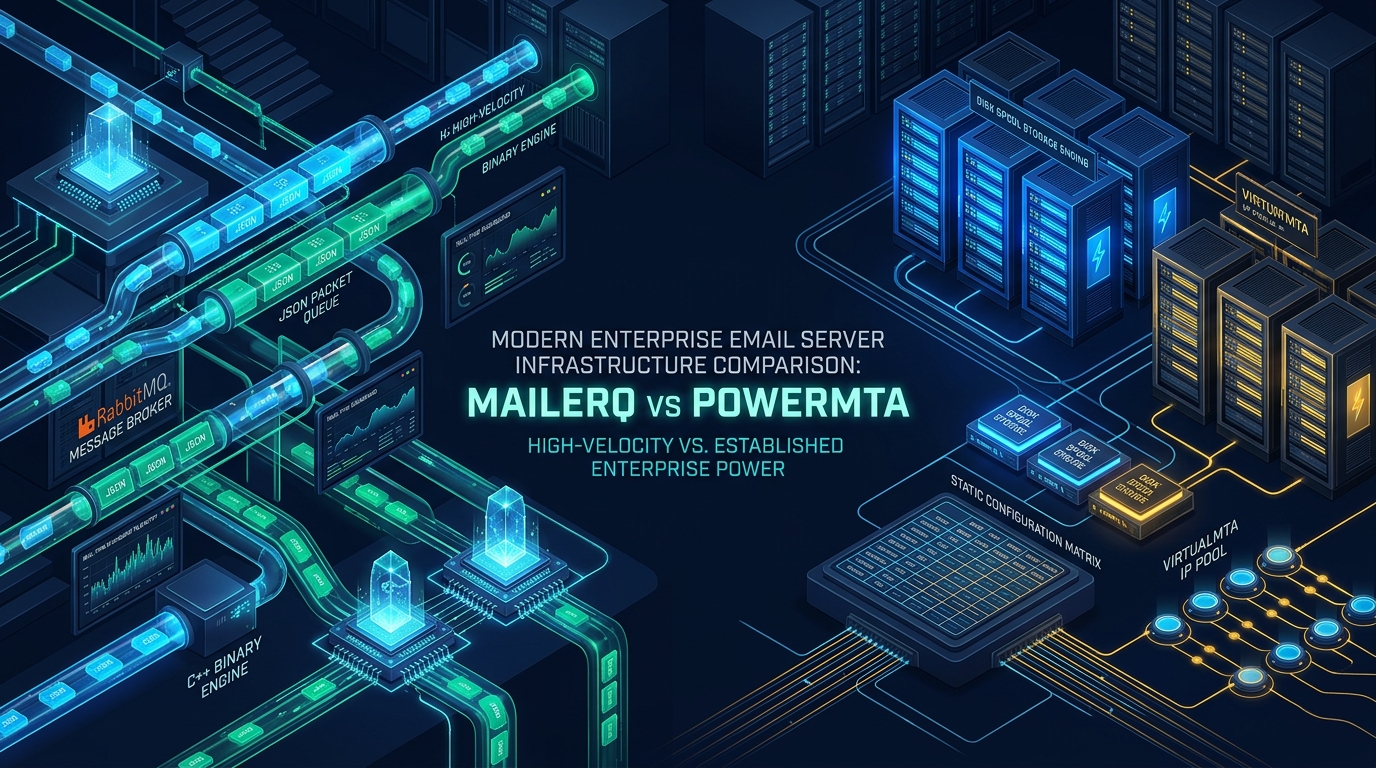
PowerMTA and MailerQ are premier commercial enterprise Mail Transfer Agents (MTAs) targeting high-volume senders, ESPs, and mission-critical transactional pipelines. While both occupy the commercial tier ($3,000 to $10,000+/year licensing) and deliver millions of messages per hour with surgical ISP throttling, they are built on fundamentally conflicting architectural philosophies.
PowerMTA (MessageBird, formerly Port25 / SparkPost) represents the established industry benchmark with its static pmta.conf directive declarations, disk-based spooling engine, VirtualMTAs (VMTAs), and two decades of field-tested deliverability rules. MailerQ (Copernica) is a modern C++ engine designed around external distributed message brokers (primarily RabbitMQ). Instead of traditional SMTP handshakes and filesystem spools, MailerQ consumes JSON message envelopes directly from message queues and publishes delivery status receipts in real-time back to AMQP topics.
Neither commercial MTA provides native automated IP warmup out of the box—both require deliverability engineering discipline. However, the architectural fit between an SMTP-centric pipeline and a queue-centric distributed microservices topology defines whether an infrastructure team succeeds or encounters painful operational friction.
- 1. Two Bulk MTA Philosophies: SMTP vs Queue-Centric
- 2. PowerMTA Deep Dive: The Established ESP Standard
- 3. MailerQ Deep Dive: The RabbitMQ C++ Engine
- 4. Configuration Syntax: Static Directives vs JSON AMQP Envelopes
- 5. Architectural & Feature Comparison Matrix
- 6. Queue Integration Patterns & Operational Trade-offs
- 7. The IP Warmup Reality in 2027
- 8. KumoMTA as the Modern Open-Source Third Option
- 9. Production Case Study: Migrating an ESP to RabbitMQ Queues
- 10. Strategic Decision Framework & 2027 Progression
- 11. The AutoSMTP Solution
1. Two Bulk MTA Philosophies: SMTP vs Queue-Centric
PowerMTA and MailerQ both serve enterprise senders pushing tens of millions of outbound messages per month, but their fundamental assumptions regarding how an MTA interacts with application code could not be more divergent.
The Core Paradigm Contrast
PowerMTA’s SMTP-Centric Philosophy: PowerMTA assumes the MTA is a dedicated, autonomous Unix server. Applications format RFC 5322 MIME messages and inject them over TCP port 25 or 587 (or through a secondary HTTP batch API). PowerMTA accepts the message, writes it to an optimized local disk spool (e.g. /var/spool/pmta), assigns it to a VirtualMTA pool, and schedules remote delivery threads according to strict per-domain throttling directives.
MailerQ’s Queue-Centric Philosophy: MailerQ assumes email is simply another asynchronous job payload in a modern microservices architecture. Applications do not establish SMTP sessions. Instead, background workers serialize a JSON message envelope containing recipient metadata, routing rules, custom IP bindings, and MIME text directly into an external RabbitMQ AMQP exchange. MailerQ runs as a high-performance C++ consumer on that queue, executes DNS lookups and SMTP deliveries, and immediately writes JSON delivery receipts back to result queues (results, bounces, complaints).
This architectural split dictates your entire operational footprint:
- Application Decoupling: With PowerMTA, if the MTA daemon is saturated or undergoing restart, upstream injection workers block or require local retry queues. With MailerQ, workers push to RabbitMQ at tens of thousands of messages per second; the message broker buffers bursts seamlessly regardless of MTA status.
- Operational Footprint: PowerMTA is self-contained. It requires no external databases or brokers to function at 3 million emails per hour. MailerQ requires a highly available, clustered RabbitMQ deployment. If RabbitMQ runs out of memory or drops connections, MailerQ stops sending.
- Real-Time Policy Enforcement: In PowerMTA, routing changes require altering
pmta.confor executing CLI commands (pmta reload,pmta set). In MailerQ, routing parameters (source IP, max delivery timestamp, retry intervals) can be injected per message dynamically in the JSON payload itself without touching server configurations.
2. PowerMTA Deep Dive: The Established ESP Standard
Originally engineered by Port25 Solutions, later acquired by SparkPost, and now maintained by MessageBird, PowerMTA is the grand architect of commercial ESP infrastructure. Virtually every major enterprise sending platform (from Oracle Eloqua and Marketo to custom deliverability agencies) has operated PowerMTA clusters.
- Proven Industry Standard: Over 20 years of production validation across billions of daily messages. Community knowledge and field templates are abundant.
- VirtualMTA (VMTA) Pools: Segment traffic across hundreds of IP addresses, domain bindings, and outbound headers with pinpoint isolation.
- Unrivaled Disk Spooling: Highly tuned C engine with custom asynchronous disk I/O routines that handle sudden multi-million message backlogs without memory exhaustion.
- Comprehensive Deliverability Controls: Native per-ISP backoff strategies, automated suppression lists, and SparkPost Signals telemetry integration.
- Self-Contained Simplicity: Runs independently on RHEL, Rocky Linux, AlmaLinux, Ubuntu, and Windows without mandatory third-party message brokers.
- Commercial Licensing Cost: Enterprise pricing ranges from $3,000 to $10,000+ annually per node, creating a substantial entry barrier.
- Static Configuration Model: Behavior is governed primarily by
pmta.conf; dynamic routing updates require reloading or custom daemon wrapper scripts. - Traditional Ingestion Bottleneck: SMTP injection introduces TCP socket overhead compared to native memory-piped AMQP queue consumption.
- Closed Source & Proprietary: Binary-only distributions with zero ability to patch core internals or audit memory safety.
3. MailerQ Deep Dive: The RabbitMQ C++ Engine
Developed in the Netherlands by Copernica, MailerQ was engineered from the ground up to eliminate the friction between modern web application frameworks and legacy SMTP servers. By treating RabbitMQ as its native heartbeat, MailerQ transforms email delivery into an observable event-driven pipeline.
- Native RabbitMQ & AMQP Integration: Applications inject structured JSON payloads directly into message queues; eliminates SMTP socket overhead and connection negotiation.
- Modern C++ Architecture: Multithreaded asynchronous network engine optimized for modern multi-core server nodes with evented epoll loops.
- Per-Message Dynamic Overrides: Control sender IP, retry schedules, custom headers, and delivery deadlines on a per-email basis in the JSON packet.
- Real-Time Web Management UI: Rich built-in console offering live charts, per-queue traffic manipulation, instantaneous pause/resume, and active log streaming.
- Event-Driven Webhooks & Result Queues: Automatically routes successful deliveries, transient deferrals, hard bounces, and FBL complaints back into dedicated AMQP result queues.
- Mandatory External Infrastructure: Depends entirely on RabbitMQ. Operational complexity expands to managing cluster nodes, Erlang cookies, and broker memory limits.
- Steep Operational Learning Curve: Infrastructure teams must possess deep dual expertise in both email deliverability (RFC protocols, PTR, DNSBLs) and RabbitMQ queue tuning.
- Smaller Ecosystem & Talent Pool: Far fewer certified engineers and publicly accessible configuration playbooks compared to the 20-year PowerMTA ecosystem.
- Comparable Licensing Fees: MailerQ is commercial software with annual subscription tiers rivaling PowerMTA’s licensing costs.
4. Configuration Syntax: Static Directives vs JSON AMQP Envelopes
To understand how differently these two MTAs operate on a daily basis, compare the mechanics of injecting a message with custom IP binding and domain rate limiting.
PowerMTA: Declarative pmta.conf Directives
PowerMTA defines outbound policies, rate limits, and IP associations statically in its central configuration file. Messages are routed by assigning a x-virtual-mta header during SMTP transmission:
# Define Outbound VirtualMTA with Dedicated IPv4
<virtual-mta vmta-outbound-01>
    smtp-source-host 192.0.2.10 mail01.example.com
</virtual-mta>

# Traffic Shaping Policy for Gmail / Google Workspace
<domain gmail.com>
    max-smtp-out          25           # Max concurrent TCP sessions
    max-msg-per-connection 100         # Max emails delivered per connection
    max-msg-rate          50/m         # Rate throttle: 50 emails per minute
    retry-after           15m          # Deferral retry backoff
    use-starttls          yes          # Mandatory TLS 1.3/1.2
</domain>

# Inbound submission relay
<source 127.0.0.1>
    always-allow-relaying yes
    process-x-virtual-mta yes
</source>
MailerQ: JSON AMQP Message Envelope via RabbitMQ
MailerQ bypasses SMTP injection entirely. Upstream microservices publish JSON objects to the outbox exchange. Routing policies, recipient addresses, and IP selections are passed natively in the message schema:
import pika
import json

# Connect to RabbitMQ Cluster
connection = pika.BlockingConnection(pika.ConnectionParameters('rabbitmq.cluster.internal'))
channel = connection.channel()

# MailerQ Native JSON Message Payload
payload = {
    "envelope": "bounces@outbound.example.com",
    "recipient": "customer@gmail.com",
    "ip": "192.0.2.10",                         # Specific egress IPv4
    "maxdelivertime": "2027-10-31 23:59:59",    # Auto-expire if queued past deadline
    "maxattempts": 5,                           # Cap retry attempts
    "tags": ["transactional", "onboarding"],    # Telemetry tagging
    "mime": {
        "from": "noreply@example.com",
        "to": "customer@gmail.com",
        "subject": "Welcome to Enterprise Cloud",
        "text": "Hello, thank you for verifying your enterprise domain.",
        "headers": {
            "List-Unsubscribe": "<https://example.com/unsub?id=8921>"
        }
    }
}

# Publish directly to MailerQ Ingest Queue
channel.basic_publish(
    exchange="",
    routing_key="outbox",
    body=json.dumps(payload),
    properties=pika.BasicProperties(
        delivery_mode=2  # Persistent message on disk
    )
)
connection.close()
5. Architectural & Feature Comparison Matrix
The following technical breakdown contrasts the underlying engineering architectures of PowerMTA and MailerQ across 10 critical operational vectors.
| Evaluation Vector | PowerMTA (MessageBird) | MailerQ (Copernica) |
|---|---|---|
| Implementation Language | C (Procedural, highly optimized memory management) | C++ (Modern multithreaded object-oriented engine) |
| Queue & Storage Model | Proprietary high-performance disk file spool | External message broker (Native RabbitMQ / AMQP) |
| Application Injection | Standard SMTP (ports 25/587) + HTTP submission API | Direct RabbitMQ AMQP queue injection + REST API |
| Configuration Paradigm | Static directive files (pmta.conf) + CLI reload |
Central JSON/SQL database + Web UI + Dynamic payload variables |
| Delivery Status & Telemetry | Text accounting logs (CSV/pipe format) + SparkPost Signals | AMQP Result Queues (JSON delivery/bounce events) + Webhooks |
| Operational Visibility | Command-line utility (pmta show status) + Web monitor |
Feature-rich real-time Web Management Console & dashboards |
| Infrastructure Dependencies | None (Self-contained standalone binary service) | Requires RabbitMQ cluster + optional MySQL/PostgreSQL storage |
| Multi-Tenancy Isolation | VirtualMTA (VMTA) pools & IP-based directive blocks | Per-customer queue segregation & dynamic payload routing tags |
| Throughput Capacity | 1,000,000 to 3,000,000+ msgs/hour per multi-core server node | 1,000,000 to 3,000,000+ msgs/hour (bound to RabbitMQ broker I/O) |
| Licensing & Commercial Cost | Commercial subscription ($3,000–$10,000+/year per instance) | Commercial subscription ($3,000–$8,000+/year per instance) |
6. Queue Integration Patterns & Operational Trade-offs
The decision to adopt MailerQ hinges almost entirely on your engineering team’s relationship with RabbitMQ. When an engineering organization already runs a mature message queue cluster for background processing, MailerQ provides seamless infrastructure synergy. However, introducing RabbitMQ solely to run an MTA introduces substantial operational liabilities.
The RabbitMQ Operational Burden
Running high-volume email through RabbitMQ requires managing persistent message queues handling hundreds of gigabytes of disk I/O under burst conditions. If your team does not have deep experience with:
- Erlang VM memory watermarks and high memory alarms that abruptly pause socket ingestion;
- RabbitMQ Quorum Queues vs Classic Mirrored Queues and their impact on cluster disk write performance;
- Network partition handling modes (
autohealvspause_minority) across availability zones; - Monitoring consumer prefetch counts and queue depth backpressure;
Then deploying MailerQ can transform an email deliverability task into an infrastructure reliability nightmare. In contrast, PowerMTA’s self-contained filesystem spool isolates disk management internally, requiring zero distributed consensus or external broker maintenance.
7. The IP Warmup Reality in 2027
A widespread misconception among operators entering the commercial MTA tier is that paying $5,000+ per year buys automated, hands-off IP warming. In reality, neither PowerMTA nor MailerQ provides autonomous IP warming out of the box.
Both platforms provide granular throttling controls, but the actual progression schedule remains the operator’s responsibility:
- PowerMTA’s Warmup Approach: Administrators must craft rigid
<domain>and<virtual-mta>directives that cap daily volumes per ISP (e.g., 50 emails/day to Gmail, incrementing by 30% daily). Advancing through warmup tiers requires external cron scripts that dynamically re-write config snippets or issuepmta set ratecommands. - MailerQ’s Warmup Approach: Operators leverage MailerQ’s REST API or database backend to update rate limits programmatically, or rely on upstream queue workers to meter the volume of messages dispatched into the outbound queue.
- The Deliverability Bottleneck: Neither MTA inspects live Google Postmaster spam ratios, Yahoo Complaint Feedback Loops, or Microsoft SNDS reputation metrics to automatically throttle back during a spam storm. If an IP encounters reputation decay, both MTAs will continue blasting until remote servers issue
421 4.7.0 Try again laterdeferral blocks.
8. KumoMTA as the Modern Open-Source Third Option
In 2027, the enterprise MTA evaluation is no longer a binary choice between PowerMTA and MailerQ. KumoMTA has emerged as a groundbreaking open-source alternative created by alumni of the original Message Systems / PowerMTA engineering teams.
Why Operators Evaluate KumoMTA
Written in Rust for maximum memory safety and blistering concurrency, KumoMTA replaces both static configuration files and rigid external brokers with a programmable Lua scripting runtime.
- Zero Commercial Licensing: 100% open-source (Apache 2.0). Eliminates the $3,000–$10,000+ annual tax per node.
- Programmable Traffic Shaping: Dynamic routing decisions, IP pooling, and bounce handling coded directly in clean Lua scripts.
- Cloud & Container Native: Native Docker images, Kubernetes Helm charts, and Prometheus metrics out of the box.
- Flexible Ingestion: Supports high-speed HTTP API ingestion alongside standard SMTP submission.
Commercial vs Open-Source Trade-off
While KumoMTA eliminates software licensing costs, commercial MTAs like PowerMTA and MailerQ still offer dedicated enterprise vendor SLAs, guaranteed turn-around on mission-critical support tickets, and decades of legacy documentation.
Organizations must evaluate whether their engineering team prefers commercial vendor accountability or modern, license-free programmable infrastructure.
9. Production Case Study: Migrating an ESP to RabbitMQ Queues
Consolidating Asynchronous Microservices with MailerQ
A marketing automation platform processing 180 million emails per month operated a distributed application topology built entirely on Python, FastAPI, and a 5-node RabbitMQ cluster. Upstream services parsed customer campaigns, rendered personalized HTML MIME bodies, and queued delivery jobs.
The Architectural Friction:
Under their previous deployment, background Celery workers consumed tasks from RabbitMQ, connected to a 3-node PowerMTA cluster over SMTP port 25, and injected messages. This created severe operational inefficiencies:
- Double Spooling Overhead: Messages were queued once in RabbitMQ and immediately queued a second time on PowerMTA’s disk filesystem.
- SMTP Connection Choke: Thousands of concurrent Celery threads saturated local TCP sockets during peak morning dispatch windows.
- Fragmented Telemetry: Upstream worker state was tracked in Grafana, while delivery receipts and bounces had to be parsed from PowerMTA’s disk accounting logs and reinjected into PostgreSQL via custom log collectors.
The MailerQ Transformation:
The organization migrated delivery execution to MailerQ by mounting it directly against their existing RabbitMQ cluster. Instead of converting queue payloads into SMTP sessions, workers simply routed finalized JSON message packets into MailerQ’s outbox exchange. MailerQ processed messages asynchronously and published real-time delivery receipts into results and bounces queues.
Results: Eliminating the SMTP injection layer reduced message processing latency by 42%. Worker server memory footprint dropped by 35% as thread pooling was simplified, and delivery telemetry became 100% real-time through RabbitMQ event streams.
10. Strategic Decision Framework & 2027 Progression
Strategic Selection Blueprint
When selecting your high-volume MTA architecture in 2027, use the following operational criteria:
Select PowerMTA When:
- Your sending pipeline relies on traditional SMTP submission from applications, CRM systems, or standard marketing platforms (e.g., MailWizz, Mumara, Sendy).
- You prioritize a battle-tested, self-contained MTA that requires zero external message broker dependencies.
- Your team values the extensive 20-year knowledge base, proven ISP configuration templates, and SparkPost Signals analytics ecosystem.
- You need dependable, predictable disk spooling that handles multi-million email spikes without Erlang or RabbitMQ cluster management.
Select MailerQ When:
- Your software architecture is already natively built on RabbitMQ or AMQP-based asynchronous message queues.
- You want to eliminate SMTP socket overhead and inject email jobs directly as structured JSON payloads.
- You need real-time, per-message routing overrides (source IP, delivery deadlines, retry caps) dynamically defined in application code.
- Your operations team demands an intuitive, real-time web management console for visual queue purging, pausing, and delivery tracing.
Consider KumoMTA When:
- You want to eliminate $3,000–$10,000+ annual software license fees per server while maintaining enterprise-grade throughput.
- Your engineering team prefers modern Lua scripting to dynamically shape traffic, manage queues, and handle ISP responses.
- You are building containerized, cloud-native email infrastructure on Kubernetes or bare-metal Linux clusters.
Deploying commercial enterprise MTAs like PowerMTA or MailerQ demands massive financial capital, dedicated Linux systems administration, and constant deliverability surveillance. AutoSMTP delivers fully managed, carrier-grade outbound email infrastructure engineered for elite deliverability at predictable flat-rate pricing.
Provisions fully licensed PowerMTA and KumoMTA clusters on enterprise bare-metal hardware with dedicated NVMe storage, isolated memory pools, and flat predictable pricing.
Autonomous warm-up algorithms dynamically monitor Google Postmaster spam ratios (<0.1%) and real-time deferrals across clean IPv4 subnets, safely scaling volume without human error.
Real-time RFC 5321 in-band 550 bounce suppression combined with automated Yahoo/Outlook Complaint Feedback Loop (CFL) ingestion to safeguard sender reputation 24/7.
Complete end-to-end DNS automation including pristine rDNS/PTR records, aligned SPF includes, rotating 2048-bit DKIM keys, strict DMARC enforcement, and custom BIMI integration.
Ready for Enterprise Outbound Email Delivery?
Deploy high-velocity dedicated MTA infrastructure with clean IP subnets, automated warming schedules, and expert deliverability management.
Explore Dedicated SMTP Infrastructure →