

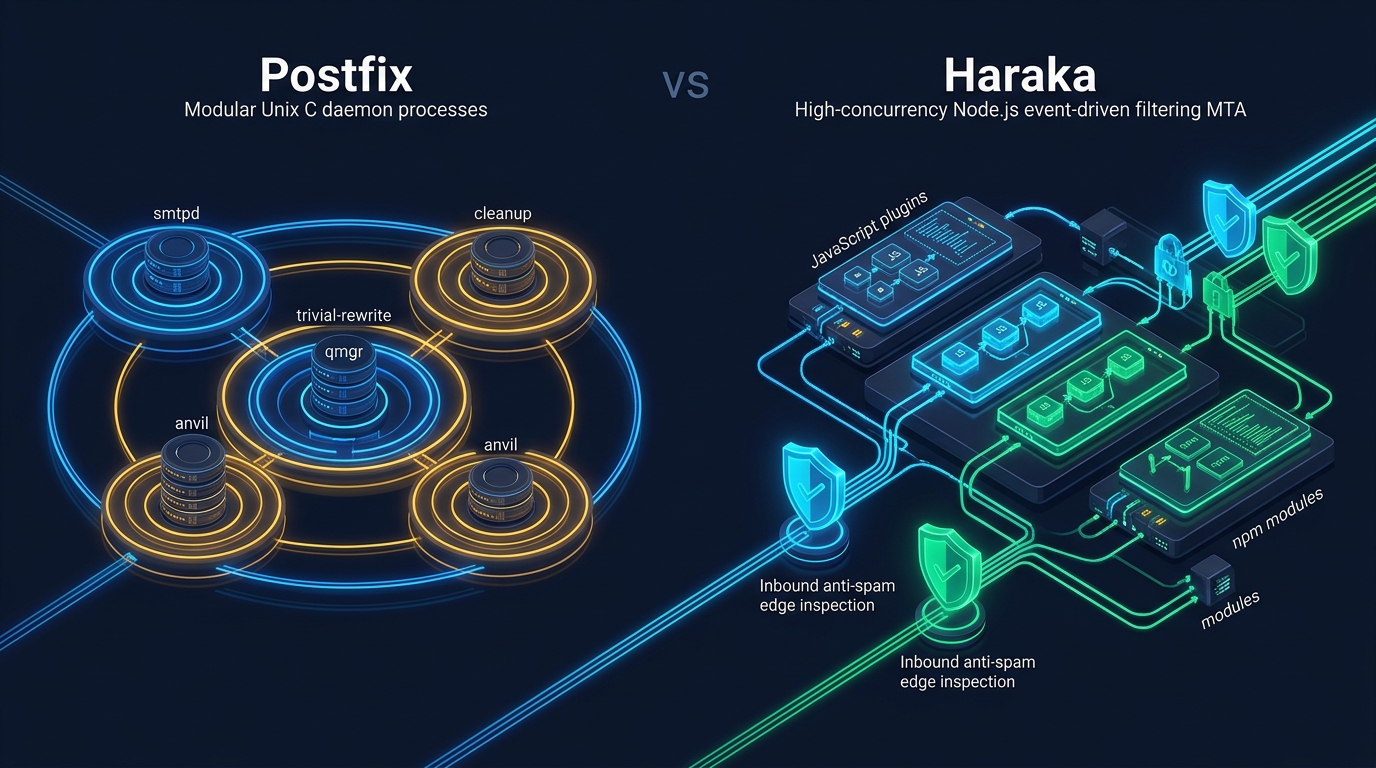
While both Postfix and Haraka implement the RFC 5321 Simple Mail Transfer Protocol and are distributed under permissive open-source licenses, they are complementary tools rather than direct competitors.
Postfix (Wietse Venema, IBM Research) is the quintessential general-purpose Unix MTA. Written in modular C, it serves as the default mail server across Linux distributions, providing complete end-to-end functionality: inbound listening, internal queue scheduling, local delivery agent (LDA) handoffs to Dovecot, and outbound relaying. Haraka (Matt Sergeant) is an event-driven Node.js SMTP server built specifically for high-concurrency edge filtering and mail submission. It does not contain a mailbox store or local delivery agent; instead, it provides granular JavaScript plugin hooks into every phase of the SMTP transaction.
In 2027 enterprise architecture, the most powerful pattern is not choosing Postfix or Haraka, but deploying them in tandem: Haraka at the edge absorbing thousands of concurrent spam connections and executing custom JavaScript validation, while Postfix at the backend manages reliable mailbox storage and final spool delivery.
- 1. Complementary Roles: Full-Stack Mail Server vs Edge Filter
- 2. Postfix Deep Dive: The Battle-Tested Unix Workhorse
- 3. Haraka Deep Dive: The Node.js Plugin Engine
- 4. Extensibility Showdown: C Milters vs JavaScript Event Hooks
- 5. Architectural & Feature Comparison Matrix
- 6. Concurrency & Performance: Epoll Event Loops vs Process Pools
- 7. The Canonical Hybrid Topology (The Craigslist Architecture)
- 8. Production Case Study: ISP Drops Inbound Spam Load by 75%
- 9. Strategic Decision Framework & 2027 Blueprint
- 10. The AutoSMTP Solution
1. Complementary Roles: Full-Stack Mail Server vs Edge Filter
To understand why Postfix and Haraka exist peacefully in modern email infrastructure, operators must separate the roles of an Edge Inspection Shield from an End-to-End Mail System.
Functional Scope Divergence
Postfix (The End-to-End Mail Server): Engineered to be an impenetrable, self-sufficient mail fortress. It receives mail, checks local aliases, parses LDAP/SQL user databases, hands messages off to IMAP/POP3 daemons (Dovecot), queues outbound deliveries across active/deferred spools, and manages connection rate-limiting through its anvil daemon. It does everything a mail server must do.
Haraka (The In-Memory Edge Interceptor): Engineered specifically to sit on port 25 facing the public internet. It leverages Node.js’s non-blocking V8 event loop to hold open tens of thousands of concurrent TCP connections with minimal memory. It applies real-time DNSBL lookups, SPF/DKIM verification, Redis rate-limiting, and custom REST API fraud checks during the SMTP handshake—dropping 80%+ of spam before it ever consumes backend disk I/O.
2. Postfix Deep Dive: The Battle-Tested Unix Workhorse
Postfix is the undisputed standard for Linux email infrastructure, powering corporate mail systems, web hosting platforms (cPanel, Plesk), and modern container suites like Mailcow.
- Proven Privilege Separation: Architected by Wietse Venema with dedicated, least-privileged daemons (
smtpd,cleanup,qmgr,anvil) providing peerless security defense-in-depth. - Complete Mailbox Storage Stack: Seamlessly routes to Maildir/mbox formats and integrates directly with Dovecot via LMTP or
dovecot-lda. - Deterministic Declarative Syntax: Key-value parameter syntax in
main.cfwith over 500 options, making operational behavior predictable across fleet nodes. - Substantial Community Knowledge: 25+ years of operational playbooks, monitoring exporters, and universal systems administration familiarity.
- Zero Software Licensing Fees: 100% free open source under the IBM Public License / Eclipse Public License.
- Rigid Process Concurrency: Process-based model allocates memory per connection; massive DDoS or dictionary spam attacks can exhaust server process limits.
- Milter Protocol Overhead: Adding custom validation requires external milter daemons communicating over TCP or Unix domain sockets, adding latency per message.
- Static Configuration Ceiling: Writing complex dynamic routing policies requires custom policy daemons or maintaining separate database lookups.
- Not Built for Fast API Integration: Querying external HTTP microservices during the SMTP transaction requires custom policy services written in Python or Perl.
3. Haraka Deep Dive: The Node.js Plugin Engine
Engineered by Matt Sergeant and utilized in high-throughput environments like Craigslist and Bounce.io, Haraka treats email transactions as asynchronous JavaScript events.
- Extreme Connection Concurrency: Single-threaded asynchronous event loop effortlessly maintains thousands of simultaneous SMTP connections.
- In-Process JavaScript Plugins: Hook directly into
connect,helo,mail,rcpt,data, andqueuewith zero socket serialization overhead. - Full Access to npm Ecosystem: Import any of the 2+ million npm packages directly into your email flow (e.g., Redis, AWS SDK, Kafka, OpenAI).
- Exceptional Anti-Spam Pipeline: Rich suite of pre-packaged plugins for GeoIP, DNSBL, Early Talker detection, Karma scoring, and rate-limiting.
- High-Velocity Submission (MSA): Functions brilliantly as a port 587 submission proxy, performing live token verification and DKIM signing before queue handoff.
- Zero Mailbox Store Functionality: Cannot deliver to local user mailboxes or host IMAP accounts; must relay validated mail to a backend MTA.
- Node.js Memory Footprint: V8 runtime consumes more baseline memory per idle process than a lightweight compiled C daemon.
- Developer-Centric Management: Troubleshooting production bugs requires JavaScript debugging and Node.js event-loop profiling rather than standard sysadmin tools.
- Smaller Ecosystem than Postfix: Less widespread documentation; production configurations require writing and maintaining custom JavaScript code.
4. Extensibility Showdown: C Milters vs JavaScript Event Hooks
The difference in how Postfix and Haraka handle custom validation logic during the SMTP transaction demonstrates their underlying architectural divide:
Haraka: Native Asynchronous JavaScript Hook
Haraka allows developers to write non-blocking JavaScript functions that validate recipients against external microservices in real time:
// Intercept RCPT TO command and query internal Redis cluster
exports.hook_rcpt = async function (next, connection, params) {
    const recipient = params[0].address().toLowerCase();
    const redis = connection.server.notes.redis;

    try {
        // Query Redis in-memory cache for customer status
        const isBanned = await redis.get(`banned:${recipient}`);
        if (isBanned) {
            return next(DENY, "Recipient account suspended for abuse.");
        }

        // Query internal REST validation API asynchronously
        const response = await fetch(`https://api.internal/v1/verify?email=${encodeURIComponent(recipient)}`);
        const data = await response.json();

        if (data.deliverable) {
            return next(); // Accept recipient and proceed
        } else {
            return next(DENY, "Recipient address does not exist.");
        }
    } catch (err) {
        connection.logerror(`Validation failure: ${err.message}`);
        return next(); // Fail open on internal API downtime
    }
};
Postfix: External Milter Socket Configuration
Postfix cannot execute inline JavaScript; it must delegate transaction inspection to an external daemon via the Sendmail Milter protocol:
# Configure external milters for content inspection and DKIM
smtpd_milters = inet:127.0.0.1:11332, inet:127.0.0.1:8891
non_smtpd_milters = $smtpd_milters
milter_default_action = accept

# Enforce recipient restrictions using static hash tables
smtpd_recipient_restrictions =
    permit_mynetworks,
    permit_sasl_authenticated,
    reject_unauth_destination,
    check_recipient_access hash:/etc/postfix/access_recipients,
    reject_unverified_recipient
5. Architectural & Feature Comparison Matrix
| Evaluation Dimension | Postfix (IBM Research / Wietse Venema) | Haraka (Matt Sergeant / Open Source) |
|---|---|---|
| Primary Role | Full general-purpose mail server (Inbound, Outbound, Storage) | High-concurrency edge filtering MTA & submission agent |
| Implementation Core | C (Modular multi-process architecture) | Node.js / JavaScript (V8 asynchronous event loop) |
| Mail Storage & IMAP | Full support (Dovecot LMTP, Maildir, mbox) | None (Must relay mail to backend mail store) |
| Extension Mechanism | Sendmail Milter protocol (IPC socket) + policy daemons | In-memory JavaScript plugin hooks (npm ecosystem) |
| Connection Model | Process-per-connection pool (OS scheduler managed) | Non-blocking single-threaded event loop (epoll) |
| Peak Edge Concurrency | Moderate (Bound by max process limits & memory) | Extreme (Thousands of concurrent sockets per thread) |
| Configuration Style | Static key-value directives (main.cf, master.cf) |
Text files + dynamic JavaScript code modules |
| Administrative Profile | Linux Systems Administrator / DevOps Engineer | JavaScript / Node.js Full-Stack Developer |
| Licensing & Cost | 100% Free Open Source (IBM / Eclipse License) | 100% Free Open Source (MIT License) |
6. Concurrency & Performance: Epoll Event Loops vs Process Pools
The difference in runtime models dictates how each platform behaves under intense traffic conditions:
Handling Inbound Storms
When an aggressive dictionary attack or botnet bombards your mail server with 10,000 concurrent SMTP handshakes:
- Postfix attempts to spawn worker processes up to its
default_process_limit(typically 100–500). Once reached, subsequent connections queue in the OS TCP backlog, causing connection timeouts for legitimate senders unless strictly throttled byanvil. - Haraka accepts all 10,000 connections into its asynchronous event loop with minimal CPU overhead. Its early-talker and DNSBL plugins identify spammers within milliseconds, issuing an immediate
550 Deniedand closing the socket before reading the message body.
7. The Canonical Hybrid Topology (The Craigslist Architecture)
The most validated architecture for high-volume email operations is deploying Haraka as the perimeter shield in front of a Postfix cluster:
[Public Internet (Port 25)]
         │
         ▼
┌────────────────────────────────────────────────────────┐
│  Tier 1: Haraka Edge Shield (DMZ / Public IP)         │
│  - Asynchronous event loop holds 20k concurrent TCP    │
│  - DNSBL & Spamhaus IP blocking                        │
│  - Real-time Redis rate-limiting                       │
│  - In-band early talker & SPF validation               │
│  - Drops 80% of junk traffic at connection time        │
└────────────────────────────────────────────────────────┘
         │ (Clean, Validated Traffic via Internal Network)
         ▼
┌────────────────────────────────────────────────────────┐
│  Tier 2: Postfix Core Mail Server (Private Subnet)     │
│  - Local user mailbox delivery via Dovecot LMTP        │
│  - Reliable disk spool queue scheduling                │
│  - Inbound IMAP/POP3 authentication                    │
│  - Zero resource exhaustion from internet spam storms  │
└────────────────────────────────────────────────────────┘
8. Production Case Study: ISP Drops Inbound Spam Load by 75%
Web Hosting Provider Eliminates Postfix Queue Saturation
A regional hosting provider managing 250,000 customer mailboxes operated a cluster of 6 Postfix servers fronted by HAProxy. During global spam waves, thousands of concurrent zombie connections saturated Postfix process pools, causing legitimate incoming emails to defer with 451 Server configuration error.
The Haraka Edge Deployment:
The provider deployed two lightweight Haraka edge nodes running on Ubuntu Linux in their DMZ. They wrote custom JavaScript plugins to inspect recipient hostnames against a central Redis replica and enforce DNSBL blacklisting.
Operational Outcomes:
- 75% Spam Load Elimination: Haraka rejected over 18 million invalid and malicious connection attempts per day at the socket level.
- Postfix CPU Drop: Backend Postfix servers experienced a 65% reduction in CPU utilization and zero queue backlog spikes.
- Rapid Feature Deployment: The engineering team was able to deploy custom anti-phishing regex checks in JavaScript within 15 minutes without restarting the backend mail system.
9. Strategic Decision Framework & 2027 Blueprint
Strategic Selection Blueprint
Deploy Postfix When:
- You need a complete, self-contained mail server to host mailboxes, deliver locally to Dovecot, and route corporate email.
- Your team consists of traditional Linux systems administrators comfortable with standard Unix text configurations (
main.cf). - You are deploying standard turnkey email suites like Mailcow, iRedMail, or cPanel.
- You want a proven, security-audited C daemon that has served as the Linux industry standard for a quarter of a century.
Deploy Haraka When:
- You need an edge MTA to filter massive incoming connection loads before passing clean mail to internal mailboxes.
- You want to build custom business logic into your email stream (e.g. querying external REST APIs, logging to Kafka, checking Redis).
- You need an authenticated Mail Submission Agent (MSA) on port 587 that signs DKIM and applies live policy routing in JavaScript.
- Your engineering organization has strong JavaScript/Node.js capabilities and treats email infrastructure as code.
Deploy Both (Hybrid Architecture) When:
- You operate an ISP, hosting platform, or high-volume enterprise receiving millions of inbound emails daily and require the optimal blend of edge filtering speed and reliable mailbox storage.
Managing multi-tier email topologies, tuning Haraka JavaScript event hooks, and securing Postfix daemons requires round-the-clock deliverability engineering. AutoSMTP provides fully managed, carrier-grade outbound email clusters with dedicated bare-metal infrastructure, clean IP subnets, and automated warming at flat predictable pricing.
Provisions fully licensed PowerMTA and KumoMTA clusters on enterprise bare-metal hardware with dedicated NVMe storage, isolated memory pools, and flat predictable pricing.
Autonomous warm-up algorithms dynamically monitor Google Postmaster spam ratios (<0.1%) and real-time deferrals across clean IPv4 subnets, safely scaling volume without human error.
Real-time RFC 5321 in-band 550 bounce suppression combined with automated Yahoo/Outlook Complaint Feedback Loop (CFL) ingestion to safeguard sender reputation 24/7.
Complete end-to-end DNS automation including pristine rDNS/PTR records, aligned SPF includes, rotating 2048-bit DKIM keys, strict DMARC enforcement, and custom BIMI integration.
Ready for Carrier-Grade Dedicated Email Infrastructure?
Deploy enterprise-grade MTA clusters with clean IP subnets, automated warming schedules, and expert deliverability management.
Explore Dedicated SMTP Infrastructure →