

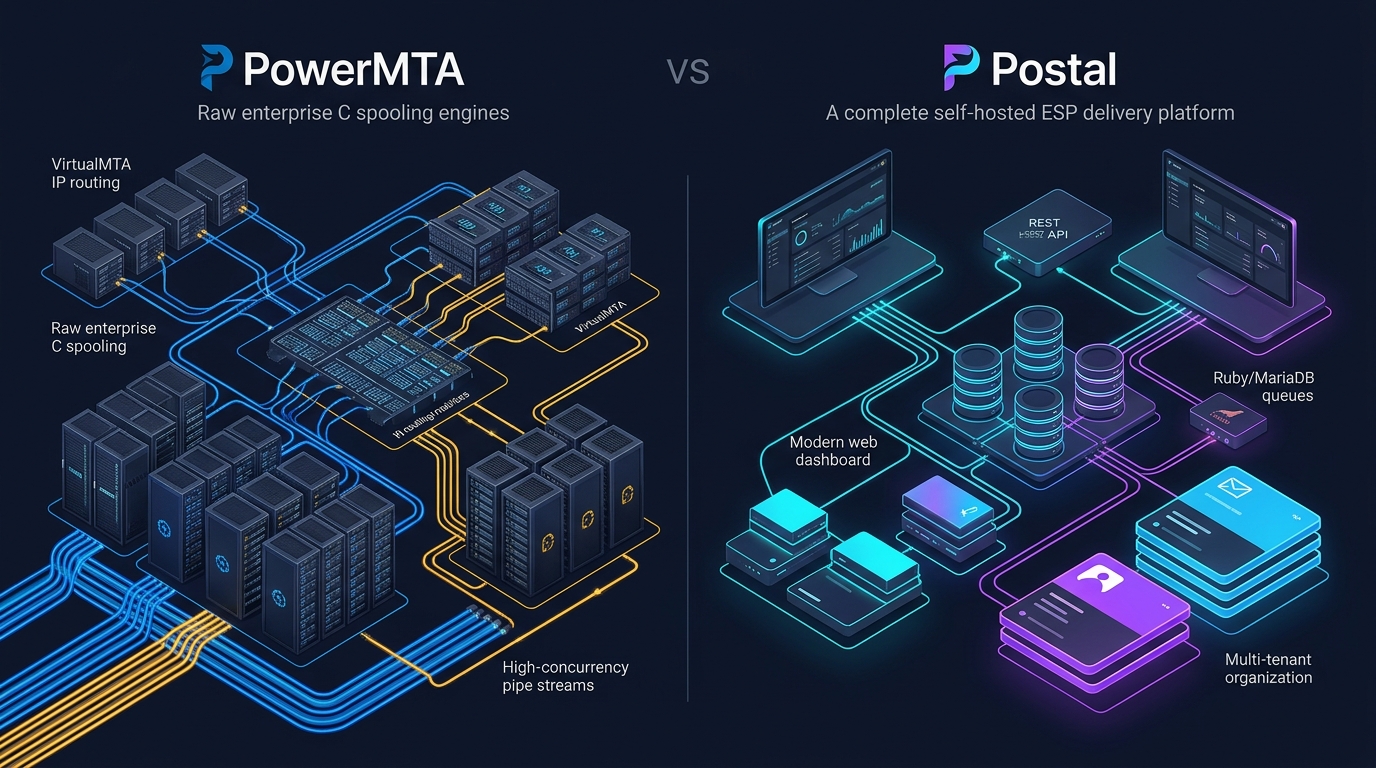
While both PowerMTA and Postal are frequently cited when engineering self-hosted outbound email delivery, comparing them directly is often an exercise in category confusion. They do not compete in the same product layer.
PowerMTA (MessageBird) is a pure, commercial MTA Engine. It provides hyper-optimized, carrier-grade SMTP delivery, VirtualMTAs, adaptive per-ISP throttling, and disk-spool concurrency designed to sustain millions of messages per hour. However, it requires the operator to build or supply their own surrounding application platform (web consoles, user management, REST APIs, open/click tracking, suppression databases).
Postal (originally created by Krystal) is an open-source Mail Delivery Platform. It bundles a custom SMTP/web delivery core with a full-featured Ruby on Rails web UI, multi-tenant organizations, REST API, webhooks, live message inspection, and click/open tracking out of the box. But Postal does not offer PowerMTA’s surgical per-ISP adaptive rate limiting or high-volume bare-metal throughput.
In 2027, the choice boils down to an architectural decision: do you need a raw, high-velocity delivery engine beneath custom software, or a complete self-hosted ESP platform ready to run out of the box?
- 1. Two Different Product Categories: Engine vs Platform
- 2. PowerMTA Deep Dive: The Raw Delivery Powerhouse
- 3. Postal Deep Dive: The Turnkey Open-Source ESP Stack
- 4. Architectural & Stack Comparison: C Daemons vs Rails & RabbitMQ
- 5. Technical & Feature Comparison Matrix
- 6. Architectural Fit by Use Case: ESPs, Agencies & SaaS
- 7. The True TCO: Build Cost vs Licensing Cost
- 8. The KumoMTA Factor: Modern Open-Source Engine Alternative
- 9. Production Case Study: Agency Reseller vs Marketing Cloud
- 10. Strategic Decision Framework & 2027 Blueprint
- 11. The AutoSMTP Solution
1. Two Different Product Categories: Engine vs Platform
To make the right technical choice between PowerMTA and Postal, an engineering team must first understand the fundamental divide between an MTA Engine and an Email Delivery Platform.
The Scope Divergence
PowerMTA (MTA Engine): Operates solely at the wire-level SMTP layer. It handles TCP connections, MX record lookups, TLS encryption, IP address pooling (VirtualMTAs), and ISP rate limits. It has no concept of marketing campaigns, sub-accounts, user permissions, or webhooks. Senders must build or purchase external software (such as MailWizz, Mumara, or in-house microservices) to feed messages into PowerMTA.
Postal (Delivery Platform): A complete self-hosted alternative to SendGrid, Mailgun, or Postmark. It provides an HTTP REST API, user authentication, multi-tenant organizations, IP pools, suppression list workflows, live log search, and webhooks for delivery, bounce, and complaint notifications. Postal is designed to be consumed directly by end-user web applications without requiring any intermediate software.
2. PowerMTA Deep Dive: The Raw Delivery Powerhouse
PowerMTA by MessageBird is built specifically for operations where outbound throughput, reputation isolation, and ISP compliance are paramount.
- Unrivaled Delivery Velocity: Sustains 1 to 3 million messages per hour per server node with minimal CPU and memory footprints.
- Adaptive Traffic Shaping: Automatically detects ISP rate-limiting codes (e.g. Gmail
421 4.7.0) and throttles back delivery threads in real time. - VirtualMTA (VMTA) Pools: Granular binding of outgoing IP addresses, hostnames, and retry algorithms across hundreds of logical sending pools.
- Comprehensive Accounting Logs: Highly detailed pipe/CSV logs recording every delivery attempt, DSN bounce, and FBL complaint.
- Commercial Enterprise Support: 24/7 SLA-backed support with dedicated deliverability escalation engineers.
- No Native Web UI: Administrative control relies strictly on CLI commands (
pmta show status) and text configuration files. - No Native Multi-Tenant User Management: Cannot create isolated accounts for different teams or clients without custom middleware.
- No REST Injection API: Relies primarily on SMTP injection; its management REST API does not handle transactional application payloads.
- High Financial Barrier: Annual commercial licensing ranges from $3,000 to $10,000+ per server instance.
3. Postal Deep Dive: The Turnkey Open-Source ESP Stack
Postal was engineered by Krystal to provide hosting providers, agencies, and SaaS developers with a self-hosted email API platform that matches the developer experience of major cloud ESPs.
- Complete Platform Out-of-the-Box: Provides a modern web UI, REST API, SMTP server, and event webhooks in a unified stack.
- Multi-Tenant Organization Hierarchy: Create isolated organizations, servers, sending domains, and API credentials for multiple clients or microservices.
- Interactive Message Inspection: Search, view, and inspect message headers, delivery attempts, and raw MIME bodies directly within the web dashboard.
- Integrated Click & Open Tracking: Tracks recipient engagement and handles automated suppression lists with zero external software.
- 100% Free & Open Source: Open-source codebase with no licensing fees; run on your own cloud or bare-metal instances.
- Lower Peak Concurrency: Built on Ruby on Rails and MariaDB; cannot match the raw multi-million throughput benchmarks of C/Rust engines.
- Basic Traffic Shaping: Lacks the sophisticated, adaptive per-ISP throttling formulas and backoff states found in PowerMTA.
- Complex Supporting Stack: Requires maintaining Ruby, Puma, RabbitMQ, MariaDB, and Fastmail SMTP daemons simultaneously.
- Community-Only Support: No commercial SLAs; troubleshooting edge-case queue corruption requires internal engineering.
4. Architectural & Stack Comparison: C Daemons vs Rails & RabbitMQ
The difference in software architecture between PowerMTA and Postal defines their operational complexity and resource demands.
PowerMTA Architectural Footprint:
  ├── Binary: Single compiled C executable (/usr/sbin/pmtad)
  ├── Storage: Local filesystem queue (/var/spool/pmta)
  ├── Config: Single structured directive file (/etc/pmta/config)
  ├── Dependencies: ZERO external databases or message brokers
  └── Memory Footprint: ~500MB RAM under multi-million message load

Postal Architectural Footprint:
  ├── Web Application: Ruby on Rails 7 (Puma application server)
  ├── Message Broker: RabbitMQ (Handles asynchronous job queuing)
  ├── Database: MariaDB / MySQL (Stores users, servers, logs, suppressions)
  ├── Fastmail SMTP Server: Node.js / C-based inbound & outbound proxy
  └── Memory Footprint: 4GB–8GB RAM minimum across all supporting daemons
5. Technical & Feature Comparison Matrix
The table below highlights the architectural differences between an enterprise MTA engine and a turnkey delivery platform.
| Evaluation Dimension | PowerMTA (MTA Engine) | Postal (Delivery Platform) |
|---|---|---|
| Product Category | Specialized outbound delivery engine | Turnkey self-hosted mail delivery platform |
| Implementation Stack | C (Native compiled procedural daemon) | Ruby on Rails + RabbitMQ + MariaDB + Node.js |
| Web Management Interface | None (Optional CLI / basic monitoring tool) | Full-featured modern web dashboard included |
| Application Injection APIs | Standard SMTP (ports 25, 587, 465) | REST API + SMTP relay endpoints |
| Multi-Tenancy Model | VirtualMTAs (IP/Hostname bindings only) | Organizations > Servers > Users > API Keys |
| ISP Traffic Shaping | Advanced adaptive rate-limiting per provider | Basic rate-limiting and connection caps |
| Click & Open Tracking | None (Requires third-party marketing software) | Built-in tracking domain and link rewriting |
| Suppression & FBL Lists | Raw text lists; operator manages workflows | Automated suppression database with web UI |
| Peak Throughput / Node | 1,000,000 to 3,000,000+ msgs/hour | 100,000 to 300,000 msgs/hour per node |
| Software Licensing | $3,000 to $10,000+/year per instance | 100% Free & Open Source (MIT License) |
6. Architectural Fit by Use Case: ESPs, Agencies & SaaS
Choosing between PowerMTA and Postal is dictated by your existing application stack and operational scale:
- For High-Volume ESPs & Bulk Senders (10M+ Emails/Month): PowerMTA is the established choice. Large ESPs already operate custom campaign interfaces, user portals, and billing engines; they only need the raw, adaptive throughput of an enterprise MTA engine. Postal’s Ruby/MariaDB queueing stack would introduce bottlenecks at this scale.
- For Digital Agencies & Resellers (1M–5M Emails/Month): Postal provides immediate time-to-market. Agencies can provision dedicated sending servers for multiple clients, issue unique API keys, and grant clients web dashboard access without writing a single line of backend platform code.
- For B2B SaaS Product Notifications: If your engineering team wants to replace SendGrid or Postmark for transactional alerts, Postal provides a drop-in API replacement that keeps all message data sovereign within your own VPC.
7. The True TCO: Build Cost vs Licensing Cost
Comparing PowerMTA and Postal solely on software licensing cost is a major engineering pitfall:
The Hidden Platform Build Cost
While Postal is free software and PowerMTA costs $3,000 to $10,000+ annually, PowerMTA requires you to build or license the entire surrounding platform. Developing custom multi-tenant portals, REST injection APIs, webhook pipelines, and Grafana monitoring around PowerMTA can easily cost $30,000 to $80,000 in dedicated software engineering time.
Conversely, Postal delivers that entire platform on Day 1 for $0, but incurs ongoing server maintenance costs across its Ruby, MariaDB, and RabbitMQ dependencies. For operations under 10 million emails per month, Postal almost always delivers a lower Total Cost of Ownership.
8. The KumoMTA Factor: Modern Open-Source Engine Alternative
In 2027, senders who require the raw delivery horsepower of PowerMTA but refuse to pay $10,000 annual licensing fees increasingly adopt KumoMTA.
Written in Rust by the former architects of PowerMTA and Momentum, KumoMTA provides the same specialized, high-velocity MTA engine focus as PowerMTA (VirtualMTAs, per-domain backoff, Lua scripting) under a free Apache 2.0 open-source license. For teams with existing application infrastructure, KumoMTA represents the natural open-source successor to PowerMTA.
9. Production Case Study: Agency Reseller vs Marketing Cloud
How a Growth Agency Replaced Shared Cloud ESPs with Postal
A marketing agency managing cold outreach and transactional dispatches across 35 client accounts spent over $3,500/month across SendGrid and Mailgun. They were frequently penalized when one client’s poor list hygiene caused shared IP degradation across other accounts.
The Architectural Evaluation:
The agency initially evaluated PowerMTA, but quickly realized they lacked the engineering resources to build a multi-client portal, API gateway, and bounce tracking system around a bare C daemon. Instead, they deployed Postal on a dedicated NVMe bare-metal server with a /27 IPv4 subnet.
Results & Operational Impact:
- Total Multi-Tenant Isolation: Each client was assigned their own Postal “Server” with isolated API keys, dedicated IP bindings, and webhooks.
- Cost Reduction: Monthly software fees dropped from $3,500 to a flat $280/month for dedicated bare-metal hosting.
- Client Self-Service: Clients gained direct access to inspect their own delivery logs and bounce reports without agency intervention.
10. Strategic Decision Framework & 2027 Blueprint
Decision Guide: MTA Engine vs Turnkey Platform
Choose PowerMTA When:
- You already have a mature frontend marketing application (e.g. MailWizz, Mumara, custom CRM) that handles users, lists, and campaigns.
- Your monthly volume exceeds 10M–20M emails and requires sustained hourly throughput of 1M+ messages per node.
- You require adaptive, automatic per-ISP rate-limiting formulas to navigate strict Gmail and Yahoo volume throttling.
- You have the budget for commercial vendor licensing and prioritize enterprise support SLAs.
Choose Postal When:
- You need a complete, self-hosted ESP alternative (UI, API, webhooks, multi-tenancy, click/open tracking) ready on Day 1.
- You are an agency, SaaS company, or development team sending under 5 million emails per month.
- You want zero software licensing fees and the ability to host all message metadata privately on your own hardware.
- Your developers prefer clean REST API endpoints and JSON webhooks over configuring raw SMTP socket handlers.
Choose KumoMTA When:
- You want PowerMTA’s extreme multi-million message throughput and MTA engine architecture, but demand a 100% free, open-source Rust solution.
Whether deploying commercial MTAs like PowerMTA or self-hosting platform stacks like Postal, configuring clean IP pools, navigating Gmail/Yahoo bulk requirements, and managing high-concurrency servers demands constant engineering attention. AutoSMTP delivers carrier-grade, fully managed dedicated email infrastructure with turnkey deliverability at flat predictable pricing.
Provisions fully licensed PowerMTA and KumoMTA clusters on enterprise bare-metal hardware with dedicated NVMe storage, isolated memory pools, and flat predictable pricing.
Autonomous warm-up algorithms dynamically monitor Google Postmaster spam ratios (<0.1%) and real-time deferrals across clean IPv4 subnets, safely scaling volume without human error.
Real-time RFC 5321 in-band 550 bounce suppression combined with automated Yahoo/Outlook Complaint Feedback Loop (CFL) ingestion to safeguard sender reputation 24/7.
Complete end-to-end DNS automation including pristine rDNS/PTR records, aligned SPF includes, rotating 2048-bit DKIM keys, strict DMARC enforcement, and custom BIMI integration.
Ready for Enterprise Dedicated Email Infrastructure?
Deploy high-velocity dedicated MTAs with clean IP subnets, automated warming schedules, and expert deliverability management.
Explore Dedicated SMTP Infrastructure →