

In 2027, comparing Postfix and Sendmail is largely an evaluation of modern Unix security standards versus legacy Internet computing history. Sendmail was the undisputed pioneer of email routing from 1981 through the early 2000s, processing as much as 80% of global internet mail. However, its monolithic C architecture and cryptic m4 macro configuration created decades of severe security vulnerabilities (including the historic 1988 Morris Worm).
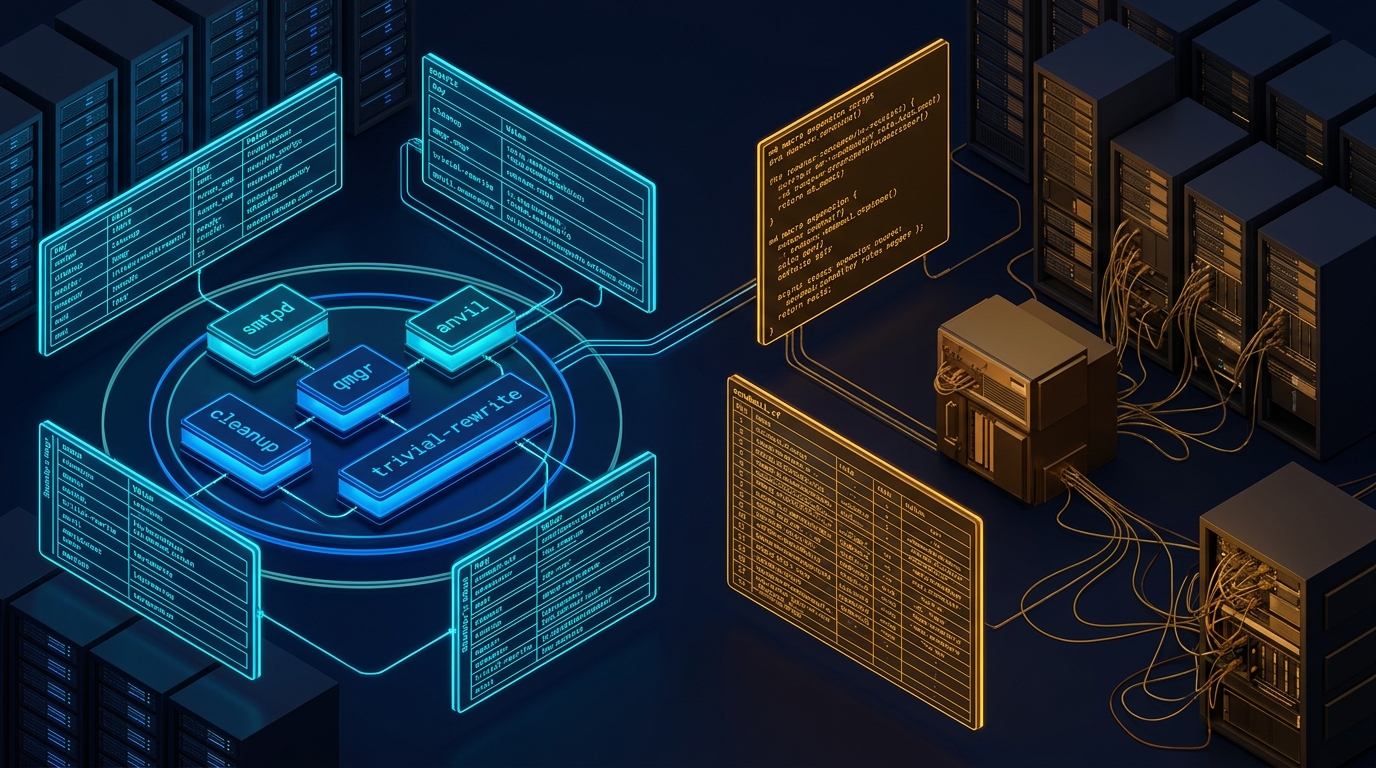
Postfix was designed in 1998 at IBM Research by security researcher Wietse Venema as a direct, structural refactoring of Sendmail. Postfix replaced Sendmail’s monolithic root-running daemon with a cooperative network of least-privileged, modular C daemons (smtpd, cleanup, qmgr, trivial-rewrite, anvil) and intuitive key-value text configuration (main.cf). Today, Postfix has replaced Sendmail as the universal default MTA across Red Hat Enterprise Linux (RHEL 8/9/10), Rocky Linux, AlmaLinux, Debian, Ubuntu, and openSUSE.
For modern mail server deployments, the question is no longer “Postfix or Sendmail?” Sendmail is formally deprecated on modern enterprise distributions, remaining relevant only for preserving legacy UUCP routing scripts or maintaining unmigrated mainframe architectures.
- 1. The State of Postfix and Sendmail in 2027
- 2. Two Origin Stories That Shaped Two Architectures
- 3. Architectural Showdown: Monolithic vs Modular Privilege Separation
- 4. Configuration Philosophy: main.cf vs Cryptic m4 Macros
- 5. Security History: The Morris Worm to Modern Defense-in-Depth
- 6. Linux Distribution Status: Where Each MTA Stands
- 7. Performance & Concurrency Benchmarks
- 8. When Does Sendmail Still Make Operational Sense?
- 9. Production Migration Guide: Moving from Sendmail to Postfix
- 10. Strategic Decision Framework & 2027 Blueprint
- 11. The AutoSMTP Solution
1. The State of Postfix and Sendmail in 2027
The transition from Sendmail to Postfix across the global Linux ecosystem is one of the most successful, complete architectural migrations in computing history.
The 2027 Industry Reality
Postfix is the De Facto Standard: Shipped as the primary MTA package on all major Linux distributions. It is actively maintained by Wietse Venema and an international engineering community, receiving prompt security patches and regular updates that maintain strict backward compatibility.
Sendmail is in Preservation Mode: The open-source Sendmail upstream has seen development slow to emergency maintenance patches. Red Hat formally deprecated Sendmail in RHEL 8 and removed it in RHEL 9. The commercial enterprise variant (Proofpoint) is maintained strictly for legacy corporate contracts where the cost of re-architecting ancient custom routing exceeds ongoing support fees.
2. Two Origin Stories That Shaped Two Architectures
The divergent design choices between Postfix and Sendmail stem directly from the decades and security threats under which they were conceived:
- Sendmail (1981, Eric Allman, UC Berkeley): Conceived when the Internet was an academic network connecting a few hundred trusted research institutions. The priority was heterogeneous network interoperability—routing mail across UUCP, BITNET, and ARPANET. Security was virtually non-existent; running as
rootwas standard practice, and them4macro language was designed for maximum Turing-complete parsing flexibility. - Postfix (1998, Wietse Venema, IBM Research): Conceived after the commercial Internet exploded and email became weaponized by spammers, buffer overflows, and remote code execution exploits. Venema designed Postfix from scratch as a secure, drop-in replacement for Sendmail, enforcing structural privilege separation and intuitive key-value configurations.
3. Architectural Showdown: Monolithic vs Modular Privilege Separation
The difference between a single monolithic daemon and an array of cooperative, sandboxed worker processes represents the core engineering contrast:
- Least-Privilege Isolation: Over a dozen dedicated daemons (
smtpd,cleanup,qmgr,local,anvil). Only the master supervisor runs asroot. - Native Chroot Sandboxing: Internet-facing daemons run inside restricted chroot jails by default on most Linux distributions.
- Crash Containment: A crash or memory exhaustion in
smtpdhas zero effect on queued messages or local mailbox deliveries. - Granular Profiling: Operators can isolate, trace, and scale individual daemons (e.g. increasing
smtpdconcurrency while keepingqmgrstable).
- Single Monolithic Executable: A single process handles network reception, alias expansion, queueing, and local disk delivery.
- Historic Root Execution: While modern Sendmail builds attempt privilege reduction, the monolithic architecture was never designed for structural isolation.
- Single Point of Failure: A severe memory corruption bug or daemon crash halts the entire mail processing pipeline.
- Complex Hardening: Enforcing strict privilege boundaries requires extensive custom OS-level wrappers and external sandboxing.
4. Configuration Philosophy: main.cf vs Cryptic m4 Macros
The administrative burden of maintaining Sendmail versus Postfix is best illustrated by examining their configuration files side by side.
Postfix: Clear Key-Value Directives (main.cf)
myhostname = mail.example.com
mydomain = example.com
myorigin = $mydomain
inet_interfaces = all
mydestination = $myhostname, localhost.$mydomain, localhost
relayhost = [smtp.outbound-relay.com]:587

# Modern TLS & SASL Security Controls
smtp_use_tls = yes
smtp_tls_security_level = encrypt
smtp_sasl_auth_enable = yes
smtp_sasl_password_maps = hash:/etc/postfix/sasl_passwd
smtp_sasl_security_options = noanonymous
Sendmail: Cryptic Macro Expansions (sendmail.mc)
OSTYPE(`linux')dnl
DOMAIN(`generic')dnl
FEATURE(`smrsh',`/usr/sbin/smrsh')dnl
FEATURE(`mailertable',`hash -o /etc/mail/mailertable.db')dnl
FEATURE(`virtusertable',`hash -o /etc/mail/virtusertable.db')dnl
define(`SMART_HOST',`smtp.outbound-relay.com')dnl
define(`RELAY_MAILER_ARGS', `TCP $h 587')dnl
FEATURE(`authinfo',`hash /etc/mail/auth/authinfo.db')dnl
MAILER(smtp)dnl
MAILER(procmail)dnl

# Must be re-compiled using m4 macro processor:
# m4 /etc/mail/sendmail.mc > /etc/mail/sendmail.cf
*Editing raw sendmail.cf directly is notoriously error-prone, requiring administrators to master single-character parsing rules (R$* < @ $* > $*). A single typo in an m4 macro can inadvertently turn an enterprise server into an open spam relay.
5. Security History: The Morris Worm to Modern Defense-in-Depth
Sendmail’s security track record is the single greatest reason for its displacement:
A Legacy of Historic Vulnerabilities
In November 1988, Robert Tappan Morris released the Morris Worm—the world’s first major internet worm. One of its primary vectors was exploiting a debug-mode buffer overflow in Sendmail’s DEBUG command, allowing remote shell access on Unix machines across ARPANET. Throughout the 1990s and early 2000s, Sendmail was plagued by recurring root-compromise CVEs disclosure cycles.
In stark contrast, Wietse Venema designed Postfix with defense-in-depth at its core. Even if an attacker finds a zero-day exploit in the network-facing smtpd daemon, the process runs as an unprivileged user (postfix) inside an isolated chroot jail, preventing local privilege escalation to the host operating system.
6. Linux Distribution Status: Where Each MTA Stands
| Operating System / Distribution | Default Shipped MTA | Sendmail Package Status |
|---|---|---|
| Red Hat Enterprise Linux 8 | Postfix | Deprecated (Legacy package) |
| RHEL 9 / RHEL 10 / Rocky / AlmaLinux | Postfix | Completely Removed from official repositories |
| Debian 12 / Ubuntu 24.04 LTS | Postfix / Exim | Optional legacy community package only |
| openSUSE Leap & Tumbleweed | Postfix | Optional maintenance package |
| FreeBSD & NetBSD | DMA / Postfix | Removed from default base system in modern releases |
7. Performance & Concurrency Benchmarks
On modern multi-core server hardware, Postfix’s modular architecture yields superior concurrency:
- CPU Multithreading & Multi-Core Distribution: Postfix’s master daemon distributes incoming SMTP connections across multiple independent worker processes that scale across available CPU cores. Sendmail’s monolithic architecture encounters locking contention under heavy queue loads.
- Spool Disk Queue Management: Postfix splits its spool directory into hashed bucket subdirectories (
incoming,active,deferred,corrupt), preventing filesystem inode degradation when thousands of messages queue simultaneously. Sendmail utilizes a flatter directory model that suffers performance bottlenecks during high-volume spikes.
8. When Does Sendmail Still Make Operational Sense?
While obsolete for greenfield deployments, Sendmail survives in very narrow edge cases:
- Legacy Mainframe & Unix Architectures: Environments running legacy AIX, HP-UX, or older Solaris systems with complex custom routing rules that have functioned untouched for 20 years.
- Specialized Proofpoint Commercial Contracts: Large financial institutions that pay Proofpoint for commercial Sendmail enterprise support and proprietary filtering appliances.
- Decades-Old UUCP Networks: Specialized closed industrial or maritime networks still utilizing non-standard UUCP protocol handoffs.
9. Production Migration Guide: Moving from Sendmail to Postfix
Financial Services Firm Retires 20-Year-Old Sendmail Server
A banking platform operated Sendmail on Red Hat Enterprise Linux since 2003, routing 200,000 daily transaction receipts. The configuration had accumulated over 600 lines of arcane m4 macros that no active engineer on the team fully understood.
The Postfix Modernization:
The firm migrated to a redundant 2-node Postfix deployment running on AlmaLinux 9. Sendmail’s virtusertable was converted into Postfix virtual_alias_maps, and mailertable entries were mapped to clean Postfix transport_maps.
Results & Operational Impact:
- Configuration Reduction: The configuration footprint shrank by 65%, replacing complex macros with a 45-line, fully commented
main.cf. - Performance Under Load: Peak morning dispatch latency dropped by 22% due to Postfix’s modular process scheduler.
- Team Agility: Routine relay changes that previously required hours of cautious m4 compilation and testing now take less than 5 minutes.
10. Strategic Decision Framework & 2027 Blueprint
Strategic Selection Blueprint
Deploy Postfix When:
- You are setting up a new Linux mail server or modernizing existing corporate email infrastructure.
- You prioritize security defense-in-depth, privilege separation, and human-readable configuration files.
- You want full compatibility with modern Linux distributions (RHEL, Debian, Ubuntu, Rocky, AlmaLinux).
- You need a dependable open-source workhorse to integrate with Dovecot, Rspamd, SpamAssassin, or OpenDKIM.
Retain Sendmail Only When:
- You are locked into legacy commercial Proofpoint contracts or proprietary mainframe systems where the risk and cost of configuration translation outweigh ongoing maintenance.
Evaluate PowerMTA or KumoMTA When:
- Your outbound volume exceeds 500,000 to 1,000,000 emails per day and requires advanced per-ISP traffic shaping, VirtualMTAs, and real-time bounce tracking.
Whether migrating from legacy Sendmail architectures or scaling Postfix beyond single-server process limits, managing mail daemons and maintaining sender reputation demands dedicated expertise. AutoSMTP delivers carrier-grade, fully managed outbound email clusters with clean IP subnets, automated warming schedules, and expert deliverability management.
Provisions fully licensed PowerMTA and KumoMTA clusters on enterprise bare-metal hardware with dedicated NVMe storage, isolated memory pools, and flat predictable pricing.
Autonomous warm-up algorithms dynamically monitor Google Postmaster spam ratios (<0.1%) and real-time deferrals across clean IPv4 subnets, safely scaling volume without human error.
Real-time RFC 5321 in-band 550 bounce suppression combined with automated Yahoo/Outlook Complaint Feedback Loop (CFL) ingestion to safeguard sender reputation 24/7.
Complete end-to-end DNS automation including pristine rDNS/PTR records, aligned SPF includes, rotating 2048-bit DKIM keys, strict DMARC enforcement, and custom BIMI integration.
Ready for Modern Dedicated Email Infrastructure?
Deploy enterprise-grade MTA clusters with clean IP subnets, automated warming schedules, and expert deliverability management.
Explore Dedicated SMTP Infrastructure →