

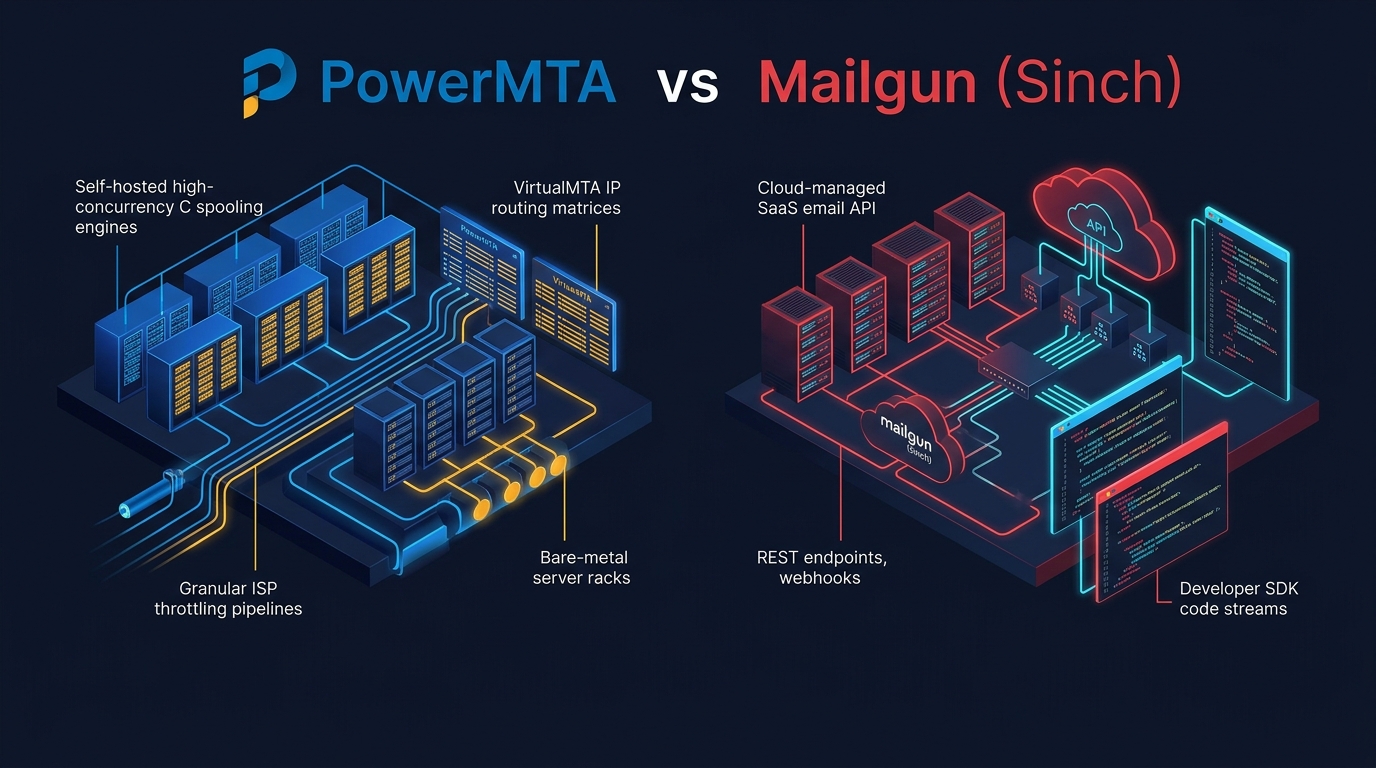
The comparison between PowerMTA and Mailgun (Sinch) represents the fundamental divide between self-hosted enterprise software and cloud-managed SaaS APIs. One is software you own, deploy, and tune on bare-metal hardware; the other is a developer-centric service you query over HTTPS or SMTP.
PowerMTA (MessageBird) is the commercial engine of choice for ESPs, major marketing clouds, and high-velocity bulk senders. It demands annual licensing ($3,000 to $10,000+/year per node) and dedicated systems administration, but gives the operator total sovereignty over VirtualMTAs, IP routing policies, in-band bounce interception, and per-ISP adaptive connection shaping.
Mailgun is a developer-friendly cloud API platform charging recurring metered CPM rates ($0.80 to $1.20 per thousand emails). It completely abstracts server administration, IP provisioning, and hardware maintenance behind intuitive REST SDKs and webhooks. However, senders remain vulnerable to strict cloud account suspensions, opaque deliverability penalties on shared pools, and compounding metered invoices as monthly volume scales.
In 2027, the financial crossover point occurs between 500,000 and 1,000,000 monthly emails. Beyond this threshold, Mailgun’s metered pricing rapidly exceeds the cost of dedicated self-hosted PowerMTA clusters.
- 1. One Software You Run, One Service You Call
- 2. PowerMTA Deep Dive: Sovereign Deliverability Engine
- 3. Mailgun Deep Dive: Developer-First Cloud API
- 4. Cost Crossover Analysis: When Does Dedicated Outperform SaaS?
- 5. Architectural & Feature Comparison Matrix
- 6. Deliverability Control: VirtualMTAs vs Managed IP Pools
- 7. Hybrid Architecture Patterns: Combining Both Worlds
- 8. The KumoMTA Alternative: Open-Source Engine
- 9. Production Case Study: Scaling Beyond Mailgun’s Metered Invoicing
- 10. Strategic Decision Framework & 2027 Blueprint
- 11. The AutoSMTP Solution
1. One Software You Run, One Service You Call
PowerMTA and Mailgun address the same technical objective—delivering email into recipient inboxes—but operate on fundamentally conflicting infrastructure philosophies.
The Structural Divide
PowerMTA (Owned Infrastructure): You license the compiled binary from MessageBird, install it on dedicated bare-metal servers or cloud instances, bind clean IPv4 subnets, and configure traffic shaping directives. You control DNS, PTR, TLS ciphers, and spool queues. There are no monthly per-email overage penalties, and no cloud vendor can abruptly suspend your sending account due to automated spam heuristics.
Mailgun (Managed API Utility): You sign up for a SaaS tier, point your applications to Mailgun’s REST endpoints or SMTP relays, and verify domain DNS records. Mailgun manages server uptime, connection pooling, and baseline IP reputation. However, your cost scales linearly with every single email sent, and severe spikes in bounce rates can trigger account throttling or instant termination.
2. PowerMTA Deep Dive: Sovereign Deliverability Engine
PowerMTA is engineered for organizations where deliverability is a core competency and email volume is measured in tens of millions of monthly dispatches.
- Sub-Linear Cost Scaling: Send 5 million or 50 million emails a month on a single bare-metal server without paying an additional cent in software fees.
- Granular VirtualMTAs (VMTAs): Bind distinct outbound IPs, hostnames, and rate limits to separate logical pools (e.g. transactional, marketing, VIP tiers).
- Per-ISP Traffic Shaping: Define exact concurrent connection limits, max messages per session, and backoff timers customized for Gmail, Yahoo, and Microsoft 365.
- Zero Account Suspension Risk: You own the server. An aggressive campaign or transient list decay cannot result in an automated vendor account lock.
- Deep Diagnostic Logs: Pipe-delimited and CSV accounting logs record every TCP handshake, DSN reply code, and in-band socket response.
- Dedicated Systems Administration: Requires experienced Linux engineers capable of managing mail queues, kernel networking, and server hardening.
- Total IP Warmup Responsibility: Clean IP subnets must be systematically warmed; poor list hygiene directly damages your owned assets.
- Commercial License Commitment: Annual licensing ($3,000 to $10,000+) requires upfront capital investment before sending the first message.
- No Native Transactional UI: Requires external software (MailWizz, Mumara, or custom API wrappers) for campaign and template management.
3. Mailgun Deep Dive: Developer-First Cloud API
Mailgun (by Sinch) has established itself as the gold standard for developer-first email delivery APIs, offering clean SDKs and robust webhook pipelines.
- Instant Time-to-Inbox: Get started in minutes with SDK libraries in Python, Node.js, Go, PHP, Ruby, and Java.
- Zero Server Management: No Linux daemons to patch, no spool disks to clean, and no network bottlenecks to troubleshoot.
- Pre-Warmed Shared Pools: Low-volume senders can immediately achieve solid inbox placement without enduring a 30-day manual IP warmup cycle.
- Rich Inbound Routing: Robust inbound parsing engine converts incoming emails into structured JSON payloads forwarded directly to your webhooks.
- Native Email Validation: Syntax verification, MX record checks, and mailbox existence pinging built directly into the platform.
- Punitive Volume Economics: At 5M+ monthly emails, Mailgun’s recurring monthly invoices rapidly exceed $3,000/month ($36,000+ annually).
- Account Suspension Vulnerability: Automated compliance bots actively pause or terminate accounts that breach bounce thresholds (>5%) or spam complaints (>0.1%).
- Shared Pool Noise: Senders on entry tiers share IP reputation with thousands of unknown third parties, exposing them to unpredictable spam folder routing.
- No Granular Traffic Shaping: Senders have zero control over TCP connection reuse, cipher suites, or customized retry timing for restrictive ISPs.
4. Cost Crossover Analysis: When Does Dedicated Outperform SaaS?
The table below models the 1-year total financial cost of Mailgun vs a dedicated self-hosted PowerMTA node across various monthly volume tiers:
| Monthly Volume | Mailgun Cost (Annual) | Dedicated PowerMTA (Annual) | Economic Winner |
|---|---|---|---|
| 100,000 / month | ~$420 / year ($35/mo Foundation tier) | ~$5,400 / year (License + Server) | Mailgun (+92% Savings) |
| 500,000 / month | ~$3,000 / year ($250/mo Scale tier) | ~$5,400 / year (License + Server) | Mailgun (Slight Advantage) |
| 1,500,000 / month | ~$10,800 / year ($900/mo Custom) | ~$6,000 / year (License + Server + IPs) | PowerMTA (44% Savings) |
| 5,000,000 / month | ~$32,000 / year (~$2,650/mo Custom) | ~$7,200 / year (License + Server + /28 IPs) | PowerMTA (77% Savings) |
| 20,000,000 / month | ~$110,000+ / year (Enterprise pricing) | ~$10,800 / year (High-tier PMTA + /27 IPs) | PowerMTA (90% Savings) |
*At 5 million monthly emails, transitioning from Mailgun to dedicated PowerMTA infrastructure saves over $24,000 every single year.
5. Architectural & Feature Comparison Matrix
| Feature / Capability | PowerMTA (MessageBird) | Mailgun (Sinch) |
|---|---|---|
| Hosting & Infrastructure | Self-hosted on dedicated bare-metal / VPS | Fully managed multi-tenant cloud SaaS |
| Pricing Paradigm | Flat annual license (~$3,000–$10,000/yr) | Recurring monthly metered CPM ($0.80–$1.20/CPM) |
| Application Injection | High-speed SMTP + internal submission APIs | RESTful HTTPS API + SMTP endpoints |
| Throughput Capacity | 1,000,000 to 3,000,000+ msgs/hour per node | Metered by plan tier and API concurrency limits |
| IP Allocation Control | Total ownership of IPv4 subnets & PTR records | Shared pools by default; dedicated IPs cost extra |
| ISP Traffic Shaping | Deeply granular (rate, sessions, backoff timers) | Automated & opaque behind Mailgun’s internal MTAs |
| Inbound Email Routing | Requires external daemon (Postfix, Haraka) | Native regex routes forwarding to webhooks |
| Account Ban & Freeze Risk | 0% (Self-hosted sovereign control) | High (Automated policy enforcement algorithms) |
6. Deliverability Control: VirtualMTAs vs Managed IP Pools
Deliverability outcomes depend entirely on how outbound reputation is segmented:
# Define Dedicated Transactional VMTA (Highest Reputation)
<virtual-mta vmta-transactional>
    smtp-source-host 192.0.2.50 tx.example.com
</virtual-mta>

# Define Dedicated Marketing VMTA (Isolated Risk)
<virtual-mta vmta-marketing>
    smtp-source-host 192.0.2.51 mktg.example.com
</virtual-mta>

# Strict In-Band Bounce Suppression Rules
<domain gmail.com>
    max-smtp-out           40
    max-msg-per-connection 100
    max-msg-rate           80/m
    retry-after            20m
</domain>
In Mailgun, senders on standard plans share IP addresses with other companies. If another tenant blasts spam, the entire IP pool suffers deferral throttling from Google and Yahoo. In contrast, PowerMTA guarantees that your IP addresses are 100% dedicated to your domains, giving you an isolated deliverability ceiling that cannot be contaminated by third parties.
7. Hybrid Architecture Patterns: Combining Both Worlds
Many enterprise organizations deploy a Hybrid Email Topology to capture the best aspects of both platforms:
- PowerMTA for High-Volume Marketing: Route all marketing blasts, promotional newsletters, and re-engagement campaigns through self-hosted PowerMTA bare-metal nodes to capitalize on flat-rate volume economics.
- Mailgun for Critical Transactional & Inbound: Route password resets, one-time passwords (OTPs), and inbound reply webhooks through Mailgun’s developer API for instant global redundancy.
- Mailgun as Warm Failover: Configure Mailgun as an automated secondary relay in your application code if the primary dedicated datacenter experiences a transient upstream fiber cut.
8. The KumoMTA Alternative: Open-Source Engine
For organizations looking to escape Mailgun’s escalating metered invoices without paying PowerMTA’s $10,000 commercial licensing fees, KumoMTA has emerged as the premier open-source solution.
Written in Rust by the original architects of PowerMTA and Momentum, KumoMTA offers carrier-grade outbound throughput, Lua-programmable traffic shaping, and native Prometheus telemetry under a 100% free Apache 2.0 license.
9. Production Case Study: Scaling Beyond Mailgun’s Metered Invoicing
E-Commerce Platform Reduces Annual Email Infrastructure Spend by $68,000
A multi-brand e-commerce retailer sending 14 million marketing and transactional emails per month saw their Mailgun invoices rise from $800/month to over $7,200/month during holiday peak seasons. Furthermore, an unintended spike in marketing complaint rates caused Mailgun’s automated compliance system to throttle their transactional order confirmations.
The Migration to Dedicated Bare-Metal MTAs:
The retailer migrated their outbound sending to a dedicated 2-node PowerMTA cluster with a dedicated /28 subnet of 16 clean IPv4 addresses. They isolated transactional traffic to 2 dedicated IPs and distributed marketing campaigns across the remaining 14 IPs.
Business Results:
- Massive Capital Savings: Annual email infrastructure spend plummeted from $86,400 to $18,200 (including server hardware, IP subnets, and PowerMTA licensing), yielding over $68,000 in direct annual savings.
- Total Stream Separation: Marketing complaints had zero impact on password reset delivery times, which consistently resolved in under 800 milliseconds.
- Complete Immunity: No risk of sudden cloud account suspensions or arbitrary sending rate throttling during major sales events.
10. Strategic Decision Framework & 2027 Blueprint
Strategic Selection Blueprint
Choose PowerMTA When:
- Your monthly email volume consistently exceeds 1 million to 2 million messages.
- You demand 100% sovereign control over dedicated IP addresses, rDNS/PTR records, and custom delivery policies.
- You want flat, predictable infrastructure expenses that do not penalize you for expanding your subscriber base.
- You have access to experienced Linux systems administrators or partner with a managed email infrastructure provider.
Choose Mailgun When:
- Your sending volume is under 500,000 emails per month where SaaS CPM pricing is highly cost-effective.
- You need rapid developer integration using language-specific REST SDKs without managing underlying operating systems.
- You require native inbound email parsing and routing to webhooks for user reply workflows.
- Your team has zero systems administration bandwidth and prefers a fully managed cloud service.
Choose KumoMTA When:
- You require the raw throughput and sovereign control of PowerMTA, but want to eliminate the $10,000 annual license tax by leveraging open-source Rust.
Transitioning from metered cloud APIs like Mailgun to dedicated MTAs like PowerMTA delivers massive financial savings, but typically introduces severe systems administration overhead. AutoSMTP bridges the gap: carrier-grade bare-metal MTA clusters, fully managed deliverability, and automated warming at flat predictable pricing.
Provisions fully licensed PowerMTA and KumoMTA clusters on enterprise bare-metal hardware with dedicated NVMe storage, isolated memory pools, and flat predictable pricing.
Autonomous warm-up algorithms dynamically monitor Google Postmaster spam ratios (<0.1%) and real-time deferrals across clean IPv4 subnets, safely scaling volume without human error.
Real-time RFC 5321 in-band 550 bounce suppression combined with automated Yahoo/Outlook Complaint Feedback Loop (CFL) ingestion to safeguard sender reputation 24/7.
Complete end-to-end DNS automation including pristine rDNS/PTR records, aligned SPF includes, rotating 2048-bit DKIM keys, strict DMARC enforcement, and custom BIMI integration.
Ready to Escape Metered Cloud Email CPMs?
Deploy dedicated bare-metal MTA clusters with clean IP subnets, automated warming schedules, and expert deliverability management.
Explore Dedicated SMTP Infrastructure →