

BIND 9 vs PowerDNS: 2027 Zone Files vs SQL Database Backends for High-Volume MTAs
Published by Fred Dawson • Senior Deliverability Systems Architect • 18 min read
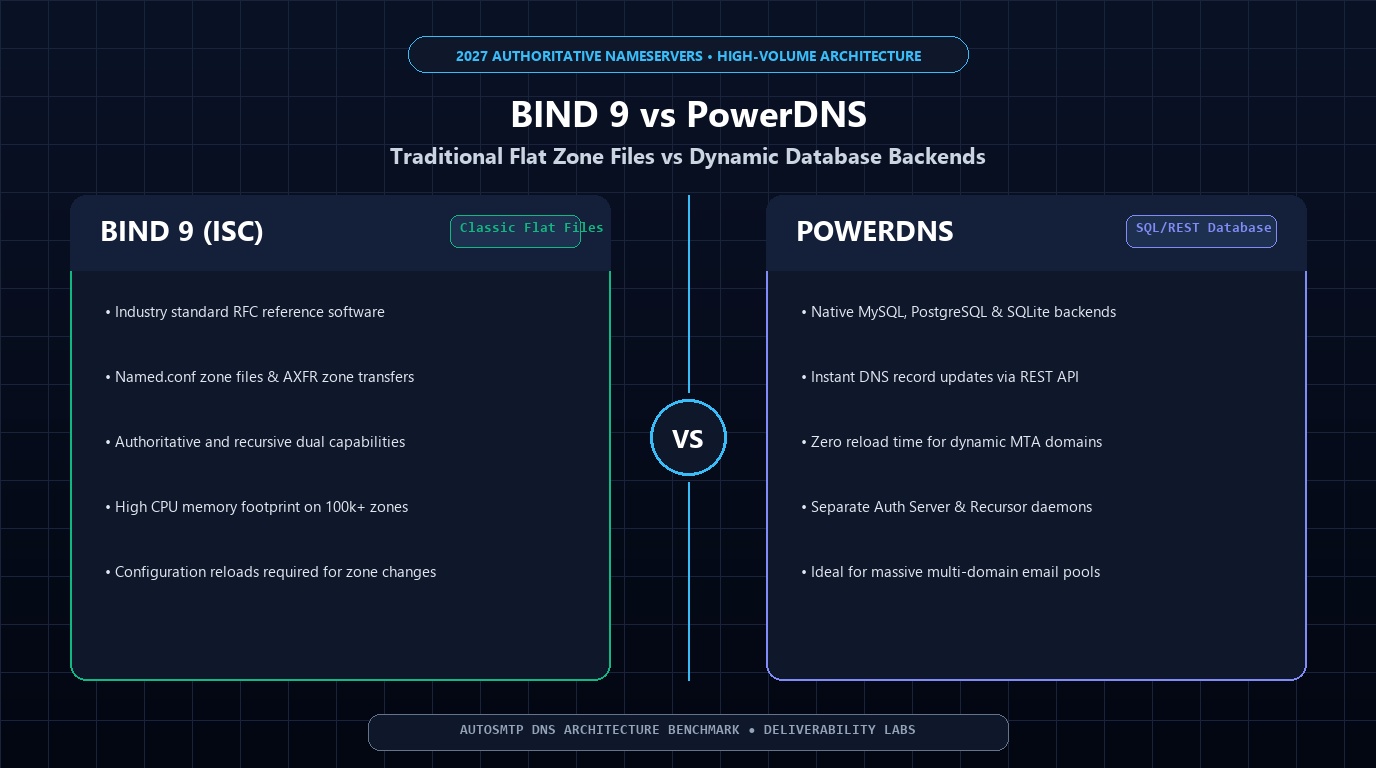
When managing sovereign, high-volume email infrastructure across hundreds or thousands of sending domains, relying on public cloud DNS interfaces introduces API rate limits and vendor lock-in. Self-hosting authoritative nameservers provides complete infrastructure independence. The two dominant open-source nameserver platforms are BIND 9 (Internet Systems Consortium) and PowerDNS Authoritative Server. While BIND 9 is the historical reference standard relying on flat zone files and named.conf, PowerDNS was engineered around a modular database architecture (MySQL, PostgreSQL, SQLite, Redis) that allows instant programmatic record updates via REST API without nameserver restarts.
- 1. Storage Backends: Flat Zone Files vs Relational SQL
- 2. Dynamic Domain Provisioning & Zero-Reload Updates
- 3. DNSSEC Automation: BIND Manual Signing vs PowerDNS SQL
- 4. High-Density Domain Fleet Scaling (10,000+ Zones)
- 5. BIND 9 vs PowerDNS Technical Matrix
- 6. The AutoSMTP Deliverability Defense Advantage
1. Storage Backends: Flat Zone Files vs Relational SQL
The foundational difference between BIND 9 and PowerDNS lies in how zone data is stored and parsed:
BIND 9 (ISC): Stores DNS records in plaintext RFC-standard master zone files on disk. The main daemon (named) parses these files into internal memory trees during startup. While this ensures ultra-fast memory lookups, modifying records requires modifying the text file, incrementing the serial number (YYYYMMDDNN), and issuing an administrative reload command via rndc reload.
PowerDNS Authoritative Server: Separates the DNS protocol engine from data storage. PowerDNS queries pluggable backends (MySQL, PostgreSQL, SQLite, BIND-style files, or LDAP). When an incoming DNS query arrives, PowerDNS queries the local database or memory packet cache. Adding a record is as simple as executing an INSERT or UPDATE SQL statement or making a single HTTP POST to the PowerDNS REST API.
# PowerDNS: Instant programmatic addition of 2048-bit DKIM record via REST API
curl -X PATCH -H "X-API-Key: $PDNS_API_KEY" \
  -d '{"rrsets": [{"name": "mail._domainkey.outbound.io.", "type": "TXT", "ttl": 300, "changetype": "REPLACE", "records": [{"content": "\"v=DKIM1; k=rsa; p=MIIBIjANBg...\"", "disabled": false}]}]}' \
  http://127.0.0.1:8081/api/v1/servers/localhost/zones/outbound.io
# Status: 204 No Content -> Live immediately with zero daemon reloads!

# BIND 9: Manual file edit, serial bump, and rndc reload:
sed -i 's/2026102001/2026102002/' /var/named/zones/outbound.io.db
echo 'mail._domainkey IN TXT "v=DKIM1; k=rsa; p=MIIBIjANBg..."' >> /var/named/zones/outbound.io.db
rndc reload outbound.io
# Output: zone reload queued (takes 1-3 seconds, locks zone table during re-parse)
2. Dynamic Domain Provisioning & Zero-Reload Updates
In high-scale cold email and programmatic marketing operations, systems continuously provision dozens of secondary tracking and sender domains daily. On BIND 9, reloading named repeatedly across a cluster of nameservers causes CPU spikes and briefly locks query threads. On PowerDNS, the database backend allows microservices to provision domains and records with zero latency and zero service disruption.
3. DNSSEC Automation: BIND Manual Signing vs PowerDNS SQL
Implementing DNSSEC in BIND 9 historically required complex cron jobs executing dnssec-signzone, generating .signed zone files, and manually tracking KSK/ZSK key rollovers. While newer BIND 9 versions include inline-signing, it requires careful raw file state management.
PowerDNS provides a fully automated, database-backed DNSSEC engine. Running pdnsutil secure-zone example.com generates cryptographic keys directly in the SQL database, signs all responses on-the-fly with live NSEC/NSEC3 records, and outputs the exact DS record required by your domain registrar in one command.
4. High-Density Domain Fleet Scaling (10,000+ Zones)
PowerDNS Database Scaling
PowerDNS scales effortlessly to millions of domains. Because zone metadata resides in a high-performance relational database (PostgreSQL with read replicas), nameserver RAM usage remains constant regardless of whether you host 50 domains or 500,000 domains. PowerDNS packet cache absorbs 99%+ of repeat queries directly from memory.
BIND 9 Memory Saturation
Because BIND 9 loads all zone files into RAM at startup, managing 100,000+ domains consumes tens of gigabytes of memory. Boot and restart times can take 5 to 15 minutes while BIND parses text files from disk, during which time DNS lookups can time out.
5. BIND 9 vs PowerDNS Technical Matrix
| Evaluation Pillar | BIND 9 (ISC) | PowerDNS Authoritative Server | Architecture Verdict |
|---|---|---|---|
| Storage Backend | RFC plaintext zone files / memory tree | MySQL, PostgreSQL, SQLite, Redis, REST | PowerDNS: Native relational database integration |
| API Automation | rndc control tool / nsupdate (RFC 2136) | Built-in HTTP REST API & JSON payloads | PowerDNS: Modern CI/CD and web application native |
| Record Update Delay | Requires file write + rndc reload (1-3s lock) | Instant (0 seconds; direct SQL read) | PowerDNS: Instant propagation for dynamic pools |
| DNSSEC Implementation | File-based dnssec-signzone or inline-signing | Automated SQL key generation (pdnsutil) | PowerDNS: Frictionless 1-command deployment |
| Industry Longevity | The foundational DNS server since 1984 | Modern enterprise standard since 2002 | BIND 9: Unmatched RFC reference completeness |
Enterprise ESP: Migrating 85,000 Client Tracking Domains to PowerDNS
A commercial email service provider hosting 85,000 custom tracking and click-redirect subdomains was running BIND 9 across four nameserver nodes. Adding new customer domains required batching file updates every 30 minutes, leading to customer onboarding delays. BIND service restarts consumed 18 GB of RAM and took 7 minutes to reload. By migrating to PowerDNS backed by a replicated PostgreSQL cluster, customer domain provisioning became instantaneous (<50ms API call), and server RAM dropped from 18 GB to under 800 MB per node.
The AutoSMTP Deliverability Defense Advantage
Inbound and outbound filtering pipelines require robust underlying transport hardware. AutoSMTP provisions sovereign, dedicated bare-metal MTA infrastructure engineered for high-throughput filtering, synchronous 550 bounce suppression, and permanent reputation control.
Provisions fully licensed PowerMTA and KumoMTA clusters on enterprise bare-metal with dedicated IPv4 subnets and predictable flat pricing.
Monitors Google Postmaster spam ratios (<0.1%) and real-time ISP deferrals with algorithmic volume scaling across your entire IP pool.
RFC 5321 in-band 550 bounce suppression, automated Yahoo/Outlook Complaint Feedback Loops (CFL), and instant bad-IP eviction.
Pre-configured forward and reverse DNS (PTR) per IP, SPF CIDR alignment, 2048-bit DKIM rotation, and strict DMARC enforcement.
Upgrade Your Email Infrastructure with Dedicated Bare Metal
Eliminate filter lag, queue serialization bottlenecks, and noisy neighbor contamination. Deploy a turnkey AutoSMTP cluster today.
Deploy Turnkey MTA Cluster →