

Anycast DNS vs Unicast DNS for Email: 2027 Global Latency, DDoS Resilience & MX Resolution
Published by Fred Dawson • Senior Deliverability Systems Architect • 18 min read
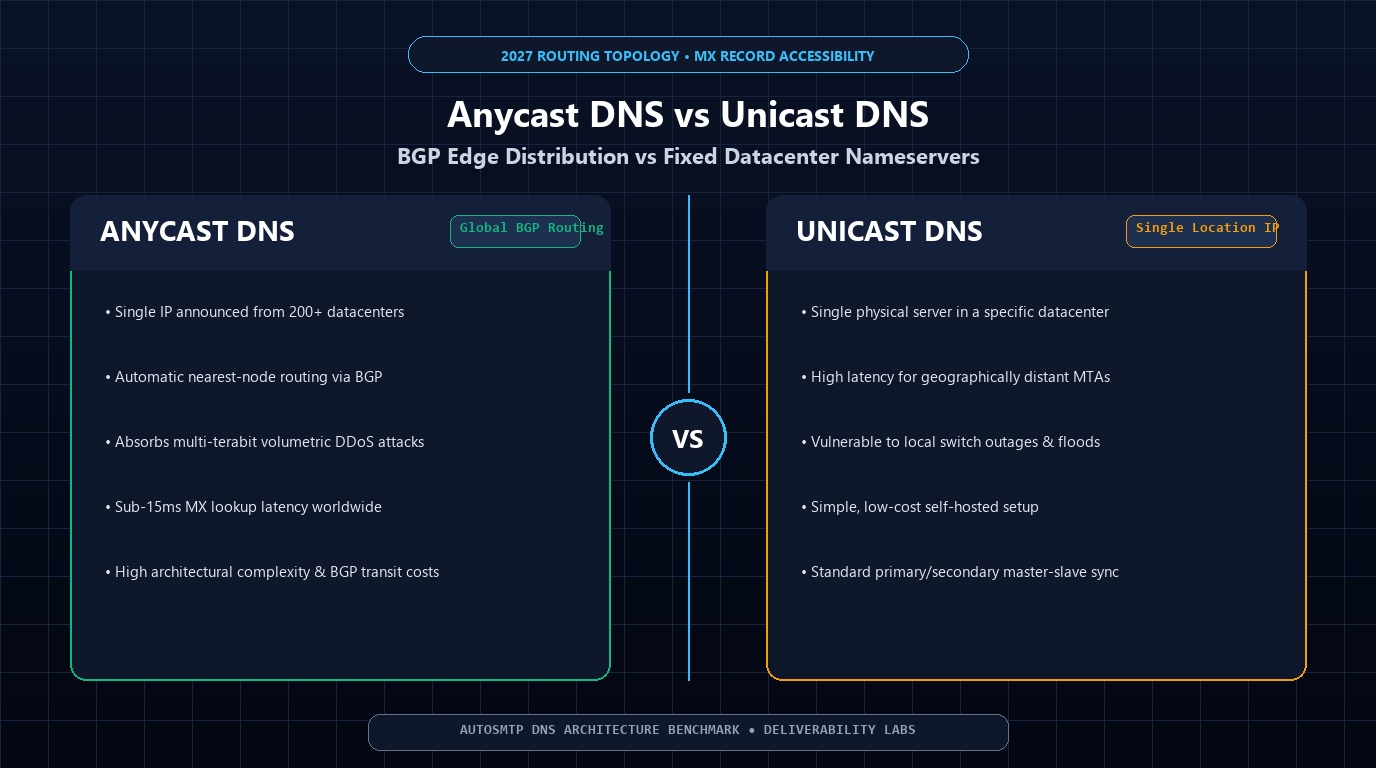
The fundamental routing protocol behind your domain’s authoritative nameservers determines how quickly destination Mail Transfer Agents across the globe can authenticate your email. Under Unicast DNS, a nameserver IP address is bound to a single physical server in a single datacenter, forcing remote MTAs on other continents to endure 150ms-250ms transatlantic network delays. Under BGP Anycast DNS, a single IP address is announced simultaneously from hundreds of worldwide datacenters, routing queries to the topologically nearest edge node in under 15ms while effortlessly absorbing multi-gigabit DDoS attacks.
- 1. BGP Routing Mechanics: Anycast vs Unicast Explained
- 2. Geographic Latency Impact on Destination MX Handshakes
- 3. Volumetric DDoS Resilience & DNS Outage Bounces
- 4. TCO & Deployment: Cloud Anycast vs Self-Hosted Unicast
- 5. Anycast vs Unicast Technical Matrix
- 6. The AutoSMTP Deliverability Defense Advantage
1. BGP Routing Mechanics: Anycast vs Unicast Explained
The difference between Unicast and Anycast DNS lies in Border Gateway Protocol (BGP) route advertisement:
Unicast DNS: A traditional network model where each authoritative nameserver (e.g., ns1.example.com and ns2.example.com) has a unique IP address bound to a single physical network interface card in a specific location (such as Falkenstein, Germany). When an MTA in Tokyo or Sydney sends an email to your domain, its DNS resolver must send UDP packets across undersea fiber cables to Germany and wait for the response.
Anycast DNS: Multiple geographically dispersed server clusters announce the exact same IP address and /24 subnet prefix via BGP to upstream Tier-1 transit providers. Internet routers use BGP Autonomous System (AS) path shortest-hop metrics to direct DNS requests to the closest physical datacenter. An MTA in Tokyo queries an Anycast edge node in Tokyo, receiving an answer in 4 milliseconds.
2. Geographic Latency Impact on Destination MX Handshakes
When an outbound MTA delivers a message to a remote server, the receiving MTA executes DNS lookups during the active SMTP transaction:
Receiving MTA in Singapore connects to Sender domain hosted on Unicast (Frankfurt):
  1. HELO/EHLO check -> Query PTR -> 185ms
  2. MAIL FROM check -> Query SPF TXT -> 190ms
  3. DATA termination -> Query DKIM TXT -> 188ms
  4. Policy enforcement -> Query DMARC TXT -> 192ms
Total Transaction Latency Added by DNS: ~755ms!

Receiving MTA in Singapore connects to Sender domain hosted on Anycast Edge:
  1. HELO/EHLO check -> Query PTR (Local Edge) -> 6ms
  2. MAIL FROM check -> Query SPF TXT (Local Edge) -> 5ms
  3. DATA termination -> Query DKIM TXT (Local Edge) -> 6ms
  4. Policy enforcement -> Query DMARC TXT (Local Edge) -> 5ms
Total Transaction Latency Added by DNS: ~22ms (34x faster!)
Excessive DNS latency during the SMTP handshake causes receiving MTAs to enforce connection throttling, deferrals (451 4.4.0 DNS lookup timeout), or sudden socket termination.
3. Volumetric DDoS Resilience & DNS Outage Bounces
If your authoritative nameservers are knocked offline by a Denial of Service attack, your entire email infrastructure collapses immediately. Destination MTAs unable to resolve your MX records or SPF/DKIM records will defer email for a few hours before issuing permanent bounces (550 5.1.2 Host unknown / DNS failure).
Unicast Vulnerability to Floods
A 20 Gbps UDP reflection flood targeted at a Unicast nameserver easily saturates the server’s 1 Gbps or 10 Gbps uplink port. The nameserver stops responding, dropping all DNS queries for all hosted domains. Legitimate email delivery worldwide stalls instantly.
Anycast Distributed Scrubbing
Because an Anycast IP is announced across 200+ global datacenters, a 500 Gbps flood is automatically fractured across hundreds of edge POPs. Each local datacenter absorbs only 2.5 Gbps of attack traffic, easily mitigated by upstream edge scrubbing hardware while clean DNS queries continue to be answered seamlessly.
4. TCO & Deployment: Cloud Anycast vs Self-Hosted Unicast
While self-hosting Unicast nameservers on two cheap $10 VPS instances is straightforward, self-hosting a private Anycast network requires an Autonomous System Number (ASN), a dedicated /24 IPv4 allocation, BGP routing software (BIRD / FRR), and transit agreements with multiple global datacenter providers—costing thousands of dollars monthly. For 99% of email operations, utilizing managed Anycast providers (Cloudflare DNS, Route 53, or NS1) delivers world-class Anycast resilience at near-zero marginal cost.
5. Anycast vs Unicast Technical Matrix
| Evaluation Dimension | Anycast DNS (Cloudflare / Route 53) | Unicast DNS (Single Datacenter VPS) | Deliverability Verdict |
|---|---|---|---|
| Global Query Latency | Sub-15ms worldwide (Answered at nearest POP) | 50ms – 250ms (Dependent on physical distance) | Anycast: Eliminates destination MTA timeout deferrals |
| DDoS Absorption | Massive (Multi-terabit distributed capacity) | Low (Limited to single server uplink port) | Anycast: Protects email from collateral attack downtime |
| Failover & Availability | Automated BGP route withdrawal if node fails | Manual DNS delegation failover across NS records | Anycast: Zero-downtime node maintenance |
| Setup Complexity | Turnkey via cloud managed DNS providers | Simple to self-host (BIND/PowerDNS on 2 VPS) | Unicast: Easier for basic internal testing |
| Commercial Cost | $0 (Cloudflare) to modest per-query pricing | $10 – $30 / month for VPS hardware | Anycast: Exceptional ROI and protection |
How a Single-Server DNS Flood Caused 300,000 Hard Bounces
A B2B marketing platform hosted their primary domain nameservers on two Unicast VPS instances in the same Chicago datacenter. During a targeted UDP amplification attack exceeding 14 Gbps, the datacenter null-routed the entire IP block for 6 hours. During this outage, Microsoft 365 and Yahoo MTAs worldwide were unable to resolve the sender’s MX and SPF records, interpreting the failure as a non-existent domain and generating over 300,000 permanent 550 bounces that damaged the sender’s domain reputation for months. Migrating to an Anycast DNS network completely insulated them from future attacks.
The AutoSMTP Deliverability Defense Advantage
Inbound and outbound filtering pipelines require robust underlying transport hardware. AutoSMTP provisions sovereign, dedicated bare-metal MTA infrastructure engineered for high-throughput filtering, synchronous 550 bounce suppression, and permanent reputation control.
Provisions fully licensed PowerMTA and KumoMTA clusters on enterprise bare-metal with dedicated IPv4 subnets and predictable flat pricing.
Monitors Google Postmaster spam ratios (<0.1%) and real-time ISP deferrals with algorithmic volume scaling across your entire IP pool.
RFC 5321 in-band 550 bounce suppression, automated Yahoo/Outlook Complaint Feedback Loops (CFL), and instant bad-IP eviction.
Pre-configured forward and reverse DNS (PTR) per IP, SPF CIDR alignment, 2048-bit DKIM rotation, and strict DMARC enforcement.
Upgrade Your Email Infrastructure with Dedicated Bare Metal
Eliminate filter lag, queue serialization bottlenecks, and noisy neighbor contamination. Deploy a turnkey AutoSMTP cluster today.
Deploy Turnkey MTA Cluster →