

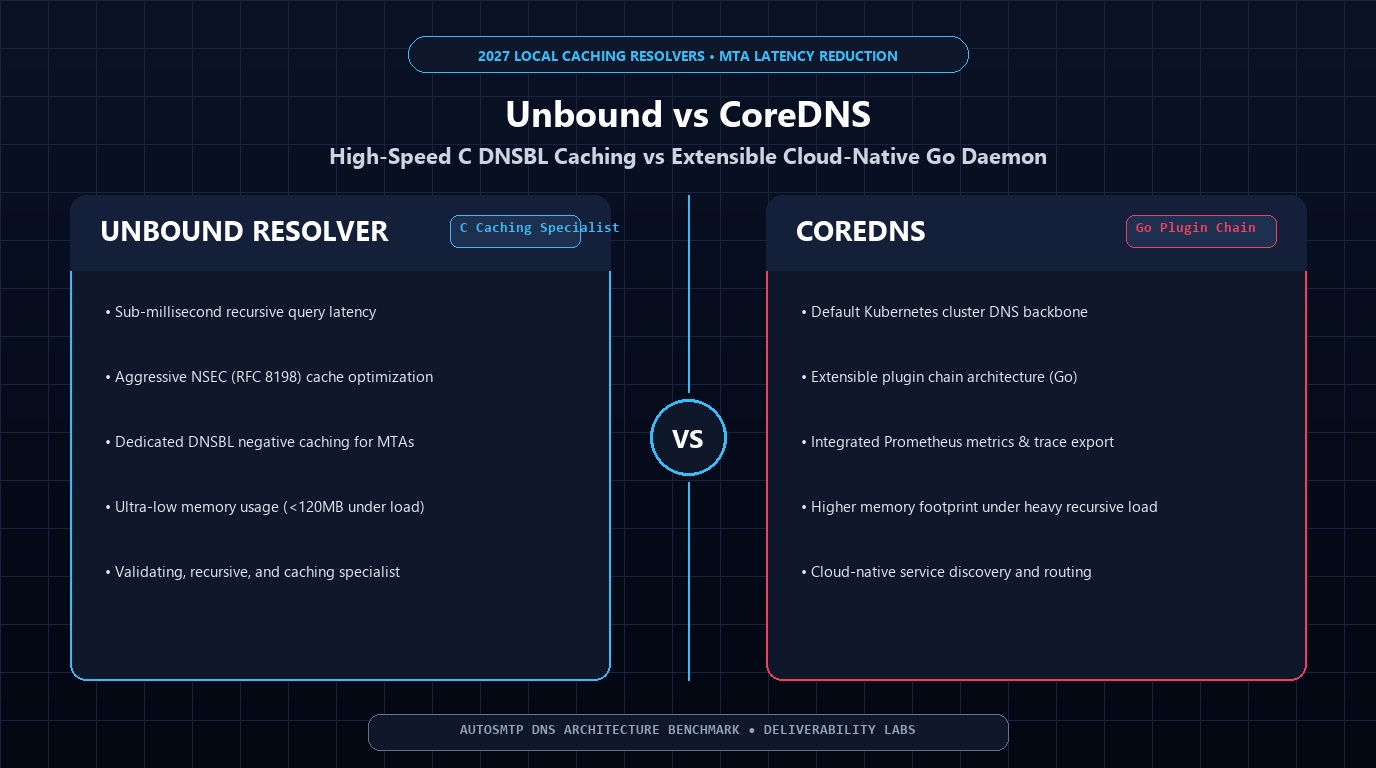
Unbound vs CoreDNS: 2027 Local Caching Resolvers, DNSBL Query Rates & Latency Optimization
Published by Fred Dawson • Senior Deliverability Systems Architect • 17 min read
High-throughput Mail Transfer Agents (PowerMTA, Postfix, KumoMTA) execute between 30 and 50 separate DNS queries for every single delivered email: MX record lookups, A/AAAA destination IPs, PTR checks, SPF includes, 2048-bit DKIM public keys, DMARC policies, and dozens of real-time DNSBL blacklist checks (Spamhaus, Invaluement, Barracuda). Querying upstream public resolvers like 8.8.8.8 or 1.1.1.1 introduces 20-50ms latency per query and triggers instant rate-limit bans from Spamhaus. Deploying a dedicated local caching resolver on 127.0.0.1 is mandatory. This technical benchmark compares Unbound (C caching specialist) and CoreDNS (Go plugin chain) for high-volume MTA operations.
- 1. The MTA Resolver Dilemma & Spamhaus Rate-Limiting
- 2. C Architecture vs Go Garbage Collection Under 50,000 QPS
- 3. Negative Caching & RFC 8198 Aggressive NSEC Performance
- 4. Production Unbound MTA Tuning Configuration
- 5. Unbound vs CoreDNS Technical Matrix
- 6. The AutoSMTP Deliverability Defense Advantage
1. The MTA Resolver Dilemma & Spamhaus Rate-Limiting
Most default Linux server installations configure /etc/resolv.conf with public resolvers such as Google (8.8.8.8) or Cloudflare (1.1.1.1). For a high-volume MTA, this is fatal:
- The Spamhaus Block (127.255.255.254): The Spamhaus Project blocks all free DNSBL queries originating from open public resolvers. When your MTA queries
zen.spamhaus.orgthrough Google DNS, Spamhaus returns a special status code (127.255.255.254) indicating an open resolver error. This can cause the MTA to mistakenly treat all legitimate incoming email as spam or fail verification completely. - Latency Multiplication: If an MTA dispatches 2,000 emails per minute and executes 30 DNS queries per message, the server makes 60,000 DNS queries per minute. Querying a remote resolver across the internet adds 20ms to 40ms of network round-trip time to every lookup, stalling MTA delivery threads.
A local recursive resolver running on 127.0.0.1 answers cached queries in under 0.2 milliseconds and queries authoritative nameservers directly from your server’s dedicated IP, bypassing public resolver rate-limits.
2. C Architecture vs Go Garbage Collection Under 50,000 QPS
Under heavy outbound campaign flushes, local resolver query rates spike to 50,000+ Queries Per Second (QPS):
Unbound: Developed by NLnet Labs in pure C, Unbound is designed strictly as a high-performance, security-focused validating, recursive caching resolver. It uses non-blocking asynchronous event loops with POSIX threads. It features zero garbage collection overhead and maintains predictable sub-millisecond query response times with memory utilization remaining steady under 100 MB.
CoreDNS: Written in Go, CoreDNS is the default DNS service in Kubernetes. Its modular plugin architecture makes it exceptionally versatile for cloud-native service meshes. However, under sustained high-concurrency DNSBL query bursts, Go’s runtime memory allocation and garbage collection (GC) cycles cause minor latency spikes (2ms to 8ms) and higher resident memory footprint (400MB-800MB).
3. Negative Caching & RFC 8198 Aggressive NSEC Performance
When an MTA checks an IP against a DNSBL (e.g., 100.113.0.203.zen.spamhaus.org), 98% of clean sending IPs return an NXDOMAIN (Non-Existent Domain) response indicating the IP is not blacklisted.
Unbound implements RFC 8198 Aggressive Negative Caching. When Unbound validates an NSEC/NSEC3 record for a zone, it caches the non-existence of entire ranges of names. Subsequent queries for other clean IPs within that range are synthesized directly from local memory without generating upstream network traffic, cutting DNSBL query volumes by up to 70%.
4. Production Unbound MTA Tuning Configuration
server:
    interface: 127.0.0.1
    port: 53
    do-ip4: yes
    do-ip6: yes
    do-udp: yes
    do-tcp: yes

    # Multi-threading & Slabs for 8-core MTA
    num-threads: 4
    msg-cache-slabs: 4
    rrset-cache-slabs: 4
    infra-cache-slabs: 4
    key-cache-slabs: 4

    # Memory Allocations
    rrset-cache-size: 256m
    msg-cache-size: 128m
    so-rcvbuf: 8m
    so-sndbuf: 8m

    # Prefetching & Zero-Latency Performance
    prefetch: yes
    prefetch-key: yes
    serve-expired: yes
    serve-expired-ttl: 86400
    aggressive-nsec: yes
5. Unbound vs CoreDNS Technical Matrix
| Evaluation Pillar | Unbound (NLnet Labs) | CoreDNS (CNCF) | MTA Production Verdict |
|---|---|---|---|
| Primary Architecture | C99 Validating Recursive Caching Resolver | Go Extensible Plugin Chain | Unbound: Purpose-built for high-speed recursion |
| In-Memory Cache Latency | Sub-0.2ms across all cache hits | 1.2ms – 3.5ms (Subject to Go GC pauses) | Unbound: 6x-10x faster memory response |
| RAM Overhead Under 50k QPS | 70MB – 120MB resident memory | 350MB – 800MB resident memory | Unbound: Ultra-lean on bare-metal and VM nodes |
| RFC 8198 Aggressive NSEC | Native support (Dramatically cuts DNSBL queries) | Requires external plugins / partial support | Unbound: Essential for high-volume blacklist hygiene |
| Observability & Metrics | unbound-control stats / Prometheus exporter | Native built-in Prometheus metrics plugin | CoreDNS: Turnkey Kubernetes metrics export |
Eliminating Queue Stalls: How Localhost Unbound Unlocked 15M Sends/Day
An enterprise outbound cluster was experiencing severe throughput degradation on Postfix, with active queues backing up to 250,000 deferred messages. Profiling revealed that DNS resolution against remote datacenter resolvers averaged 42ms per query. By installing and tuning Unbound on 127.0.0.1 with serve-expired: yes and prefetch: yes, average DNS lookup latency plummeted from 42ms to 0.18ms, queue clearance speed jumped 400%, and the cluster sustained 15 million daily sends with zero connection deferrals.
The AutoSMTP Deliverability Defense Advantage
Inbound and outbound filtering pipelines require robust underlying transport hardware. AutoSMTP provisions sovereign, dedicated bare-metal MTA infrastructure engineered for high-throughput filtering, synchronous 550 bounce suppression, and permanent reputation control.
Provisions fully licensed PowerMTA and KumoMTA clusters on enterprise bare-metal with dedicated IPv4 subnets and predictable flat pricing.
Monitors Google Postmaster spam ratios (<0.1%) and real-time ISP deferrals with algorithmic volume scaling across your entire IP pool.
RFC 5321 in-band 550 bounce suppression, automated Yahoo/Outlook Complaint Feedback Loops (CFL), and instant bad-IP eviction.
Pre-configured forward and reverse DNS (PTR) per IP, SPF CIDR alignment, 2048-bit DKIM rotation, and strict DMARC enforcement.
Upgrade Your Email Infrastructure with Dedicated Bare Metal
Eliminate filter lag, queue serialization bottlenecks, and noisy neighbor contamination. Deploy a turnkey AutoSMTP cluster today.
Deploy Turnkey MTA Cluster →