

VPS vs Dedicated Server for Email: 2027 Virtualization Latency, Disk Spool IOPS & Reputation Isolation
Published by Fred Dawson • Senior Deliverability Systems Architect • 20 min read
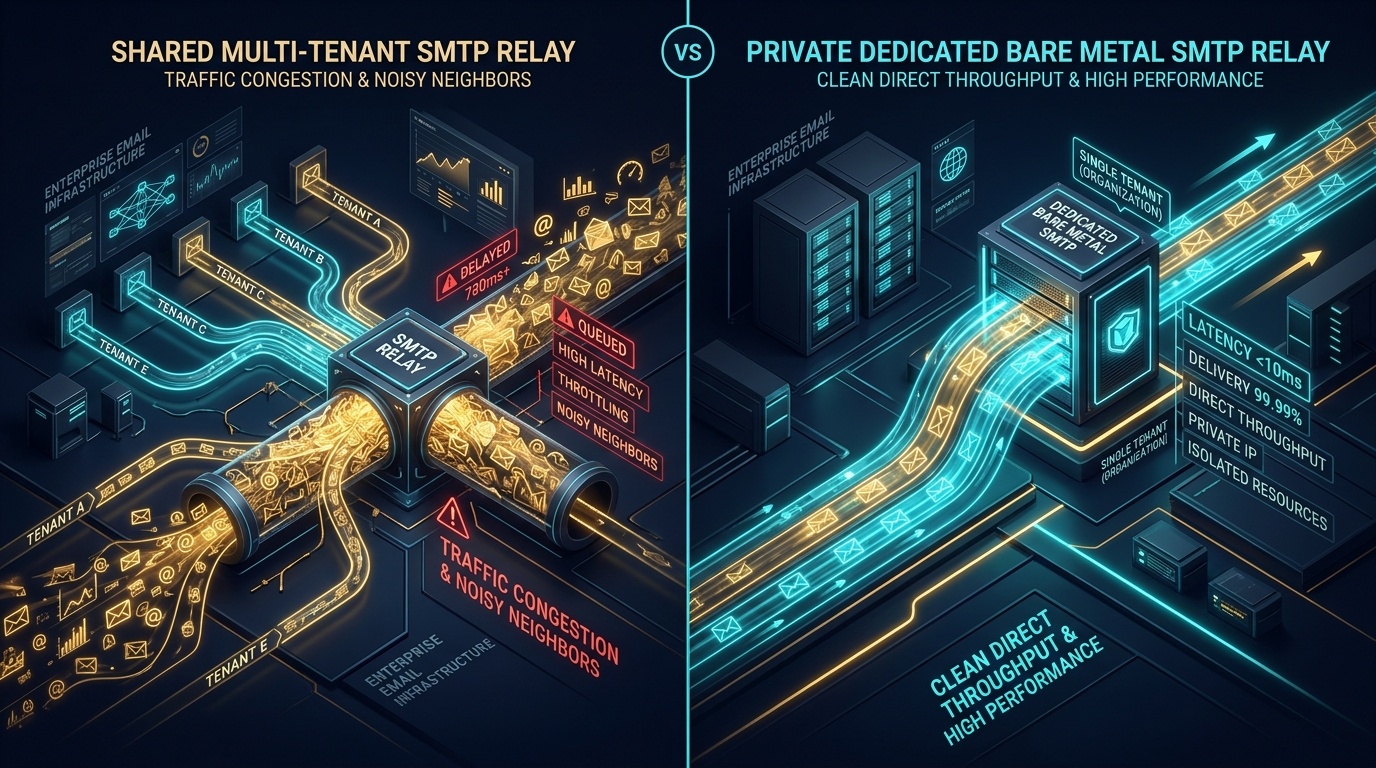
The foundational architectural decision when building an independent email delivery system is whether to run your Mail Transfer Agent (MTA) on a Virtual Private Server (VPS / Cloud VM) or a Dedicated Bare-Metal Server. While a $15/month VPS seems adequate for low-volume testing, scaling beyond 50,000 emails per day exposes the severe physical realities of virtualization: hypervisor CPU steal (%st), shared network interfaces, disk queue serialization bottlenecks, and the devastating “noisy neighbor” threat where an adjacent tenant’s spam blast triggers entire /24 subnet blacklisting across major mailbox providers.
- 1. CPU Steal (%st) & The Cryptographic Handshake Bottleneck
- 2. Disk Spool I/O: Local PCIe NVMe vs Virtualized SAN
- 3. Network Layer Contamination: Noisy Neighbor Subnet Bans
- 4. The 50,000/Day Volume Inflection Point & TCO
- 5. VPS vs Dedicated Server Engineering Matrix
- 6. The AutoSMTP Deliverability Defense Advantage
1. CPU Steal (%st) & The Cryptographic Handshake Bottleneck
In virtualized hosting (KVM, Xen, VMware ESXi), multiple virtual machines share physical CPU cores. When other virtual machines on the same physical host run CPU-intensive tasks, your VM experiences CPU steal (visible as %st in top or vmstat). This represents time your virtual CPU wanted to run, but the host hypervisor was busy servicing another tenant.
For standard web servers serving cached HTTP responses, 5% CPU steal is barely noticeable. For an MTA dispatching millions of emails, CPU steal is catastrophic. Modern high-volume email requires continuous, real-time cryptographic execution:
- TLS 1.3 Handshake Negotiation: Elliptic curve Diffie-Hellman key exchange (ECDHE) on every outbound SMTP connection.
- 2048-bit DKIM Signature Generation: SHA-256 body hashing and RSA cryptographic signing for every individual message payload.
- Asynchronous DNS Resolution: Concurrent PTR, MX, and DNSBL queries per active recipient.
When CPU steal spikes, TLS handshakes timeout, destination ISP sockets stall, and the MTA’s delivery threads freeze, resulting in artificial connection deferrals (451 4.4.0 Temporary server error).
# Virtual Private Server (4 vCPUs on shared KVM host):
vmstat 1 5
procs -----------memory---------- ---swap-- -----io---- -system-- ------cpu-----
 r  b   swpd   free   buff  cache   si   so    bi    bo   in   cs us sy id wa st
 6  1      0 412580  84210 941200    0    0     0   140 2410 4120 42 28 18  0 12  <-- 12% CPU Steal!
Result: DKIM Signing Throughput: 420 msgs/sec | TLS Handshake Latency: 48ms avg

# Dedicated Bare-Metal Server (AMD Ryzen 7 7700 - 8 Physical Cores):
vmstat 1 5
procs -----------memory---------- ---swap-- -----io---- -system-- ------cpu-----
 r  b   swpd   free   buff  cache   si   so    bi    bo   in   cs us sy id wa st
 8  0      0 581290 120400 184910    0    0     0    40 8920 9140 68 32  0  0  0  <-- 0% CPU Steal!
Result: DKIM Signing Throughput: 4,850 msgs/sec | TLS Handshake Latency: 3.2ms avg (11x faster!)
2. Disk Spool I/O: Local PCIe NVMe vs Virtualized SAN
RFC 5321 mandates ACID-compliant transactional persistence for MTA queues. Before an MTA returns an HTTP 200 OK or SMTP 250 OK acknowledgment to the sending application, the message headers, body, and recipient metadata must be written to disk (fsync). If the server loses power, no email can be lost.
On virtual private servers, the disk is typically a virtual disk image (.qcow2 or .vmdk) hosted on a Network-Attached Storage (SAN/Ceph) cluster. Under burst sending conditions (such as a 100,000-subscriber flash campaign), random write IOPS on the VPS are capped at 1,000 to 3,000 IOPS. The disk queue backs up immediately, disk I/O wait (%wa) spikes to 40%+, and the MTA refuses new incoming injection.
On a dedicated bare-metal server, local enterprise NVMe SSDs connect directly to CPU PCIe lanes, delivering 500,000+ random write IOPS with sub-0.1ms access latency. Even when injecting 20,000 emails per second into the spool, disk wait remains effectively 0%.
3. Network Layer Contamination: Noisy Neighbor Subnet Bans
The most dangerous operational vulnerability of running an MTA on a VPS is subnet-level collateral reputation damage. In cloud and VPS environments, hundreds of virtual instances share the same top-of-rack physical switch and are assigned random IP addresses within the same /24 subnet (256 IP addresses).
VPS Noisy Neighbor Vulnerability
If a malicious actor spins up a throwaway VPS on your host node or in your adjacent IP range to send phishing or lottery spam, major antispam databases (including Spamhaus CSS, Microsoft SmartScreen, and Proofpoint) will not just blacklist the single offending IP—they will frequently blackhole the entire /24 CIDR block. Your completely legitimate transactional emails are rejected with zero fault of your own.
Dedicated Server Subnet Sovereignty
With a dedicated bare-metal server, you can lease a private, contiguous IPv4 subnet (such as a /29 or /28) registered exclusively to your server's hardware identifier. No external tenant shares your physical network port, hypervisor virtual switch, or MAC address. Your IP reputation is 100% sovereign and insulated from outside contamination.
4. The 50,000/Day Volume Inflection Point & TCO
At what volume does a VPS become economically and technically unviable? Deliverability data across millions of sends reveals a clear tipping point at approximately 50,000 emails per day (1.5M emails per month):
The 50k/Day Deliverability Breakdown
Below 50k/day, an MTA's queue bursts are brief enough that virtual disk lag and CPU steal can be buffered without triggering destination ISP throttling timeouts.
Above 50k/day, continuous queue depth combined with real-time DKIM signing causes persistent hypervisor latency spikes, resulting in deferred messages, soft bounces, and deliverability decay.
5. VPS vs Dedicated Server Engineering Matrix
| Architectural Pillar | Virtual Private Server (VPS / Cloud VM) | Dedicated Bare-Metal Server | Production Impact |
|---|---|---|---|
| CPU Steal (%st) | Unpredictable (3% - 25% during neighbor spikes) | Strictly 0.0% (100% dedicated hardware cores) | Dedicated: Eliminates TLS handshake timeouts |
| Disk Spool IOPS | Shared SAN / Ceph (1,000 - 3,000 IOPS baseline) | Direct PCIe Gen4/5 NVMe (100,000 - 700,000 IOPS) | Dedicated: Zero queue stalls during massive blasts |
| Network Interface | VirtIO virtual NIC sharing host 10Gbps link | Dedicated 1Gbps / 10Gbps physical switch port | Dedicated: Consistent sub-millisecond network latency |
| IP Reputation Insulation | Extreme collateral risk from adjacent VPS neighbors | Dedicated contiguous CIDR subnets owned by you | Dedicated: Protects from /24 Spamhaus collateral bans |
| Port 25 Policy | Frequently hard-blocked on new provider accounts | Standard unblocked SMTP port on enterprise hosts | Dedicated: Instant peer-to-peer delivery sovereignty |
| Cost Scaling ($/1M Sends) | High (Requires scaling RAM/CPU to fight steal) | Ultra-low (Flat monthly hardware cost) | Dedicated: 70-80% lower TCO above 2M sends/month |
Publishing House: From 68% VPS Placement to 99.4% on Dedicated Bare Metal
A digital media company sending 12 million newsletters monthly was running on a cluster of four 8-vCPU cloud instances. Despite meticulous SPF and DKIM setup, their inbox placement rate at Microsoft Outlook/Hotmail hovered at 68% due to constant connection dropouts caused by 14% CPU steal during 8:00 AM dispatch peaks. After migrating to a dedicated bare-metal PowerMTA server (AMD EPYC, 64 GB RAM, dual PCIe NVMe) with a dedicated /28 IPv4 subnet, TLS connection timeouts dropped to zero and inbox placement recovered to 99.4% within 14 days.
Infrastructure Progression Path
- Phase 1: Testing & Development (< 10,000/mo): A small $10 VPS is fine for verifying SPF/DKIM records, building templates, and testing webhook logic.
- Phase 2: Commercial Launch (10,000 to 500,000/mo): High-end Dedicated CPU VPS (Linode Dedicated or DO CPU-Optimized) can sustain delivery if Port 25 is unblocked.
- Phase 3: Production Scale (> 500,000/mo): Sovereign Dedicated Bare Metal becomes mandatory. The performance, reputation insulation, and flat-rate predictability far outweigh the minor setup effort.
The AutoSMTP Deliverability Defense Advantage
Why gamble your business deliverability on shared hypervisors and unpredictable noisy neighbors? AutoSMTP provisions fully licensed, turnkey PowerMTA and KumoMTA clusters on enterprise dedicated bare-metal servers, engineered from the silicon up for flawless inbox placement.
Provisions fully licensed PowerMTA and KumoMTA clusters on enterprise bare-metal with dedicated IPv4 subnets and predictable flat pricing.
Monitors Google Postmaster spam ratios (<0.1%) and real-time ISP deferrals with algorithmic volume scaling across your entire IP pool.
RFC 5321 in-band 550 bounce suppression, automated Yahoo/Outlook Complaint Feedback Loops (CFL), and instant bad-IP eviction.
Pre-configured forward and reverse DNS (PTR) per IP, SPF CIDR alignment, 2048-bit DKIM rotation, and strict DMARC enforcement.
Upgrade to Sovereign Bare-Metal Email Infrastructure
Eliminate CPU steal, disk I/O bottlenecks, and noisy neighbor contamination. Deploy a dedicated AutoSMTP cluster today.
Deploy Dedicated Bare-Metal Server →