

Linode vs DigitalOcean for Email Servers: 2027 Port 25 Policies, Floating IPs & Reverse DNS
Published by Fred Dawson • Senior Deliverability Systems Architect • 17 min read
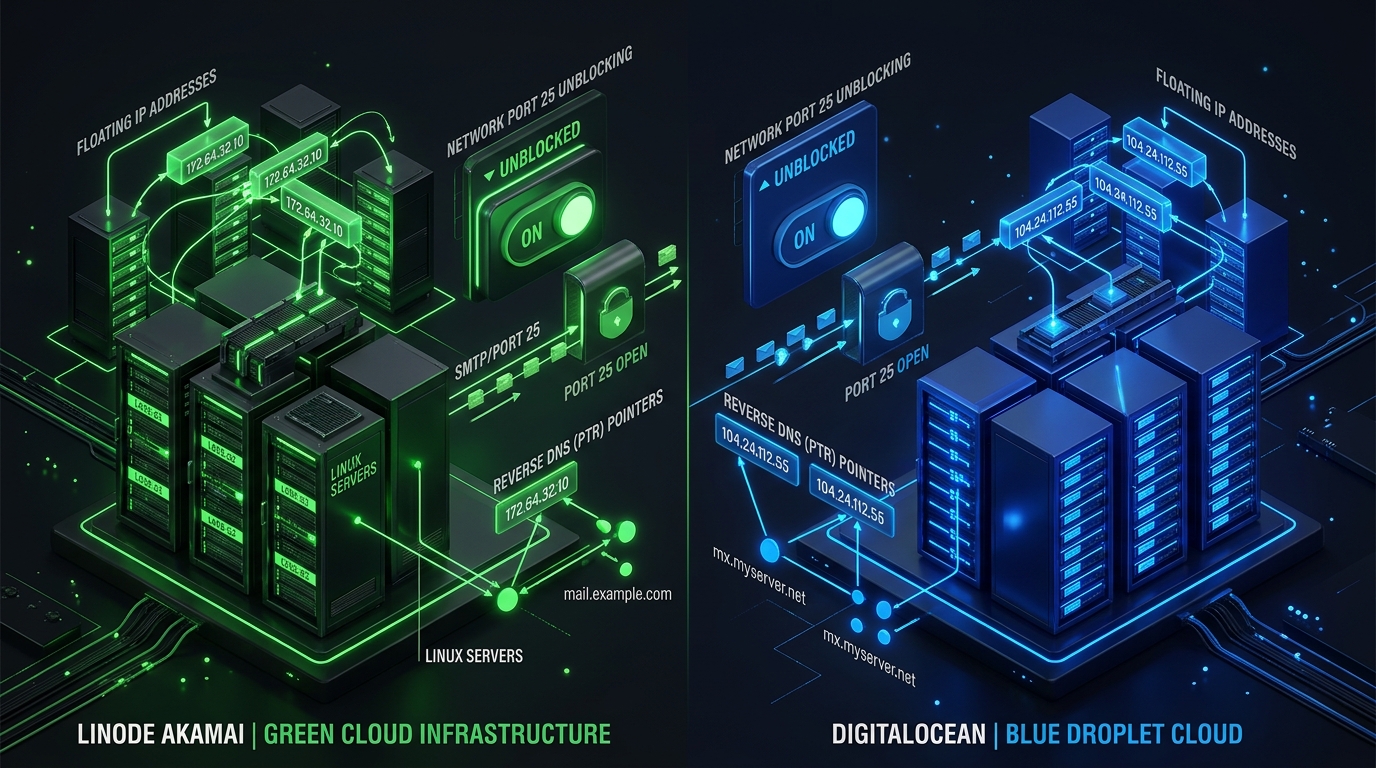
Developer cloud providers like Linode (Akamai Connected Cloud) and DigitalOcean Droplets are the natural starting point for self-hosting Linux workloads. However, self-hosting an enterprise Mail Transfer Agent (MTA) or transactional SMTP relay requires direct peer-to-peer TCP Port 25 access and granular PTR (Reverse DNS) configuration. In recent years, DigitalOcean enacted a blanket block on outbound Port 25 for all newly created accounts, actively pushing users toward third-party SaaS relays like SendGrid. Linode maintains a transparent verification ticket process for Port 25 while offering native BGP IP sharing and granular rDNS controls.
- 1. The Outbound Port 25 Hurdle: DO Ban vs Linode Unblock
- 2. Reverse DNS (PTR) Precision & Automation
- 3. IP Failover: Linode BGP Sharing vs DO Reserved IPs
- 4. Hypervisor CPU Steal & Queue Processing Jitter
- 5. Linode vs DigitalOcean Architectural Matrix
- 6. The AutoSMTP Deliverability Defense Advantage
1. The Outbound Port 25 Hurdle: DO Ban vs Linode Unblock
To deliver an email to Gmail, Yahoo, or Microsoft 365, your server must establish an outbound TCP connection on port 25 to the recipient’s MX record. Without open outbound port 25, self-hosting an MTA is impossible.
Linode (Akamai): Verification Ticket Pathway
On Linode, outbound port 25 is blocked initially for fraud mitigation. However, Linode provides a clear, documented administrative path to unblock it. Customers submit a support ticket providing their sending domain name, company website, SPF/DKIM/DMARC records, and CAN-SPAM/GDPR compliance details. Legitimate senders with verified accounts routinely have port 25 opened within 2 to 6 hours.
DigitalOcean: Strict Commercial Prohibition
Since 2022, DigitalOcean has enforced a rigid policy blocking outbound port 25 on all new accounts. Support tickets requesting port 25 unblocking are virtually always met with an automated canned response advising the user to use a third-party relay (such as Twilio SendGrid or Mailgun) over ports 587 or 2525. For direct self-hosted delivery, DigitalOcean is functionally a dead end for new operators.
2. Reverse DNS (PTR) Precision & Automation
RFC 5321 and RFC 7208 require that the IP address delivering an email must have a valid PTR (Pointer) record that resolves back to the hostname specified in the MTA’s HELO / EHLO greeting (Forward-Confirmed Reverse DNS, or FCrDNS). Major ISPs immediately reject incoming SMTP connections with a 550 5.7.1 Missing PTR record error if this check fails.
DigitalOcean’s Hostname-Coupled PTR: DigitalOcean automates PTR generation by tying the PTR record directly to the Droplet name in the control panel. If your droplet is named mail.example.com, DO automatically sets the IPv4 PTR to mail.example.com. While simple, this creates headaches when running multi-IP pools or virtual MTAs, as secondary IPv4 addresses cannot be assigned custom PTR hostnames independently without third-party DNS routing workarounds.
Linode’s Explicit Per-IP rDNS: Linode Cloud Manager provides an explicit, decoupled “Edit Reverse DNS” interface for every single IPv4 and IPv6 address assigned to a Linode instance. Operators can set custom PTR records programmatically via the Linode REST API (POST /v4/networking/ips/{address}) without altering instance hostnames or internal configurations.
# Update PTR record for specific secondary IP on Linode
curl -H "Content-Type: application/json" \
     -H "Authorization: Bearer $LINODE_API_TOKEN" \
     -X PUT -d '{"rdns": "outbound-01.transactmail.io"}' \
     https://api.linode.com/v4/networking/ips/192.0.2.45

# Verify Forward-Confirmed Reverse DNS (FCrDNS)
dig -x 192.0.2.45 +short
# Output: outbound-01.transactmail.io.

dig +short outbound-01.transactmail.io
# Output: 192.0.2.45 (Valid FCrDNS Match confirmed!)
3. IP Failover: Linode BGP Sharing vs DO Reserved IPs
For mission-critical transactional email clusters that cannot afford downtime, IP failover allows a secondary standby MTA node to inherit the primary sending IP if the active node crashes—preserving IP reputation and avoiding cold starts on fresh IP addresses.
Linode offers IP Sharing via BGP. An operator can configure multiple Linodes within the same datacenter to share an IP address. Using routing daemons like BIRD or keepalived, health checks can trigger instant BGP failover in sub-second time without issuing external REST API calls. DigitalOcean relies on Reserved IPs (Floating IPs), which require making an asynchronous HTTP API call to reassign the IP to another droplet, incurring a 5 to 15-second re-association delay during which active SMTP sessions drop.
4. Hypervisor CPU Steal & Queue Processing Jitter
Standard VPS instances on both Linode and DigitalOcean use shared CPU virtualization. Under heavy multi-tenant hypervisor load, “noisy neighbor” instances running crypto miners or database benchmarks steal CPU cycles from your instance, measured by the %st (CPU steal) metric in Linux.
For an MTA, CPU steal causes TLS handshake latency spikes and delays in real-time 2048-bit DKIM signature calculations. While both providers offer Dedicated CPU instances (Linode Dedicated CPU vs DigitalOcean Dedicated Droplets) that eliminate CPU steal, their baseline costs ($36–$48/mo for 2 vCPUs) approach the pricing of a complete bare-metal dedicated server that delivers 8 physical cores and raw NVMe performance.
5. Linode vs DigitalOcean Architectural Matrix
| Technical Dimension | Linode (Akamai Connected Cloud) | DigitalOcean Droplets | Deliverability Impact |
|---|---|---|---|
| Port 25 Outbound Access | Unblocked via verified support ticket | Hard block on new accounts; redirects to SendGrid | Linode: Viable for self-hosted MTA operations |
| rDNS (PTR) Configuration | Explicit per-IP editing in Cloud Manager & API | Coupled strictly to Droplet hostname | Linode: Granular control for multi-IP sending pools |
| IP Failover Architecture | BGP-routed native IP sharing (sub-second) | Reserved IP reassignment via API (5-15s delay) | Linode: Seamless high-availability MTA clustering |
| Egress Bandwidth Quota | Generous pooled transfer (1TB – 5TB included) | Pooled transfer (1TB – 5TB included); $0.01/GB overage | Tie: Both far superior to AWS $0.09/GB egress tax |
| Dedicated CPU Options | Dedicated CPU Linodes (AMD EPYC / Intel Xeon) | General Purpose / CPU-Optimized Droplets | Tie: Both eliminate noisy neighbor CPU steal |
The 48-Hour DigitalOcean Roadblock
A SaaS CRM platform attempted to spin up a self-hosted Postfix cluster on DigitalOcean Droplets in NYC3. After configuring SPF, DKIM, and MX records, all outbound delivery failed with Connection timed out on port 25. Upon opening a support ticket requesting port 25 removal, DO support replied within 4 hours with an automated rejection citing antispam policy and recommending SendGrid. The team was forced to migrate their entire Ansible configuration to Linode, where port 25 was verified and opened in under 3 hours, restoring their delivery roadmap.
Developer VPS vs Enterprise Bare-Metal
While Linode is clearly the superior developer cloud for email compared to DigitalOcean, all VPS platforms share inherent deliverability ceilings:
- Virtual disk I/O limits spool flush rates during sudden traffic surges.
- Virtual IP pools share upstream network switches with thousands of untrusted virtual machines, increasing DNSBL blast radius.
- When monthly sending volume exceeds 500,000 emails, dedicated bare metal provides 10x higher disk IOPS, cleaner IP subnets, and lower total unit cost.
The AutoSMTP Deliverability Defense Advantage
Skip the support ticket gauntlet, port 25 rejections, and noisy neighbor hypervisor jitter. AutoSMTP provisions sovereign, dedicated bare-metal MTA infrastructure engineered for sustained high-volume delivery, permanent reputation control, and flat-rate predictability.
Provisions fully licensed PowerMTA and KumoMTA clusters on enterprise bare-metal with dedicated IPv4 subnets and predictable flat pricing.
Monitors Google Postmaster spam ratios (<0.1%) and real-time ISP deferrals with algorithmic volume scaling across your entire IP pool.
RFC 5321 in-band 550 bounce suppression, automated Yahoo/Outlook Complaint Feedback Loops (CFL), and instant bad-IP eviction.
Pre-configured forward and reverse DNS (PTR) per IP, SPF CIDR alignment, 2048-bit DKIM rotation, and strict DMARC enforcement.
Bypass VPS Port 25 Restrictions Forever
Deploy a turnkey, dedicated bare-metal AutoSMTP server cluster with pre-warmed IP architecture and automated deliverability monitoring.
Deploy Turnkey Bare-Metal Cluster →