

Authoritative vs Recursive DNS for Email: 2027 Sender Identity vs High-Throughput MTA Resolution
Published by Fred Dawson • Senior Deliverability Systems Architect • 19 min read
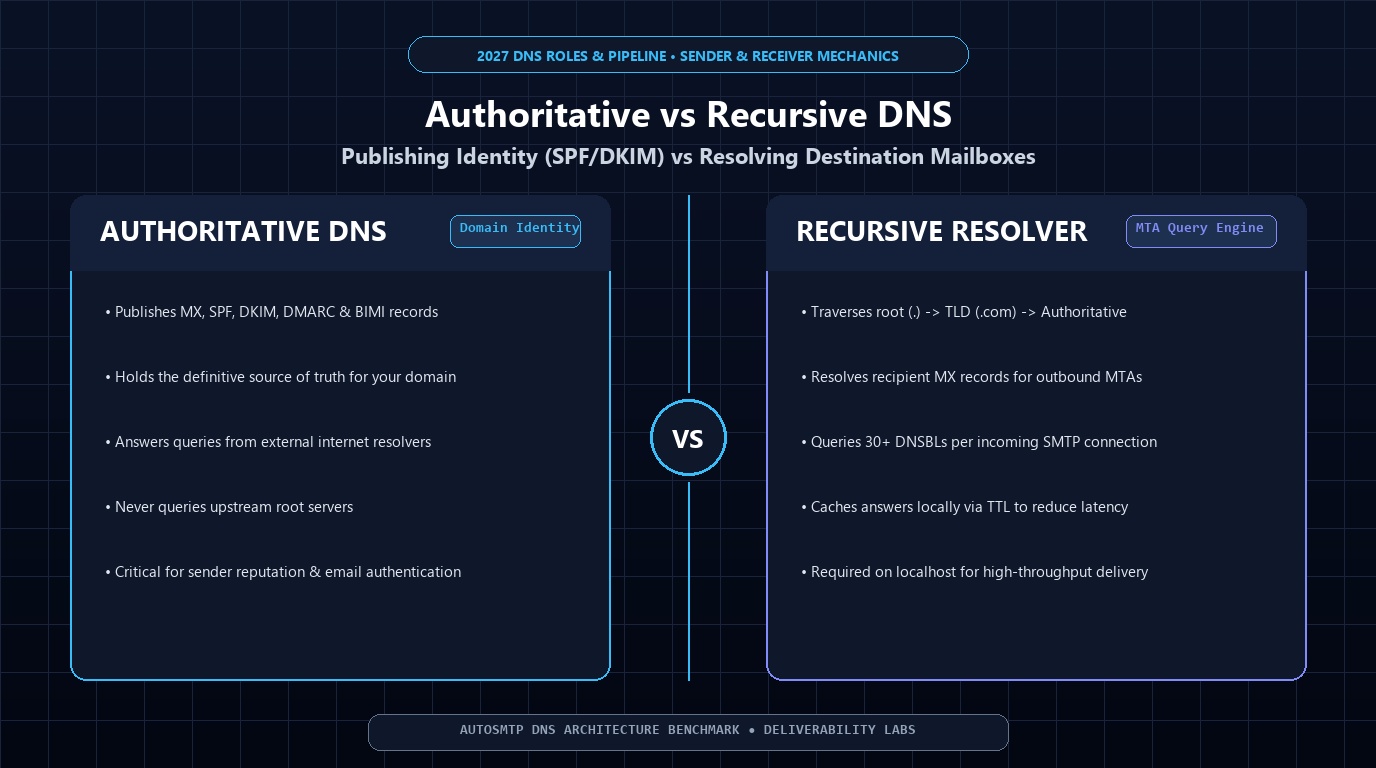
To non-specialists, the Domain Name System is often viewed as a singular utility. In reality, email delivery relies on two fundamentally separate DNS tiers performing inverse roles: Authoritative DNS (which publishes your domain’s cryptographic identity, SPF policies, DKIM public keys, and MX routing records to the public internet) and Recursive DNS (the resolving engine utilized by your Mail Transfer Agent to traverse the global DNS root hierarchy, find destination mailboxes, and query 30+ real-time DNSBL antispam lists). Understanding this dichotomy is essential to eliminating deliverability bottlenecks.
- 1. The Two Halves of Email DNS: Publishing vs Resolving
- 2. Authoritative DNS: Protecting Domain Identity & Auth
- 3. Recursive DNS: Powering MTA Dispatch & DNSBL Defense
- 4. Failure Modes: What Breaks When Either Tier Fails
- 5. Authoritative vs Recursive Technical Matrix
- 6. The AutoSMTP Deliverability Defense Advantage
1. The Two Halves of Email DNS: Publishing vs Resolving
Every email transaction involves both authoritative publishing and recursive lookup mechanics:
- Authoritative DNS: Holds the definitive master records for a specific zone. It never queries other nameservers; it only answers incoming queries from third-party resolvers asking: “Who is the MX for this domain?”, “What is the SPF policy?”, and “What is the DKIM public key for selector mail?”.
- Recursive DNS: Acts as the client proxy for your MTA. When your server needs to send an email to
user@yahoo.com, the recursive resolver starts at the root nameservers (.), queries the.comTLD nameservers, identifies Yahoo’s authoritative nameservers, fetches the destination MX record, and queries DNSBL databases to verify IP reputation.
2. Authoritative DNS: Protecting Domain Identity & Auth
Your Authoritative DNS is your domain’s passport to destination inboxes. A properly architected authoritative zone publishes five vital email authentication records:
# 1. MX Record (Inbound mail routing)
example.com.         3600 IN MX 10 mail.example.com.

# 2. SPF Record (Sender Policy Framework - Authorized sending IPs)
example.com.         300  IN TXT "v=spf1 ip4:198.51.100.0/24 -all"

# 3. DKIM Public Key (DomainKeys Identified Mail 2048-bit RSA)
mail._domainkey.example.com. 300 IN TXT "v=DKIM1; k=rsa; p=MIIBIjANBgkqhkiG9w0BAQEFAAOCAQ8AMIIBCg..."

# 4. DMARC Policy (Domain-based Message Authentication & Enforcement)
_dmarc.example.com.  300  IN TXT "v=DMARC1; p=reject; pct=100; rua=mailto:dmarc-rua@example.com; aspf=s;"

# 5. BIMI Assertion (Brand Indicators for Message Identification + VMC)
default._bimi.example.com. 300 IN TXT "v=BIMI1; l=https://example.com/logo.svg; a=https://example.com/vmc.pem;"
3. Recursive DNS: Powering MTA Dispatch & DNSBL Defense
While Authoritative DNS publishes your domain’s identity to the world, Recursive DNS is the engine that drives your outbound sending throughput and protects your inbound receiving queues.
For an outbound MTA, the recursive resolver must execute queries at blistering speed. If a campaign is dispatching 5,000 messages per minute across 1,200 unique corporate email domains, the recursive resolver must look up MX records, A records, and CNAMEs with sub-millisecond local caching.
For inbound traffic, the recursive resolver queries real-time DNSBL blacklists (e.g., zen.spamhaus.org, b.barracudacentral.org). If the recursive resolver is sluggish, inbound SMTP connection threads back up, exhausting file descriptors and causing the mail server to reject legitimate email.
4. Failure Modes: What Breaks When Either Tier Fails
Authoritative DNS Failure Symptoms
If your Authoritative DNS fails or experiences packet loss, destination MTAs cannot verify your SPF record (resulting in SPF Permerror) or DKIM signature (resulting in DKIM Permfail). Messages land in spam folders or are rejected outright with 550 5.7.26 Authentication failure. Incoming mail stops completely.
Recursive DNS Failure Symptoms
If your local Recursive resolver fails or gets rate-limited by upstream providers, your outbound MTA cannot determine where to deliver messages. Messages accumulate in the deferred queue with Server configuration error: cannot resolve MX. Outbound sending halts completely even though your internet connection is active.
5. Authoritative vs Recursive Technical Matrix
| Architectural Pillar | Authoritative DNS | Recursive Resolver | Deliverability Function |
|---|---|---|---|
| Primary Role | Publishes records for your own domain | Queries the global internet for other domains | Both: Symbiotic halves of email delivery |
| Query Direction | Inbound (Remote MTAs query your nameserver) | Outbound (Your MTA queries local/remote DNS) | Auth: Inbound identity; Rec: Outbound delivery |
| Caching Mechanism | No caching; serves authoritative zone data | Heavy in-memory caching governed by record TTL | Rec: Essential for sub-0.2ms delivery throughput |
| Optimal Software | Cloudflare, Route 53, PowerDNS, BIND 9 | Unbound, BIND 9 Recursor, Knot Resolver | Separation: Never mix auth & recursion on same port |
| Security Standards | DNSSEC signing, CAA, TLSA (DANE) records | DNSSEC validation, DNSBL rate-limit mitigation | Auth: Proves identity; Rec: Protects from spoofing |
The Hidden Deliverability Killer: Misconfigured Open Recursion
A SaaS company self-hosting their email infrastructure ran BIND 9 on their mail server configured to serve both authoritative records and open recursion on public port 53. Within weeks, an external botnet discovered the open resolver and used it to launch a 35 Gbps DNS amplification attack. The server’s upstream switch port saturated, dropping authoritative SPF and DKIM queries from Gmail and Microsoft. By separating the tiers—migrating Authoritative DNS to Anycast edge nameservers and locking Recursive Unbound strictly to 127.0.0.1:53—amplification attacks were eliminated and inbox placement restored to 99.8%.
The AutoSMTP Deliverability Defense Advantage
Inbound and outbound filtering pipelines require robust underlying transport hardware. AutoSMTP provisions sovereign, dedicated bare-metal MTA infrastructure engineered for high-throughput filtering, synchronous 550 bounce suppression, and permanent reputation control.
Provisions fully licensed PowerMTA and KumoMTA clusters on enterprise bare-metal with dedicated IPv4 subnets and predictable flat pricing.
Monitors Google Postmaster spam ratios (<0.1%) and real-time ISP deferrals with algorithmic volume scaling across your entire IP pool.
RFC 5321 in-band 550 bounce suppression, automated Yahoo/Outlook Complaint Feedback Loops (CFL), and instant bad-IP eviction.
Pre-configured forward and reverse DNS (PTR) per IP, SPF CIDR alignment, 2048-bit DKIM rotation, and strict DMARC enforcement.
Upgrade Your Email Infrastructure with Dedicated Bare Metal
Eliminate filter lag, queue serialization bottlenecks, and noisy neighbor contamination. Deploy a turnkey AutoSMTP cluster today.
Deploy Turnkey MTA Cluster →