

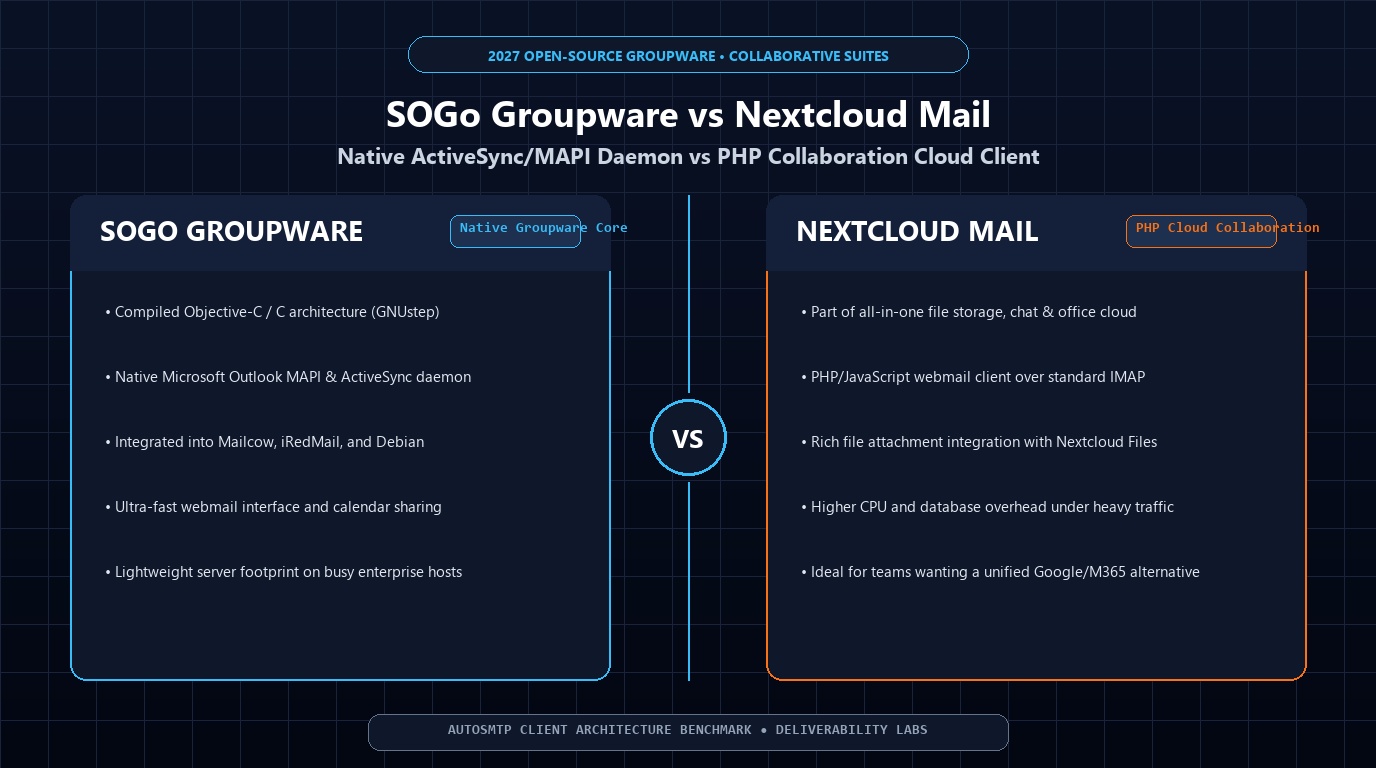
SOGo vs Nextcloud Mail: 2027 Enterprise Open-Source Groupware Benchmark
Published by Fred Dawson • Senior Deliverability Systems Architect • 20 min read
Enterprise email infrastructure requires more than basic SMTP and IMAP transport—organizations demand shared team calendars, address books (CardDAV), global address lists (GAL), mobile synchronization, and an intuitive webmail interface. In the open-source Linux ecosystem, two platforms dominate this space with radically contrasting architectural philosophies: SOGo and Nextcloud Mail. SOGo (written in compiled C and Objective-C via the GNUstep runtime) is a dedicated, ultra-lean groupware daemon renowned as the default webmail and ActiveSync engine in Mailcow. Nextcloud Mail is an integrated PHP web application running inside the expansive Nextcloud collaboration platform (which encompasses Files, Talk, Deck, and Office). This benchmark evaluates runtime performance, memory consumption under 5,000+ active mailboxes, native Microsoft Exchange ActiveSync (EAS) support, CalDAV/CardDAV capabilities, and infrastructure scalability.
- 1. Architectural Philosophy: Dedicated C Groupware vs PHP Collaboration Suite
- 2. Mobile Synchronization: Native Exchange ActiveSync (EAS) vs DAV Protocol Stacks
- 3. Memory Footprint, PHP-FPM Overhead & Concurrency Scaling
- 4. Shared Calendars, CardDAV & Global Address Lists (LDAP/AD)
- 5. SOGo vs Nextcloud Mail Technical Matrix
- 6. The AutoSMTP Deliverability Defense Advantage
1. Architectural Philosophy: Dedicated C Groupware vs PHP Collaboration Suite
The choice between SOGo and Nextcloud Mail represents a fundamental architectural decision between a specialized, high-throughput groupware daemon and an all-in-one collaborative cloud platform:
SOGo: Engineered from the ground up as a high-performance messaging and groupware server. Written in compiled C and Objective-C using the GNUstep runtime, SOGo runs as a standalone daemon (sogod) with pre-forked worker pools. SOGo interfaces directly with your mail system: it connects to Dovecot via IMAP, Postfix via SMTP Submission, and your enterprise directory via LDAP, OpenLDAP, or Microsoft Active Directory. SOGo does not attempt to be a cloud file storage provider or video conferencing app—its sole focus is ultra-fast email, shared calendars, address books, and mobile synchronization.
Nextcloud Mail: An application module operating inside the broader Nextcloud PHP ecosystem. Nextcloud Mail turns Nextcloud into a unified workspace where emails, cloud files (Nextcloud Files), chat channels (Nextcloud Talk), project boards (Deck), and collaborative documents (Nextcloud Office) reside under a single interface. However, Nextcloud Mail is fundamentally a webmail client connecting to an external IMAP server; it is not a standalone groupware server and requires the entire Nextcloud PHP-FPM, database, and Redis caching infrastructure to run.
# SOGo Process Model: Compiled native C daemon with dedicated worker pool
/usr/sbin/sogod -WOWorkersCount 30 -WOPort 127.0.0.1:20000
# (Each worker consumes ~20-30MB RAM; handles native ActiveSync, CalDAV, CardDAV, and Web UI)

# Nextcloud Mail Process Model: Web app running on shared PHP-FPM pool
php-fpm: pool www (executing index.php -> apps/mail/lib/Controller/...)
# (Requires full Nextcloud framework bootstrap, Redis session locking, and heavy MySQL queries)
2. Mobile Synchronization: Native Exchange ActiveSync (EAS) vs DAV Protocol Stacks
The decisive technological differentiator for enterprise mobile fleets is Exchange ActiveSync (EAS) support:
- SOGo Native EAS: SOGo includes a fully integrated, high-performance Exchange ActiveSync implementation. iOS, Android, and Windows devices can configure the account as a native “Exchange” profile. In a single setup step, the user gains instant push synchronization of Email, Shared Calendars, Corporate Contacts, and Global Address Lists (GAL). No third-party apps or separate CalDAV/CardDAV profiles are needed.
- Nextcloud Mail (No Native EAS): Nextcloud Mail has zero native Exchange ActiveSync capabilities. Nextcloud provides CalDAV and CardDAV endpoints for calendars and contacts, but email must be configured separately using standard IMAP. On iOS and Android devices, employees must manually configure two separate accounts (an IMAP account for mail and a CalDAV/CardDAV account for calendars/contacts), or install third-party sync apps like DAVx5.
3. Memory Footprint, PHP-FPM Overhead & Concurrency Scaling
When scaling to thousands of corporate mailboxes, resource efficiency becomes critical:
SOGo: Lean C Worker Efficiency
Because SOGo is written in compiled C/Objective-C, a pre-forked pool of 30 to 50 sogod workers can effortlessly service 5,000+ active mailboxes while consuming less than 1.5 GB of total server RAM. Database writes are limited strictly to calendar event metadata and user preferences.
Nextcloud: Heavy PHP & Database Footprint
Nextcloud Mail executes within the heavy Nextcloud PHP runtime. Each active webmail session consumes 128MB to 256MB of PHP-FPM memory. In addition, Nextcloud Mail indexes message envelopes into the Nextcloud MySQL database, generating heavy I/O operations and requiring massive Redis caching instances under multi-thousand-user concurrency.
4. Shared Calendars, CardDAV & Global Address Lists (LDAP/AD)
Both platforms deliver robust groupware capabilities, but cater to different organizational needs:
SOGo Enterprise Directory Integration: SOGo is designed for seamless integration with corporate LDAP and Microsoft Active Directory environments. It natively provides Global Address Lists (GAL) with real-time autocompletion, resource booking (conference rooms, projectors), delegate calendar permissions (allowing administrative assistants to manage executive schedules), and granular Free/Busy scheduling across teams.
Nextcloud Collaborative Workspace: Nextcloud excels when email is just one component of a broader digital workplace. An email attachment in Nextcloud Mail can be saved directly to Nextcloud Files with one click, shared via an expiring password-protected link, or edited collaboratively in real time using Nextcloud Office (OnlyOffice/Collabora). For organizations already committed to Nextcloud as their cloud file hub, Nextcloud Mail provides a unified user experience.
5. SOGo vs Nextcloud Mail Technical Matrix
| Pillar / Feature | SOGo Groupware | Nextcloud Mail | Architectural Verdict |
|---|---|---|---|
| Runtime & Language | Compiled C / Objective-C (sogod daemon) | PHP 8.x + Vue.js (Nextcloud App) | SOGo delivers significantly higher throughput per CPU cycle |
| Microsoft ActiveSync (EAS) | Native Built-In (Push Mail, Cal, Contacts) | None (Requires separate IMAP + CalDAV) | SOGo allows 1-click native “Exchange” setup on mobile |
| RAM Usage (5,000 Mailboxes) | ~1 GB – 2 GB RAM | 8 GB – 16 GB+ RAM (PHP-FPM + Redis) | SOGo requires 75-85% less hardware memory |
| Enterprise Directory (LDAP/AD) | Deep native support + GAL + Resources | Supported via Nextcloud LDAP app | Both integrate with corporate Active Directory / LDAP |
| Shared Calendars & CalDAV | Native CalDAV server with Free/Busy & delegation | Nextcloud Calendar app (CalDAV) | Both support robust calendar sharing & meeting invites |
| File Storage & Collaboration | Email & groupware only (Laser-focused) | Complete suite (Files, Office, Talk, Deck) | Nextcloud provides a complete Google Workspace alternative |
| Mail Server Bundling | Default groupware in Mailcow: dockerized | Standalone cloud platform | SOGo is the premier choice for dedicated mail appliances |
Scaling Campus Groupware for 15,000 Students and Faculty
A state university campus hosted webmail and calendars for 15,000 faculty and student accounts on a Nextcloud cluster. During peak morning class enrollment periods, concurrent webmail logins created massive PHP-FPM worker exhaustion and database lock escalations, requiring 32 GB of dedicated server RAM and frequent daemon restarts. Furthermore, students struggled with complex manual CalDAV setup on mobile devices. By migrating email and groupware to SOGo deployed on an enterprise Mailcow bare-metal cluster, server RAM dropped to 3.5 GB, response times fell below 20ms, and mobile setup was streamlined into a single native ActiveSync Exchange profile.
The AutoSMTP Deliverability Defense Advantage
Inbound and outbound filtering pipelines require robust underlying transport hardware. AutoSMTP provisions sovereign, dedicated bare-metal MTA infrastructure engineered for high-throughput filtering, synchronous 550 bounce suppression, and permanent reputation control.
Provisions fully licensed PowerMTA and KumoMTA clusters on enterprise bare-metal with dedicated IPv4 subnets and predictable flat pricing.
Monitors Google Postmaster spam ratios (<0.1%) and real-time ISP deferrals with algorithmic volume scaling across your entire IP pool.
RFC 5321 in-band 550 bounce suppression, automated Yahoo/Outlook Complaint Feedback Loops (CFL), and instant bad-IP eviction.
Pre-configured forward and reverse DNS (PTR) per IP, SPF CIDR alignment, 2048-bit DKIM rotation, and strict DMARC enforcement.
Upgrade Your Email Infrastructure with Dedicated Bare Metal
Eliminate filter lag, queue serialization bottlenecks, and noisy neighbor contamination. Deploy a turnkey AutoSMTP cluster today.
Deploy Turnkey MTA Cluster →