

Exchange ActiveSync (EAS) vs IMAP: Push Architecture & Mobile Protocol Overhead (2027)
Published by Fred Dawson • Senior Deliverability Systems Architect • 19 min read
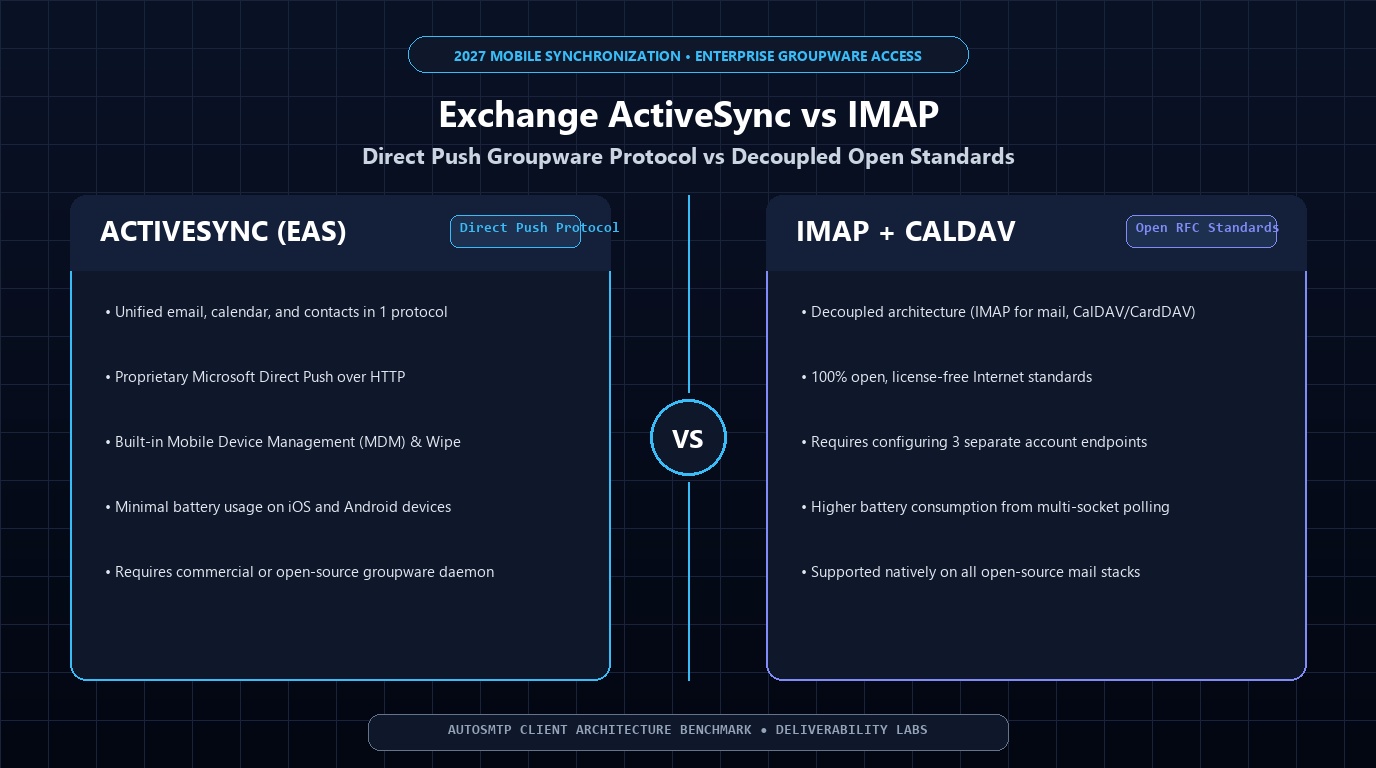
When configuring corporate email accounts on mobile devices (iOS, Android, Windows), systems engineers face an architectural choice: Microsoft Exchange ActiveSync (EAS) or IMAP (with CalDAV/CardDAV). Exchange ActiveSync—developed by Microsoft and licensed universally across mobile operating systems—is an optimized protocol utilizing compressed binary XML (WBXML) over HTTPS designed specifically for wireless networks. Crucially, EAS provides unified synchronization of Email, Calendars, Contacts, Tasks, and Notes in a single compressed stream. IMAP, in contrast, is an open, universal standard strictly limited to email messaging, requiring separate protocols (CalDAV on port 8443 and CardDAV) to manage groupware data. This benchmark explores push mechanisms (Direct Push long-polling vs IMAP IDLE), battery efficiency, firewall traversal, server resource demands, and open-source implementations (SOGo, Z-Push).
- 1. Scope & Ecosystem: Unified Groupware vs Mail-Only Sync
- 2. Push Mechanics: EAS Direct Push vs IMAP IDLE
- 3. WBXML Binary Compression & Mobile Bandwidth Consumption
- 4. Server Overhead, Licensing & Open-Source Backends (SOGo / Z-Push)
- 5. ActiveSync vs IMAP Technical Matrix
- 6. The AutoSMTP Deliverability Defense Advantage
1. Scope & Ecosystem: Unified Groupware vs Mail-Only Sync
The primary operational difference between Exchange ActiveSync and IMAP is functional scope:
Exchange ActiveSync (EAS): A comprehensive enterprise groupware protocol. When a mobile user configures an “Exchange” account on iOS or Android, a single setup process configures Email, Shared Calendars, Address Books (Contacts), Tasks, Reminders, and Global Address Lists (GAL). Furthermore, EAS includes native mobile device management (MDM) hooks—allowing administrators to enforce PIN lockouts, remote device wipe upon employee termination, and storage encryption policies directly at the protocol level.
IMAP: An email-only protocol defined by RFC 3501. IMAP has zero awareness of calendars, meetings, or contact lists. To achieve a complete mobile business experience, administrators must deploy and configure three separate services:
- IMAP (TCP 993): For email message synchronization.
- SMTP Submission (TCP 587/465): For sending outbound emails.
- CalDAV (TCP 8008/8443): For calendar invitations and event synchronization.
- CardDAV (TCP 8008/8443): For address book and contact synchronization.
For end users, configuring three separate server profiles and managing separate authentication endpoints creates frequent setup errors and support desk tickets.
2. Push Mechanics: EAS Direct Push vs IMAP IDLE
Instant email delivery to smartphones relies on push notification architecture:
EAS Direct Push: Dynamic Heartbeat Long-Polling
EAS uses Direct Push over standard HTTPS (port 443). The mobile client issues an HTTP Ping request with a specified heartbeat interval (e.g., 900 seconds / 15 minutes). The server holds the HTTP connection open. If a new email arrives or a calendar meeting is updated during this window, the server immediately responds with the folder ID, and the client pulls the change. If no event occurs, the server responds with a 200 OK at the end of the interval, and the client issues another Ping.
Crucially, EAS includes an adaptive heartbeat algorithm: if a carrier NAT firewall drops connections after 10 minutes, the client detects the drop and automatically adjusts its heartbeat interval downward (e.g., to 8 minutes) to preserve reliable push without wasting battery.
IMAP IDLE (RFC 2177): Keeps a persistent TCP socket open. While effective on stable desktop Ethernet connections, mobile cellular carriers frequently terminate idle TCP connections without sending FIN/RST packets. When this occurs, an IMAP client remains unaware that the connection is dead, causing incoming messages to be delayed until the client manually polls or reconnects.
3. WBXML Binary Compression & Mobile Bandwidth Consumption
EAS was engineered specifically for mobile networks where bandwidth and battery are constrained:
WAP Binary XML (WBXML): Rather than transmitting verbose XML or plaintext strings, EAS encodes XML tags into 1-byte binary tokens. For example, the XML tag <Email:Subject> is represented as a single byte 0x05. Content data is compressed on-the-fly. In field testing across identical 50-message mailboxes, EAS consumes 40% to 65% less cellular bandwidth than standard IMAP with uncompressed plaintext MIME headers.
# EAS Direct Push: Single HTTPS POST Ping (Port 443)
POST /Microsoft-Server-ActiveSync?Cmd=Ping&User=ceo@company.com HTTP/1.1
Host: mail.company.com
Content-Type: application/vnd.ms-sync.wbxml
[Binary Encoded Heartbeat: 900s, Folders: Inbox, Calendar]

# Server holds connection. If new email arrives at second 142:
HTTP/1.1 200 OK
Content-Type: application/vnd.ms-sync.wbxml
[Binary Token: FolderChanges -> Inbox]
# Client immediately pulls message body with sub-second latency!

# IMAP IDLE: Persistent TCP Socket (Port 993)
C: a01 IDLE
S: + idling
# Connection held open on TCP level. If carrier NAT drops state, client hangs silently.
4. Server Overhead, Licensing & Open-Source Backends (SOGo / Z-Push)
While EAS offers superior mobile UX, server-side implementation involves distinct licensing and architectural considerations:
- Commercial Licensing: Exchange ActiveSync is a proprietary Microsoft technology. Commercial servers (such as Microsoft Exchange, Kerio Connect, or SmarterMail) pay per-mailbox royalties to Microsoft.
- Open-Source Daemons: The open-source community provides reverse-engineered EAS implementations that run on Linux:
- SOGo: Written in native C and Objective-C, SOGo includes a high-performance native EAS daemon. SOGo translates EAS commands directly into backend IMAP, SMTP, and CalDAV/CardDAV operations, providing out-of-the-box Exchange push compatibility for Mailcow and standalone mail servers.
- Z-Push: A PHP-based open-source implementation of EAS that interfaces with Dovecot IMAP and various backend groupware engines.
- Stateful Storage Overhead: An EAS server must maintain persistent synchronization state machines (SyncKey tracking) for every connected mobile device ID. If a user connects five devices, the server tracks five independent synchronization states, requiring dedicated database storage.
5. ActiveSync vs IMAP Technical Matrix
| Feature / Capability | Exchange ActiveSync (EAS) | IMAP (RFC 3501) | Operational Reality |
|---|---|---|---|
| Synchronized Data Types | Email, Calendar, Contacts, Tasks, Notes | Email Only | IMAP requires separate CalDAV/CardDAV configuration |
| Transport Protocol | HTTPS (Port 443) with WBXML | Dedicated TCP (Port 993 with TLS) | EAS effortlessly traverses restrictive corporate firewalls |
| Push Architecture | Direct Push (Dynamic HTTP Long-Poll) | IMAP IDLE (Persistent TCP Socket) | EAS adapts to cellular NAT timeout drops automatically |
| Mobile Battery Impact | Ultra-low (Adaptive radio sleep) | Moderate-to-High (Frequent keep-alives) | EAS preserves smartphone battery on mobile networks |
| Device Management (MDM) | Native remote wipe, PIN enforce, encryption | None (Email retrieval only) | EAS enforces corporate security policies on BYOD phones |
| Server Resource Load | High (Maintains device SyncKey state) | Low-to-Moderate (Stateless per-command) | IMAP scales to more concurrent connections with less RAM |
| Licensing & Open Source | Microsoft licensed / SOGo / Z-Push | 100% Free Open IETF Standard | IMAP is supported natively by every mail daemon on earth |
Solving Corporate Firewall Blocks for 3,500 Mobile Executives
A global consulting firm deployed standard IMAP (port 993) and CalDAV (port 8443) for its workforce. When consultants visited client corporate campuses and government facilities, strict outbound firewall policies blocked non-standard ports (993 and 8443), leaving consultants unable to receive emails or view meeting updates on their mobile devices. By deploying SOGo to provide an Exchange ActiveSync endpoint on standard HTTPS port 443, 100% of mobile synchronization succeeded through corporate proxies without security friction.
The AutoSMTP Deliverability Defense Advantage
Inbound and outbound filtering pipelines require robust underlying transport hardware. AutoSMTP provisions sovereign, dedicated bare-metal MTA infrastructure engineered for high-throughput filtering, synchronous 550 bounce suppression, and permanent reputation control.
Provisions fully licensed PowerMTA and KumoMTA clusters on enterprise bare-metal with dedicated IPv4 subnets and predictable flat pricing.
Monitors Google Postmaster spam ratios (<0.1%) and real-time ISP deferrals with algorithmic volume scaling across your entire IP pool.
RFC 5321 in-band 550 bounce suppression, automated Yahoo/Outlook Complaint Feedback Loops (CFL), and instant bad-IP eviction.
Pre-configured forward and reverse DNS (PTR) per IP, SPF CIDR alignment, 2048-bit DKIM rotation, and strict DMARC enforcement.
Upgrade Your Email Infrastructure with Dedicated Bare Metal
Eliminate filter lag, queue serialization bottlenecks, and noisy neighbor contamination. Deploy a turnkey AutoSMTP cluster today.
Deploy Turnkey MTA Cluster →