

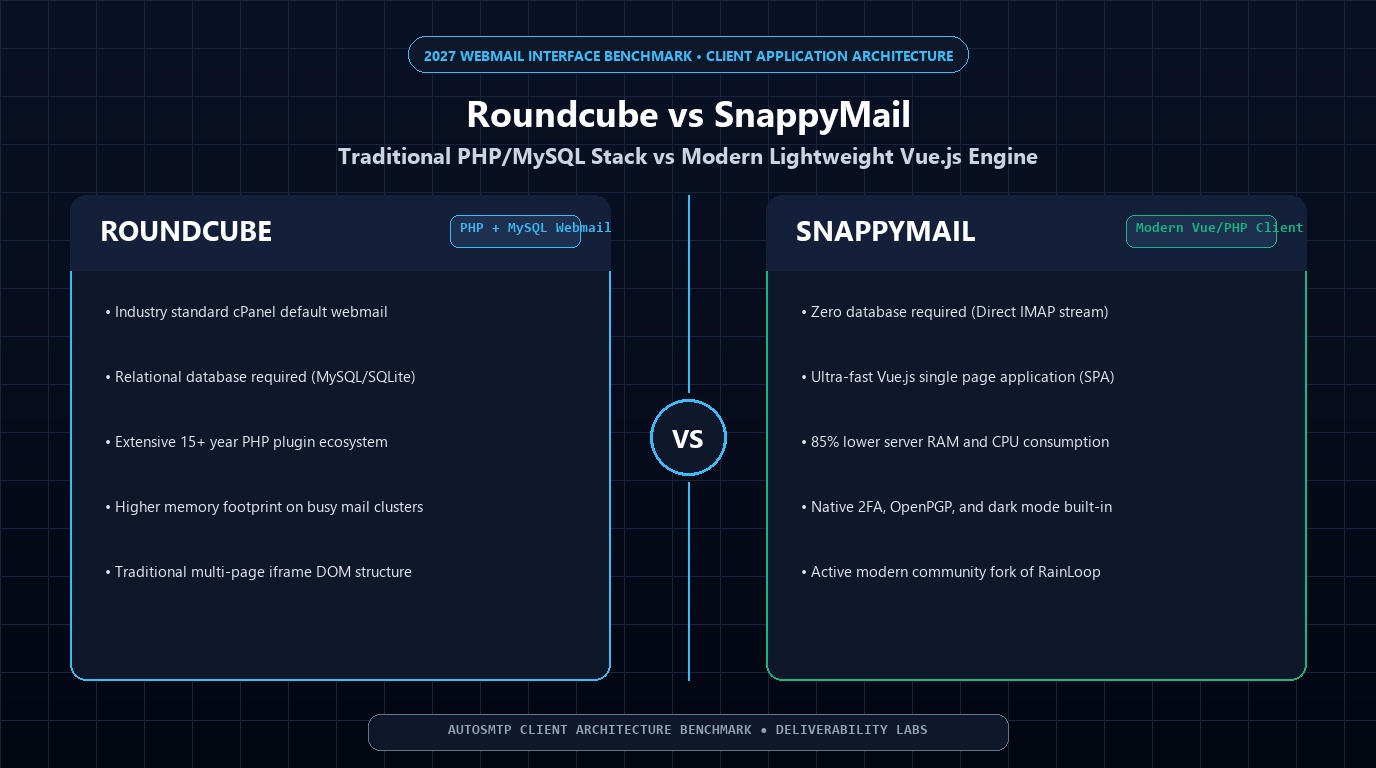
Roundcube vs SnappyMail: 2027 Webmail Client Benchmark for Dedicated Email Servers
Published by Fred Dawson • Senior Deliverability Systems Architect • 18 min read
Webmail interfaces serve as the primary human touchpoint for corporate email accounts, domain administrators, and end users. When configuring dedicated mail infrastructure on Postfix, Dovecot, or Stalwart, selecting between Roundcube Webmail and SnappyMail dictates server memory consumption, database overhead, security ergonomics, and mobile responsiveness. Roundcube represents the venerable, battle-tested standard—powering millions of cPanel, Debian, and Plesk installations with a robust PHP/MySQL architecture and vast plugin ecosystem. SnappyMail (the modern, high-performance fork of RainLoop) abandons SQL database dependencies entirely, delivering an ultra-lightweight Vue.js single-page application (SPA) acting as a direct stateless proxy against IMAP/SMTP sockets. This benchmark evaluates memory overhead, client-side PGP encryption, mobile UX, and high-concurrency scaling.
- 1. Core Architecture: SQL-Backed Traditional Stack vs Stateless Vue.js SPA
- 2. Memory Footprint & Server Concurrency Under Load
- 3. Security Architecture & OpenPGP Encryption Models
- 4. Mobile Responsiveness, Skins & Plugin Extensibility
- 5. Roundcube vs SnappyMail Technical Matrix
- 6. The AutoSMTP Deliverability Defense Advantage
1. Core Architecture: SQL-Backed Traditional Stack vs Stateless Vue.js SPA
The foundational divergence between Roundcube and SnappyMail lies in how each application manages state, sessions, and user configuration.
Roundcube Webmail: Operates as a traditional server-side rendered PHP application. Roundcube requires a relational database (MySQL, MariaDB, PostgreSQL, or SQLite) to operate. Every user login creates rows across multiple relational tables—storing user preferences, session tokens, cached folder lists, contact address books, search indexes, and message caches. Whenever an email is opened or a folder refreshed, Roundcube executes database queries alongside IMAP socket operations. While this architecture allows robust server-side caching and administrative control, it introduces significant database I/O contention on high-density servers.
SnappyMail: Built as a modern, stateless webmail proxy. SnappyMail requires no SQL database backend whatsoever. The server-side PHP component is an ultra-lean gateway that connects directly to the IMAP (TCP 993) and SMTP (TCP 465/587) sockets. User preferences, contact lists, and identities can be stored either in lightweight flat JSON files on disk or synchronized directly to the user’s IMAP mailbox via IMAP METADATA (RFC 5464) and private storage folders. The frontend is a snappy, reactive Single Page Application (SPA) written in Vue.js that renders all HTML, MIME structures, and attachments directly inside the user’s web browser.
SnappyMail: Stateless Scalability
Zero SQL maintenance. You can deploy SnappyMail across multiple load-balanced web frontends behind Nginx without managing shared database replication or Redis session clusters. If the web server dies, zero user mailbox data is lost because state lives entirely inside IMAP.
Roundcube: Database Locking Contention
On servers hosting 10,000+ mailboxes, Roundcube’s session and cache tables frequently become primary bottlenecks. High-volume read/write operations cause table locking, InnoDB buffer pool thrashing, and high disk I/O wait times during morning login spikes.
# Roundcube Architecture: Multi-tiered dependency chain
User Browser ---> Nginx ---> PHP-FPM 8.2 (128MB/worker) ---> MariaDB (InnoDB Session/Cache)
                                                         ---> Dovecot IMAP (TCP 993)
                                                         ---> Postfix SMTP (TCP 587)

# SnappyMail Architecture: Direct stateless socket proxy
User Browser (Vue.js SPA) ---> Nginx ---> PHP-FPM 8.2 (16MB/worker) ---> Dovecot IMAP (TCP 993)
                                                                    ---> Postfix SMTP (TCP 587)
# (Zero database queries; contacts synced to IMAP or flat JSON storage)
2. Memory Footprint & Server Concurrency Under Load
For system administrators managing mail servers on budget VPS or high-density bare-metal clusters, RAM utilization per webmail session dictates total tenant capacity.
- PHP Memory Consumption: Roundcube requires a minimum
memory_limit = 64Minphp.ini, with 128M to 256M recommended when users view MIME messages with large attachments or search multi-gigabyte mailboxes. SnappyMail runs comfortably withmemory_limit = 16Mor32M, consuming a fraction of server RAM per concurrent worker. - Disk & Asset Footprint: A typical Roundcube installation with default skins and core plugins occupies 60MB to 120MB on disk. SnappyMail’s entire distribution is under 10MB, optimized for micro-containers and fast edge distribution.
- Page Navigation Latency: In Roundcube, switching between folders or opening threads triggers full or partial server roundtrips with HTML re-rendering. In SnappyMail, Vue.js fetches raw JSON over AJAX/REST, rendering message bodies locally in the browser with sub-100ms response times.
3. Security Architecture & OpenPGP Encryption Models
End-to-end email encryption is paramount for executive correspondence and compliance-driven organizations. Roundcube and SnappyMail implement OpenPGP through radically different security philosophies:
Client-Side WebCrypto vs Server-Side GnuPG
Roundcube (Enigma Plugin): Leverages the server’s local gpg binary. When a user decrypts an email or signs a message, their private PGP key must either reside on the server’s filesystem or be temporarily uploaded to server memory. If the mail server host is compromised, the user’s private encryption keys can be intercepted in plaintext.
SnappyMail: Implements modern, client-side OpenPGP using the browser’s native WebCrypto API and OpenPGP.js. Private keys are imported directly into the user’s local browser storage (or hardware token) and encrypted with their passphrase. Key decryption and message signing happen 100% inside the client’s browser sandbox—the unencrypted message and private key never touch the web server or PHP backend.
4. Mobile Responsiveness, Skins & Plugin Extensibility
User adoption hinges on mobile usability across smartphones and tablets:
Roundcube: Introduced the responsive “Elastic” skin in version 1.4, which significantly improved mobile usability compared to the legacy “Larry” interface. However, Elastic remains an adapted desktop interface with nested menus and slide-out drawers that can feel sluggish on older mobile devices.
SnappyMail: Built from day one with a mobile-first, reactive design. Gesture navigation (swiping to archive or delete), touch-optimized action buttons, and instantaneous dark-mode switching make SnappyMail feel closer to a native iOS/Android mobile client than a webmail page.
Ecosystem & Plugins: Where Roundcube retains a commanding advantage is in third-party plugins. With over 15 years of development, Roundcube offers hundreds of plugins for cPanel password synchronization, vacation auto-responders, Sieve filtering GUIs, custom LDAP address books, and two-factor authentication (TOTP/U2F). SnappyMail features an active, curated plugin repository (including Sieve filters, 2FA, and nextcloud contacts), but its ecosystem is more focused and compact.
5. Roundcube vs SnappyMail Technical Matrix
| Feature / Metric | Roundcube Webmail | SnappyMail | Architectural Impact |
|---|---|---|---|
| Frontend Architecture | Server-Side PHP + jQuery / Skins | Vue.js Single Page App (SPA) | SnappyMail delivers instant, fluid sub-100ms UI transitions |
| Database Requirement | Mandatory (MySQL, MariaDB, PostgreSQL) | None (Stateless IMAP proxy / Flat files) | SnappyMail eliminates database contention and table locking |
| PHP Memory per Worker | 64 MB – 128 MB+ | 16 MB – 32 MB | SnappyMail supports 4x-8x higher user concurrency per server |
| OpenPGP Encryption | Server-side GnuPG (Enigma plugin) | Client-side WebCrypto / OpenPGP.js | SnappyMail keeps private keys strictly inside the browser |
| Two-Factor Authentication | TOTP, Duo, FIDO2 via plugins | Native built-in TOTP & FIDO2 / WebAuthn | Both provide robust multi-factor security |
| Sieve Mail Filtering GUI | Comprehensive (managesieve plugin) | Built-in Sieve filter editor | Both support server-side Dovecot/Pigeonhole rules |
| Mobile Responsiveness | Good (Elastic skin, responsive CSS) | Exceptional (Native SPA touch/gesture feel) | SnappyMail offers a superior smartphone experience |
| Plugin Ecosystem | Extensive (Hundreds of community plugins) | Focused (Core essentials + modern add-ons) | Roundcube excels in bespoke enterprise legacy integrations |
Eliminating MariaDB Bottlenecks for 40,000 Mailboxes
A managed hosting provider running a multi-server Dovecot IMAP cluster with 40,000 active business mailboxes suffered from recurring MariaDB CPU spikes during business hours. Over 65% of all database queries were generated by Roundcube writing session data and caching address books. By transitioning their primary webmail entrypoint to SnappyMail running on stateless Nginx/PHP-FPM containers, the database load dropped to near zero. Server memory utilization decreased by 62%, and average mailbox load times dropped from 1.4 seconds to 180 milliseconds.
The AutoSMTP Deliverability Defense Advantage
Inbound and outbound filtering pipelines require robust underlying transport hardware. AutoSMTP provisions sovereign, dedicated bare-metal MTA infrastructure engineered for high-throughput filtering, synchronous 550 bounce suppression, and permanent reputation control.
Provisions fully licensed PowerMTA and KumoMTA clusters on enterprise bare-metal with dedicated IPv4 subnets and predictable flat pricing.
Monitors Google Postmaster spam ratios (<0.1%) and real-time ISP deferrals with algorithmic volume scaling across your entire IP pool.
RFC 5321 in-band 550 bounce suppression, automated Yahoo/Outlook Complaint Feedback Loops (CFL), and instant bad-IP eviction.
Pre-configured forward and reverse DNS (PTR) per IP, SPF CIDR alignment, 2048-bit DKIM rotation, and strict DMARC enforcement.
Upgrade Your Email Infrastructure with Dedicated Bare Metal
Eliminate filter lag, queue serialization bottlenecks, and noisy neighbor contamination. Deploy a turnkey AutoSMTP cluster today.
Deploy Turnkey MTA Cluster →