

PowerMTA vs Postfix vs Postal: 2027 Commercial Carrier, Linux Default & Web Platform 3-Way Showdown
Published by Fred Dawson • Senior Deliverability Systems Architect • 22 min read
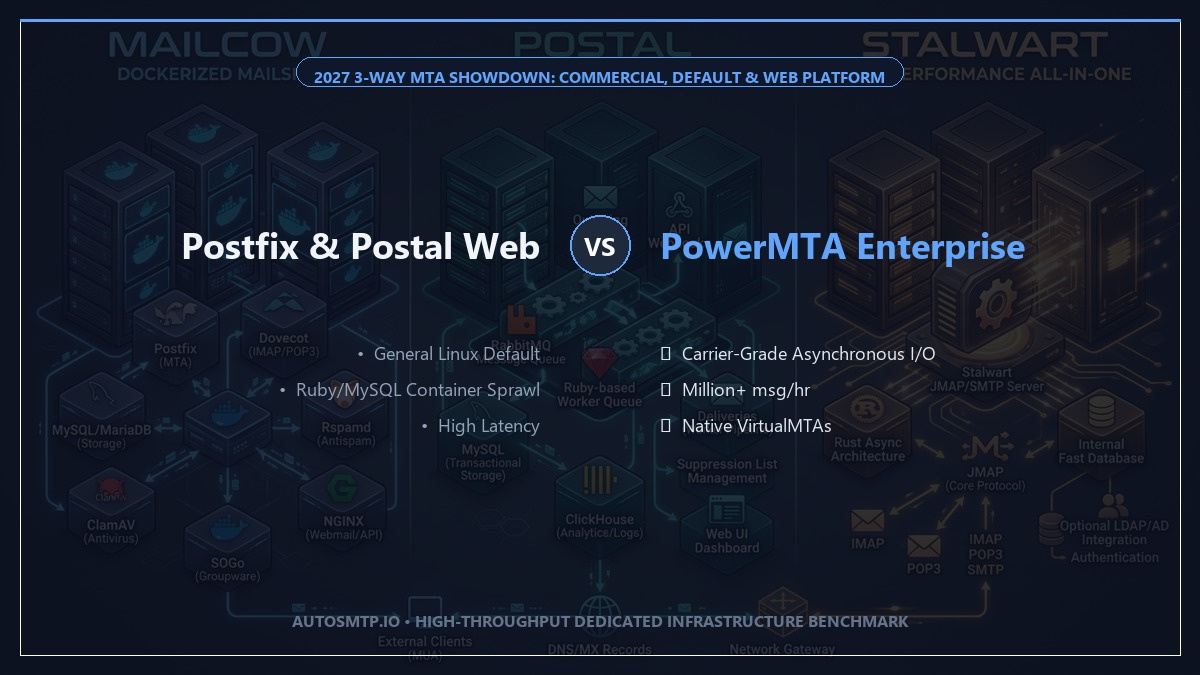
When engineering a self-hosted email infrastructure stack, technical architects face a defining crossroads among three distinct architectural paradigms: PowerMTA, Postfix, and Postal. PowerMTA 5.5 is the commercial carrier-grade standard, written in C++ with an asynchronous event-driven I/O core engineered for wire-speed delivery across multi-IP pools (1,000,000+ msg/hr). Postfix is the ubiquitous open-source Unix workhorse, renowned for modular security and rock-solid stability, yet requiring complex multi-instance bindings (`postmulti`) to manage modern multi-IP allocations. Postal is a modern open-source web-based email delivery platform (similar to SendGrid or Mailgun) built on Ruby on Rails with MySQL and RabbitMQ, offering turnkey webhooks and click tracking out of the box at the expense of heavy container overhead and limited low-level ISP traffic shaping. This three-way technical benchmark compares the internal concurrency mechanics, multi-IP routing capabilities, resource consumption, and high-volume delivery limits of all three platforms in 2027.
- 1. Three Architectural Paradigms: Dedicated Carrier, Modular Unix & Web Stack
- 2. Concurrency & Spool Mechanics: Asynchronous Event Loops vs Process Forking
- 3. Multi-IP Routing & Virtualization: VirtualMTAs vs Postmulti vs IP Pools
- 4. Real-Time ISP Traffic Shaping & Automated Backoff Logic
- 5. PowerMTA vs Postfix vs Postal 3-Way Comparison Matrix
- 6. The AutoSMTP Deliverability Defense Advantage
1. Three Architectural Paradigms: Dedicated Carrier, Modular Unix & Web Stack
The three systems were engineered to solve fundamentally different networking problems:
- PowerMTA (Commercial Carrier-Grade): Developed by Port25 (SparkPost), PowerMTA was designed from the ground up to solve the specific bottlenecks of commercial bulk and transactional outbound email: managing hundreds of source IP addresses, adhering to shifting ISP connection limits, and processing millions of messages without disk thrashing. It is a single, unified C++ binary operating as an ultra-high-performance network daemon.
- Postfix (Modular Open-Source Unix Standard): Designed by Wietse Venema as an alternative to Sendmail, Postfix emphasizes defense-in-depth security. It divides mail processing into small, least-privilege daemon processes (`smtpd`, `cleanup`, `qmgr`, `smtp`) communicating via internal IPC sockets. While exceptional for general-purpose mail servers, this multi-process architecture introduces context-switching overhead under massive concurrent outbound loads.
- Postal (Self-Hosted SaaS-Style Delivery Platform): Developed by Kualo, Postal is not just an MTA—it is a full-fledged web-based email platform with a graphical dashboard, multi-organization billing, REST APIs, and live open/click tracking. However, because it runs on Ruby on Rails backed by RabbitMQ, MySQL, and multiple Docker containers, it demands substantial server memory (8GB to 16GB RAM) and exhibits higher internal message queue latency.
2. Concurrency & Spool Mechanics: Asynchronous Event Loops vs Process Forking
How each engine handles simultaneous outbound connections determines its hardware throughput ceiling:
# POWERMTA: Single Asynchronous C++ Process with Thread Pool
Single Daemon (pmtad) ──> Asynchronous Event Loop (epoll/kqueue)
                          ├── Maintains 10,000+ outbound sockets concurrently
                          ├── Direct memory buffers to Gen4 NVMe disk spool
                          └── Throughput: 1,000,000+ msg/hr at < 15% CPU

# POSTFIX: Modular Multi-Process Forking Architecture
Master Process (master) ──> Spawns N parallel smtp delivery processes
                            ├── Each delivery process handles 1 active connection
                            ├── Process table overhead & memory lock under 5,000+ conns
                            └── Throughput: 50,000 – 100,000 msg/hr ceiling

# POSTAL: Ruby on Rails + RabbitMQ + Docker Multi-Container Stack
Web Ingest ──> Ruby FastMCP / Webhook ──> RabbitMQ Queue ──> Postal Delivery Worker
               (Container context-switching, Ruby GC pauses & MySQL write latency)
               └── Throughput: 20,000 – 40,000 msg/hr on standard hardware
3. Multi-IP Routing & Virtualization: VirtualMTAs vs Postmulti vs IP Pools
In modern deliverability engineering, routing messages through dedicated source IP subnets is mandatory:
PowerMTA VirtualMTA Power
- Declarative
<virtual-mta>blocks bind directly to any local IP. - Dynamic stream routing via
x-virtual-mtaheaders or recipient rules. - Native round-robin virtual pools with automated percentage-based traffic weights.
- In-band 550 bounce suppression updates suppression lists at the socket level.
Postfix & Postal Multi-IP Complexities
- Postfix: Binding multiple source IPs requires running
postmultito spawn separate Postfix instances, each with dedicated spool dirs and config files. - Postfix: Alternatively requires complex `sender_dependent_default_transport_maps` hash tables.
- Postal: Supports IP pools in web GUI, but lacks granular per-IP rate-limiting directives.
4. Real-Time ISP Traffic Shaping & Automated Backoff Logic
Receiving mail servers at Gmail, Microsoft, and Yahoo return dynamic rate-limit codes that require immediate adaptation:
# POWERMTA: Granular Declarative ISP Domain Macros (config)
<domain gmail.com>
    max-msg-per-connection 25
    max-smtp-out 50
    backoff-to-normal-after 15m
    backoff-max-msg-rate 5/m
    use-starttls yes
    require-tls yes
</domain>

# POSTFIX: Master.cf Transport Overrides (Fragmented Across Config Files)
# Requires defining custom transport in master.cf, adding to transport_maps,
# and configuring rate-delay parameters in main.cf:
# gmail_destination_concurrency_limit = 20
# gmail_destination_rate_delay = 1s

# POSTAL: Web GUI Global Throttle Only
# Lacks per-MX granular socket throttling and automated RFC 5321 backoff modes
5. PowerMTA vs Postfix vs Postal 3-Way Comparison Matrix
| Pillar / Capability | PowerMTA Enterprise 5.5 | Postfix Open-Source | Postal Web Platform |
|---|---|---|---|
| Primary Role | Commercial carrier-grade outbound MTA | Universal general-purpose Linux MTA | Self-hosted SendGrid/Mailgun alternative |
| Peak Outbound Throughput | 1,000,000+ messages/hour burst | 50,000 – 100,000 messages/hour | 20,000 – 40,000 messages/hour |
| Underlying Language & Stack | C++ (Asynchronous non-blocking) | C (Modular multi-process daemon) | Ruby on Rails + RabbitMQ + MySQL |
| RAM Memory Footprint | ~100 MB – 250 MB under heavy load | ~30 MB – 80 MB under heavy load | 8 GB – 16 GB (Docker containers) |
| Multi-IP Virtualization | Native <virtual-mta> and pools |
Complex postmulti instances |
Basic IP pool assignment in UI |
| Automated ISP Backoff | Real-time automatic backoff logic | None; manual queue pause/tuning | None; static retry intervals |
| License & Cost | Commercial proprietary license | Free & Open Source (IBM Public License) | Free & Open Source (MIT License) |
Evaluating Postfix, Postal and PowerMTA for a 15-Million Monthly Outbound Fleet
A B2B marketing platform delivering 15 million transactional and campaign emails monthly tested all three platforms. Postal provided a beautiful UI, but its Ruby/Docker containers suffered RabbitMQ queue crashes during 500,000-subscriber flash broadcasts. Postfix handled delivery reliably, but maintaining 16 separate IP addresses across 4 server instances via postmulti created administrative friction and slow failover recovery.
The Final Architecture: The engineering team standardized on Dual AutoSMTP Bare-Metal Nodes running PowerMTA 5.5. Outbound broadcast times dropped by 78%, memory utilization stabilized at under 200MB, and native VirtualMTA directives enabled dynamic traffic routing across clean /29 subnets with zero DevOps overhead.
The AutoSMTP Deliverability Defense Advantage
Inbound and outbound filtering pipelines require robust underlying transport hardware. AutoSMTP provisions sovereign, dedicated bare-metal MTA infrastructure engineered for high-throughput filtering, synchronous 550 bounce suppression, and permanent reputation control.
Provisions fully licensed PowerMTA and KumoMTA clusters on enterprise bare-metal with dedicated IPv4 subnets and predictable flat pricing.
Monitors Google Postmaster spam ratios (<0.1%) and real-time ISP deferrals with algorithmic volume scaling across your entire IP pool.
RFC 5321 in-band 550 bounce suppression, automated Yahoo/Outlook Complaint Feedback Loops (CFL), and instant bad-IP eviction.
Pre-configured forward and reverse DNS (PTR) per IP, SPF CIDR alignment, 2048-bit DKIM rotation, and strict DMARC enforcement.
Upgrade Your Email Infrastructure with Dedicated Bare Metal
Eliminate filter lag, queue serialization bottlenecks, and noisy neighbor contamination. Deploy a turnkey AutoSMTP cluster today.
Deploy Turnkey MTA Cluster →