

PowerMTA vs Sendmail: 2027 Carrier-Grade Commercial Engine vs Legacy Unix Daemon
Published by Fred Dawson • Senior Deliverability Systems Architect • 20 min read
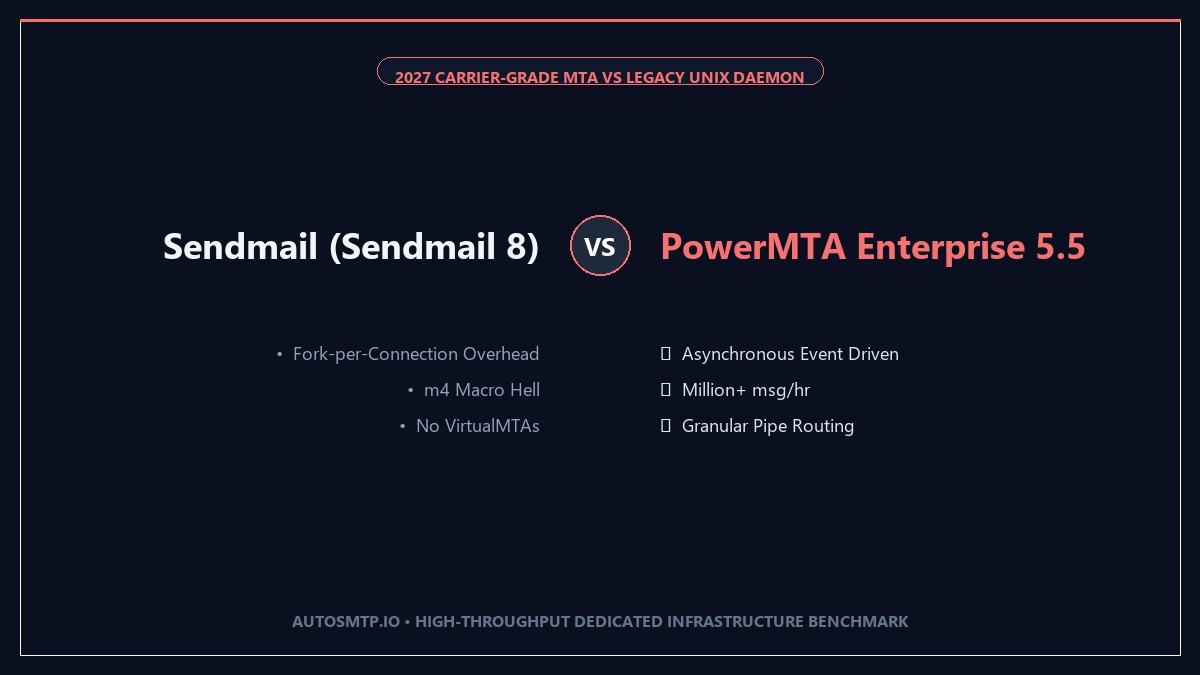
In the history of internet communications, few software programs cast a longer shadow than Sendmail. Originally authored by Eric Allman in 1983, Sendmail powered the early ARPANET and defined the foundational RFC 821 SMTP relaying standard. However, entering 2027, Sendmail’s 40-year-old monolithic architecture—reliant on synchronous process forking, notoriously arcane m4 macro configuration files, and complete lack of native IP pool virtualization—renders it fundamentally obsolete for modern commercial email operations. Conversely, PowerMTA (v5.5 Enterprise) is the industry-standard carrier-grade outbound message transfer agent engineered specifically for high-velocity transactional and bulk delivery, featuring non-blocking asynchronous I/O, granular per-domain rate limiting, native VirtualMTA IP grouping, and real-time in-band 550 bounce suppression. This technical benchmark contrasts the internal architecture, operational complexity, and throughput limits of both MTAs.
- 1. Concurrency Architecture: Asynchronous Event Loops vs Process Forking
- 2. Configuration Syntax: Clean Human Directives vs Arcane m4 Macros
- 3. VirtualMTAs & Multi-IP Source Binding
- 4. Granular ISP Traffic Shaping & Automated Backoff Logic
- 5. PowerMTA vs Sendmail Technical Comparison Matrix
- 6. The AutoSMTP Deliverability Defense Advantage
1. Concurrency Architecture: Asynchronous Event Loops vs Process Forking
The performance disparity between Sendmail and PowerMTA is rooted in their fundamental operating system process models:
- Sendmail’s Fork-per-Connection Overhead: Sendmail was designed when system resources were scarce and network traffic was low. For every incoming and outgoing SMTP connection, Sendmail spawns a separate child operating system process via the POSIX
fork()system call. Under heavy volume (thousands of messages queued), this architecture triggers severe process table exhaustion, massive context-switching overhead, and kernel memory thrashing. Sendmail servers frequently collapse into unrecoverable load averages (>100.0) when hit with large broadcast queues. - PowerMTA’s High-Concurrency Event Engine: PowerMTA utilizes a modern asynchronous, non-blocking multi-threaded architecture with lightweight thread pools. A single PowerMTA daemon process easily maintains tens of thousands of simultaneous outbound TCP connections across multiple network interfaces, delivering 1,000,000+ messages per hour on standard bare-metal hardware with minimal CPU utilization.
2. Configuration Syntax: Clean Human Directives vs Arcane m4 Macros
System administrators universally dread managing Sendmail configuration files due to their reliance on preprocessor macros:
# SENDMAIL: Cryptic m4 Macro Syntax (sendmail.mc requiring compilation via m4)
divert(-1)dnl
include(`/usr/share/sendmail-cf/m4/cf.m4')dnl
VERSIONID(`setup for linux')dnl
OSTYPE(`linux')dnl
define(`confPRIVACY_FLAGS', `authwarnings,novrfy,noexpn,restrictqrun')dnl
define(`confMAX_MESSAGE_SIZE', `20971520')dnl
FEATURE(`nouucp', `reject')dnl
FEATURE(`smrsh', `/usr/sbin/smrsh')dnl
FEATURE(`virtusertable', `hash -o /etc/mail/virtusertable.db')dnl
# Complex custom rule sets requiring assembly-like string rewrites ($#error, $:OK)

# POWERMTA: Clean, Declarative Human Directives (config)
<virtual-mta vmta-pool-marketing>
    smtp-source-host 162.251.122.170 mta1.yourdomain.com
</virtual-mta>

<domain-macro gmail-domains>
    gmail.com, googlemail.com
</domain-macro>

<domain $gmail-domains>
    max-msg-per-connection 20
    max-smtp-out 50
    backoff-to-normal-after 15m
    use-starttls yes
    require-tls yes
</domain>
3. VirtualMTAs & Multi-IP Source Binding
In modern deliverability engineering, routing different message streams (transactional vs marketing vs warmup) through specific dedicated source IP addresses is mandatory:
Sendmail IP Routing Limitations
- Sendmail binds exclusively to a single primary source IP address defined in the operating system routing table.
- Binding to multiple outbound IP addresses requires running multiple separate Sendmail daemon instances with distinct spool directories, configuration files, and process IDs.
- No native capability to route messages to specific IPs based on envelope sender header, customer ID, or campaign tag.
PowerMTA VirtualMTA Power
- Native
<virtual-mta>and<virtual-mta-pool>directives allow arbitrary grouping of dozens of IPv4/IPv6 addresses within a single configuration. - Dynamic stream routing via SMTP command headers (
x-virtual-mta) or recipient domain matching. - Automated round-robin distribution and weighted load balancing across /28 and /29 IP allocations.
4. Granular ISP Traffic Shaping & Automated Backoff Logic
Major receiving ISPs enforce strict connection limits and deferral rules that require real-time protocol handling:
Automated RFC 5321 Backoff vs Sendmail Queue Freezes
When destination servers at Microsoft or Yahoo return 421 4.7.0 [TSS04] Message temporarily deferred, Sendmail’s only mechanism is placing the message back into its general queue to retry at the next scheduled queue run (typically 15 to 30 minutes later). Sendmail continues blasting the destination with subsequent messages, resulting in an immediate 24-hour IP ban.
PowerMTA monitors destination SMTP response codes in real time. Upon receiving a 421 or 451 rate-limit response, PowerMTA automatically engages Backoff Mode: it suspends outbound delivery to that specific MX for a configured duration (e.g., 15 minutes), reduces concurrent connections, and resumes delivery at a moderated pace once the ISP clears the block.
5. PowerMTA vs Sendmail Technical Comparison Matrix
| Pillar / Capability | PowerMTA Enterprise 5.5 | Sendmail 8.x Daemon | Operational Advantage |
|---|---|---|---|
| Outbound Speed | 1,000,000+ messages/hour burst | 2,000 – 5,000 messages/hour max | PowerMTA: 200x–500x higher throughput |
| Concurrency Model | Non-blocking asynchronous thread pool | Process fork per connection (POSIX fork) | PowerMTA: Zero process table exhaustion |
| IP Virtualization | Native VirtualMTAs & Virtual Pools | Single interface bind (requires multiple daemons) | PowerMTA: Granular stream isolation on 1 server |
| Configuration Engine | Plain text human directives | Complex m4 macro compilation (sendmail.cf) | PowerMTA: Rapid zero-error provisioning |
| Automated Backoff | Real-time ISP throttling & backoff modes | None; static queue retry intervals | PowerMTA: Prevents IP blacklisting during deferrals |
| Monitoring & Telemetry | Web GUI, real-time command API & pipe logs | CLI mailq only |
PowerMTA: Instant queue visibility and queue pausing |
Retiring Legacy Sendmail Clusters for Dual PowerMTA Bare-Metal Nodes
A regional banking group was operating 14 legacy Red Hat servers running Sendmail to handle daily transactional alerts, monthly statements, and security OTP notifications. During morning statement delivery bursts, Sendmail processes overloaded server CPU cores, resulting in statement delivery delays of up to 14 hours and intermittent OTP timeouts.
The Transition: The institution consolidated all 14 Sendmail servers onto dual Dedicated AutoSMTP Bare-Metal Nodes running PowerMTA 5.5. The entire monthly statement run of 2.4 million emails now completes in under 75 minutes. Server resource utilization plummeted, and transactional OTPs deliver in sub-second latency.
The AutoSMTP Deliverability Defense Advantage
Inbound and outbound filtering pipelines require robust underlying transport hardware. AutoSMTP provisions sovereign, dedicated bare-metal MTA infrastructure engineered for high-throughput filtering, synchronous 550 bounce suppression, and permanent reputation control.
Provisions fully licensed PowerMTA and KumoMTA clusters on enterprise bare-metal with dedicated IPv4 subnets and predictable flat pricing.
Monitors Google Postmaster spam ratios (<0.1%) and real-time ISP deferrals with algorithmic volume scaling across your entire IP pool.
RFC 5321 in-band 550 bounce suppression, automated Yahoo/Outlook Complaint Feedback Loops (CFL), and instant bad-IP eviction.
Pre-configured forward and reverse DNS (PTR) per IP, SPF CIDR alignment, 2048-bit DKIM rotation, and strict DMARC enforcement.
Upgrade Your Email Infrastructure with Dedicated Bare Metal
Eliminate filter lag, queue serialization bottlenecks, and noisy neighbor contamination. Deploy a turnkey AutoSMTP cluster today.
Deploy Turnkey MTA Cluster →