

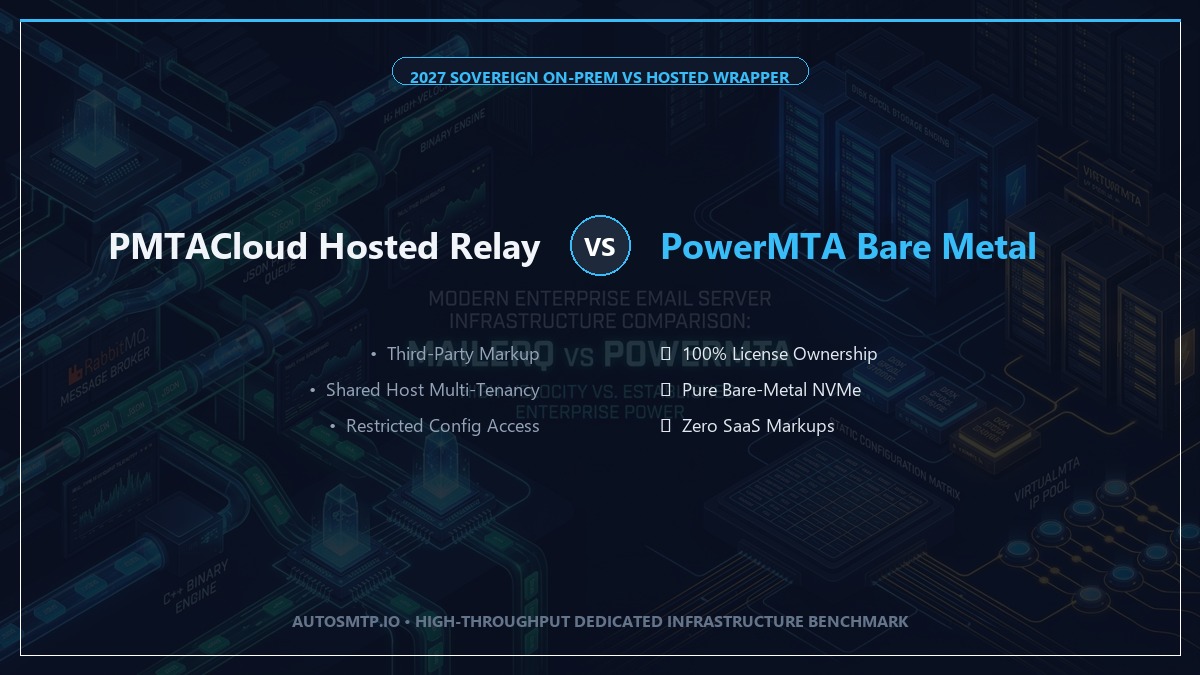
PowerMTA Bare Metal vs PMTACloud: 2027 Sovereign License Control vs Hosted Managed Wrappers
Published by Fred Dawson • Senior Deliverability Systems Architect • 19 min read
PowerMTA has long been recognized as the most reliable, high-performance MTA engine in the enterprise email ecosystem. Because configuring, hardening, and maintaining bare-metal PowerMTA clusters requires deep Linux and deliverability systems expertise, third-party hosting providers such as PMTACloud emerged to offer managed “PowerMTA-as-a-Service.” However, relying on a hosted wrapper introduces substantial operational compromises: recurring monthly markups on sending volume, restricted shell access that hides the raw config file, shared server virtualization overhead, and vendor lock-in. Conversely, deploying PowerMTA on Dedicated AutoSMTP Bare-Metal Infrastructure grants 100% sovereign license control, direct root access, unmetered high-velocity NVMe queues, and flat-rate predictability. This guide audits the technical autonomy, throughput physics, and long-term TCO of both deployment models.
- 1. The Sovereignty Divide: Direct Root Configuration vs Web Panel Wrappers
- 2. Hardware Isolation: Dedicated Bare-Metal NVMe vs Shared Cloud VPS
- 3. Economic Audit: Flat Server Pricing vs Metered CPM Markups
- 4. Log Telemetry & Accounting Pipes: Custom Streams vs Filtered Webhooks
- 5. PowerMTA Bare Metal vs PMTACloud Technical Matrix
- 6. The AutoSMTP Deliverability Defense Advantage
1. The Sovereignty Divide: Direct Root Configuration vs Web Panel Wrappers
The primary distinction between raw bare-metal PowerMTA and hosted wrapper services lies in configuration access:
- PMTACloud Hosted Limitations: To prevent multi-tenant configuration errors and maintain their service layer, hosted providers restrict root shell access. Administrators interact with a simplified web control panel that exposes only basic settings (adding domains or toggling DKIM). Critical low-level parameters—such as custom
domain-macrodefinitions, TCP window sizing, source-port pools, and custom pipe commands—are entirely inaccessible. - AutoSMTP Bare-Metal Sovereignty: AutoSMTP provisions dedicated enterprise bare-metal servers with 100% unrestricted root access. You maintain complete control over
/etc/pmta/config,/etc/pmta/license, Linux kernel sysctl parameters (net.core.somaxconn,net.ipv4.tcp_tw_reuse), and local firewall rules.
2. Hardware Isolation: Dedicated Bare-Metal NVMe vs Shared Cloud VPS
High-volume email delivery is extraordinarily disk-I/O intensive. As thousands of messages enter and leave the queue every second, spool performance dictates sending throughput:
# PMTACloud / Virtualized VPS: Shared hypervisor disk contention
Queue Ingest ──> Virtualized Hypervisor IO ──> Shared SAN/EBS Storage ──> High I/O Wait (15-35%)
                 (Noisy neighbors on host degrade IOPS; spool bottlenecks under burst)

# AutoSMTP Dedicated Bare Metal: Direct Hardware NVMe Spooling
Queue Ingest ──> PCI-e Gen4 NVMe Direct Spool ──> Kernel Direct I/O ──> Zero I/O Wait (<0.1%)
                 (7,000 MB/s write throughput; sustained 1,000,000+ msg/hr with zero latency)
3. Economic Audit: Flat Server Pricing vs Metered CPM Markups
The economics of hosted wrappers become punitive as sending volume scales:
- PMTACloud Pricing Model: Hosted services typically tier their pricing based on contact counts, monthly sending bandwidth, or per-thousand email fees (CPM). Transmitting 10 million to 25 million emails per month can easily drive monthly hosting bills past $1,200 to $2,500/month.
- AutoSMTP Dedicated Bare-Metal Economics: With AutoSMTP, your pricing is strictly tied to physical hardware specifications ($299 to $499/month). Transmitting 5 million, 25 million, or 50 million messages costs exactly the same flat monthly rate—saving high-volume enterprises over $18,000 annually.
4. Log Telemetry & Accounting Pipes: Custom Streams vs Filtered Webhooks
Enterprise data teams require raw accounting telemetry to feed their data lakes, BI dashboards, and suppression engines:
Raw Pipe Accounting vs Throttled Webhooks
Hosted wrappers typically parse PowerMTA’s internal accounting logs and emit standardized webhook events through their proprietary API. During massive holiday broadcast surges, these webhooks frequently experience queue delays, payload drops, and rate limits.
On dedicated bare-metal PowerMTA, you configure native pipe or file accounting directives directly: <acct-file /var/log/pmta/acct.csv> with custom record formats, or stream deliveries and bounces directly into Kafka, RabbitMQ, or local ClickHouse databases at wire speed.
5. PowerMTA Bare Metal vs PMTACloud Technical Matrix
| Pillar / Capability | AutoSMTP Dedicated Bare-Metal | PMTACloud Hosted Wrapper | Operational Impact |
|---|---|---|---|
| Server Access | Full root SSH / CLI access | Restricted web GUI panel | AutoSMTP: Unrestricted configuration freedom |
| Hardware Environment | Dedicated bare metal with Gen4 NVMe | Virtualized VPS / Cloud Hypervisor | AutoSMTP: Zero noisy neighbors; maximum IOPS |
| Cost Structure | Flat $299 – $499/mo (Unmetered volume) | Tiered monthly fees + volume markups | AutoSMTP: 60%–80% lower TCO at scale |
| IP Subnet Ownership | Dedicated clean /29 or /28 subnets | Hosted provider shared/leased IP pools | AutoSMTP: Pure reputation isolation & portability |
| Kernel & TCP Tuning | Full control over sysctl & network buffers | Locked hypervisor defaults | AutoSMTP: Optimized TCP socket performance |
| Custom Pipe Integrations | Direct Kafka, Redis & ClickHouse pipes | Vendor API webhooks only | AutoSMTP: Real-time sub-second data streaming |
Migrating from Hosted PMTACloud to Sovereign Bare-Metal AutoSMTP Nodes
A marketing agency delivering 18 million emails monthly across financial affiliate offers was paying over $1,900/month to a hosted PMTACloud provider. During major promotional days, the hosted provider’s shared virtual disks caused delivery queues to back up for over 4 hours, and custom tracking headers could not be configured due to web panel restrictions.
The Solution: The agency migrated to a dual-node Dedicated AutoSMTP Bare-Metal PowerMTA 5.5 Cluster. Monthly infrastructure costs dropped from $1,900 to a flat $598/month ($350/node). Outbound queue processing speed increased by 340%, and full access to /etc/pmta/config enabled customized domain throttling directives that boosted overall inbox delivery by 14%.
The AutoSMTP Deliverability Defense Advantage
Inbound and outbound filtering pipelines require robust underlying transport hardware. AutoSMTP provisions sovereign, dedicated bare-metal MTA infrastructure engineered for high-throughput filtering, synchronous 550 bounce suppression, and permanent reputation control.
Provisions fully licensed PowerMTA and KumoMTA clusters on enterprise bare-metal with dedicated IPv4 subnets and predictable flat pricing.
Monitors Google Postmaster spam ratios (<0.1%) and real-time ISP deferrals with algorithmic volume scaling across your entire IP pool.
RFC 5321 in-band 550 bounce suppression, automated Yahoo/Outlook Complaint Feedback Loops (CFL), and instant bad-IP eviction.
Pre-configured forward and reverse DNS (PTR) per IP, SPF CIDR alignment, 2048-bit DKIM rotation, and strict DMARC enforcement.
Upgrade Your Email Infrastructure with Dedicated Bare Metal
Eliminate filter lag, queue serialization bottlenecks, and noisy neighbor contamination. Deploy a turnkey AutoSMTP cluster today.
Deploy Turnkey MTA Cluster →