

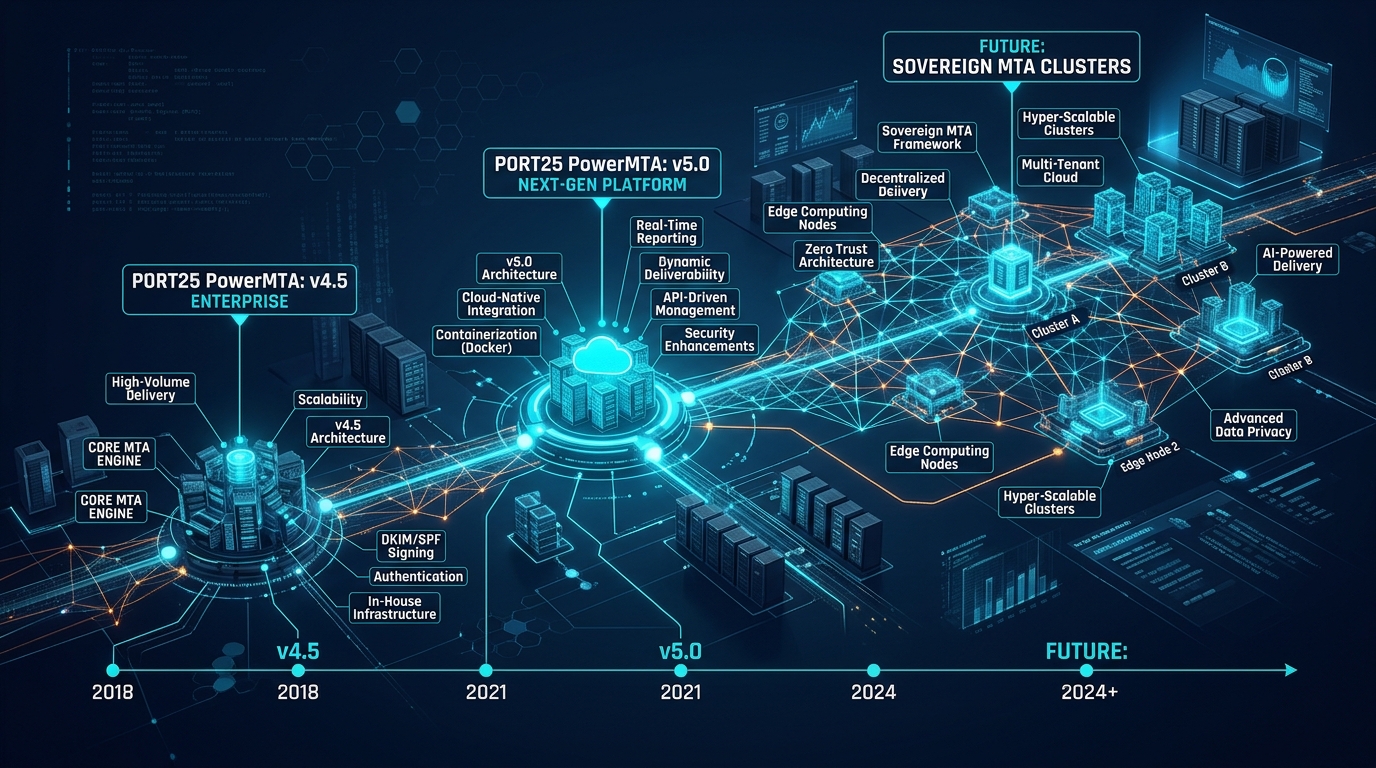
PowerMTA Roadmap & Bird Acquisition: Enterprise Longevity, Alternatives & Sovereign Infrastructure
Published by Fred Dawson • Senior Deliverability Systems Architect • 18 min read
Over the past two decades, Port25 PowerMTA established itself as the undisputed backbone of enterprise email deliverability, powering the world’s largest Email Service Providers (ESPs), financial institutions, and high-volume marketing senders. However, following a series of high-profile corporate acquisitions—first by SparkPost in 2019, and subsequently by global communications conglomerate Bird (formerly MessageBird)—the long-term roadmap, licensing structure, and software release cadence of PowerMTA have undergone profound shifts. Enterprise systems architects face pressing questions: What is Bird’s strategic vision for PowerMTA in 2026 and beyond? How does the transition from perpetual licenses to cloud subscriptions affect existing fleets? And what role do modern carrier alternatives like KumoMTA and Halon play in future-proofing your mail architecture? This strategic analysis provides a candid, engineering-driven evaluation of the PowerMTA ecosystem.
- 1. The Ownership Evolution: Port25 → SparkPost → Bird
- 2. What Changed Under Bird: Licensing, Support & Priorities
- 3. Technical Analysis of PowerMTA 5.0 and Current Milestones
- 4. Operational Risks Facing Legacy PowerMTA Operators
- 5. The Emerging Carrier Landscape: KumoMTA, Halon & MailerQ
- 6. The 2026 Enterprise Future-Proofing Playbook
- 7. Enterprise MTA Ecosystem Comparison Matrix
- 8. The AutoSMTP Sovereign Infrastructure Shield
1. The Ownership Evolution: Port25 → SparkPost → Bird
To evaluate the trajectory of PowerMTA, it is essential to understand the succession of ownership transitions over the last seven years:
Timeline of PowerMTA Corporate Ownership
2001–2019 (Port25 Solutions Inc.): Founded in Maryland, Port25 operated as an independent, hyper-focused software vendor. The engineering team dedicated itself exclusively to optimizing C++ transport socket code, maintaining direct relationships with deliverability consultants, and pioneering Virtual MTA IP pooling.
2019–2021 (SparkPost Acquisition): Cloud API competitor SparkPost acquired Port25 to consolidate the on-premises market and integrate PowerMTA telemetry into its “Signals” deliverability platform. PowerMTA development slowed as resources shifted toward SparkPost’s managed cloud edge.
2021–Present (Bird Acquisition): Omnichannel communications giant MessageBird (rebranded to Bird) acquired SparkPost for $600M. Under Bird’s leadership, the corporate priority pivoted toward building an all-in-one CRM, SMS, WhatsApp, and cloud API suite, leaving standalone on-premises MTA software in a specialized maintenance phase.
2. What Changed Under Bird: Licensing, Support & Priorities
Enterprise users operating high-volume PowerMTA clusters have experienced tangible operational shifts under Bird’s governance:
1. Transition Away from Perpetual Licensing
Procuring traditional perpetual licenses with one-time capital expenditures has become increasingly restrictive. Commercial sales teams actively steer enterprise inquiries toward recurring subscription contracts, bundled cloud API commitments, or Bird’s cloud sending platform.
2. Core Software Stability & Reliability
On the engineering side, PowerMTA remains extraordinarily stable. It runs seamlessly on modern enterprise Linux distributions (CentOS Stream, AlmaLinux 9, Rocky Linux, Debian 12), requires virtually zero maintenance once tuned, and delivers rock-solid RFC 5321 adherence.
3. Technical Analysis of PowerMTA 5.0 and Current Milestones
The release of PowerMTA 5.0 introduced vital modern architectural features designed to bridge on-premises software with modern API-driven backends:
# ==============================================================================
# KEY ENHANCEMENTS IN POWERMTA 5.0 & CURRENT MAINTENANCE RELEASES
# ==============================================================================
# 1. Native HTTP Submission API:
# Enables applications to inject JSON payloads directly over port 8080/8443
# Bypasses local SMTP conversation overhead for REST-native web applications.

# 2. Modern Web Monitoring Console:
# Responsive HTML5 dashboard replacing legacy tables with live graph rendering,
# real-time queue searches, and per-Virtual-MTA delivery metrics.

# 3. Modern Transport Security:
# Native TLS 1.3 cipher negotiation, automated DANE (DNS-based Authentication
# of Named Entities) verification, and enhanced SNI (Server Name Indication).

# 4. Modern Linux Kernel Optimizations:
# Enhanced epoll socket handling and support for 64-bit multi-threading architectures.
4. Operational Risks Facing Legacy PowerMTA Operators
While PowerMTA continues to power billions of daily transactions, organizations running unmaintained installations face three distinct operational risks:
Legacy Version Exposure (PMTA 4.0 / 4.5)
Many legacy clusters remain running on outdated versions (e.g., PowerMTA 4.0r8 or 4.5r1) hosted on deprecated CentOS 6 or 7 servers. These installations lack modern OpenSSL 3.x cryptographic libraries, cannot negotiate TLS 1.3, and are vulnerable to modern exploit chains like SMTP Smuggling.
In-House Deliverability Knowledge Loss
As veteran systems engineers retire, enterprise IT departments frequently lose the specialized domain knowledge required to edit complex /etc/pmta/config files, diagnose smtp-421 ISP backoff directives, and rebalance IP pool weights.
5. The Emerging Carrier Landscape: KumoMTA, Halon & MailerQ
Due to licensing uncertainty, the carrier MTA ecosystem has experienced a technological renaissance, giving architects viable strategic options:
| MTA Platform | Core Architecture | Licensing Model | Strategic Best Fit |
|---|---|---|---|
| Port25 PowerMTA | C++ compiled daemon with on-disk spool | Commercial (Per-instance / Subscription) | Established high-volume senders wanting proven stability |
| KumoMTA | Open-Source Rust with Lua policy engine | Apache 2.0 (Free & Open Source) | Cloud-native teams wanting zero license fees & modern code |
| Halon | C++ engine with Halon Scripting Language (HSL) | Commercial enterprise carrier | Large telecom carriers & Tier-1 global service providers |
| MailerQ | C++ engine tightly coupled with RabbitMQ | Commercial per-server / monthly tier | Microservice architectures driven by message broker queues |
6. The 2026 Enterprise Future-Proofing Playbook
How should technology leaders navigate their mail infrastructure over the next 3 to 5 years?
The 3-Pillar Infrastructure Resilience Strategy
1. Maintain & Harden Existing PowerMTA Deployments: If you possess stable PowerMTA licenses, do not discard them. Migrate your host operating systems to modern AlmaLinux 9 bare metal, update your configuration files to enforce strict RFC 5321 syntax against SMTP Smuggling, and implement MTA-STS / TLS-RPT reporting.
2. Decouple Application Injection: Ensure your application layer injects email via standard SMTP or modular HTTP endpoints rather than hardcoding proprietary vendor APIs. This preserves architectural agility.
3. Adopt Hybrid Sovereign Clusters via AutoSMTP: Protect your operations against vendor lock-in by utilizing a managed infrastructure provider like AutoSMTP. AutoSMTP manages the bare metal, IP subnets, and delivers a hybrid environment capable of orchestrating both PowerMTA and KumoMTA nodes under a unified management interface.
7. Enterprise MTA Ecosystem Comparison Matrix
| Evaluation Criteria | PowerMTA (Current v5.0) | KumoMTA (Open Source) | Cloud APIs (Bird / SendGrid) |
|---|---|---|---|
| Infrastructure Ownership | 100% Dedicated / On-Prem | 100% Dedicated / Cloud-Native | 0% (Multi-Tenant Cloud) |
| Development Velocity | Maintenance & Security Releases | Rapid Open-Source Innovation | Continuous Feature Updates |
| Hardware Footprint | Ultra-Lean (<2GB RAM) | Modern Rust Efficiency (<4GB RAM) | Zero Local Footprint |
| Vendor Lock-In Risk | Moderate (Proprietary license) | Zero (Open Source Apache 2.0) | High (Proprietary REST endpoints) |
| Deliverability Control | Complete Wire-Level Precision | Complete Lua Policy Control | Restricted to Cloud Presets |
The AutoSMTP Deliverability Defense Advantage
Inbound and outbound filtering pipelines require robust underlying transport hardware. AutoSMTP provisions sovereign, dedicated bare-metal MTA infrastructure engineered for high-throughput filtering, synchronous 550 bounce suppression, and permanent reputation control.
Provisions fully licensed PowerMTA and KumoMTA clusters on enterprise bare-metal with dedicated IPv4 subnets and predictable flat pricing.
Monitors Google Postmaster spam ratios (<0.1%) and real-time ISP deferrals with algorithmic volume scaling across your entire IP pool.
RFC 5321 in-band 550 bounce suppression, automated Yahoo/Outlook Complaint Feedback Loops (CFL), and instant bad-IP eviction.
Pre-configured forward and reverse DNS (PTR) per IP, SPF CIDR alignment, 2048-bit DKIM rotation, and strict DMARC enforcement.
Upgrade Your Email Infrastructure with Dedicated Bare Metal
Eliminate filter lag, queue serialization bottlenecks, and noisy neighbor contamination. Deploy a turnkey AutoSMTP cluster today.
Deploy Turnkey MTA Cluster →