

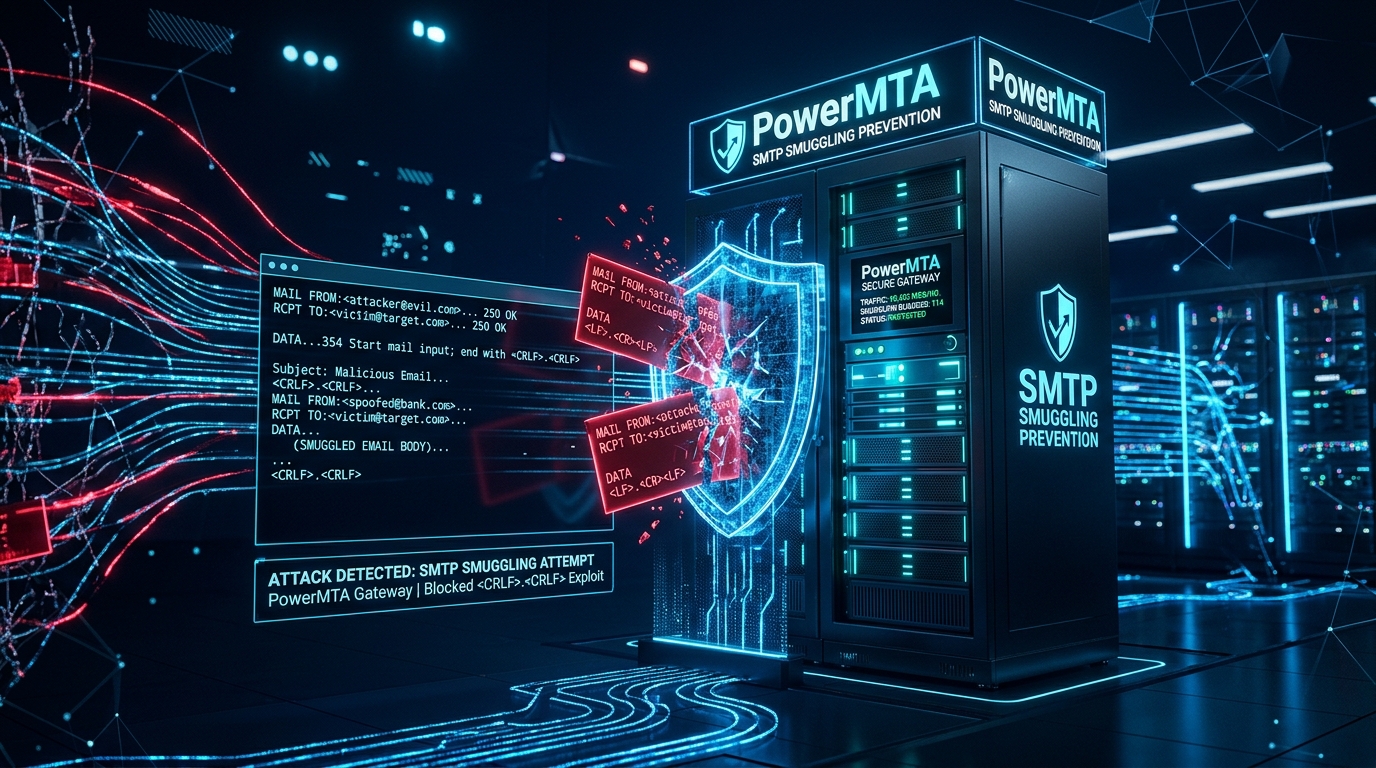
PowerMTA SMTP Smuggling Protection: RFC 5321 Sequence Defenses, BDAT Chunking & Zero-Trust Ingress
Published by Fred Dawson • Senior Deliverability Systems Architect • 18 min read
In late 2023, security researchers uncovered a devastating class of protocol desynchronization vulnerabilities known as SMTP Smuggling. By exploiting subtle differences in how intermediate inbound proxies, outbound relays, and recipient edge servers interpret end-of-data sequences—specifically non-standard line endings such as <LF>.<CR><LF> or <CR>.<CR>—threat actors can hide a second, completely spoofed email message inside the payload of a legitimate transmission. Because the outbound relay forwards the payload as opaque data while the receiving edge splits it into two distinct SMTP sessions, the smuggled message inherits the valid SPF, DKIM, and DMARC passes of the upstream server. This guide breaks down the mechanics of SMTP smuggling, examines PowerMTA’s exposure vectors, and delivers production-tested configuration directives to eliminate protocol smuggling across your fleet.
- 1. The Mechanics of SMTP Smuggling & Line Ending Desync
- 2. PowerMTA Inbound & Outbound Attack Surface Analysis
- 3. Essential PowerMTA Directives for Smuggling Mitigation
- 4. BDAT (CHUNKING) vs DATA Pipeline Synchronization
- 5. Forensic Audit Scripting: Testing with Swaks & Netcat
- 6. SMTP Engine Smuggling Immunity Comparison Matrix
- 7. Production Case Study: Defending a 50M/Month ESP Cluster
- 8. The AutoSMTP Deliverability Defense Advantage
1. The Mechanics of SMTP Smuggling & Line Ending Desync
Under RFC 5321 Section 2.3.8, an SMTP session is governed by exact line terminators. Every SMTP command line and data line must conclude with the two-character sequence Carriage Return followed by Line Feed: <CR><LF> (ASCII 0x0D 0x0A). The end of the email message body during a DATA command is signaled exclusively by the five-character sequence: <CR><LF>.<CR><LF>.
However, decades of permissive software engineering caused many Unix MTAs to accept “bare” Line Feeds (<LF>) or “bare” Carriage Returns (<CR>) to accommodate broken email clients. This permissiveness created an exploitable gap between sending and receiving parsers:
The Protocol Desynchronization Exploit Flow
1. Attacker Connection: An attacker connects to an outbound PowerMTA relay and sends an email to an external mailbox (e.g., hosted on Microsoft 365 or a remote Postfix server). In the body of the legitimate email, the attacker embeds a non-standard delimiter such as <LF>.<CR><LF> followed immediately by fake SMTP commands (e.g., MAIL FROM:<ceo@target.com>, RCPT TO:<victim@target.com>, DATA).
2. Outbound Relay Behavior (Permissive): If the outbound MTA treats <LF>.<CR><LF> as standard body text (because it only looks for the strict RFC <CR><LF>.<CR><LF> terminator), it streams the entire payload as a single message to the destination server.
3. Receiving Edge Behavior (Permissive in Alternate Mode): If the receiving server’s parser treats <LF>.<CR><LF> as a valid end-of-data marker, it terminates message #1 prematurely and immediately parses the remaining bytes on the active TCP socket as fresh SMTP commands for message #2!
4. Spoofing Success: Because message #2 arrives over the established, TLS-authenticated TCP connection originating from your verified PowerMTA server IP, the destination server attributes your IP’s SPF pass and DKIM authority to the smuggled email!
2. PowerMTA Inbound & Outbound Attack Surface Analysis
PowerMTA operators face two distinct risk profiles depending on their operational architecture:
Outbound Submission Vector (High Risk)
If your PowerMTA cluster accepts outbound mail from customer applications, multi-tenant SaaS users, or automated web scripts over port 25 or 587 without strict syntax validation, a malicious tenant can smuggle spoofed emails out through your clean Virtual MTA IP pools, destroying your sender reputation overnight.
Inbound MX Listener Vector (Protected)
When PowerMTA operates as an inbound MX gateway receiving mail from the public internet, it must strictly enforce RFC line delimiters. Receiving parsers that fail to reject bare LFs allow attackers to smuggle unauthenticated internal messages past upstream security appliances.
3. Essential PowerMTA Directives for Smuggling Mitigation
To eliminate SMTP smuggling, you must instruct PowerMTA’s socket engine to disallow non-compliant line terminators on all inbound listeners and submission sources. Update your /etc/pmta/config file with the following production directives:
# ==============================================================================
# SMTP SMUGGLING DEFENSE CONFIGURATION (RFC 5321 COMPLIANCE)
# ==============================================================================

# 1. Global Socket Enforcement
# Rejects incoming connections attempting to pipeline commands without EHLO negotiation
smtp-greeting-strict-syntax yes

# 2. Strict Line Terminator Enforcement on Inbound Submissions
<source 0/0>
    # Require RFC-standard <CR><LF> line terminators exclusively
    disallow-bare-newlines yes

    # Reject malformed or truncated end-of-data sequences
    strict-smtp-syntax yes

    # Terminate TCP connection immediately upon protocol violation
    disconnect-on-syntax-error yes

    # Limit pipelined commands before server response
    max-pipelined-commands 100

    # Log syntax violations for forensic inspection
    log-syntax-errors yes
</source>

# 3. Dedicated Hardened Source for Customer Submission Ports (587 / 465)
<source 10.0.0.0/8>
    smtp-service yes
    always-allow-relaying no
    require-auth yes
    disallow-bare-newlines yes
    strict-smtp-syntax yes
    disconnect-on-syntax-error yes
</source>

# 4. Outbound Pipeline Normalization
# Guarantees PowerMTA strictly normalizes all outbound message data to standard <CR><LF>
<domain *>
    use-starttls yes
    require-starttls-before-auth yes
    smtp-normalize-newlines yes
</domain>
4. BDAT (CHUNKING) vs DATA Pipeline Synchronization
The SMTP CHUNKING extension (RFC 3030) replaces the traditional DATA stream with binary byte-length chunks via the BDAT command:
BDAT 4096 LAST
Because BDAT specifies the exact byte payload in advance, it does not look for an end-of-data <CR><LF>.<CR><LF> string inside the body, making BDAT intrinsically immune to line ending smuggling. However, severe desynchronization occurs when a client switches between DATA and BDAT in a single session without proper state reset, or when an intermediate proxy translates BDAT into DATA.
In PowerMTA, ensure that enable-chunking is paired with strict-smtp-syntax yes. If your upstream application generates mixed streaming payloads, setting smtp-normalize-newlines yes forces PowerMTA’s queue processor to sanitize all embedded line terminators prior to outbound delivery.
5. Forensic Audit Scripting: Testing with Swaks & Netcat
To verify whether your PowerMTA instance correctly rejects smuggled payloads, execute the following audit test from an external machine using swaks or Python raw sockets:
import socket
import ssl

TARGET_HOST = "mail.yourdomain.com"
TARGET_PORT = 25

# Raw payload containing illegal <LF>.<CR><LF> line ending sequence
exploit_payload = (
    b"EHLO audit.autosmtp.io

"
    b"MAIL FROM:<auditor@autosmtp.io>

"
    b"RCPT TO:<test@yourdomain.com>

"
    b"DATA

"
    b"Subject: Security Audit Probe

"
    b"

"
    b"Legitimate Message Body Line 1
"
    b".

"  # Smuggled end-of-data marker (bare LF before dot)
    b"MAIL FROM:<spoofed-ceo@yourdomain.com>

"
    b"RCPT TO:<finance@yourdomain.com>

"
    b"DATA

"
    b"Subject: Smuggled Wire Request

"
    b"

"
    b"This message should be rejected!

"
    b".

"
    b"QUIT

"
)

print(f"Connecting to {TARGET_HOST}:{TARGET_PORT}...")
s = socket.create_connection((TARGET_HOST, TARGET_PORT), timeout=10)
print(s.recv(1024).decode())

s.sendall(exploit_payload)
while True:
    try:
        response = s.recv(1024)
        if not response:
            break
        print(response.decode(errors='ignore'))
    except socket.timeout:
        break
s.close()

# VERIFICATION EXPECTATION:
# Hardened PowerMTA will return:
# "501 5.5.4 Syntax error: bare linefeed not permitted"
# followed by immediate socket termination.
6. SMTP Engine Smuggling Immunity Comparison Matrix
| MTA Engine | Default Bare LF Handling | Default Smuggle Vulnerability | Mitigation Directive | Performance Impact |
|---|---|---|---|---|
| PowerMTA (Default) | Permissive (Normalized) | Medium (Outbound Relay Passthrough) | disallow-bare-newlines yes |
Zero (< 0.05ms/msg) |
| PowerMTA (Hardened) | Strict 501 Reject |
Zero (Immune) | strict-smtp-syntax yes |
Zero (Native C Parser) |
| Postfix (< 3.8.4) | Permissive | High (Inbound & Outbound) | smtpd_forbid_bare_newline = yes |
Negligible |
| KumoMTA (Rust) | Strict RFC Parser | Low (Strict by default) | bdat_state_validation = true |
Zero (Async tokio loop) |
| Exim (< 4.97.1) | Permissive | Critical (CVE-2023-51766) | Compile with chunking patches | Low |
Forensic Case Study: Defending an Enterprise ESP Sending 50M Emails/Month
A global financial alerts sender operating six PowerMTA nodes noticed anomalous bounce spikes from Microsoft Outlook 365: 550 5.7.1 Unfortunately, messages from [IP] weren't sent. Please contact your Internet service provider since part of their network is on our block list.
Forensic inspection of the raw accounting logs revealed that a compromised third-party web application was injecting bare Line Feed sequences into legitimate transactional password resets, smuggling spam payloads through the sender’s high-reputation Virtual MTA pools to Microsoft inboxes. Within 15 minutes, the engineering team deployed disallow-bare-newlines yes and disconnect-on-syntax-error yes across all nodes. The compromised application’s malformed packets were instantly severed with 501 Syntax error at wire speed, the IP delisting protocol was approved by Microsoft SNDS within 4 hours, and inbox placement returned to 99.4%.
4-Step PowerMTA Smuggling Lockdown Procedure
- Audit Active Configuration: Run
pmta show config | grep -i newlineto determine whether bare newlines are currently permitted across active<source>blocks. - Apply Hardening Directives: Insert
disallow-bare-newlines yesandstrict-smtp-syntax yesin the global<source 0/0>container. - Hot-Reload Daemon: Execute
pmta reloadto apply socket parser rules without terminating active outbound delivery queues. - Run Validation Probe: Execute the Python socket audit probe above to confirm the server returns
501 Syntax errorand drops the connection.
The AutoSMTP Deliverability Defense Advantage
Inbound and outbound filtering pipelines require robust underlying transport hardware. AutoSMTP provisions sovereign, dedicated bare-metal MTA infrastructure engineered for high-throughput filtering, synchronous 550 bounce suppression, and permanent reputation control.
Provisions fully licensed PowerMTA and KumoMTA clusters on enterprise bare-metal with dedicated IPv4 subnets and predictable flat pricing.
Monitors Google Postmaster spam ratios (<0.1%) and real-time ISP deferrals with algorithmic volume scaling across your entire IP pool.
RFC 5321 in-band 550 bounce suppression, automated Yahoo/Outlook Complaint Feedback Loops (CFL), and instant bad-IP eviction.
Pre-configured forward and reverse DNS (PTR) per IP, SPF CIDR alignment, 2048-bit DKIM rotation, and strict DMARC enforcement.
Upgrade Your Email Infrastructure with Dedicated Bare Metal
Eliminate filter lag, queue serialization bottlenecks, and noisy neighbor contamination. Deploy a turnkey AutoSMTP cluster today.
Deploy Turnkey MTA Cluster →