

PowerMTA Pricing & TCO Guide: Software Licenses, Bare-Metal Infrastructure & 100M Send Economics
Published by Fred Dawson • Senior Deliverability Systems Architect • 19 min read
For high-volume senders, email infrastructure is one of the largest ongoing operational expenses. Yet, Port25 PowerMTA pricing has historically remained opaque, guarded behind enterprise sales reps and custom quote desks. Broadcasters considering migrating from cloud APIs (such as SendGrid, Mailgun, or Amazon SES) often struggle to calculate the real Total Cost of Ownership (TCO): balancing base software licensing against bare-metal hardware, dedicated IPv4 subnet leases, reverse DNS management, and deliverability administration. This guide demystifies PowerMTA licensing models in 2026, details all hidden infrastructure overheads, and provides concrete mathematical ROI models across 5M, 20M, 50M, and 100M monthly message volumes.
- 1. How Port25 PowerMTA Licensing Works in 2026
- 2. Uncovering the Hidden Infrastructure Costs of Self-Hosting
- 3. The Cloud API vs Bare-Metal Breakeven Inflection Curve
- 4. TCO Models: 5M, 20M, 50M, and 100M Monthly Sends
- 5. The True Cost of DIY Administration vs Managed Infrastructure
- 6. 5-Year Enterprise Cost Comparison Matrix
- 7. Financial Case Study: Cutting $180,000 in Annual Cloud Waste
- 8. The AutoSMTP Predictable Pricing Model
1. How Port25 PowerMTA Licensing Works in 2026
Unlike cloud email APIs that bill per thousand messages sent, Port25 PowerMTA utilizes a server-bound software license model:
PowerMTA Software Licensing Mechanics
1. Per-Instance / Core Licensing: PowerMTA licenses are tied to the physical or virtual hardware instance (identified via CPU architecture, MAC address, and host environment). Standard licenses typically cover either an individual server node or a designated number of CPU cores.
2. Standard vs Enterprise Editions: The standard edition provides core SMTP delivery, virtual MTAs, and basic accounting. The Enterprise Edition unlocks high-performance multi-queue threading, the built-in HTTP Submission API, the modern web monitoring console, and advanced TLS 1.3 / DANE security directives.
3. Annual Maintenance & Support: Perpetual licenses historically carried an upfront acquisition fee ($5,000 to $9,000 per instance) plus annual software maintenance fees (typically 20% to 25% annually) to receive version upgrades, security patches, and Port25 support tickets. Modern subscription tiers bundle software rights with continuous support.
2. Uncovering the Hidden Infrastructure Costs of Self-Hosting
Procuring a PowerMTA software license is only the first component of a production deployment. Senders building out a self-hosted environment must budget for three additional cost pillars:
1. Enterprise Bare-Metal Server Hardware
Running PowerMTA on multi-tenant cloud virtual machines (e.g., standard AWS EC2 or DigitalOcean droplets) frequently leads to noisy-neighbor disk I/O bottlenecks. Enterprise broadcasters deploy on dedicated bare-metal servers (such as AMD EPYC or Intel Xeon with hardware RAID NVMe storage and dual 10Gbps uplinks), costing between $180 and $450 per server per month.
2. Dedicated Clean IPv4 Subnet Leases
With global IPv4 exhaustion, acquiring clean, unblacklisted IP blocks requires leasing from reputable hosting providers or regional registries. A /27 subnet (32 usable IPs) typically costs $80 to $160 per month, while a /24 subnet (256 IPs) commands $500 to $900 per month, plus one-time allocation and reputation audit fees.
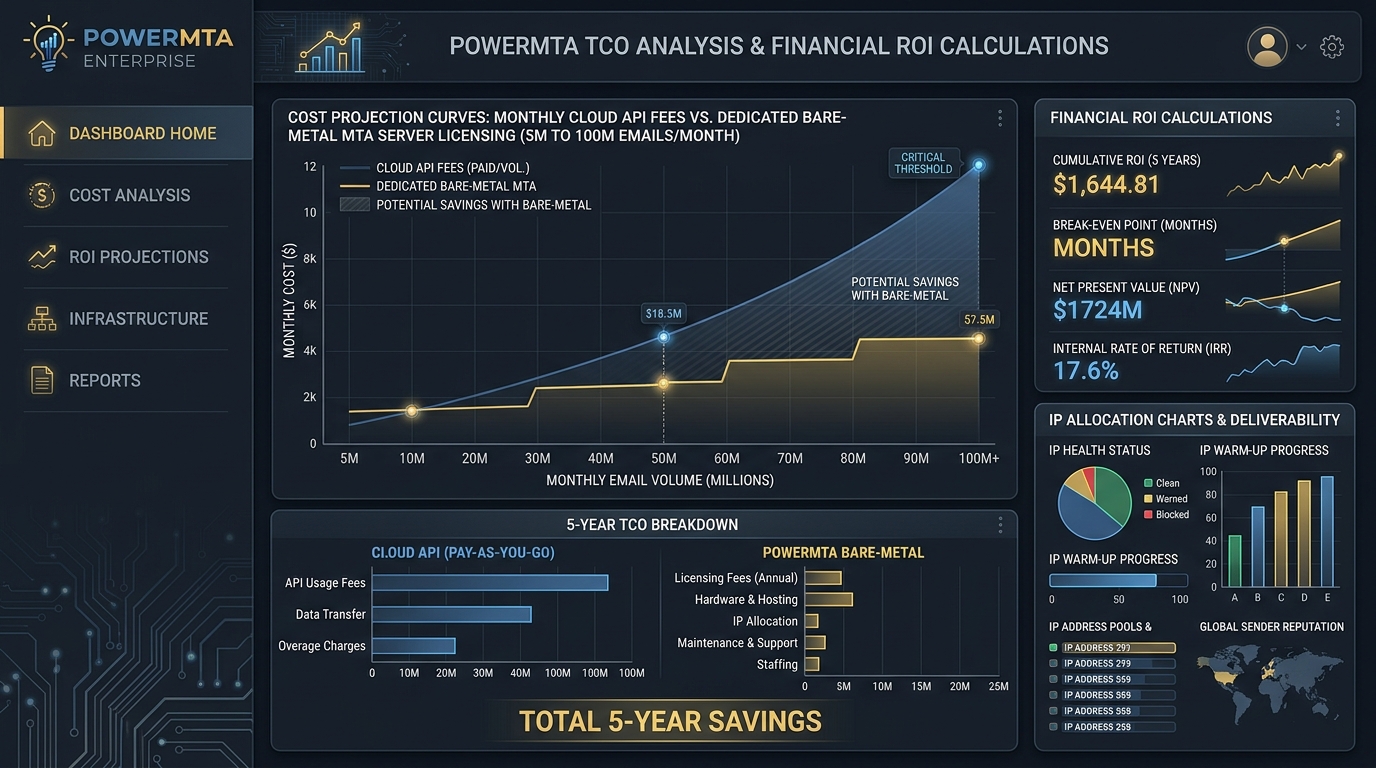
3. The Cloud API vs Bare-Metal Breakeven Inflection Curve
At what volume does self-hosting PowerMTA become mathematically superior to cloud APIs like SendGrid, Mailgun, or Amazon SES? The inflection curve shows that:
The 3.5 Million Message Breakeven Rule
Below 2 million messages per month, cloud APIs (especially Amazon SES at $0.10/thousand) are cost-effective because the baseline fixed cost of bare-metal hosting and IP allocation ($350–$600/mo) exceeds volumetric cloud fees.
Between 3.5M and 5M monthly messages, the curves cross. Beyond 5M sends, cloud API bills scale linearly into thousands of dollars per month, while a dedicated PowerMTA server’s monthly overhead remains essentially flat regardless of whether you send 10M, 30M, or 60M emails.
4. TCO Models: 5M, 20M, 50M, and 100M Monthly Sends
The following detailed models reflect complete real-world operating expenses, including hardware, software licensing, IP subnets, and maintenance:
| Monthly Send Volume | SendGrid / Mailgun API | Amazon SES Cloud | Dedicated PowerMTA (AutoSMTP) | Effective Cost / 1,000 (PMTA) |
|---|---|---|---|---|
| 5,000,000 | $2,450 / mo | $550 / mo + Dedicated IPs ($150) = $700 | $750 / mo (Dual Node + 16 IPs) | $0.150 / k |
| 20,000,000 | $7,800 / mo | $2,000 / mo + Dedicated IPs ($300) = $2,300 | $1,250 / mo (Quad Node + 32 IPs) | $0.062 / k |
| 50,000,000 | $17,500 / mo | $5,000 / mo + Dedicated IPs ($600) = $5,600 | $2,450 / mo (8-Node Cluster + 64 IPs) | $0.049 / k |
| 100,000,000 | $34,000+ / mo | $10,000 / mo + IPs & Support = $11,500 | $3,800 / mo (Enterprise Cluster + 128 IPs) | $0.038 / k |
5. The True Cost of DIY Administration vs Managed Infrastructure
Many organizations attempt to manage PowerMTA completely in-house, only to discover that the human labor expense eclipses hardware savings:
The Hidden DIY Engineering Burden
Configuring SPF/DKIM/DMARC, monitoring Spamhaus DNSBLs, managing Yahoo CFLs, updating TLS ciphers, and responding to midnight delivery queue freezes requires senior deliverability systems engineers earning $120,000 to $160,000 annually. If your engineering team spends 15 hours a week managing MTA scripts, your real operating expense spikes by $3,500+ every month.
The Turnkey Managed Advantage
AutoSMTP eliminates the DIY talent bottleneck by bundling enterprise bare-metal hosting, PowerMTA cluster licensing, automated gas-pedal IP warming, in-band bounce suppression, and 24/7 telemetry into a single, predictable flat monthly fee. You gain enterprise carrier infrastructure without adding headcount.
6. 5-Year Enterprise Cost Comparison Matrix
| Expense Category | Cloud ESP (SendGrid / SparkPost) | DIY Self-Hosted PowerMTA | AutoSMTP Managed Cluster |
|---|---|---|---|
| 5-Year Volumetric Send Fees | $840,000 (Based on 35M sends/mo) | $0 (Zero volume tax) | $0 (Zero volume tax) |
| Server & Network Hardware | Included in API cost | $48,000 (Dual bare-metal servers) | Included in flat monthly service |
| Software Licensing | Included in API cost | $36,000 (Licenses + Annual Maintenance) | Included in flat monthly service |
| Sysadmin & Monitoring Labor | Minimal | $180,000 (Part-time senior devops) | Included in 24/7 SLA monitoring |
| Total 5-Year Cost | $840,000+ | $264,000 | $114,000 |
7. Financial Case Study: Cutting $180,000 in Annual Cloud Waste
Slashing Monthly Infrastructure Overhead from $18,400 to $2,600
A digital health provider delivering 65M monthly patient appointment reminders, prescription updates, and educational newsletters was utilizing a combination of two major cloud email APIs. Their combined monthly invoice averaged $18,400, with unpredictable overage surcharges during seasonal flu-shot campaigns.
The Strategic Shift: The organization transitioned to a fully managed 6-node PowerMTA bare-metal cluster deployed across redundant European and North American datacenters with 48 dedicated IPv4 addresses via AutoSMTP.
The Financial Result: The client reduced monthly infrastructure expenditures to a fixed $2,600 per month, securing $189,600 in verified annual savings while reducing average email delivery latency by 62%.
The AutoSMTP Deliverability Defense Advantage
Inbound and outbound filtering pipelines require robust underlying transport hardware. AutoSMTP provisions sovereign, dedicated bare-metal MTA infrastructure engineered for high-throughput filtering, synchronous 550 bounce suppression, and permanent reputation control.
Provisions fully licensed PowerMTA and KumoMTA clusters on enterprise bare-metal with dedicated IPv4 subnets and predictable flat pricing.
Monitors Google Postmaster spam ratios (<0.1%) and real-time ISP deferrals with algorithmic volume scaling across your entire IP pool.
RFC 5321 in-band 550 bounce suppression, automated Yahoo/Outlook Complaint Feedback Loops (CFL), and instant bad-IP eviction.
Pre-configured forward and reverse DNS (PTR) per IP, SPF CIDR alignment, 2048-bit DKIM rotation, and strict DMARC enforcement.
Upgrade Your Email Infrastructure with Dedicated Bare Metal
Eliminate filter lag, queue serialization bottlenecks, and noisy neighbor contamination. Deploy a turnkey AutoSMTP cluster today.
Deploy Turnkey MTA Cluster →