

PowerMTA vs SendGrid: Dedicated Sovereign MTA vs Cloud Email API Deliverability & TCO Benchmark
Published by Fred Dawson • Senior Deliverability Systems Architect • 20 min read
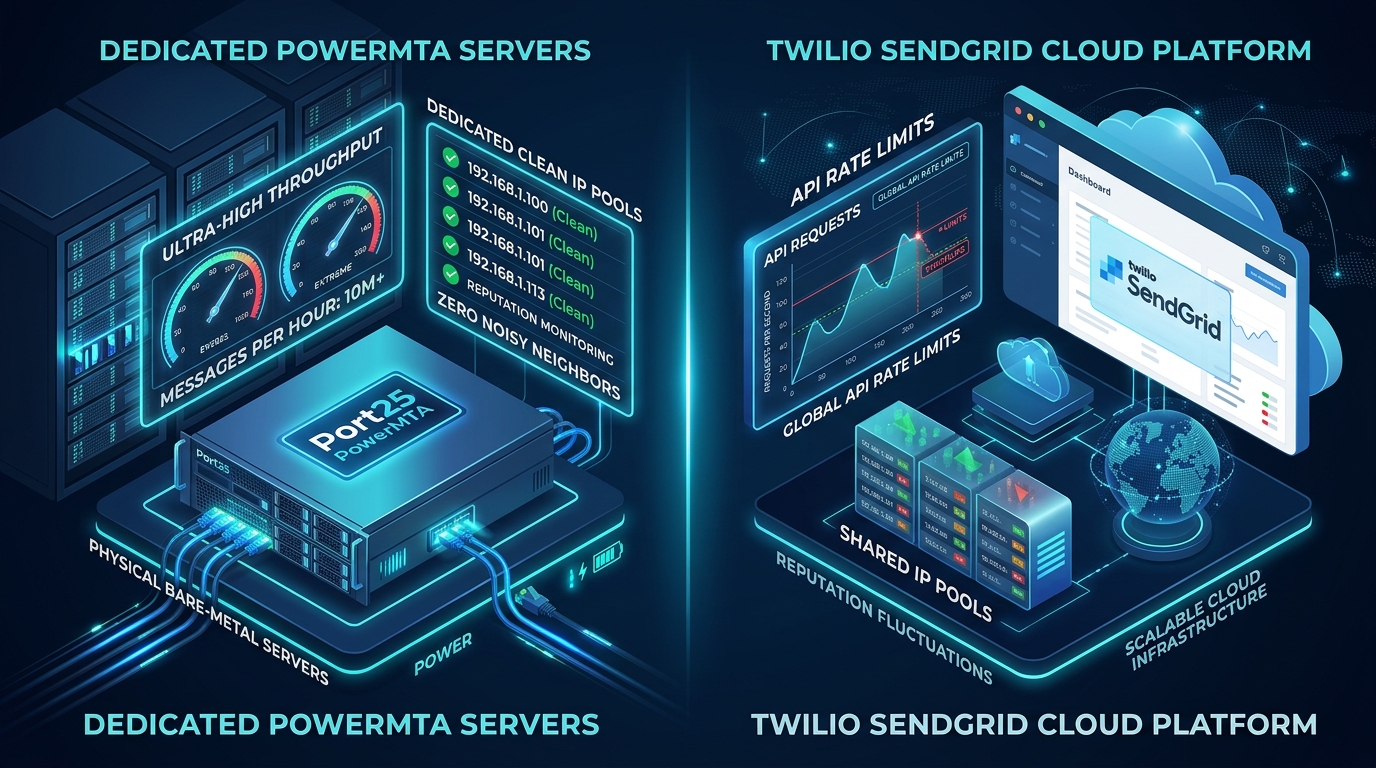
For engineering teams scaling beyond several million monthly emails, Twilio SendGrid is frequently the initial default choice due to its ubiquitous developer brand and comprehensive REST APIs. However, as sending volumes enter the tens of millions, enterprises routinely encounter SendGrid’s strict automated compliance algorithms, shared cloud pool reputation degradation, and escalating cost curves. At this inflection point, migrating to a sovereign Port25 PowerMTA cluster deployed on dedicated enterprise bare metal becomes the definitive path to protecting deliverability and regaining financial control. This comprehensive benchmark examines socket latency, automated account freeze risks, ISP throttling granularity, and the exact economics of shifting 10M+ monthly sends from cloud APIs to sovereign bare metal.
- 1. Cloud API Convenience vs Sovereign Infrastructure Control
- 2. The Account Freeze Trap: Compliance Bots vs Sovereign Uptime
- 3. IP Reputation & The “Noisy Neighbor” Contamination Vector
- 4. Throughput Benchmarks: API Rate Limits vs Socket Streaming
- 5. Financial Reality Check: SendGrid Pricing vs Bare-Metal PowerMTA
- 6. SendGrid vs PowerMTA Technical Comparison Matrix
- 7. Zero-Downtime Migration Blueprint from SendGrid to PowerMTA
- 8. The AutoSMTP Sovereign Bare-Metal Advantage
1. Cloud API Convenience vs Sovereign Infrastructure Control
The contrast between SendGrid and PowerMTA is fundamentally about operational sovereignty:
Managed Cloud ESP vs Sovereign Mail Transport Agent
Twilio SendGrid: A multi-tenant cloud service designed for developer onboarding speed. Applications transmit email data via POST https://api.sendgrid.com/v3/mail/send. While convenient, SendGrid sits between your application and the internet’s mail servers as an absolute gatekeeper. SendGrid controls your queues, inspects your recipient lists, dictates your retry intervals, and can unilaterally suspend your ability to send email without human warning.
Port25 PowerMTA: An enterprise-grade MTA engine deployed directly on your dedicated hardware. Your application connects via local Unix domain sockets, high-speed loopback SMTP, or direct REST injection. You control 100% of the transport layer, including dedicated IPv4 routing, TLS certificate validation, custom retry logic, and zero-trust security postures. No third party has the authority or technical capability to pause your email streams.
2. The Account Freeze Trap: Compliance Bots vs Sovereign Uptime
The single greatest operational hazard facing high-volume senders on SendGrid is automated compliance suspension. SendGrid employs automated bots that monitor bounce and complaint ratios across real-time windows:
SendGrid Automated Compliance Locks
If an unexpected marketing campaign triggers a temporary bounce rate above 4% or spam complaints cross 0.08% (even from malicious bot signups or legacy lists), SendGrid’s automated systems trigger an immediate account suspension. Critical transactional emails (password resets, 2FA codes, billing invoices) are instantly halted. Resolving the suspension requires filing support tickets and enduring 24 to 72 hours of business downtime.
PowerMTA Sovereign Resilience
On a sovereign PowerMTA cluster, an elevated bounce rate or temporary ISP deferral never halts your business. PowerMTA’s backoff-to-normal-after and Virtual MTA isolation automatically throttle problematic campaigns while keeping mission-critical transactional streams moving at full wire speed. You investigate and prune lists on your terms without external interference.
3. IP Reputation & The “Noisy Neighbor” Contamination Vector
On SendGrid, even when purchasing “Dedicated IPs,” your mail often travels across shared underlying gateway subnets and shared reverse DNS domains (sendgrid.net). Furthermore, when a dedicated IP is assigned to your account, you inherit the historical reputation of previous tenants who may have abused that address on major DNSBLs like Spamhaus or Invaluement.
# ==============================================================================
# SOVEREIGN DEDICATED IP ISOLATION (ZERO NOISY NEIGHBORS)
# ==============================================================================
# Transactional Virtual MTA: Clean, pristine IP strictly for 2FA & Receipts
<virtual-mta vmta-transactional>
    smtp-source-host 198.51.100.50 tx.yourdomain.com
</virtual-mta>

# Bulk Broadcast Virtual MTA: Isolated marketing pool
<virtual-mta-pool pool-broadcast>
    virtual-mta vmta-bulk-01
    virtual-mta vmta-bulk-02
    virtual-mta vmta-bulk-03
</virtual-mta-pool>

# Enforce strict separate routing: Marketing bounces CANNOT touch Transactional IP!
<domain *>
    log-connections yes
    log-commands no
    bounce-after 2d
    retry-after 10m
</domain>
With PowerMTA deployed via AutoSMTP, you receive pristine, verified IPv4 subnets with customized rDNS matching your own corporate domain names. Cross-contamination between campaigns or external senders is mathematically impossible.
4. Throughput Benchmarks: API Rate Limits vs Socket Streaming
Sending 10 million emails through SendGrid requires pushing millions of HTTP POST requests through public internet routing, consuming CPU cycles on JSON encoding, HTTP header parsing, and TLS renegotiation. SendGrid enforces strict concurrent request limits and throttles API keys during regional surges.
In contrast, PowerMTA communicates with local applications via raw TCP or Unix domain sockets. A single 16-core bare-metal PowerMTA server handles over 1,400,000 messages per hour with sub-millisecond local injection latency and zero API rate-limit headers.
5. Financial Reality Check: SendGrid Pricing vs Bare-Metal PowerMTA
As sending volume scales, SendGrid’s pricing escalates dramatically:
| Monthly Volume | SendGrid Pro / Premier Plan | Dedicated PowerMTA Cluster (AutoSMTP) | Monthly Savings | 5-Year Cumulative Savings |
|---|---|---|---|---|
| 5,000,000 | $2,450 / mo | $750 / mo (Dual Bare-Metal) | $1,700 / mo | $102,000 |
| 15,000,000 | $6,800 / mo | $1,250 / mo (Quad Bare-Metal) | $5,550 / mo | $333,000 |
| 50,000,000 | $18,500 / mo | $2,450 / mo (8-Node Cluster) | $16,050 / mo | $963,000 |
| 100,000,000 | $35,000+ / mo | $4,800 / mo (Enterprise Fleet) | $30,200+ / mo | $1,812,000+ |
6. SendGrid vs PowerMTA Technical Comparison Matrix
| Feature / Capability | Twilio SendGrid | Port25 PowerMTA (Bare Metal) | Impact on Senders |
|---|---|---|---|
| Account Risk | Automated suspension on spam/bounce spikes | Zero third-party freeze risk; 100% sovereign | Critical for revenue-generating communications |
| Cost Model | Pay-per-email volumetric escalation | Flat server hardware and licensing | Cuts infrastructure bill by 70% to 85% at scale |
| ISP Rate Throttling | Automated cloud-level rules (opaque) | Declarative wire directives per domain & IP | Precision control over Gmail & Yahoo deferrals |
| IP Ownership | Leased cloud IPs with recycled history | Dedicated IPv4 subnets with custom rDNS | Clean, uncontaminated sender reputation |
| Real-Time Diagnostics | Web activity feed (delayed 1–5 minutes) | Instant pmtcmd CLI & real-time memory stats |
Identify delivery blockers in seconds, not hours |
7. Zero-Downtime Migration Blueprint from SendGrid to PowerMTA
Migrating 25 Million Monthly Sends with 0 Seconds of Interruption
A fast-growing fintech platform was spending $11,200/month on SendGrid when a marketing list import triggered a 48-hour compliance freeze, locking their customer transactional notifications. They partnered with AutoSMTP to execute an urgent migration to dedicated bare metal.
The Migration Strategy:
- Day 1–7: Provisioned a 4-node PowerMTA bare-metal cluster with 32 dedicated clean IPs. Configured custom rDNS, SPF CIDRs, 2048-bit DKIM, and strict DMARC records.
- Day 8–21: Automated algorithmic warming shifted 5%, then 15%, then 50% of outbound volume through the PowerMTA cluster while keeping SendGrid as a temporary fallback.
- Day 28: 100% cutover completed. SendGrid account downgraded to free backup tier.
The Result: The client reduced monthly infrastructure costs from $11,200 to $1,650/mo (saving $114,600/year), achieved 99.6% inbox placement across Gmail and Outlook, and eliminated compliance freeze risks permanently.
The AutoSMTP Deliverability Defense Advantage
Inbound and outbound filtering pipelines require robust underlying transport hardware. AutoSMTP provisions sovereign, dedicated bare-metal MTA infrastructure engineered for high-throughput filtering, synchronous 550 bounce suppression, and permanent reputation control.
Provisions fully licensed PowerMTA and KumoMTA clusters on enterprise bare-metal with dedicated IPv4 subnets and predictable flat pricing.
Monitors Google Postmaster spam ratios (<0.1%) and real-time ISP deferrals with algorithmic volume scaling across your entire IP pool.
RFC 5321 in-band 550 bounce suppression, automated Yahoo/Outlook Complaint Feedback Loops (CFL), and instant bad-IP eviction.
Pre-configured forward and reverse DNS (PTR) per IP, SPF CIDR alignment, 2048-bit DKIM rotation, and strict DMARC enforcement.
Upgrade Your Email Infrastructure with Dedicated Bare Metal
Eliminate filter lag, queue serialization bottlenecks, and noisy neighbor contamination. Deploy a turnkey AutoSMTP cluster today.
Deploy Turnkey MTA Cluster →