

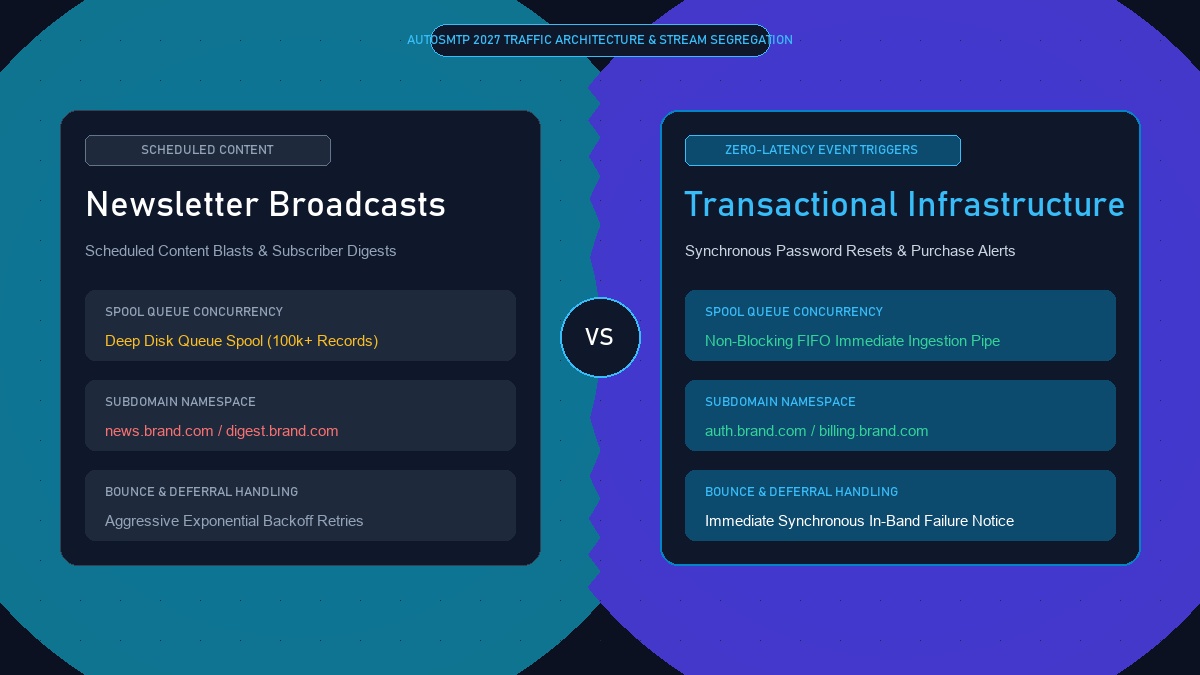
Newsletter vs Transactional Email Infrastructure: 2027 Stream Separation Architecture & Delivery Economics
Executive Summary: Digital publishers, media brands, and SaaS companies operate two fundamentally distinct messaging channels: editorial newsletters (mass scheduled broadcasts sent to 50,000–1,000,000+ subscribers simultaneously) and transactional infrastructure (event-driven user notifications, password resets, and subscription billing receipts). Routing morning newsletter editions through the same mail transfer agent (MTA) or IP address as transactional triggers creates immediate delivery bottlenecks. A 300,000-subscriber morning dispatch fills outbound disk queues and triggers Gmail rate-limit deferrals, causing password reset links and login tokens to back up for hours. Furthermore, natural email list decay (20% annually) exposes newsletter streams to spam traps and spam complaints, threatening the deliverability of high-value transactional receipts. Decoupling newsletter spools from transactional relays via dedicated subdomains, isolated /29 IPv4 pools, and multi-tier MTAs is essential for publisher survival.
- 1. The Publisher Dilemma: Mass Editorial Blasts vs Synchronous Auth Relays
- 2. Newsletter Delivery Mechanics: Burst Windows & Disk Spool Ingestion
- 3. Transactional Delivery Mechanics: Zero-Wait In-Memory Sockets
- 4. Reputation Decay Dynamics: Why Newsletters Threaten Transactional Trust
- 5. Subdomain Namespace Architecture: news.brand.com vs auth.brand.com
- 6. Hybrid Architectural Patterns: Self-Hosted Frontend + Bare-Metal MTA
- 7. Unit Cost Economics: Metered Cloud CPMs vs Sovereign Bare-Metal Appliances
- 8. Production Case Study: Digital Media House Slicing Password Latency
- 9. Multi-Spool PowerMTA & KumoMTA Implementation Directives
- 10. Strategic Decision Matrix & Infrastructure Checklist
1. The Publisher Dilemma: Mass Editorial Blasts vs Synchronous Auth Relays
For modern content companies, media networks, and SaaS platforms, email represents both the primary marketing audience vehicle and the core transactional authentication pipeline. However, treating these two workloads as identical network traffic is an engineering flaw:
- Editorial Newsletters: Dispatched in concentrated, bursty intervals (e.g., 08:00 AM Eastern every Tuesday). Outbound volume spikes from 0 to 500,000 messages within seconds. Receivers like Gmail, Yahoo, and Outlook throttle inbound connections to protect their MX servers, deferring messages with
421 4.7.28codes. - Transactional Alerts: Transmitted continuously throughout the day in response to discrete user events. These messages carry immediate operational dependencies: if a password reset or magic login link takes longer than 60 seconds to arrive, the user abandons the site.
2. Newsletter Delivery Mechanics: Burst Windows & Disk Spool Ingestion
When an editorial platform initiates a newsletter broadcast, the sending application generates hundreds of thousands of MIME messages. In an unsegregated architecture, these messages flood the local MTA’s spool directory on disk. Even with high-speed NVMe arrays, queuing 500,000 files creates extensive file descriptor contention and memory utilization.
Because major mailbox providers cap connection concurrency (for example, Google enforces a limit of 40 simultaneous TCP connections per IP), the MTA must queue messages on disk and retry deferred recipients using exponential backoff schedules over several hours. During this period, the outbound IP’s connection slots are 100% saturated with newsletter traffic.
3. Transactional Delivery Mechanics: Zero-Wait In-Memory Sockets
In contrast, transactional email requires a zero-wait, non-blocking ingestion path. A user completing a purchase or requesting a two-factor authentication code cannot tolerate being placed at the tail end of a 500,000-message disk queue. Transactional pipelines must operate over reserved, high-priority in-memory buffers that establish dedicated TCP sockets to destination MX servers in under 500 milliseconds.
4. Reputation Decay Dynamics: Why Newsletters Threaten Transactional Trust
Newsletters suffer from natural subscriber list decay. Industry telemetry confirms that opt-in email lists decay by 20% to 25% annually as subscribers change jobs, abandon old mailboxes, or stop opening messages. Over time, unpruned newsletter lists hit pristine spam traps deployed by Spamhaus, Barracuda, and Abusix.
Furthermore, human behavior differs across email types: subscribers routinely click “Mark as Spam” on newsletters simply because they no longer wish to read them, rather than using the unsubscribe link. If newsletter complaint rates cross Google’s 0.10% spam threshold, Google’s automated postmaster filters downgrade the domain’s reputation. If password resets share that domain, they are immediately diverted to the Spam folder.
5. Subdomain Namespace Architecture: news.brand.com vs auth.brand.com
The first mandatory step in publisher email architecture is strict subdomain delegation:
Subdomain: auth.branddomain.com or notify.branddomain.com
Traffic Type: 1:1 user triggers, password resets, billing receipts, 2FA codes.
Reputation Metrics: 70%+ open rates, zero unsubscribes, <0.005% complaints. Consistently awarded “High” reputation in Google Postmaster Tools.
Subdomain: news.branddomain.com or digest.branddomain.com
Traffic Type: Daily content digests, marketing promos, creator newsletters.
Reputation Metrics: 25%–35% open rates, compliant RFC 8058 1-click unsubscribe headers, actively monitored spam complaint ratios.
6. Hybrid Architectural Patterns: Self-Hosted Frontend + Bare-Metal MTA
High-volume publishers often make the mistake of using expensive developer transactional APIs (like Postmark or SendGrid) to send mass newsletters, resulting in exorbitant monthly CPM bills. Conversely, sending newsletters via SaaS marketing suites like Mailchimp incurs severe per-contact database taxes.
The optimal enterprise publisher pattern is a Decoupled Hybrid Architecture:
- Editorial Management Layer: Newsletters are composed and managed inside self-hosted platforms (MailWizz, Ghost, or custom CMS) with zero contact fees.
- Sovereign Delivery Engine: Outbound delivery routes through an AutoSMTP bare-metal cluster running PowerMTA or KumoMTA, equipped with a dedicated /29 clean IPv4 subnet and dynamic gas-pedal warming.
- Autonomous Transactional Pipe: Critical web application events inject directly into a dedicated, high-priority VirtualMTA pool over TLS Port 465.
7. Unit Cost Economics: Metered Cloud CPMs vs Sovereign Bare-Metal Appliances
The financial advantage of separating and self-hosting newsletter delivery becomes overwhelming as publications grow past 100,000 subscribers:
| Monthly Delivery Volume | SaaS ESP (e.g., Mailchimp / Klaviyo) | Developer Cloud API (e.g., SendGrid / Postmark) | AutoSMTP Dedicated Bare-Metal Cluster |
|---|---|---|---|
| 500,000 Emails / Month | $600 – $950 / month | $380 – $550 / month | $249 / month (Flat appliance rate) |
| 2,000,000 Emails / Month | $1,800 – $2,600 / month | $1,200 – $1,800 / month | $299 / month (Flat appliance rate) |
| 5,000,000 Emails / Month | $4,500 – $6,500 / month | $2,800 – $4,200 / month | $399 / month (Flat appliance rate) |
| Subscriber Contact Tax | Billed on total database records | Billed on monthly email sends | Zero contact tax (Unlimited records) |
8. Production Case Study: Digital Media House Slicing Password Latency
How an Online News Network Eliminated a 42-Minute Authentication Lag During Breaking News Alerts
Background: A digital publishing network with 420,000 daily newsletter subscribers and a paywalled premium membership model operated on a single cloud email service. Whenever a major breaking news alert dispatched at 08:30 AM, their outbound queue filled with 420,000 messages. During this 90-minute window, paying subscribers attempting to log in on mobile devices experienced password reset and magic link delays averaging 34 to 42 minutes, resulting in an influx of frustrated customer support tickets and abandoned subscriptions.
The Solution: In late 2026, the publisher deployed AutoSMTP Dedicated Infrastructure, creating two physically isolated delivery streams:
1. Transactional member logins and billing receipts were isolated on auth.mediahouse.com, routed through a dedicated PowerMTA instance with priority 10 in-memory queues and a dedicated clean IPv4 address.
2. Editorial digests and breaking news alerts were mapped to digest.mediahouse.com across a multi-IP /29 pool with dynamic rate-shaping.
3. Both streams were provisioned with independent 2048-bit DKIM keys and DMARC alignment.
Results:
- Sub-Second Member Logins: Magic login links and password resets arrived in subscriber inboxes in an average of 420 milliseconds—completely unaffected by breaking news blasts.
- Cost Reduction: The publisher slashed monthly email delivery infrastructure costs from $1,650 to a flat $299/month, saving over $16,000 annually.
- Primary Inbox Consistency: Transactional email achieved 99.7% Primary Inbox placement, while newsletter editions landed consistently in the Updates/Promotions tab without spam penalties.
9. Multi-Spool PowerMTA & KumoMTA Implementation Directives
Below is the production configuration deployed on AutoSMTP dedicated servers to separate editorial newsletter spools from transactional relays:
10. Strategic Decision Matrix & Infrastructure Checklist
Newsletter Stream Checklist:
- Publish from dedicated subdomains (
news.brand.com). - Implement automated list scrubbing to eliminate spam traps and 90-day inactives.
- Deploy compliant RFC 8058 1-click unsubscribe headers in every header.
- Use high-concurrency multi-IP pools to absorb large morning spikes.
Transactional Stream Checklist:
- Publish from isolated subdomains (
auth.brand.com). - Enforce sub-second latency SLA (<1s delivery target for OTPs).
- Bind to a clean, isolated dedicated IPv4 address with zero marketing traffic.
- Assign maximum priority in MTA queue configurations to prevent blocking.
Stop paying monthly contact penalties to SaaS marketing platforms. AutoSMTP delivers turnkey, fully managed dedicated bare-metal email clusters engineered for sovereign control, maximum throughput, and uncompromised inbox placement.
Provisions fully licensed PowerMTA/KumoMTA clusters on enterprise bare metal with flat, predictable pricing regardless of database contact size.
Monitors Google Postmaster spam ratios (<0.1%) and real-time deferrals across clean IPv4 subnets, ramping delivery automatically.
RFC 5321 in-band 550 bounce suppression + automated Yahoo/Outlook CFL ingest directly into suppression registries.
Pre-configured rDNS/PTR, SPF, 2048-bit DKIM, strict DMARC, and BIMI integration verified prior to cluster handoff.
Ready for Sovereign Dedicated Email Infrastructure?
Deploy enterprise bare-metal MTAs with dedicated IPs, automated IP warming, and flat-rate pricing. Protect your transactional delivery forever.
Explore Dedicated SMTP Clusters & Pricing →