

SMTP Port 25 vs 587: 2027 Submission, Relay, STARTTLS & Cloud Firewall Decision Framework
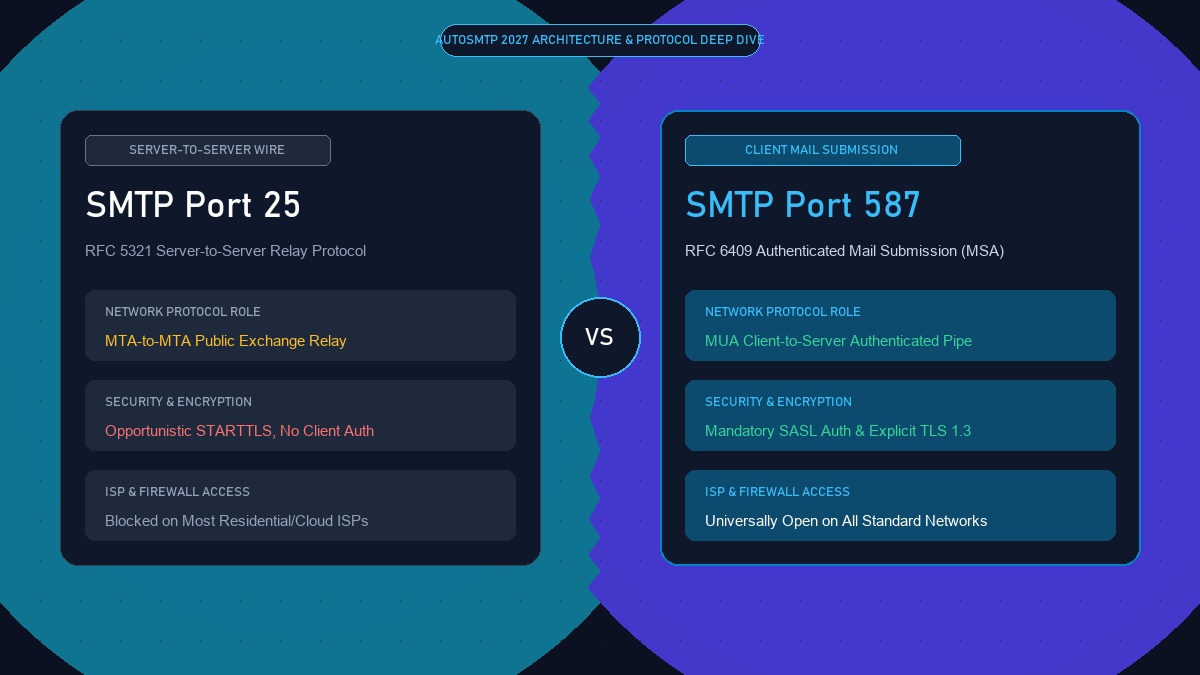
Executive Summary: The distinction between SMTP Port 25 and Port 587 represents one of the most critical foundational boundaries in email transport architecture. Defined by RFC 5321 (Port 25) and RFC 6409 (Port 587), these two network endpoints serve completely non-interchangeable purposes: Port 25 is the universal wire for inter-server mail exchange (MTA-to-MTA relay), while Port 587 is the secure standard for client-to-server mail submission (MSA) with mandatory authentication. Because Port 25 is blocked by default across virtually all residential ISPs and public cloud hyperscalers (AWS, DigitalOcean, GCP, Hetzner, Linode) to prevent rogue botnet spam, applications attempting to inject email directly on Port 25 suffer instant connection drops. Understanding how Port 25, Port 587, and modern Port 465 (Implicit TLS via RFC 8314) interact is essential for designing resilient outbound clusters.
- 1. The Fundamental Split: Mail Relay (RFC 5321) vs Mail Submission (RFC 6409)
- 2. Port 25 in 2027: The Global MTA-to-MTA Exchange Wire
- 3. Port 587 in 2027: The Authenticated Client Submission Standard
- 4. Port 465 & The Implicit TLS Revival (RFC 8314 Mandate)
- 5. Port 2525: The De-Facto Alternate Submission Port
- 6. Cryptographic Security: STARTTLS Downgrades vs Implicit TLS
- 7. Cloud & Residential ISP Port 25 Blocking Realities
- 8. Production Server Configuration: Postfix, PowerMTA & KumoMTA
- 9. Production Case Study: Resolving App Delivery Timeouts Across Cloud Networks
- 10. Architectural Decision Framework & Port Selection Matrix
1. The Fundamental Split: Mail Relay (RFC 5321) vs Mail Submission (RFC 6409)
To understand email transport, one must separate the concepts of message submission from message relay. In the original ARPANET era (RFC 821), Port 25 handled both tasks. A desktop client connecting to its local server and a remote server delivering a message across continents both used Port 25. However, this unified model proved catastrophic as the internet expanded, creating rampant open relays and botnet spam originating from residential IP addresses.
To restore security, the Internet Engineering Task Force (IETF) formally decoupled the protocols:
- Mail Submission Agent (MSA) on Port 587 (RFC 6409): Handles traffic originating from a Mail User Agent (MUA, such as an application, web server, or desktop client) injecting an email into the first-hop server. This connection always requires explicit authentication (SASL username/password) and TLS encryption.
- Mail Transfer Agent (MTA) on Port 25 (RFC 5321): Handles traffic between two servers (such as your PowerMTA cluster delivering to Google’s MX server
aspmx.l.google.com). Because the receiving server does not know who you are prior to connection, Port 25 operates without client authentication credentials, relying instead on IP reputation, SPF, DKIM, and DMARC for trust verification.
2. Port 25 in 2027: The Global MTA-to-MTA Exchange Wire
Port 25 remains the universal backbone of the internet’s email infrastructure. Every public mail exchange record published in DNS points to an MTA listening on Port 25. The protocol lifecycle on Port 25 operates as follows:
- Your outbound MTA performs a DNS MX query for the recipient’s domain (e.g.,
dig MX gmail.com). - Your server opens a TCP socket to the resolved IP on TCP Port 25.
- The receiving MTA sends an initial
220banner greeting. - Your MTA issues
EHLO outbound.yourdomain.com. - The receiving server advertises supported extensions, including
250-STARTTLS. - Your server negotiates TLS 1.3 encryption and transmits the message envelope (
MAIL FROM,RCPT TO,DATA).
3. Port 587 in 2027: The Authenticated Client Submission Standard
Port 587 is the standard submission channel for modern web applications, CRMs, ecommerce stores (WooCommerce, Shopify apps), and marketing automation frontends (MailWizz, Sendy). Unlike Port 25, an MSA listening on Port 587 enforces strict operational policies:
- Mandatory Authentication: Unauthenticated attempts are met with
530 5.7.0 Authentication required. Open relays are mathematically impossible on a properly configured Port 587 listener. - Sender Address Enforcement: The MSA can enforce that the authenticated user only sends from domains authorized for their tenant account, preventing internal spoofing.
- Universal Firewall Penetration: Port 587 is universally permitted across corporate firewalls, residential internet service providers, and cloud hosting platforms.
Universal Network Accessibility: Never blocked by cloud providers or residential ISPs; flawless app-to-server injection.
Strict Authentication Standards: Built-in SASL encryption ensures only authorized services can dispatch messages.
RFC 6409 Compliance: Automatically applies message header cleanup, Message-ID injection, and Date stamping if missing.
Default Cloud Firewall Blocks: AWS, Hetzner, DigitalOcean, and GCP block outbound Port 25 by default on all compute instances.
Vulnerable to STRIPTLS: Opportunistic STARTTLS can be intercepted by malicious on-path network adversaries without MTA-STS.
Zero In-Band Client Auth: Cannot require passwords from remote MTAs delivering inbound mail, exposing port to spam scrapers.
4. Port 465 & The Implicit TLS Revival (RFC 8314 Mandate)
Historically assigned to “SMTPS” in the late 1990s, Port 465 was originally revoked by the IANA in favor of STARTTLS on Port 587. However, the operational security landscape changed drastically with the publication of RFC 8314 in 2018.
RFC 8314 formally reinstated Port 465 as the recommended standard for email submission, designating it for Implicit TLS (also known as TLS Wrapper Mode). Unlike Port 587—which begins as cleartext and upgrades to encryption via the STARTTLS command—Port 465 establishes a TLS handshake before any SMTP commands are exchanged. This eliminates the possibility of plaintext sniffing, protocol negotiation tampering, or downgrade attacks.
5. Port 2525: The De-Facto Alternate Submission Port
While not recognized by the IETF or IANA as an official RFC standard, Port 2525 has emerged as the universal alternate submission port across major cloud ESPs (including AutoSMTP, SendGrid, Mailgun, and Amazon SES). In legacy corporate networks or highly restricted university environments where firewalls aggressively inspect and throttle Port 587, Port 2525 provides a reliable, unblocked transport channel that operates identically to Port 587 (requiring SASL authentication and STARTTLS).
6. Cryptographic Security: STARTTLS Downgrades vs Implicit TLS
The core technical vulnerability of STARTTLS (used on Port 25 and Port 587) is that it begins in cleartext. A network adversary performing a Man-in-the-Middle (MitM) attack can intercept the server’s initial response and strip the 250-STARTTLS capability announcement—a technique known as a STRIPTLS attack. Deceived into believing encryption is unsupported, the sending client transmits credentials and email content in plaintext.
To defend against STRIPTLS attacks in 2027:
- On client-to-server connections, organizations are transitioning toward Port 465 (Implicit TLS) or enforcing strict
require-starttlssettings. - On server-to-server relay (Port 25), domain owners must deploy MTA-STS (RFC 8461) and DANE (RFC 7672) to mandate cryptographic verification before message transmission.
7. Cloud & Residential ISP Port 25 Blocking Realities
If you launch a virtual private server on AWS EC2, DigitalOcean, Google Cloud, Linode, or Hetzner, outbound connections on Port 25 are blocked by default. Cloud hyperscalers implement this policy to prevent spammers from spinning up ephemeral VPS instances and blasting malicious campaigns. While some providers permit unblocking via formal identity verification tickets, others (such as Google Cloud and Oracle Cloud) enforce permanent Port 25 blocks, requiring users to route all external email through third-party relays.
8. Production Server Configuration: Postfix, PowerMTA & KumoMTA
A production email infrastructure cluster must listen on both Port 25 (to receive incoming mail and bounces) and Port 587/465 (to receive authenticated injection from your applications). Below are exact configuration examples:
9. Production Case Study: Resolving App Delivery Timeouts Across Cloud Networks
How a FinTech Platform Fixed Intermittent AWS Connection Drops by Re-Architecting Transport Ports
Background: A high-volume financial services SaaS application deployed across AWS ECS containers was sending transactional statements and one-time verification codes (OTPs) by attempting to connect directly to an on-premise mail server via Port 25. As AWS security groups updated and NAT gateways rotated, outbound connections on Port 25 experienced silent packet drops, causing 14% of OTP messages to time out after 60 seconds.
The Solution: In late 2026, the engineering team re-architected their injection layer. Internal microservices were re-configured to inject all transactional payloads to an AutoSMTP bare-metal PowerMTA cluster via Port 465 using Implicit TLS (TLS Wrapper Mode) with dedicated credentials. The AutoSMTP cluster, provisioned on unblocked enterprise transit, took over full responsibility for queue management, automated retries, and Port 25 inter-server delivery to Gmail, Microsoft 365, and corporate banking gateways.
Results:
- Zero Connection Timeouts: Ingestion socket latency dropped from 620ms (with intermittent drops) to a rock-solid 42ms over Port 465.
- Elimination of Downgrade Attacks: Implicit TLS completely shielded customer financial statements from STRIPTLS interception vulnerabilities.
- Global Delivery Speed: 99.4% of OTP codes reached end-user inboxes within 1.8 seconds of generation.
10. Architectural Decision Framework & Port Selection Matrix
| Port Number | Standard Protocol Name | RFC Standard | Encryption Method | Authentication | Primary Production Use Case |
|---|---|---|---|---|---|
| Port 25 | SMTP Relay | RFC 5321 | Opportunistic STARTTLS | None (reputation based) | Server-to-Server MTA Relay (Delivering directly to Gmail, Yahoo, etc.) |
| Port 587 | Mail Submission (MSA) | RFC 6409 | Mandatory STARTTLS | Mandatory SASL Auth | Web Application & Client Submission (WordPress, MailWizz, CRM injection) |
| Port 465 | SMTPS (Implicit TLS) | RFC 8314 | Implicit TLS Wrapper | Mandatory SASL Auth | High-Security Application Ingestion (Immune to STRIPTLS downgrade attacks) |
| Port 2525 | Alternate Submission | De-Facto Industry | STARTTLS | Mandatory SASL Auth | Firewall Fallback (When residential or corporate proxies block Port 587) |
When to Connect to Port 587 / 465:
- Connecting your website, web application, or CRM to an outbound email server.
- Injecting marketing newsletters from MailWizz or self-hosted frontends into an MTA.
- Submitting email from a cloud VPS instance (AWS, DigitalOcean, GCP) where Port 25 is blocked.
- Ensuring high-security transmission immune to cleartext credential leaks.
When Your Server Must Use Port 25:
- Delivering outbound messages to the recipient’s mail provider (Google MX, Microsoft MX).
- Listening for incoming mail addressed to your domain’s MX records.
- Ingesting asynchronous Feedback Loop (FBL) and RFC 3464 bounce notifications.
- Exchanging mail between sovereign bare-metal MTA nodes in a distributed cluster.
Stop paying monthly contact penalties to SaaS marketing platforms. AutoSMTP delivers turnkey, fully managed dedicated bare-metal email clusters engineered for sovereign control, maximum throughput, and uncompromised inbox placement.
Provisions fully licensed PowerMTA/KumoMTA clusters on enterprise bare metal with flat, predictable pricing regardless of database contact size.
Monitors Google Postmaster spam ratios (<0.1%) and real-time deferrals across clean IPv4 subnets, ramping delivery automatically.
RFC 5321 in-band 550 bounce suppression + automated Yahoo/Outlook CFL ingest directly into suppression registries.
Pre-configured rDNS/PTR, SPF, 2048-bit DKIM, strict DMARC, and BIMI integration verified prior to cluster handoff.
Ready for Sovereign Dedicated Email Infrastructure?
Deploy enterprise bare-metal MTAs with dedicated IPs, automated IP warming, and flat-rate pricing. Eliminate cloud port blocks and SaaS restrictions forever.
Explore Dedicated SMTP Clusters & Pricing →