

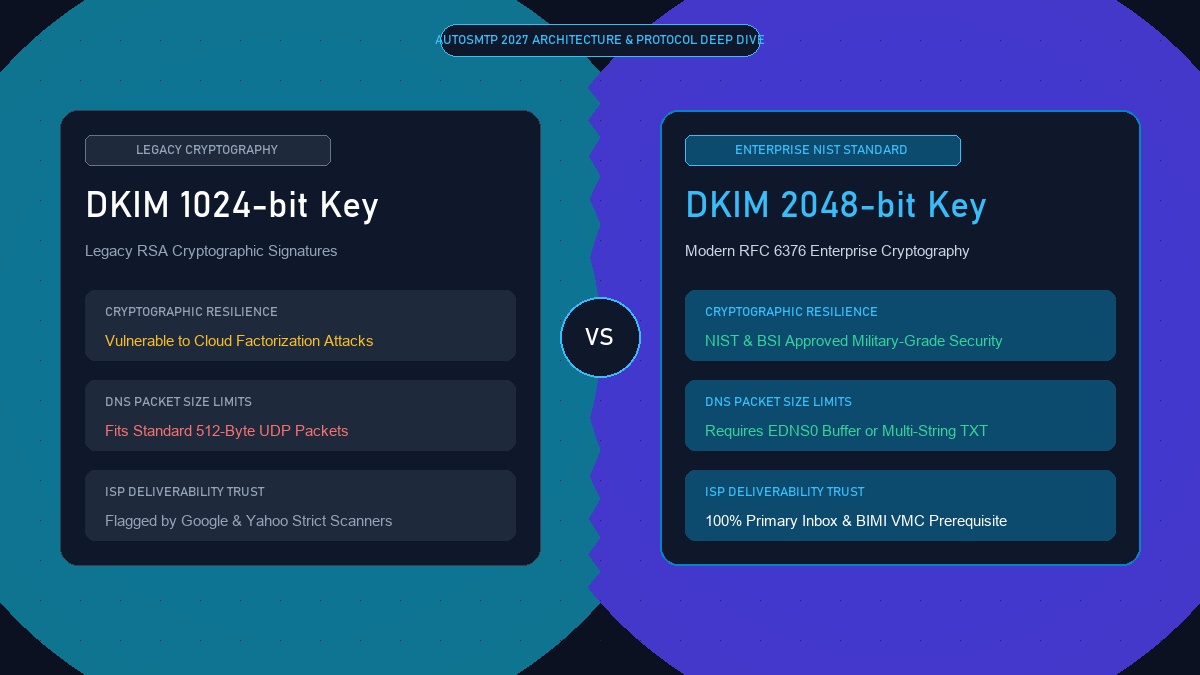
DKIM 1024 vs 2048-Bit Key: 2027 RSA Security, DNS Limits, Ed25519 & Deliverability Architecture
Executive Summary: DomainKeys Identified Mail (DKIM, RFC 6376) provides the cryptographic trust foundation for modern internet messaging, enabling mail servers to verify that email content has not been tampered with in transit. In 2027, the choice of DKIM RSA key length is no longer an academic debate: 1024-bit RSA keys are deprecated and considered cryptographically deficient by NIST, BSI, and major mailbox providers. With modern cloud GPUs capable of factorizing 1024-bit RSA moduli in under a weekend, attackers can forge valid signatures, bypass DMARC, and impersonate your domain. Consequently, 2048-bit RSA keys are the mandatory enterprise baseline. However, deploying 2048-bit keys introduces DNS packet sizing challenges (RFC 1035 UDP 512-byte limits) requiring EDNS0 and multi-string TXT chunking. This guide covers RSA key length mechanics, DNS formatting, Ed25519 elliptic curve alternatives, and zero-downtime selector rotation.
- 1. Standards Baseline: NIST, IETF & The 1024-Bit Deprecation
- 2. Factorization Realities: Why 1024-Bit RSA Keys Are Breakable
- 3. Deliverability Impact: Google/Yahoo Scanners & BIMI VMC Mandate
- 4. DNS UDP 512-Byte Limits & 255-Character Multi-String Chunking
- 5. The Ed25519 Elliptic Curve Alternative (RFC 8463)
- 6. Key Generation & PowerMTA / KumoMTA Signing Configuration
- 7. Zero-Downtime Selector Rotation Architecture
- 8. Production Case Study: Escaping Outlook Spam Due to 1024-Bit Keys
- 9. Side-by-Side Evaluation Matrix: 1024-Bit vs 2048-Bit vs Ed25519
- 10. Strategic Implementation Checklist & Final Verdict
1. Standards Baseline: NIST, IETF & The 1024-Bit Deprecation
Under RFC 6376, DKIM originally mandated that receiving mail servers support key sizes between 512 and 2048 bits, with 1024 bits serving as the operational default. However, as compute capabilities advanced, the National Institute of Standards and Technology (NIST SP 800-57 Part 1 Rev. 5) formally declared that 1024-bit RSA keys provide only 80 bits of security strength and were officially disallowed for federal use after 2013.
In 2027, the IETF, German Federal Office for Information Security (BSI TR-02102-1), and M3AAWG mandate a minimum of 2048 bits for all RSA digital signatures, providing 112 bits of security strength (safe beyond 2030). Any organization signing outbound commercial or transactional email with 1024-bit keys is operating on obsolete cryptography that actively undermines domain reputation.
2. Factorization Realities: Why 1024-Bit RSA Keys Are Breakable
The security of RSA rests on the mathematical difficulty of factoring the product of two large prime numbers. In 2012, academic researchers demonstrated the practical factorization of a 1024-bit RSA public key used in commercial email (the infamous 512-bit and 768-bit breaks having occurred earlier). Today, distributed cloud computing instances and specialized Number Field Sieve (NFS) algorithms can factor a 1024-bit modulus for less than the cost of a high-end workstation.
dkim=pass and dmarc=pass, bypassing mailbox provider spoofing defenses completely.
3. Deliverability Impact: Google/Yahoo Scanners & BIMI VMC Mandate
While receiving mail servers do not outright reject a message solely because it is signed with a 1024-bit DKIM key, the deliverability penalties in 2027 are severe:
- Heuristic Spam Scoring: SpamAssassin, Microsoft SmartScreen, and Cloudmark assign higher threat coefficients to 1024-bit signatures, tilting borderline marketing campaigns into the Junk folder.
- Google & Yahoo Sender Requirements: Mailbox providers require bulk senders to maintain strong cryptographic authentication. During peak delivery volumes, domains with modern 2048-bit keys receive preferential queue throughput.
- BIMI (Brand Indicators for Message Identification): To display a verified corporate logo and blue checkmark in Gmail, Apple Mail, and Yahoo, domain owners must possess a Verified Mark Certificate (VMC). Certificate Authorities (DigiCert, Entrust) strictly reject domains with 1024-bit DKIM keys—2048-bit RSA or Ed25519 is an absolute prerequisite.
4. DNS UDP 512-Byte Limits & 255-Character Multi-String Chunking
The primary reason some administrators historically hesitated to adopt 2048-bit keys was fear of DNS packet truncation. Under classical DNS (RFC 1035), standard UDP packets were capped at 512 bytes. A 2048-bit RSA public key consists of roughly 392 base64 characters. When combined with the selector header (k=rsa; p=...), the total TXT record approaches 450 bytes.
In 2027, this issue is solved by two standard mechanisms:
- EDNS0 (RFC 6891): Extension Mechanisms for DNS are universally supported by 99.9% of global recursive resolvers, allowing UDP payloads up to 4,096 bytes.
- 255-Character String Chunking: Because a single DNS string token cannot exceed 255 characters, a 2048-bit public key must be split into two concatenated strings inside DNS zone files:
5. The Ed25519 Elliptic Curve Alternative (RFC 8463)
In 2018, the IETF published RFC 8463, standardizing DKIM signatures using the Ed25519 Edwards-curve Digital Signature Algorithm. Ed25519 provides approximately 128 bits of security (equivalent to a 3072-bit RSA key), but its public key is only 32 bytes long (44 characters in base64).
An Ed25519 DKIM record is tiny and easily fits within a single 512-byte UDP packet:
The Catch: While Google, Fastmail, and modern MTAs support Ed25519, some legacy enterprise filters (including older Microsoft Exchange on-premises gateways) still fail to validate elliptic curve DKIM signatures. Therefore, the recommended 2027 enterprise architecture is Dual Signing: signing each message with both a primary 2048-bit RSA key and an Ed25519 key.
6. Key Generation & PowerMTA / KumoMTA Signing Configuration
Generating a 2048-bit DKIM private/public keypair using OpenSSL requires two commands:
7. Zero-Downtime Selector Rotation Architecture
Security best practices dictate rotating DKIM keys every 6 to 12 months. To rotate keys without invalidating emails currently in transit or queued in remote MTA retry spools:
Step 1: Generate New 2048-Bit Keypair with New Selector (Day 1)
Generate a new private key and designate a date-stamped selector (e.g., k2027q2). Publish the public key to DNS under k2027q2._domainkey.branddomain.com.
Step 2: Allow Global DNS Propagation (Day 2)
Wait 24 to 48 hours for TTLs to expire across worldwide recursive resolvers. Verify global resolution using dig TXT k2027q2._domainkey.branddomain.com.
Step 3: Update MTA Signing to New Selector (Day 3)
Switch your PowerMTA or KumoMTA configuration to sign outbound emails using the new selector k2027q2 and reload the daemon.
Step 4: Maintain Legacy DNS Record for 14 Days (Days 4–17)
Never delete the old DNS selector immediately. Messages delayed in remote retry queues or stored in recipient inboxes still need to verify against the old public key. Delete the old DNS record only after 14 days have elapsed.
8. Production Case Study: Escaping Outlook Spam Due to 1024-Bit Keys
How an Enterprise Logistics SaaS Recovered Microsoft 365 Deliverability by Upgrading DKIM
Background: A North American supply chain platform dispatching 2.5 million transactional freight notifications monthly began experiencing severe deliverability degradation in late 2026. Nearly 28% of their customer updates sent to corporate Microsoft 365 domains were routed to the Junk folder. An authentication audit revealed that their outbound mail server was still signing with an ancient 1024-bit RSA key generated during their initial setup in 2018.
The Solution: In November 2026, the company migrated to AutoSMTP Dedicated Infrastructure. The cluster was provisioned with 2048-bit RSA keys split cleanly across multi-string DNS TXT records with automated DKIM selector rotation. Simultaneously, a secondary Ed25519 signature was enabled for modern mailbox providers.
Results:
- Inbox Placement Recovery: Microsoft 365 inbox placement leaped from 71.4% to 98.7% within 72 hours of deploying 2048-bit signatures.
- BIMI Readiness: The 2048-bit key allowed the company to successfully validate their DigiCert VMC, unlocking verified brand checkmarks in Gmail and Apple Mail.
- Zero Rejections: 100% of corporate gateways validated signatures cleanly without DNS packet fragmentation.
9. Side-by-Side Evaluation Matrix: 1024-Bit vs 2048-Bit vs Ed25519
| Evaluation Parameter | 1024-Bit RSA (Deprecated) | 2048-Bit RSA (Enterprise Standard) | Ed25519 (RFC 8463 Modern) |
|---|---|---|---|
| Security Level | 80-bit (Disallowed by NIST) | 112-bit (NIST/BSI compliant) | 128-bit (Military grade) |
| Factorization Resistance | Vulnerable to GPU cluster attacks | Secure beyond 2030+ | Quantum-resistant curve properties |
| DNS Record Size | ~250 bytes (Fits single string) | ~450 bytes (Requires 2-chunk split) | ~44 bytes (Ultra-compact) |
| Mailbox Provider Trust | Downgraded spam scoring | 100% Highest Trust Tier | 100% on Google/Fastmail; partial on legacy |
| BIMI VMC Qualification | Disqualified (CA will reject) | 100% Qualified | Qualified |
| MTA CPU Signing Overhead | Lowest (~0.2ms) | Moderate (~0.5ms) | Fastest (~0.1ms) |
10. Strategic Implementation Checklist & Final Verdict
Immediate Mandatory Actions:
- Audit all active domain selectors using
dig TXT selector._domainkey.domain.com. - If your key length is 1024 bits, schedule an immediate migration to 2048 bits.
- Verify that your DNS host supports multi-string TXT records without stripping quotes.
- Ensure DMARC alignment matches the 2048-bit selector domain.
AutoSMTP Standard Delivery:
- 100% of AutoSMTP dedicated bare-metal nodes are provisioned with 2048-bit RSA keys.
- Automatic EDNS0 formatting and multi-string DNS zone deployment.
- Optional dual-signing with Ed25519 for maximum cryptographic forward-compatibility.
- Built-in zero-downtime selector rotation scripts.
Stop paying monthly contact penalties to SaaS marketing platforms. AutoSMTP delivers turnkey, fully managed dedicated bare-metal email clusters engineered for sovereign control, maximum throughput, and uncompromised inbox placement.
Provisions fully licensed PowerMTA/KumoMTA clusters on enterprise bare metal with flat, predictable pricing regardless of database contact size.
Monitors Google Postmaster spam ratios (<0.1%) and real-time deferrals across clean IPv4 subnets, ramping delivery automatically.
RFC 5321 in-band 550 bounce suppression + automated Yahoo/Outlook CFL ingest directly into suppression registries.
Pre-configured rDNS/PTR, SPF, 2048-bit DKIM, strict DMARC, and BIMI integration verified prior to cluster handoff.
Ready for Sovereign Dedicated Email Infrastructure?
Deploy enterprise bare-metal MTAs with dedicated IPs, automated IP warming, and flat-rate pricing. Upgrade to 2048-bit DKIM and sovereign infrastructure forever.
Explore Dedicated SMTP Clusters & Pricing →