

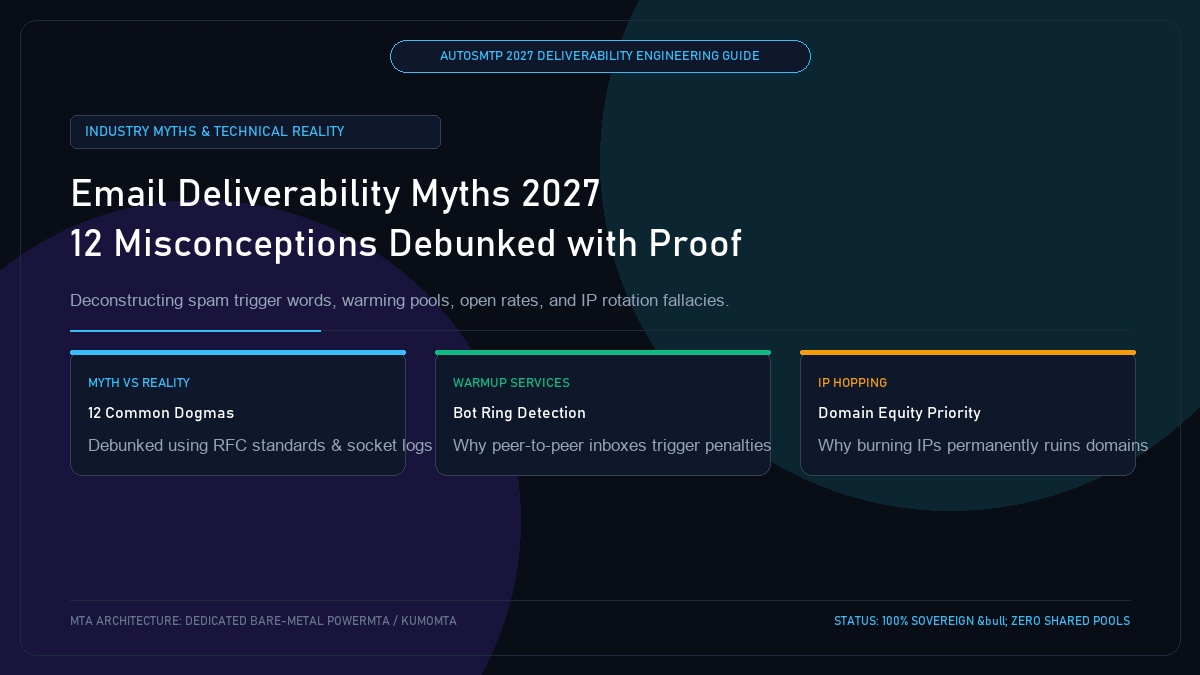
Email Deliverability Myths in 2027: 12 Common Misconceptions Debunked with Technical Proof
Published by Fred Dawson • Senior Deliverability Systems Architect • 25 min read
Email deliverability is surrounded by outdated folklore, snake-oil software claims, and cargo-cult marketing advice. Tactics that worked in 2015—such as rotating sending IPs every week or running automated peer-to-peer “warmup” bots—are actively penalized by modern AI-driven mailbox algorithms in 2027. Believing these myths leads engineering and marketing teams to invest in the wrong solutions while ignoring foundational infrastructure flaws. In this technical guide, we systematically debunk the 12 most pervasive deliverability myths using RFC protocol standards, socket telemetry, and machine learning realities.
- 1. Myth 1: Peer-to-Peer Warmup Tools Build Real Deliverability
- 2. Myth 2: IP Rotation Solves Low Deliverability
- 3. Myth 3: “Spam Words” Are the Primary Cause of Spam Placement
- 4. Myth 4: Open Rates Accurately Reflect Human Readership
- 5. Myth 5: DMARC p=none Protects Your Domain from Abuse
- 6. Myth 6: Shared ESP Pools Are Sufficient for High Volume
- 7. Myths 7 to 12: Unsubscribes, HTML, Traps & Pruning
- 8. Myth vs Technical Reality Diagnostic Matrix
- 9. Case Study: Dismantling a $15,000/Mo Warmup Bot Farm
- 10. The AutoSMTP Deliverability Defense Advantage
1. Myth 1: Peer-to-Peer Warmup Tools Build Real Deliverability
The Common Myth
Subscribing to automated “warmup” SaaS networks (where hundreds of fake inboxes open, star, and reply to each other’s nonsensical emails) tricks Google and Microsoft into granting high sender reputation.
The Technical Reality
Google and Microsoft detect synthetic warmup clusters within hours. The repetitive sending patterns, interconnected mailbox mesh, and lack of real human browsing telemetry trigger automated spam penalties and permanent domain blacklisting.
2. Myth 2: IP Rotation Solves Low Deliverability
Senders often believe that when their emails begin landing in spam, switching to a new IP address gives them a “clean slate.” In 2027, Domain Reputation completely dominates IP reputation. Mailbox providers evaluate the cryptographic DKIM signing domain (d=domain.com). If your domain reputation is decayed, routing mail through 50 new IP addresses merely burns through clean subnets without restoring inbox placement.
3. Myth 3: “Spam Words” Are the Primary Cause of Spam Placement
Blacklisting individual words like “free” or “guarantee” is obsolete. Modern mailbox filters use deep transformer NLP models that evaluate the semantic tone, grammatical cohesion, and user context. Legitimate transactional and marketing emails use promotional terms constantly without penalty, provided their authentication, IP health, and complaint rates are clean.
4. Myth 4: Open Rates Accurately Reflect Human Readership
Following Apple’s Mail Privacy Protection (MPP) and enterprise security proxy scanners, remote 1×1 tracking pixels are pre-fetched by proxy servers automatically. Reported open rates of 45% often reflect 20% real human opens and 25% synthetic proxy fetches. True deliverability is measured via socket response telemetry (SMTP 250 OK) and downstream click-through conversion rates.
5. Myth 5: DMARC p=none Protects Your Domain from Abuse
DMARC p=none Is Passive Monitoring Only
A policy of p=none merely tells receiving mail servers to send aggregate reports back to you. It instructs them to take zero protective action against spoofed emails. To comply with 2027 Google and Yahoo bulk sender requirements and block impersonation, senders must enforce p=quarantine or p=reject.
6. Myth 6: Shared ESP Pools Are Sufficient for High Volume
High-volume senders on shared cloud ESPs (e.g., Mailchimp, SendGrid shared tiers) share IP reputation with thousands of unknown accounts. When a neighboring tenant blasts an unverified list and hits a Spamhaus trap, every customer on that shared IP pool suffers immediate throttling and junk folder placement.
7. Myths 7 to 12: Unsubscribes, HTML, Traps & Pruning
- Myth 7 (Unsubscribes Hurt Reputation): False. High unsubscribe rates have zero negative impact on spam scores. In fact, an unsubscribe prevents the user from clicking “Report Spam,” which is the true reputation killer.
- Myth 8 (Plain Text Always Beats HTML): False. Plain text without DKIM or clean headers is frequently flagged by phishing filters. Clean, semantic HTML with a synchronized plain-text part performs best.
- Myth 9 (List Cleaning Removes All Spam Traps): False. Third-party verification tools only check for active MX records and SMTP syntax. They cannot detect pristine spam traps, which are valid active mailboxes run by security agencies.
- Myth 10 (BIMI Works Without a VMC): False. While Yahoo supports non-VMC BIMI, Google Workspace strictly requires a Verified Mark Certificate (VMC) backed by a registered trademark.
- Myth 11 (Pruning Inactive Users Loses Value): False. Emailing subscribers who have not engaged in 180+ days tanks open rates and trips recycled traps. Removing them elevates inbox placement for your active audience.
- Myth 12 (Sending More Email Fixes Pipeline Deficits): False. Doubling sending volume when reputation is declining accelerates ISP rate throttling and leads to complete domain quarantine.
8. Myth vs Technical Reality Diagnostic Matrix
| Pervasive Industry Myth | Underlying Technical Reality | Consequence of Believing the Myth |
|---|---|---|
| Automated Warmup Bots | Identified as synthetic spam rings by MBPs | Domain-level algorithmic blacklisting |
| Rapid IP Rotation | Domain reputation follows your brand permanently | Burning valuable clean /29 subnets uselessly |
| Spam Trigger Words | Filters evaluate semantic NLP intent & auth | Wasting hours stripping normal English vocabulary |
| DMARC p=none Safety | Enforces zero blocking; spoofing still occurs | Non-compliance with Google 2027 mandates |
Dismantling a $15,000/Month Warmup Bot Farm to Restore Real Deliverability
A high-growth fintech startup was paying $15,000 monthly for an automated warmup network consisting of 4,000 synthetic Gmail and Outlook mailboxes. Despite “99% Warmup Scores” on their dashboard, their actual production customer newsletters were landing 80% in the spam folder. Google had identified the warmup IP mesh and flagged the startup’s root domain for synthetic manipulation. Deliverability engineers completely disconnected the warmup bot farm, migrated the outbound stream to a dedicated AutoSMTP bare-metal cluster, and deployed a genuine algorithmic warm-up strategy using active opt-in user cohorts. Within 21 days, real customer open rates climbed from 7% to 38%.
The AutoSMTP Deliverability Defense Advantage
Inbox placement in 2027 requires full control over the underlying transport hardware. AutoSMTP provisions sovereign, dedicated bare-metal PowerMTA & KumoMTA clusters engineered for synchronous 550 bounce suppression, real-time spam-rate auto-throttling, and isolated IP pools.
Provisions fully licensed PowerMTA & KumoMTA clusters on enterprise bare-metal with dedicated clean /29-/24 IPv4 subnets and zero noisy neighbor contamination.
Monitors Google Postmaster spam ratios (<0.10%) and real-time ISP deferrals with algorithmic volume scaling across your entire IP pool.
RFC 5321 in-band 550 bounce suppression, automated Yahoo/Outlook Complaint Feedback Loops (CFL), and instant bad-IP eviction.
Pre-configured forward and reverse DNS (PTR) per IP, SPF CIDR alignment, 2048-bit DKIM rotation, and strict DMARC enforcement.
Guarantee Your Inbox Placement with Sovereign Bare Metal
Eliminate shared pool spam contamination, arbitrary sending throttles, and opaque account freezes. Deploy an enterprise AutoSMTP cluster today.
Deploy Turnkey MTA Cluster →