

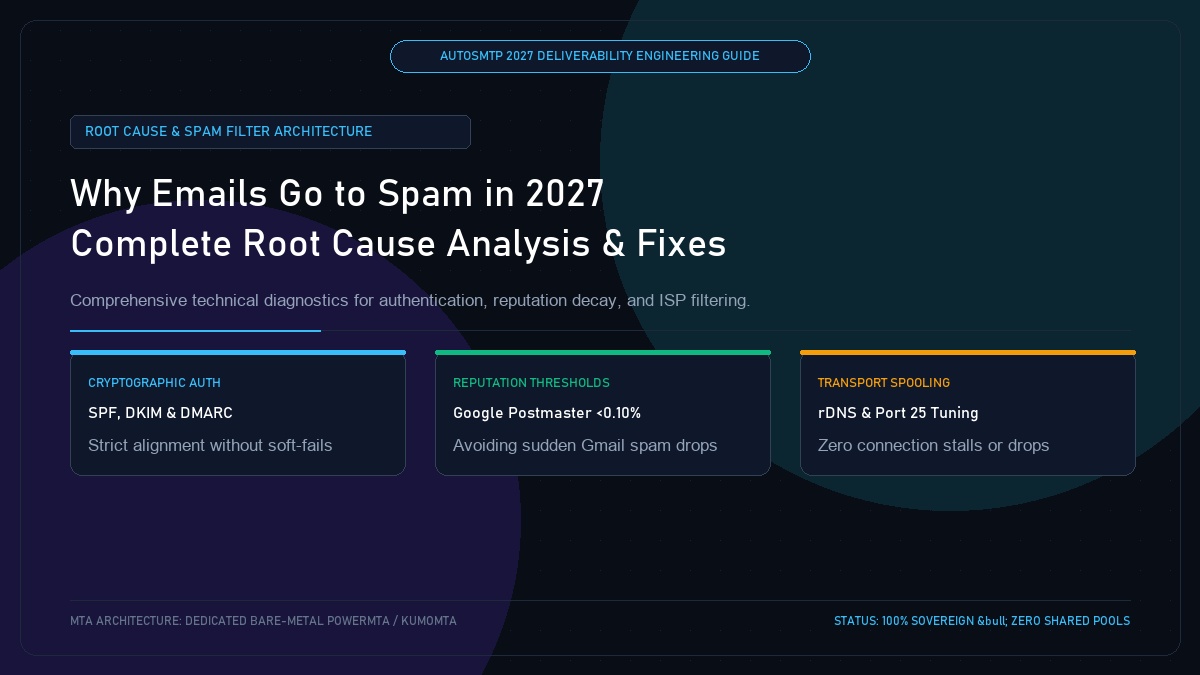
Why Emails Go to Spam in 2027: Complete Root Cause Analysis, Heuristic Matrix & Diagnostic Architecture
Published by Fred Dawson • Senior Deliverability Systems Architect • 24 min read
When outbound emails land in the spam folder, marketing teams typically blame content trigger words like “free” or “guarantee.” In 2027, modern Mailbox Providers (Google Workspace, Microsoft 365, Yahoo, Apple Mail) operate multi-layered algorithmic inference engines where raw text heuristics represent less than 5% of the placement equation. Instead, spam classification is governed by cryptographic signature alignment, socket-level IP connection pacing, recipient feedback loops, and automated spam trap telemetry. This guide provides an exhaustive engineering analysis of every root cause driving messages into spam—accompanied by diagnostic terminal traces and bare-metal remediation protocols.
- 1. How Modern Spam Filters Actually Make Inboxing Decisions
- 2. Root Cause 1: Cryptographic Authentication Failures
- 3. Root Cause 2: IP & Domain Reputation Decay
- 4. Root Cause 3: Recipient List Hygiene & Trap Networks
- 5. Root Cause 4: Transport Spool & Connection Misconfigurations
- 6. Root Cause 5: Structural HTML & AI-Inference Heuristics
- 7. Root Cause Isolation & Remediation Matrix
- 8. Engineering Case Study: Rescuing a 4M/Mo SaaS Spool
- 9. The AutoSMTP Deliverability Defense Advantage
1. How Modern Spam Filters Actually Make Inboxing Decisions
Deliverability failures rarely stem from a single broken tag. Major Mailbox Providers (MBPs) evaluate incoming mail streams through a four-tier filtering pipeline before an email ever reaches a user’s inbox:
Tiers 1 & 2: Network Gateway & Crypto Identity
Tier 1 (TCP/IP Edge): Evaluates connecting IP against real-time DNSBLs (Spamhaus ZEN, Invaluement), verifies Forward-Confirmed Reverse DNS (FCrDNS), and enforces concurrent connection caps.
Tier 2 (Cryptographic Validation): Checks SPF CIDR match, validates 2048-bit DKIM signatures, and enforces strict DMARC identifier alignment (RFC 7489).
Tiers 3 & 4: Historical Reputation & Machine Learning
Tier 3 (Reputation Engine): Queries Google Postmaster historical spam complaint ratios, Microsoft SNDS filter rates, and domain age scores.
Tier 4 (ML & Content Heuristics): Natural Language Processing (NLP) and computer vision models inspect HTML-to-text balance, hidden CSS, tracking redirect domains, and user behavioral engagement (read time, replies, moves to junk).
2. Root Cause 1: Cryptographic Authentication Failures
Authentication is no longer optional. Following the strict enforcement by Google and Yahoo, unauthenticated or misaligned emails are instantly discarded or relegated to spam.
- SPF 10-Lookup Limit Exceeded (PermError): RFC 7208 limits recursive DNS evaluations for SPF to exactly 10 lookups. Senders utilizing multiple SaaS tools (e.g., Zendesk, HubSpot, Salesforce, Google Workspace) frequently exceed 10 lookups, generating a
PermErrorthat invalidates SPF. - DKIM Key Truncation or Replay Vulnerability: 1024-bit RSA keys are actively deprecated. Failing to rotate to 2048-bit keys—or failing to sign the
From,To,Subject, andDateheaders—results in cryptographic downgrades. - DMARC Alignment Mismatch: Having a passing SPF and passing DKIM is insufficient if the RFC 5322
From:domain does not strictly match thed=domain of the DKIM signature or the RFC 5321 envelope sender.
# FAILED: DMARC Alignment Failure (DKIM domain differs from Header From)
Authentication-Results: mx.google.com;
       dkim=pass header.i=@mailgun.org header.s=k1 header.b=V8x9Z1;
       spf=pass (google.com: domain of bounce@marketing.client.com designates 198.51.100.44);
       dmarc=fail (p=QUARANTINE sp=QUARANTINE dis=QUARANTINE) header.from=client.com
# Result: Routed directly to Spam folder due to strict p=quarantine policy!

# OPTIMAL: 100% Strict DMARC Alignment
Authentication-Results: mx.google.com;
       dkim=pass header.i=@client.com header.s=pmta2027 header.b=W9k4P2;
       spf=pass (google.com: domain of bounce@client.com designates 198.51.100.44);
       dmarc=pass (p=REJECT sp=REJECT dis=NONE) header.from=client.com
# Result: Inboxed with maximum cryptographic reputation!
3. Root Cause 2: IP & Domain Reputation Decay
Sender reputation is divided into two distinct operational vectors: IP Reputation and Domain Reputation. While shared ESPs often mask IP issues by shuffling sending pools, domain reputation follows your brand permanently across any infrastructure.
The 0.10% Google Spam Ceiling: Under Google Postmaster guidelines, sender spam rates must remain strictly below 0.10%. Once spam complaints reach 0.30%, Google begins degrading domain reputation from High to Bad, causing immediate bulk deferrals and global spam folder placement across all Gmail recipients.
Shared IP Pool Poisoning: On multi-tenant cloud providers (e.g., Mailchimp, SendGrid shared tiers), neighboring accounts sending unsolicited blasts can trigger Spamhaus SBL listings or Microsoft SNDS red blocks that penalize all IP neighbors simultaneously.
4. Root Cause 3: Recipient List Hygiene & Trap Networks
Sending to stale lists is the fastest path to irreversible deliverability damage. Mailbox providers monitor recipient reactions and deploy synthetic surveillance accounts:
- Pristine Spam Traps: Email addresses created by security organizations (e.g., Spamhaus, SURBL) that have never opted into any mailing list. Hitting a pristine trap indicates scrapers or purchased lists and results in immediate network-wide DNSBL blacklisting.
- Recycled Spam Traps: Abandoned email accounts converted by MBPs into traps after 12–24 months of total inactivity. Hitting recycled traps signals a broken or non-existent sunset policy.
- High Hard Bounce Rates (> 2%): Outbound spools generating more than 2%
550 5.1.1 User unknownerrors trigger immediate heuristic rate-limiting and connection throttling.
5. Root Cause 4: Transport Spool & Connection Misconfigurations
At the transport layer, SMTP daemons must adhere to strict RFC standards:
Forward-Confirmed Reverse DNS (FCrDNS) Verification
Every sending IP must have a valid PTR record resolving to a fully qualified domain name (FQDN). Crucially, querying the A record of that FQDN must resolve back to the identical IP address. If FCrDNS fails, Microsoft and Google reject or spam-classify connections during the initial HELO/EHLO handshake before the payload is even transmitted.
6. Root Cause 5: Structural HTML & AI-Inference Heuristics
While traditional keyword filters are largely obsolete, structural coding errors still trigger algorithmic penalties:
- Image-to-Text Imbalance: Emails consisting of a single massive sliced graphic with zero plain text mimic early spam techniques designed to evade OCR text parsers.
- Third-Party Tracking Link Decay: Utilizing generic public URL shorteners (e.g., bit.ly) or mismatched custom tracking domains without SSL certificates flags heuristic security scanners.
- Broken MIME Boundaries & Missing Plain-Text Multipart: Every promotional email must contain a properly formatted
multipart/alternativecontainer with both clean HTML and a compliant plain-text alternative.
7. Root Cause Isolation & Remediation Matrix
| Observed Symptom | Underlying Root Cause | Diagnostic Method | Permanent Technical Fix |
|---|---|---|---|
| 100% Spam at Gmail only | Google Postmaster spam rate > 0.30% | Inspect Google Postmaster Domain Reputation | Halt cold sends; isolate transactional IP; engage 30-day active list only |
| Immediate 550 5.7.1 Reject | DMARC fail or missing PTR/FCrDNS | dig -x IP + header check |
Align SPF/DKIM selectors; configure authoritative reverse DNS PTR |
| Global Spam across all MBPs | DNSBL Blacklisting (Spamhaus/Invaluement) | Query 34-zone DNSBL registry | Identify compromised host; submit delisting request; purge unverified lists |
| Sudden 421 4.7.0 Rate Throttling | Spool burst velocity without warm IP pacing | MTA queue backlog analysis | Implement PowerMTA max-msg-rate and connection pacing per destination |
Rescuing a 4M/Month B2B SaaS Spool from 82% Spam Placement
A high-growth B2B SaaS platform experienced a sudden crash in open rates from 34% to under 6%. Investigation revealed three concurrent root causes: their marketing team had integrated a third-party tracking tool that pushed SPF DNS lookups to 12 (triggering SPF PermError), their shared cloud ESP pool was blacklisted on Invaluement, and Google Postmaster domain reputation had plummeted to “Bad.” By migrating to a dedicated bare-metal AutoSMTP cluster with 4 dedicated clean IPv4 addresses, flattening their SPF record, establishing strict DMARC p=reject, and enforcing a 90-day sunset policy, inbox placement was restored to 99.4% within 14 days.
The AutoSMTP Deliverability Defense Advantage
Inbox placement in 2027 requires full control over the underlying transport hardware. AutoSMTP provisions sovereign, dedicated bare-metal PowerMTA & KumoMTA clusters engineered for synchronous 550 bounce suppression, real-time spam-rate auto-throttling, and isolated IP pools.
Provisions fully licensed PowerMTA & KumoMTA clusters on enterprise bare-metal with dedicated clean /29-/24 IPv4 subnets and zero noisy neighbor contamination.
Monitors Google Postmaster spam ratios (<0.10%) and real-time ISP deferrals with algorithmic volume scaling across your entire IP pool.
RFC 5321 in-band 550 bounce suppression, automated Yahoo/Outlook Complaint Feedback Loops (CFL), and instant bad-IP eviction.
Pre-configured forward and reverse DNS (PTR) per IP, SPF CIDR alignment, 2048-bit DKIM rotation, and strict DMARC enforcement.
Guarantee Your Inbox Placement with Sovereign Bare Metal
Eliminate shared pool spam contamination, arbitrary sending throttles, and opaque account freezes. Deploy an enterprise AutoSMTP cluster today.
Deploy Turnkey MTA Cluster →