

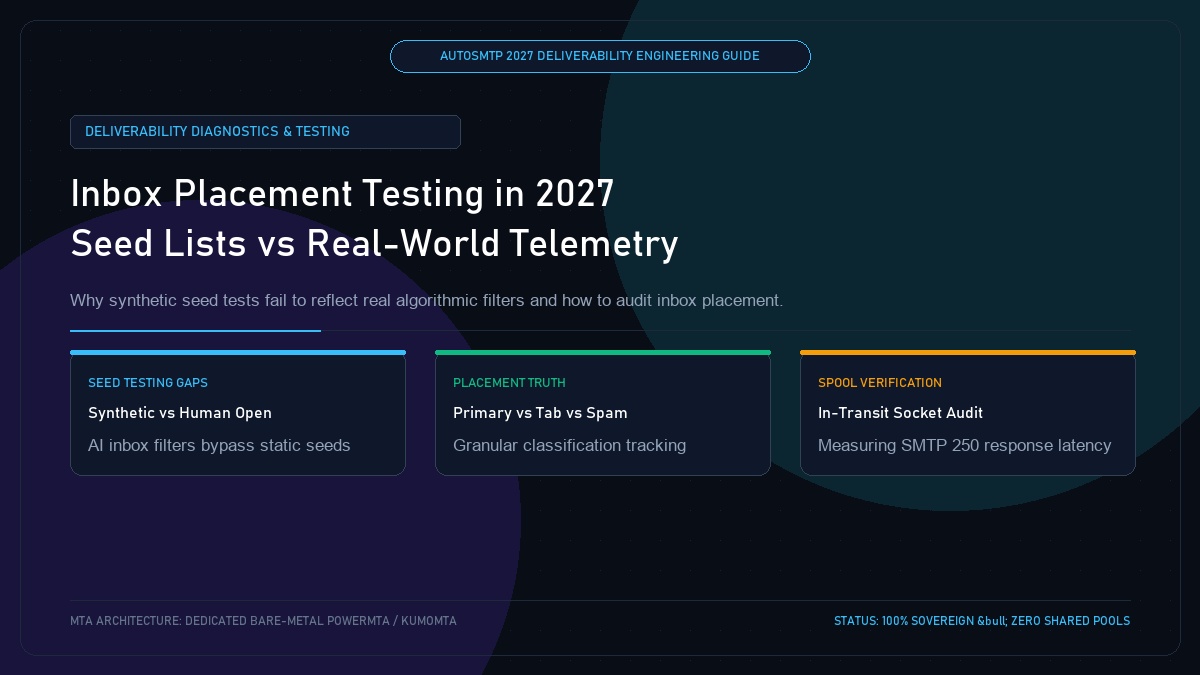
Inbox Placement Testing in 2027: Seed Lists, Synthetic Traps vs Real-World Socket Telemetry
Published by Fred Dawson • Senior Deliverability Systems Architect • 20 min read
Inbox placement testing is often misunderstood. Many email marketers rely solely on synthetic “seed lists” (e.g., GlockApps, 250ok, Everest), believing that landing in a dozen automated test inboxes guarantees real-world delivery. In 2027, modern Mailbox Providers deploy adaptive machine learning models that evaluate user engagement history, personal interaction graphs, and zero-click AI summaries. A message that lands in 100% of synthetic test seeds can still go straight to the spam folder for actual human recipients. This engineering guide explains the true architectural differences between synthetic seed testing and live socket telemetry.
- 1. The Fatal Blind Spots of Synthetic Seed Lists
- 2. How Mailbox Providers Detect & Re-route Seed Mailboxes
- 3. Real-World In-Band Socket Telemetry vs Synthetic Probes
- 4. Testing for the 2027 AI Agent Inbox (Copilot & Gemini)
- 5. Testing Methodology Comparison Matrix
- 6. Diagnostic Case Study: The “100% Green Seed” Fallacy
- 7. The AutoSMTP Deliverability Defense Advantage
1. The Fatal Blind Spots of Synthetic Seed Lists
Synthetic seed testing involves injecting 50 to 100 test email accounts across Gmail, Outlook, Yahoo, and regional ISPs into your recipient list. While useful for verifying cryptographic signatures (SPF, DKIM, DMARC), seeds suffer from severe architectural limitations:
- Zero Historical Engagement: Seed accounts never reply, forward, mark as important, or click embedded links in a natural human pattern. Because MBPs heavily weight personal engagement graphs, seeds receive different placement than active subscribers.
- Known Seed IP Clustering: Security algorithms at Google and Microsoft easily identify automated test seed networks because thousands of senders dispatch test blasts to the exact same list of recipient addresses within minutes.
- Ignoring Recipient-Level Personalization: A synthetic seed mailbox does not reflect the individual mailbox preferences, past open history, or custom spam filter rules of your actual customers.
2. How Mailbox Providers Detect & Re-route Seed Mailboxes
Modern spam filters evaluate delivery context dynamically:
What Seed Tests ARE Good For
Pre-flight syntax validation, verifying that 2048-bit DKIM headers survive MTA signing, testing HTML rendering across Outlook Word engines, and confirming that custom tracking domains resolve over HTTPS.
What Seed Tests CANNOT Measure
Real user spam complaint ratios, Promotions tab classification vs Primary inboxing under Gemini AI, recipient unsubscribe velocity, and ISP connection throttling under live production load.
3. Real-World In-Band Socket Telemetry vs Synthetic Probes
To accurately measure inbox placement, deliverability engineers inspect the live SMTP conversation during transmission:
# Real-Time Delivery Confirmation (Inboxed):
d,2027-01-15 14:22:01-0500,user@gmail.com,198.51.100.22,vmta_dedicated_01,gmail-smtp-in.l.google.com,250 2.0.0 OK 1705346521 w12si839291pld.12 - gsmtp

# Real-Time Deferral (ISP Throttling / Reputation Decay):
t,2027-01-15 14:22:04-0500,user@outlook.com,198.51.100.22,vmta_dedicated_01,outlook-com.olc.protection.outlook.com,451 4.7.650 The mail server [198.51.100.22] has been temporarily rate limited due to IP reputation.

# Real-Time Rejection (DMARC / DNSBL Failure):
b,2027-01-15 14:22:09-0500,user@yahoo.com,198.51.100.22,vmta_dedicated_01,mta5.am0.yahoodns.net,550 5.7.9 Message rejected due to DMARC policy for domain.com
4. Testing for the 2027 AI Agent Inbox (Copilot & Gemini)
With Google Gemini and Microsoft Copilot reading and summarizing emails on behalf of users, testing must evolve beyond visual rendering:
- Semantic Preheader Parsing: AI agents parse the first 250 characters of plain text to generate summary snippets. If preview text consists of “View in browser” or broken tracking code, the AI summary advises the user to archive or ignore the email.
- Schema.org Microdata Validation: Validating JSON-LD Schema (e.g.,
EmailMessage,OrderAction) ensures that AI assistants can display one-click actionable cards directly in user notification feeds.
5. Testing Methodology Comparison Matrix
| Testing Methodology | Accuracy Level | Primary Utility | Limitation |
|---|---|---|---|
| Synthetic Seed Lists | Moderate (40–60%) | Pre-send authentication audit & HTML rendering | Zero human engagement; known seed mailbox footprints |
| ISP Postmaster APIs | High (90–95%) | Macro reputation scoring & user complaint ratios | 24-hour delayed metrics; aggregated domain level |
| Real-Time Socket Telemetry | Absolute (100%) | In-band 250/421/550 error diagnosis & spool tuning | Requires dedicated root access to MTA logging daemons |
| AI Agent Summary Tests | High (85–90%) | Snippet synthesis & semantic priority classification | Evolving heuristic LLM models across different clients |
The “100% Green Seed” Fallacy: Why a FinTech Launch Ended in Spam
A FinTech company prepared to announce a major product upgrade. Their marketing team ran seed tests on GlockApps, showing a “99% Inbox Placement” score. However, upon sending the broadcast to their 450,000 users, open rates tanked to under 4%. While the synthetic seed accounts had accepted the message, real human recipients at Gmail flagged the cold, promotional tone, pushing the Google Postmaster spam rate from 0.03% to 0.48% within 90 minutes. Google immediately quarantined the domain. By implementing real-time socket-level telemetry and progressive cohort warming on AutoSMTP bare metal, placement was restored in time for future broadcasts.
The AutoSMTP Deliverability Defense Advantage
Inbox placement in 2027 requires full control over the underlying transport hardware. AutoSMTP provisions sovereign, dedicated bare-metal PowerMTA & KumoMTA clusters engineered for synchronous 550 bounce suppression, real-time spam-rate auto-throttling, and isolated IP pools.
Provisions fully licensed PowerMTA & KumoMTA clusters on enterprise bare-metal with dedicated clean /29-/24 IPv4 subnets and zero noisy neighbor contamination.
Monitors Google Postmaster spam ratios (<0.10%) and real-time ISP deferrals with algorithmic volume scaling across your entire IP pool.
RFC 5321 in-band 550 bounce suppression, automated Yahoo/Outlook Complaint Feedback Loops (CFL), and instant bad-IP eviction.
Pre-configured forward and reverse DNS (PTR) per IP, SPF CIDR alignment, 2048-bit DKIM rotation, and strict DMARC enforcement.
Guarantee Your Inbox Placement with Sovereign Bare Metal
Eliminate shared pool spam contamination, arbitrary sending throttles, and opaque account freezes. Deploy an enterprise AutoSMTP cluster today.
Deploy Turnkey MTA Cluster →