

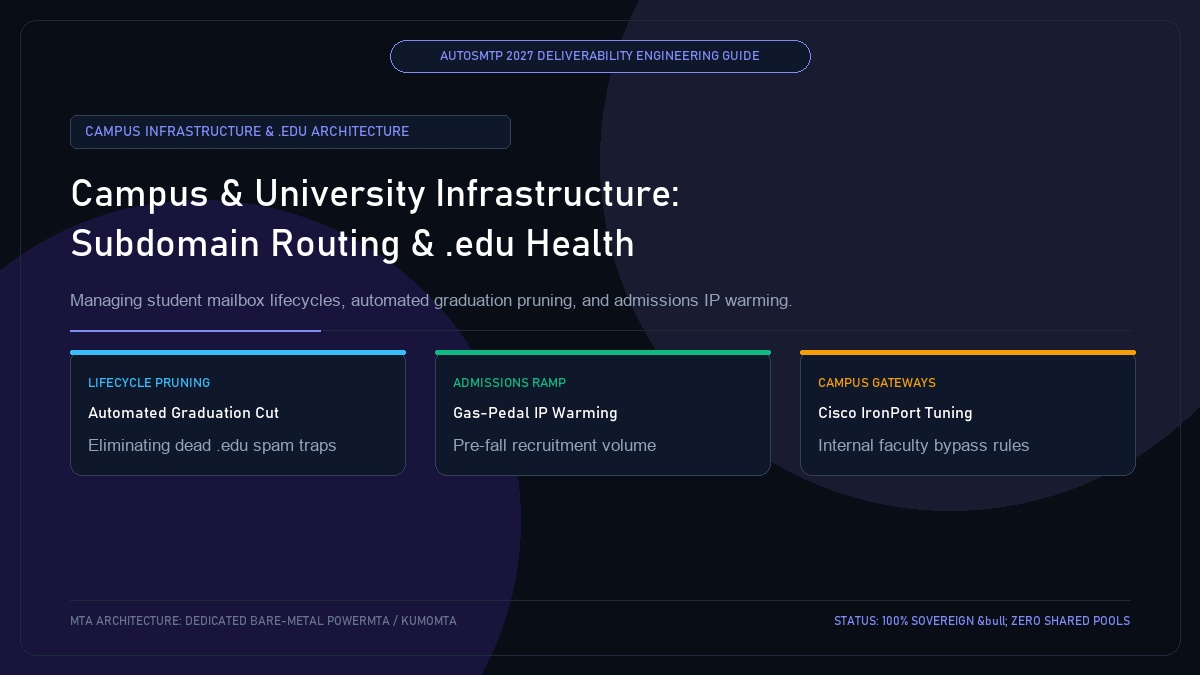
Campus & University Email Infrastructure: Subdomain Isolation, Dormant Student Pruning & .edu Deliverability
Published by Fred Dawson • Senior Deliverability Systems Architect • 24 min read
Managing email infrastructure for a modern research university or multi-campus college system is an extraordinary operational challenge. Universities host hundreds of thousands of active student accounts, tens of thousands of faculty and researchers, prospective admissions pipelines, and multi-decade alumni donor networks under a single accredited .edu domain. The primary risk in higher education deliverability is address churn: every graduation cycle, tens of thousands of student accounts are abandoned. Within 12 months, major mailbox providers repurpose these inactive mailboxes into recycled spam traps. This architectural guide explains how university CIOs and campus IT teams construct isolated subdomain architectures and automate student lifecycle governance.
- 1. The Multi-Audience Campus Problem: Admissions vs Faculty vs Alumni
- 2. The Graduated Student Trap: Recycled Spam Traps on .edu Domains
- 3. Architectural Subdomain Blueprint for Higher Education
- 4. Configuring Campus Security Gateways: Barracuda & Cisco ESA
- 5. University Email Stream Governance Matrix
- 6. Case Study: Tier-1 Research University Cleans 45,000 Dead Accounts
- 7. The AutoSMTP Deliverability Defense Advantage
1. The Multi-Audience Campus Problem: Admissions vs Faculty vs Alumni
Higher education institutions maintain fundamentally incompatible email traffic streams under one brand: high-risk marketing outreach to prospective teenagers, high-volume donor solicitation campaigns to alumni, and mission-critical faculty research communications. Blending these streams on a single domain or shared mail server ensures that an admissions spam complaint will disrupt official faculty correspondence.
2. The Graduated Student Trap: Recycled Spam Traps on .edu Domains
When students graduate, their university mailboxes are often left active or forwarded to personal Gmail addresses. When the student stops checking their university email, the mailbox decays. Senders who continue to blast alumni newsletters to unengaged 5-year-old student addresses trigger recycled spam traps, landing the university on Spamhaus blocklists.
3. Architectural Subdomain Blueprint for Higher Education
Campus IT architects strictly segregate mail streams across dedicated subdomains:
mail.university.edu: Active faculty, staff, and enrolled coursework communication. Strict DMARCp=reject.apply.university.edu: Admissions, prospect recruitment, and financial aid reminders. Isolated outbound marketing MTAs.alumni.university.edu: Alumni association and capital development campaigns. Automated 90-day engagement sunsetting.
4. Configuring Campus Security Gateways: Barracuda & Cisco ESA
Campus security appliances (Barracuda ESG, Cisco ESA) inspect inbound email to university employees. When campus departments blast internal newsletters, firewalls often mistake the burst for an internal phishing outbreak. Campus IT must establish dedicated internal IP relays that bypass spam heuristics for authenticated internal broadcasts.
5. University Email Stream Governance Matrix
| Campus Stream | Assigned Subdomain | MTA Infrastructure | Lifecycle Rule | DMARC Policy |
|---|---|---|---|---|
| Admissions Outreach | apply.university.edu |
Dedicated Marketing Relays | Purge unaccepted leads after 12m | p=quarantine |
| Active Student Mail | students.university.edu |
Cloud / Microsoft 365 Education | Deactivate 6 months post-graduation | p=reject |
| Faculty & Admin | university.edu |
Core Academic MTAs | Immediate employee offboarding purge | p=reject |
| Alumni Relations | alumni.university.edu |
Dedicated Warm Pool Relays | Sunset after 90 days of inactivity | p=reject |
Tier-1 Research University Cleans 45,000 Dormant Accounts
A major research university with 55,000 active students and 300,000 alumni found itself listed on the Spamhaus SBL, resulting in worldwide rejection of professor grant submissions. Deliverability engineers discovered that the alumni association was blasting monthly newsletters to 45,000 graduated student accounts that had been inactive for over 3 years, hitting 14 recycled spam traps. Engineers integrated the alumni database with the university registrar API to prune inactive accounts, isolated alumni communications onto alumni.university.edu with dedicated bare-metal AutoSMTP relays, and enforced strict sunset policies. Spamhaus delisted the university within 24 hours, and institutional deliverability was permanently restored.
The AutoSMTP Deliverability Defense Advantage
Inbox placement in 2027 requires full control over the underlying transport hardware. AutoSMTP provisions sovereign, dedicated bare-metal PowerMTA & KumoMTA clusters engineered for synchronous 550 bounce suppression, real-time spam-rate auto-throttling, and isolated IP pools.
Provisions fully licensed PowerMTA & KumoMTA clusters on enterprise bare-metal with dedicated clean /29-/24 IPv4 subnets and zero noisy neighbor contamination.
Monitors Google Postmaster spam ratios (<0.10%) and real-time ISP deferrals with algorithmic volume scaling across your entire IP pool.
RFC 5321 in-band 550 bounce suppression, automated Yahoo/Outlook Complaint Feedback Loops (CFL), and instant bad-IP eviction.
Pre-configured forward and reverse DNS (PTR) per IP, SPF CIDR alignment, 2048-bit DKIM rotation, and strict DMARC enforcement.
Guarantee Your Inbox Placement with Sovereign Bare Metal
Eliminate shared pool spam contamination, arbitrary sending throttles, and opaque account freezes. Deploy an enterprise AutoSMTP cluster today.
Deploy Turnkey MTA Cluster →