

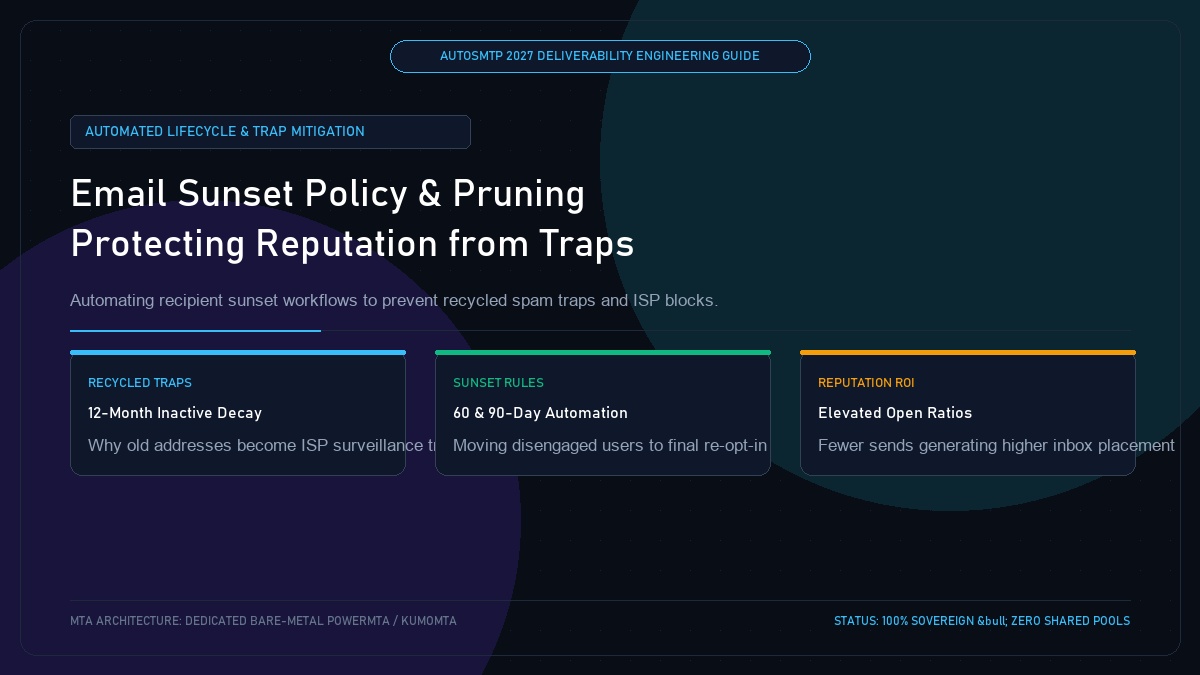
Email Sunset Policy & Automated Pruning: Protecting Sender Reputation from Recycled Spam Traps
Published by Fred Dawson • Senior Deliverability Systems Architect • 21 min read
An email sunset policy is the deliberate, automated process of removing unengaged subscribers from your active sending lists. While marketing departments often resist list pruning out of fear of shrinking their database, deliverability engineers recognize that a sunset policy is an absolute prerequisite for maintaining top-tier sender reputation. In 2027, Mailbox Providers convert abandoned consumer inboxes into recycled spam traps after 12 months of inactivity. Continuing to mail these addresses guarantees blacklisting on Spamhaus and severe Google Postmaster penalties. This guide explains how to design and automate an enterprise sunset policy.
- 1. Why Unengaged Subscribers Are a Direct Deliverability Threat
- 2. The Mechanics of Recycled Spam Traps
- 3. Designing the 30-60-90 Day Sunset Workflow
- 4. Automated Pruning & Database State Management
- 5. The Economic Paradox: Why Smaller Lists Generate More Revenue
- 6. Sunset Policy Execution Matrix by Industry
- 7. Case Study: Publishing Fleet Restores 99% Placement via Pruning
- 8. The AutoSMTP Deliverability Defense Advantage
1. Why Unengaged Subscribers Are a Direct Deliverability Threat
Sending email to people who do not open it damages deliverability in two distinct ways:
Algorithmic Engagement Penalty
Google and Microsoft measure the ratio of delivered messages that are opened vs ignored. When 70% of your email sits unopened, mailbox algorithms infer that your messages are low quality, pushing future broadcasts to the spam folder.
Trap Conversion Risk
Every abandoned email address is a ticking time bomb. Mailbox providers monitor abandoned accounts and convert them into recycled spam traps. Senders without sunset policies inevitably hit these traps.
2. The Mechanics of Recycled Spam Traps
When an email user abandons their mailbox (e.g., switches to a new address or leaves a company), the provider deactivates the account. For the first 6–12 months, incoming emails bounce with 550 5.1.1 User unknown. However, after 12 months, the provider reactivates the address as a surveillance trap. An email sent to that address will accept connections (250 OK) but immediately log a trap hit against your sending domain.
3. Designing the 30-60-90 Day Sunset Workflow
- Days 0–30: Active Cohort. Receives standard broadcast cadence.
- Days 31–60: Cooling Cohort. Frequency reduced by 50%. Focus on high-value educational content.
- Days 61–90: Dormant Cohort. Removed from daily broadcasts; entered into automated 2-step re-engagement sequence.
- Day 91+: Hard Sunset. Automatically moved to permanent suppression. Never mailed again.
4. Automated Pruning & Database State Management
-- Automated nightly sunset job
UPDATE subscribers
SET status = 'SUNSETTED', sunset_at = NOW()
WHERE status = 'ACTIVE'
  AND last_open_at < DATE_SUB(NOW(), INTERVAL 90 DAY)
  AND last_click_at < DATE_SUB(NOW(), INTERVAL 90 DAY)
  AND created_at < DATE_SUB(NOW(), INTERVAL 90 DAY);

-- Result: Zero-touch automatic suppression of high-risk contacts
5. The Economic Paradox: Why Smaller Lists Generate More Revenue
When a company prunes 25% of its inactive database, overall open rates typically increase from 18% to 32%. Because Google and Microsoft observe elevated engagement ratios, they promote the remaining 75% of your volume directly to the Primary inbox rather than the Promotions or Spam folders. Net message views and attributed sales revenue increase substantially.
6. Sunset Policy Execution Matrix by Industry
| Industry Vertical | Sending Frequency | Inactivity Warning | Hard Sunset Cutoff |
|---|---|---|---|
| Daily News / Media | 5 – 7 sends / week | 30 Days Inactive | 60 Days Inactive |
| E-Commerce Retail | 2 – 4 sends / week | 60 Days Inactive | 90 Days Inactive |
| B2B SaaS / Enterprise | 1 – 2 sends / week | 90 Days Inactive | 120 Days Inactive |
Publishing Fleet Restores 99% Primary Inboxing by Pruning 400,000 Inactives
A digital newsletter media group sending 15 million emails monthly saw their open rate decline from 31% to 14% over a year. Deliverability engineers discovered that 400,000 of their 1.8 million subscribers had not opened an email in over 120 days, and the domain had logged 3 recycled trap hits on Yahoo. By executing an automated sunset policy and pruning those 400,000 inactive accounts, their list size shrank by 22%, but overall opens increased by 38% within 2 weeks as Gmail and Yahoo promoted their broadcasts back to the Primary inbox.
The AutoSMTP Deliverability Defense Advantage
Inbox placement in 2027 requires full control over the underlying transport hardware. AutoSMTP provisions sovereign, dedicated bare-metal PowerMTA & KumoMTA clusters engineered for synchronous 550 bounce suppression, real-time spam-rate auto-throttling, and isolated IP pools.
Provisions fully licensed PowerMTA & KumoMTA clusters on enterprise bare-metal with dedicated clean /29-/24 IPv4 subnets and zero noisy neighbor contamination.
Monitors Google Postmaster spam ratios (<0.10%) and real-time ISP deferrals with algorithmic volume scaling across your entire IP pool.
RFC 5321 in-band 550 bounce suppression, automated Yahoo/Outlook Complaint Feedback Loops (CFL), and instant bad-IP eviction.
Pre-configured forward and reverse DNS (PTR) per IP, SPF CIDR alignment, 2048-bit DKIM rotation, and strict DMARC enforcement.
Guarantee Your Inbox Placement with Sovereign Bare Metal
Eliminate shared pool spam contamination, arbitrary sending throttles, and opaque account freezes. Deploy an enterprise AutoSMTP cluster today.
Deploy Turnkey MTA Cluster →