

Email Sender Reputation Score: How ISPs Calculate It, What Degrades It & How to Rebuild It
Published by Fred Dawson • Senior Deliverability Systems Architect • 24 min read
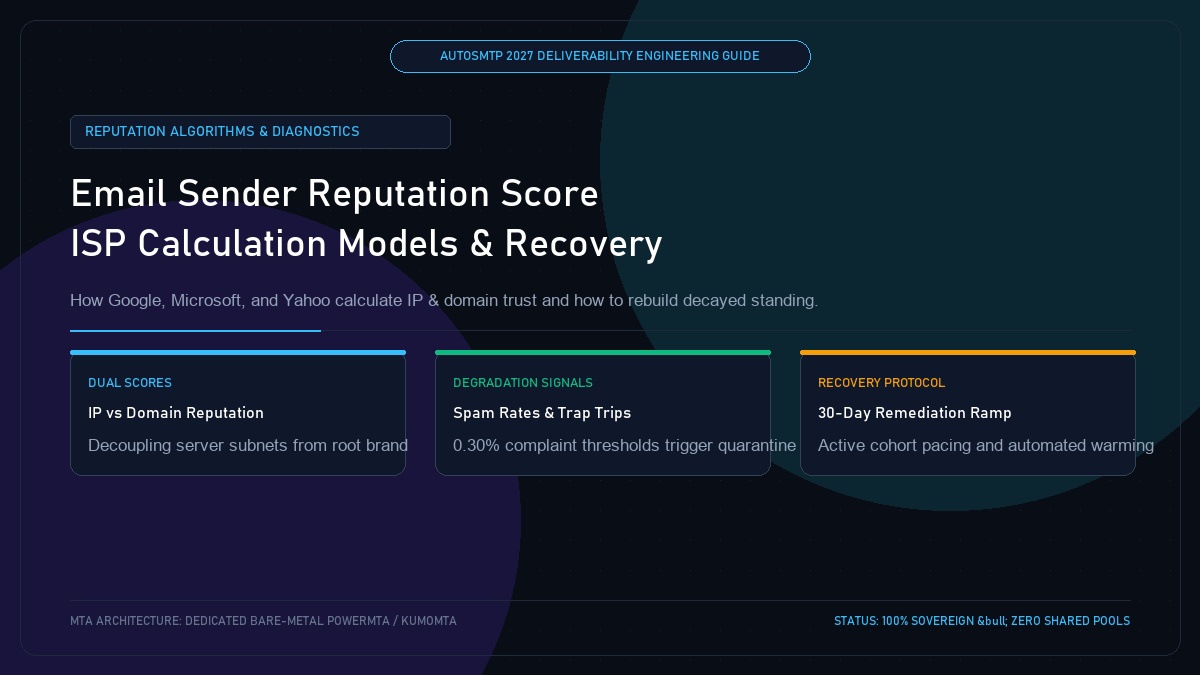
Your email sender reputation is the single most critical asset in digital marketing. Like a credit score, it takes months of disciplined sending habits to build and can be ruined in a single reckless afternoon. In 2027, Mailbox Providers calculate sender reputation using dual scoring engines: IP Reputation (hardware, connection stability, subnet hygiene) and Domain Reputation (cryptographic DMARC identity, organizational trust, user feedback history). This master engineering guide details the mathematical scoring models utilized by Google, Microsoft, and Yahoo, the degradation triggers that destroy deliverability, and the exact 30-day remediation roadmap required to rebuild decayed reputation.
- 1. The Dual Scoring Architecture: IP vs Domain Reputation
- 2. How Mailbox Providers Calculate Reputation Scores
- 3. The Five Fatal Reputation Degradation Triggers
- 4. Authoritative Reputation Monitoring Channels
- 5. The 30-Day Reputation Remediation & Warming Protocol
- 6. Reputation Score Diagnostic & Action Matrix
- 7. Case Study: Rebuilding a Damaged Enterprise Domain Reputation
- 8. The AutoSMTP Deliverability Defense Advantage
1. The Dual Scoring Architecture: IP vs Domain Reputation
Deliverability engineers must understand how mailbox providers separate server hardware from organizational identity:
IP Reputation (Hardware & Transport)
Tied to the physical or virtual IPv4 address sending the email. Measures connection volume spikes, Forward-Confirmed Reverse DNS (FCrDNS), TLS handshakes, and network-level DNSBL listings (Spamhaus ZEN). On dedicated servers, you own 100% of your IP reputation.
Domain Reputation (Cryptographic Identity)
Tied to the authenticated domain in the d= tag of the 2048-bit DKIM signature and RFC 5322 From: header. Google’s spam filters prioritize Domain Reputation over IP reputation. If your domain reputation decays to “Bad,” switching IPs will not restore deliverability.
2. How Mailbox Providers Calculate Reputation Scores
Reputation engines calculate scores continuously using weighted historical moving averages:
- User-Reported Complaints (Weight: 45%): The single most damaging negative signal. Exceeding 1 complaint per 1,000 recipients (> 0.10%) inflicts immediate algorithmic penalties.
- Spam Trap Interceptions (Weight: 25%): Hitting pristine security traps results in severe rating drops and potential blocklisting on Spamhaus SBL.
- Positive User Engagement (Weight: 20%): Messages opened, read for > 8 seconds, marked as important, replied to, or moved out of spam actively boost domain reputation.
- Hard Bounce Rates (Weight: 10%): Exceeding 2% hard bounces signals poor list hygiene and scraping activity.
3. The Five Fatal Reputation Degradation Triggers
1. Volume Shock (Burst Sending on Cold IPs)
Spiking outbound volume from 5,000 to 200,000 messages in a single morning mimics compromised botnet behavior. Mailbox providers immediately reject incoming connections with 421 4.7.0 Rate limit exceeded.
2. Inactive Cohort Reactivation Blasts
Broadcasting to subscribers who have not engaged in over 180 days triggers high bounce rates, recycled spam trap hits, and elevated complaint ratios.
4. Authoritative Reputation Monitoring Channels
Engineers query three primary authoritative platforms to evaluate reputation:
- Google Postmaster Tools: Domain Reputation tiers: High (minimal spam), Medium (occasional spam), Low (regular spam folder placement), Bad (near 100% spam or rejection).
- Microsoft SNDS: Filter result color codes: Green (< 0.3% complaints), Yellow (0.3%–1.0%), Red (> 1.0% or trap trips).
- Cisco Talos Intelligence: Global IP and domain reputation classified as Good, Neutral, or Poor.
5. The 30-Day Reputation Remediation & Warming Protocol
Rebuilding a damaged reputation requires a disciplined, four-phase technical remediation schedule:
Phase 1: Quarantine & Root Cause Isolation (Days 1–5)
Halt all marketing campaigns. Verify 100% strict DMARC alignment, rotate DKIM selectors, and implement RFC 8058 one-click unsubscribe headers. Purge all unverified or unengaged contacts (> 90 days inactive).
Phase 2: Ultra-Engaged Cohort Sending (Days 6–12)
Resume sending exclusively to recipients who have opened or clicked within the last 14 days. Limit daily volume to 1,000–5,000 messages per IP. High open rates (40%+) send positive engagement signals to mailbox filters.
Phase 3: Progressive Volume Expansion (Days 13–21)
Expand targeting to 30-day active subscribers. Scale volume by 20% daily while closely tracking Google Postmaster spam ratios to ensure they remain below 0.05%.
Phase 4: Full Cohort Normalization (Days 22–30)
Gradually incorporate 60-day active contacts. Monitor Google Postmaster status until domain reputation officially updates to “High.”
6. Reputation Score Diagnostic & Action Matrix
| Reputation Status | Observed Inbox Placement | Primary Cause | Mandatory Engineering Action |
|---|---|---|---|
| High / Green | 95% – 99% Primary Inbox | Clean lists, strict auth, < 0.05% spam rate | Maintain consistent sending cadence and automated hygiene |
| Medium / Yellow | 60% – 80% (Promotions tab heavy) | Spam complaint rate between 0.10% and 0.25% | Throttle volume; restrict audience to 30-day actives |
| Low / Red | 15% – 40% (Predominantly Spam) | Spam complaint rate > 0.30% or trap hits | Halt cold broadcasts; execute Phase 1 quarantine protocol |
| Bad / Blocked | 0% – 5% (Bulk 550 Rejections) | Spamhaus listing, broken auth, severe complaints | Delisting petitions; complete list re-verification; IP remap |
Rebuilding an Enterprise Domain Reputation from “Bad” to “High”
A SaaS enterprise suffered a domain reputation crash to “Bad” on Google Postmaster following an automated onboarding sequence that emailed 350,000 unverified signups, generating an 0.44% spam complaint rate. Google routed all subsequent company emails into spam. Deliverability engineers paused the sequence, deployed real-time API verification on user signups, and placed the domain on an AutoSMTP dedicated bare-metal cluster. By executing the 30-day remediation protocol—sending exclusively to high-intent product notification users—Google Postmaster updated the domain reputation back to “High” on Day 24, restoring 99.2% inbox placement.
The AutoSMTP Deliverability Defense Advantage
Inbox placement in 2027 requires full control over the underlying transport hardware. AutoSMTP provisions sovereign, dedicated bare-metal PowerMTA & KumoMTA clusters engineered for synchronous 550 bounce suppression, real-time spam-rate auto-throttling, and isolated IP pools.
Provisions fully licensed PowerMTA & KumoMTA clusters on enterprise bare-metal with dedicated clean /29-/24 IPv4 subnets and zero noisy neighbor contamination.
Monitors Google Postmaster spam ratios (<0.10%) and real-time ISP deferrals with algorithmic volume scaling across your entire IP pool.
RFC 5321 in-band 550 bounce suppression, automated Yahoo/Outlook Complaint Feedback Loops (CFL), and instant bad-IP eviction.
Pre-configured forward and reverse DNS (PTR) per IP, SPF CIDR alignment, 2048-bit DKIM rotation, and strict DMARC enforcement.
Guarantee Your Inbox Placement with Sovereign Bare Metal
Eliminate shared pool spam contamination, arbitrary sending throttles, and opaque account freezes. Deploy an enterprise AutoSMTP cluster today.
Deploy Turnkey MTA Cluster →