

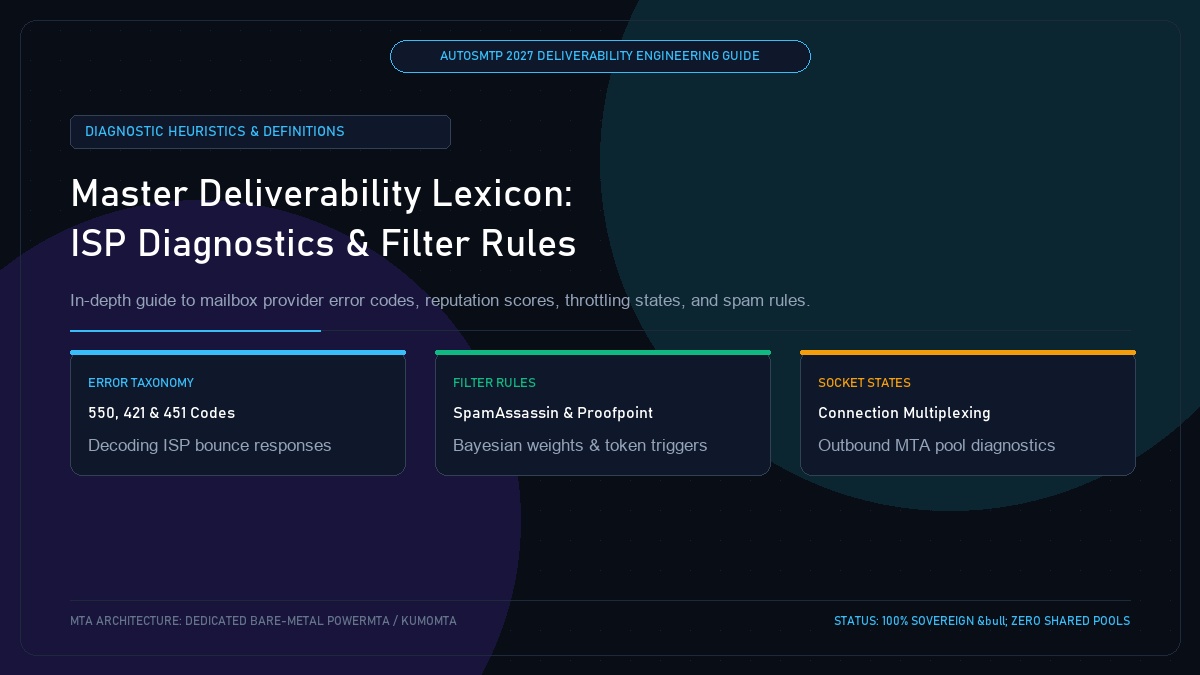
The Master Email Deliverability Lexicon: Diagnostic Terms & ISP Heuristics
Published by Fred Dawson • Senior Deliverability Systems Architect • 26 min read
Diagnosing email delivery failures requires moving past generic error messages like “undelivered” or “rejected” and decoding the exact cryptographic, transport, and heuristic signals returned by receiving mail servers. In high-volume production environments, an accurate diagnosis of whether an email was dropped due to IP connection rate-limiting (421 4.7.0), a mailbox quota error (452 4.2.2), or an unaligned DMARC policy violation (550 5.7.26) dictates the exact technical remediation. This master lexicon translates complex RFC status codes, ISP feedback loop signals, and anti-spam heuristics into actionable engineering diagnostics.
- 1. Core SMTP Status Codes: Decoding 2xx, 4xx, and 5xx Responses
- 2. RFC 3463 Enhanced Status Codes: Pinpoint Error Identification
- 3. ISP Throttling States: Backoff Intervals & Rate Limits
- 4. Algorithmic Spam Heuristics: Bayesian, NLP & Engagement Weights
- 5. Master Deliverability Diagnostic & Error Resolution Matrix
- 6. Case Study: Operations Team Automates Diagnostic Triage
- 7. The AutoSMTP Deliverability Defense Advantage
1. Core SMTP Status Codes: Decoding 2xx, 4xx, and 5xx Responses
Every SMTP transaction concludes with a standardized 3-digit status code returned by the receiving MTA:
- 2xx Success (e.g., 250 OK): The message has been successfully handed off to the receiving mail system. Note: A 250 OK does not guarantee inbox placement; it merely confirms receipt at the gateway.
- 4xx Transient Failure (e.g., 421, 451): A temporary failure condition (rate limiting, mailbox full, greylisting). The sending MTA must keep the message in queue and retry.
- 5xx Permanent Failure (e.g., 550, 554): A fatal rejection (non-existent mailbox, DMARC rejection, IP blacklisting). Senders must immediately suppress the address.
2. RFC 3463 Enhanced Status Codes: Pinpoint Error Identification
Modern MTAs accompany 3-digit codes with dot-separated subcodes (e.g., 5.7.1) that indicate the exact failure mechanism:
4.7.0 / 4.7.1 (IP Rate Limiting)
The receiving provider (e.g. Gmail) has detected too many simultaneous socket connections or rapid volume from your IP. Remedy: increase backoff retry interval and throttle outbound connections.
5.7.26 (Authentication Policy Failure)
The message failed SPF or DKIM alignment and the domain’s DMARC policy mandates rejection. Remedy: fix DNS record alignment before dispatching another message.
3. ISP Throttling States: Backoff Intervals & Rate Limits
When an ISP enters a throttling state with your MTA, continuing to hammer the connection will escalate the penalty into a temporary 24-hour IP ban. Outbound MTAs must implement dynamic exponential backoff retry algorithms.
4. Algorithmic Spam Heuristics: Bayesian, NLP & Engagement Weights
Spam filters evaluate messages across multiple weighted vectors: sender IP reputation (40%), domain cryptographic alignment (25%), recipient engagement history (20%), and content/HTML token analysis (15%).
5. Master Deliverability Diagnostic & Error Resolution Matrix
| SMTP Code | Enhanced Code | Diagnostic Meaning | Required Engineering Action |
|---|---|---|---|
| 421 | 4.7.0 |
Connection rate limit exceeded | Reduce concurrent connections; backoff 15m |
| 451 | 4.7.1 |
Greylisting active or server busy | Maintain RFC retry queue (retry in 10-15m) |
| 550 | 5.1.1 |
Unknown user / Mailbox not found | Permanently suppress address immediately |
| 550 | 5.7.1 |
Relay access denied / Blacklisted | Check DNSBL listings (Spamhaus, Invaluement) |
| 554 | 5.7.9 |
Message rejected due to DMARC | Audit DKIM signing and From: alignment |
SaaS Operations Team Automates Log Triage to Cut Queue Latency by 92%
An enterprise software platform dispatching 5M weekly notifications suffered from persistent delivery queue backlog. Customer support was inundated with complaints that password reset emails were arriving hours late. By deploying an automated log triage script that parsed RFC 3463 subcodes, the operations team discovered that their MTAs were treating temporary 4.7.0 Gmail connection throttles with aggressive 30-second retries, causing Gmail to extend the throttle penalty. Adjusting the PowerMTA backoff retry interval to 15 minutes immediately cleared the throttle, collapsing average queue latency by 92%.
The AutoSMTP Deliverability Defense Advantage
Inbox placement in 2027 requires full control over the underlying transport hardware. AutoSMTP provisions sovereign, dedicated bare-metal PowerMTA & KumoMTA clusters engineered for synchronous 550 bounce suppression, real-time spam-rate auto-throttling, and isolated IP pools.
Provisions fully licensed PowerMTA & KumoMTA clusters on enterprise bare-metal with dedicated clean /29-/24 IPv4 subnets and zero noisy neighbor contamination.
Monitors Google Postmaster spam ratios (<0.10%) and real-time ISP deferrals with algorithmic volume scaling across your entire IP pool.
RFC 5321 in-band 550 bounce suppression, automated Yahoo/Outlook Complaint Feedback Loops (CFL), and instant bad-IP eviction.
Pre-configured forward and reverse DNS (PTR) per IP, SPF CIDR alignment, 2048-bit DKIM rotation, and strict DMARC enforcement.
Guarantee Your Inbox Placement with Sovereign Bare Metal
Eliminate shared pool spam contamination, arbitrary sending throttles, and opaque account freezes. Deploy an enterprise AutoSMTP cluster today.
Deploy Turnkey MTA Cluster →