

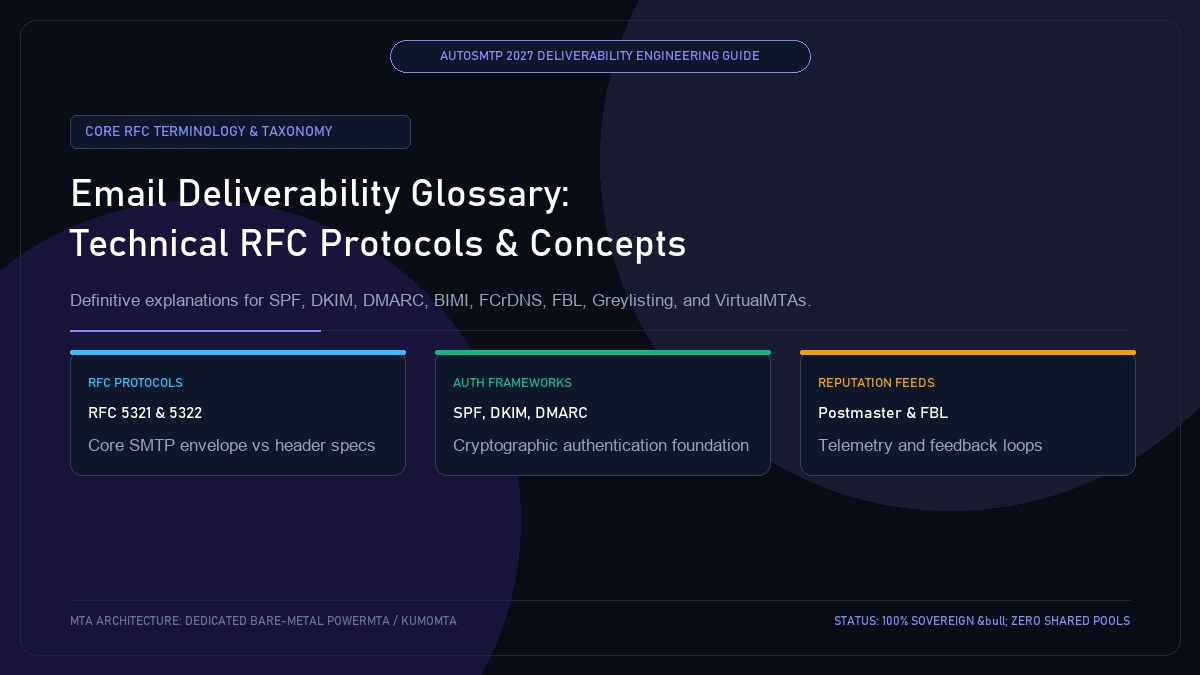
Enterprise Email Deliverability Glossary 2027: Technical RFC Protocols & Infrastructure Terms
Published by Fred Dawson • Senior Deliverability Systems Architect • 24 min read
In the high-stakes discipline of enterprise email infrastructure, precision of language is an engineering requirement. Senders who confuse envelope senders with header senders, misinterpret soft bounce error codes, or misunderstand DMARC alignment modes inevitably make costly architectural errors. Modern email delivery relies on a rigorous web of Internet Engineering Task Force (IETF) Request for Comments (RFC) standards that govern transport, encryption, cryptographic authentication, and recipient privacy. This authoritative glossary defines the core RFC protocols and technical concepts that underpin global email deliverability in 2027.
1. Core Transport & Message Structure RFCs
- RFC 5321 (Simple Mail Transfer Protocol – SMTP): Defines the fundamental protocol for transferring mail across IP networks. Specifies SMTP command verbs (
HELO,EHLO,MAIL FROM,RCPT TO,DATA,QUIT) and 3-digit status codes. - RFC 5322 (Internet Message Format – IMF): Specifies the syntax for text messages sent using SMTP. Crucially distinguishes between the Envelope Sender (RFC 5321
MAIL FROM) and the Header Sender (RFC 5322From:). - RFC 6531 (SMTP Extension for Internationalized Email – SMTPUTF8): Permits non-ASCII characters in email mailbox addresses and header values.
2. Cryptographic Authentication & Identity RFCs
- RFC 7208 (Sender Policy Framework – SPF): Allows domain owners to publish DNS records specifying authorized IP addresses for outbound mail. Enforces the strict 10-lookup evaluation limit.
- RFC 6376 (DomainKeys Identified Mail – DKIM): Defines asymmetric cryptographic signatures attached to email headers, enabling receivers to verify that the message content was not altered in transit.
- RFC 7489 (Domain-based Message Authentication, Reporting & Conformance – DMARC): Unifies SPF and DKIM through domain alignment, empowering senders to publish enforcement policies (
p=none,p=quarantine,p=reject). - RFC 8617 (Authenticated Received Chain – ARC): Preserves email authentication assessment results across intermediate forwarding hops (e.g., mailing lists).
3. In-Transit Encryption & Security RFCs
- RFC 3207 (SMTP Service Extension for Secure SMTP over TLS): Defines the
STARTTLScommand for upgrading plaintext SMTP connections to encrypted TLS channels. - RFC 8461 (SMTP MTA Strict Transport Security – MTA-STS): Enables domains to declare their ability and requirement to receive TLS-secured SMTP connections via DNS and HTTPS policy files.
- RFC 8460 (SMTP TLS Reporting – TLSRPT): Defines reporting mechanisms for monitoring TLS connection failures between MTAs.
4. Unsubscribe & Feedback Loop RFCs
- RFC 8058 (Signaling One-Click Functionality for List-Unsubscribe): Mandates the injection of
List-Unsubscribe: <URL>andList-Unsubscribe-Post: List-Unsubscribe=One-Clickheaders, allowing mailbox clients to render native opt-out buttons. - RFC 5965 (An Extensible Format for Email Feedback Reports – ARF): Defines the standard Abuse Reporting Format (ARF) used by major ISPs in Complaint Feedback Loops (FBL).
5. Master Deliverability RFC Reference Matrix
| Standard Specification | Protocol Domain | Primary Operational Purpose | Deliverability Impact if Missing |
|---|---|---|---|
| RFC 5321 | Transport Envelope | Socket connection negotiation | Connection dropping / 500 error |
| RFC 5322 | Message Syntax | Header & MIME boundary formatting | SpamAssassin AST formatting penalty |
| RFC 7208 (SPF) | DNS Authentication | Outbound IP authorization | Soft-fail / 550 SPF check failure |
| RFC 6376 (DKIM) | Cryptographic Signature | Body and header integrity verification | 550 DKIM missing rejection |
| RFC 7489 (DMARC) | Policy Enforcement | Domain alignment and spoof defense | Instant rejection under MAGY mandates |
| RFC 8058 | Opt-Out Mechanism | 1-Click unsubscribe in client UI | Elevated spam complaints > 0.10% |
The AutoSMTP Deliverability Defense Advantage
Inbox placement in 2027 requires full control over the underlying transport hardware. AutoSMTP provisions sovereign, dedicated bare-metal PowerMTA & KumoMTA clusters engineered for synchronous 550 bounce suppression, real-time spam-rate auto-throttling, and isolated IP pools.
Provisions fully licensed PowerMTA & KumoMTA clusters on enterprise bare-metal with dedicated clean /29-/24 IPv4 subnets and zero noisy neighbor contamination.
Monitors Google Postmaster spam ratios (<0.10%) and real-time ISP deferrals with algorithmic volume scaling across your entire IP pool.
RFC 5321 in-band 550 bounce suppression, automated Yahoo/Outlook Complaint Feedback Loops (CFL), and instant bad-IP eviction.
Pre-configured forward and reverse DNS (PTR) per IP, SPF CIDR alignment, 2048-bit DKIM rotation, and strict DMARC enforcement.
Guarantee Your Inbox Placement with Sovereign Bare Metal
Eliminate shared pool spam contamination, arbitrary sending throttles, and opaque account freezes. Deploy an enterprise AutoSMTP cluster today.
Deploy Turnkey MTA Cluster →