

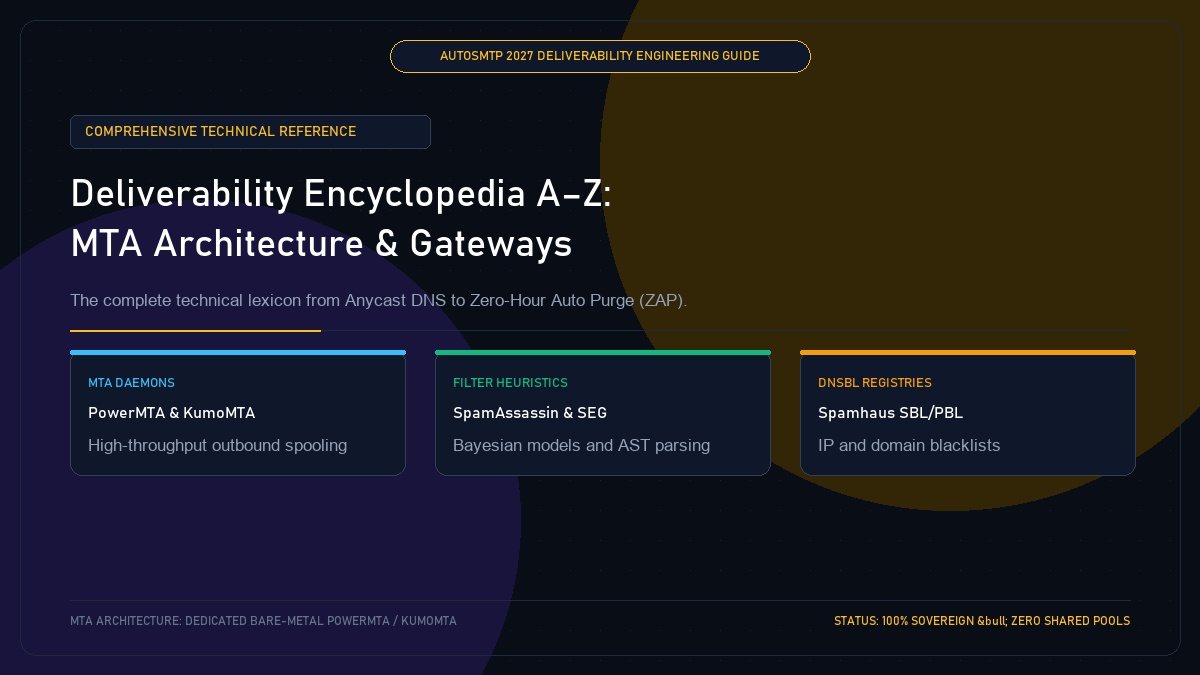
The A–Z Email Deliverability Encyclopedia: MTA Architecture, DNS Auth & Reputation Feeds
Published by Fred Dawson • Senior Deliverability Systems Architect • 28 min read
Welcome to the definitive A–Z encyclopedic compendium of enterprise email deliverability. From low-level network routing protocols and DNS record architectures to algorithmic mailbox heuristics and ISP feedback loops, this reference organizes every critical concept, acronym, and tool required to navigate modern email delivery. Whether troubleshooting an obscure 421 deferral code, configuring a sovereign bare-metal PowerMTA node, or preparing for an enterprise compliance audit, this encyclopedia serves as your definitive engineering field reference.
- 1. Section A – C: Anycast, BIMI & Canonicalization
- 2. Section D – F: DMARC, Envelope & FCrDNS
- 3. Section G – L: Greylisting, Honeypots & List-Unsubscribe
- 4. Section M – P: MTA-STS, Postmaster & PowerMTA
- 5. Section Q – Z: Quarantine, Spamhaus & Zero-Hour Auto Purge
- 6. The AutoSMTP Deliverability Defense Advantage
1. Section A – C: Anycast, BIMI & Canonicalization
- Anycast DNS: A network addressing method where multiple servers share the same IP address across global points of presence, ensuring near-instantaneous DNS lookups for SPF, DKIM, and MX records.
- ARC (Authenticated Received Chain): An email authentication protocol (RFC 8617) designed to preserve authentication states through intermediary forwarding servers like mailing lists.
- Bayesian Filter: A statistical machine learning anti-spam algorithm that calculates the mathematical probability of an email being spam based on the frequency of specific words and tokens.
- BIMI (Brand Indicators for Message Identification): An email specification that displays authenticated brand logos next to incoming messages in supporting clients (Gmail, Apple Mail) when paired with DMARC
p=rejectand a Verified Mark Certificate (VMC). - Canonicalization: The standardization process (relaxed vs simple) in DKIM signing that normalizes whitespace and line breaks before hashing to prevent signatures from breaking in transit.
- Complaint Feedback Loop (CFL / FBL): A service provided by ISPs (Yahoo, Outlook) that forwards recipient spam complaints back to the sender in ARF format for automated suppression.
2. Section D – F: DMARC, Envelope & FCrDNS
- DMARC: Domain-based Message Authentication, Reporting & Conformance. Enforces domain alignment between the visible From: header and SPF/DKIM domains.
- DNSBL (DNS-based Blackhole List): Real-time blocklists (such as Spamhaus, Barracuda, Invaluement) queried by receiving mail servers to reject connection attempts from known spam IPs.
- Dwell Time: The duration a subscriber keeps an email open on their screen. Gmail and Microsoft evaluate long dwell times (>8 seconds) as strong positive engagement signals.
- Envelope Sender: The email address specified in the SMTP
MAIL FROM:command, used by receiving servers to return bounce notifications (Return-Path). - FCrDNS (Forward-Confirmed Reverse DNS): A networking configuration where an IP address resolves to a domain name via PTR, and that domain name resolves back to the identical IP address via an A record. Mandatory for MAGY compliance.
3. Section G – L: Greylisting, Honeypots & List-Unsubscribe
- Greylisting: An anti-spam defense where receiving MTAs reject initial delivery attempts with a temporary 451 code to verify that the sender maintains a legitimate RFC-compliant retry queue.
- Hard Bounce: A permanent delivery failure code (5xx) indicating the recipient mailbox does not exist, has been deleted, or the domain has no valid MX records.
- Honeypot / Spam Trap: An email address deliberately published or recycled by security organizations to catch senders who harvest addresses without valid opt-in consent.
- IP Warming: The methodical process of gradually increasing sending volume on a new, unrated IP address over 4 to 8 weeks to establish positive reputation baseline metrics.
- List-Unsubscribe: In-header email metadata enabling mail clients to render native one-click unsubscribe buttons (RFC 8058).
4. Section M – P: MTA-STS, Postmaster & PowerMTA
- MTA (Mail Transfer Agent): The server software daemon (PowerMTA, KumoMTA, Postfix) responsible for routing and dispatching email via SMTP.
- MTA-STS: SMTP MTA Strict Transport Security. A standard requiring TLS encryption for all incoming connections, preventing Man-in-the-Middle (MITM) attacks.
- Postmaster Tools: Web portals provided by Google and Yahoo displaying granular sender telemetry: domain reputation, IP reputation, spam complaint ratios, and delivery errors.
- PowerMTA: Enterprise-grade outbound MTA software engine developed for high-throughput transactional and marketing email delivery, supporting VirtualMTA clustering and granular rate-limiting.
5. Section Q – Z: Quarantine, Spamhaus & Zero-Hour Auto Purge
- Quarantine: A DMARC policy (
p=quarantine) or gateway defense state where unauthenticated or suspicious messages are diverted to the junk folder or admin review queue. - Recycled Spam Trap: An abandoned email address once owned by a real person that was deactivated and subsequently resurrected by an ISP to catch senders with poor list hygiene.
- Spamhaus: The preeminent international non-profit threat intelligence organization maintaining authoritative DNSBL registries (SBL, XBL, PBL, DBL).
- Sunset Policy: An automated data governance protocol that progressively throttles and eventually removes subscribers who have shown zero engagement over 60 to 90 days.
- VirtualMTA: A logical outbound routing abstraction within PowerMTA that maps specific email traffic streams to dedicated source IP addresses and hostnames.
- ZAP (Zero-Hour Auto Purge): A Microsoft 365 security feature that automatically identifies and removes malicious or spam emails from user inboxes even after they have already been delivered.
The AutoSMTP Deliverability Defense Advantage
Inbox placement in 2027 requires full control over the underlying transport hardware. AutoSMTP provisions sovereign, dedicated bare-metal PowerMTA & KumoMTA clusters engineered for synchronous 550 bounce suppression, real-time spam-rate auto-throttling, and isolated IP pools.
Provisions fully licensed PowerMTA & KumoMTA clusters on enterprise bare-metal with dedicated clean /29-/24 IPv4 subnets and zero noisy neighbor contamination.
Monitors Google Postmaster spam ratios (<0.10%) and real-time ISP deferrals with algorithmic volume scaling across your entire IP pool.
RFC 5321 in-band 550 bounce suppression, automated Yahoo/Outlook Complaint Feedback Loops (CFL), and instant bad-IP eviction.
Pre-configured forward and reverse DNS (PTR) per IP, SPF CIDR alignment, 2048-bit DKIM rotation, and strict DMARC enforcement.
Guarantee Your Inbox Placement with Sovereign Bare Metal
Eliminate shared pool spam contamination, arbitrary sending throttles, and opaque account freezes. Deploy an enterprise AutoSMTP cluster today.
Deploy Turnkey MTA Cluster →