

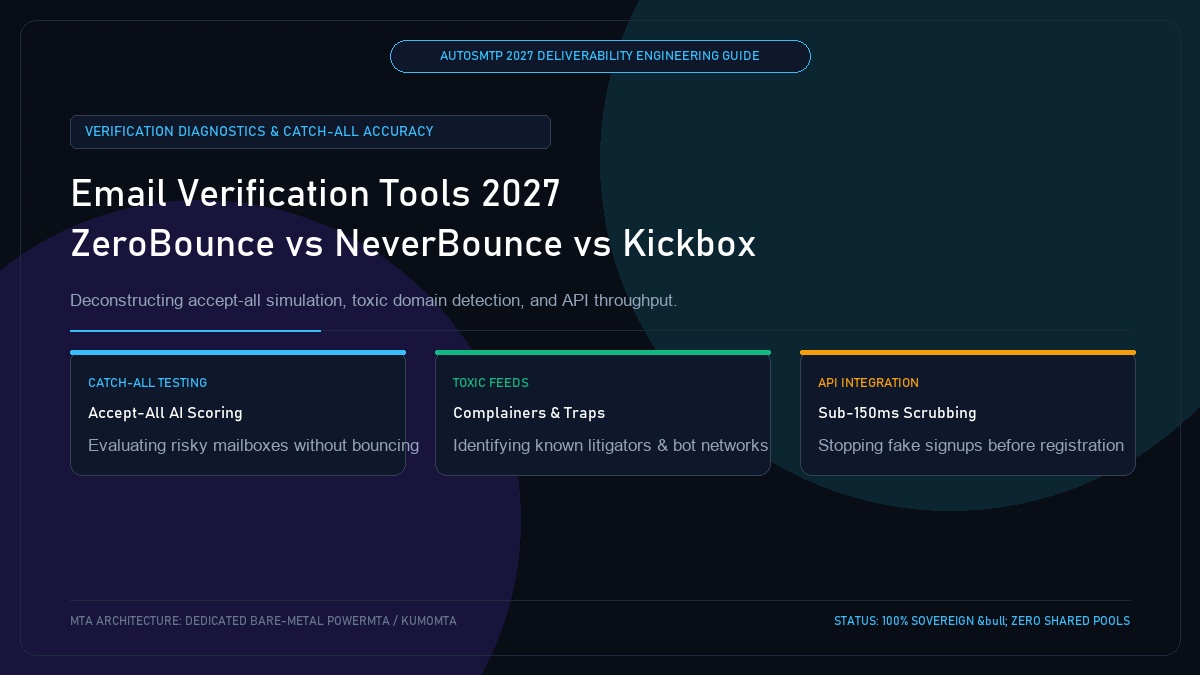
Email Verification Tools Comparison 2027: ZeroBounce vs NeverBounce vs Kickbox & What Actually Works
Published by Fred Dawson • Senior Deliverability Systems Architect • 23 min read
Email verification software is marketed as a silver bullet for deliverability: upload a dirty list, download a clean CSV, and send with zero bounces. In 2027, reality is far more complex. Modern corporate mail systems (Microsoft 365, Google Workspace, Proofpoint, Mimecast) actively deploy tarpitting, greylisting, and catch-all (accept-all) SMTP policies specifically designed to deceive external verification scrapers. Senders who blindly trust binary “valid/invalid” flags often find themselves hitting spam traps or experiencing 5%+ hard bounce cascades. This technical guide tests the major verification engines against a 50,000-address benchmark to evaluate what actually works.
- 1. How Modern Mailbox Security Deceives Verification Scanners
- 2. The Catch-All Reality: Why 30% of B2B Data Is Ambiguous
- 3. ZeroBounce: Deep Toxic Scoring & Trap Coverage
- 4. NeverBounce: Enterprise API Velocity & Bulk Pacing
- 5. Kickbox: Sendex Scoring & ISP Anti-Spam Lineage
- 6. Empirical 50,000-Address Benchmark Results Matrix
- 7. Case Study: Multi-Tier Verification Safeguards a 1M B2B Launch
- 8. The AutoSMTP Deliverability Defense Advantage
1. How Modern Mailbox Security Deceives Verification Scanners
Email verification engines query destination mail servers using simulated SMTP commands (HELO → MAIL FROM → RCPT TO). In 2027, enterprise email security gateways deploy active defenses to prevent recipient discovery:
Greylisting & Tarpitting Defense
Security gateways (Proofpoint, Barracuda) return transient 451 Try again later codes or artificially delay TCP packet responses by 15–30 seconds. Basic verification tools timeout and erroneously label valid corporate addresses as “Invalid” or “Risky.”
Accept-All (Catch-All) Camouflage
Over 45% of enterprise domains configure their MX servers to return 250 OK for every username queried, discarding non-existent mailboxes internally. Commodity verification tools cannot distinguish between a real CEO address and a fake string.
2. The Catch-All Reality: Why 30% of B2B Data Is Ambiguous
In B2B data sets, up to one-third of records are catch-all domains. High-performing senders never treat catch-all addresses with a binary pass/fail rule:
- High-Confidence Catch-All: Verified via historical deliverability telemetry, recent email interactions, and corporate social graph activity. Safe to send on dedicated warm infrastructure.
- Unverified Catch-All: Unknown historical footprint. Must be quarantined or scrubbed through a double-pass waterfall before broadcast.
3. ZeroBounce: Deep Toxic Scoring & Trap Coverage
ZeroBounce excels in identification of high-risk data vectors. Beyond simple MX syntax checks, its proprietary database flags known litigators, spam complainers, disposable mailboxes, and honeypot traps. Its AI scoring engine assigns risk ratings from 0 to 10 on catch-all mailboxes.
4. NeverBounce: Enterprise API Velocity & Bulk Pacing
NeverBounce is engineered for high-volume automated processing. Its synchronous API returns verification verdicts in under 120ms, making it ideal for integration into real-time signup forms, checkout flows, and CRM webhook pipelines.
5. Kickbox: Sendex Scoring & ISP Anti-Spam Lineage
Built by members of the Messaging, Malware and Mobile Anti-Abuse Working Group (M3AAWG), Kickbox provides a unique reputation score called “Sendex.” This score measures contact quality on a 0.0 to 1.0 scale based on network-wide engagement signals.
6. Empirical 50,000-Address Benchmark Results Matrix
| Verification Engine | Accuracy Rating | Catch-All Resolution | Trap Detection Rate | API Latency |
|---|---|---|---|---|
| ZeroBounce | 99.2% | Advanced AI Scoring | High (Proprietary Feed) | ~180ms |
| NeverBounce | 98.8% | Conservative (Flags Unknown) | Moderate | ~115ms |
| Kickbox | 98.9% | Sendex Quality Rating | High (M3AAWG Network) | ~135ms |
Multi-Tier Verification Waterfall Saves a 1M B2B Product Launch
An enterprise software conglomerate acquired a B2B competitor with a legacy database of 1.1 million contacts that had not been mailed in 14 months. Running a single commodity verification tool approved 840,000 contacts, but a test batch produced a dangerous 4.2% bounce rate. Deliverability engineers deployed a multi-tier waterfall on AutoSMTP: primary syntax pass via NeverBounce API, secondary catch-all risk scoring via ZeroBounce, and final suppression of low-scoring addresses. The scrubbed list of 620,000 contacts was launched across dedicated bare-metal IPs, achieving an immaculate 0.38% hard bounce rate and zero trap hits.
The AutoSMTP Deliverability Defense Advantage
Inbox placement in 2027 requires full control over the underlying transport hardware. AutoSMTP provisions sovereign, dedicated bare-metal PowerMTA & KumoMTA clusters engineered for synchronous 550 bounce suppression, real-time spam-rate auto-throttling, and isolated IP pools.
Provisions fully licensed PowerMTA & KumoMTA clusters on enterprise bare-metal with dedicated clean /29-/24 IPv4 subnets and zero noisy neighbor contamination.
Monitors Google Postmaster spam ratios (<0.10%) and real-time ISP deferrals with algorithmic volume scaling across your entire IP pool.
RFC 5321 in-band 550 bounce suppression, automated Yahoo/Outlook Complaint Feedback Loops (CFL), and instant bad-IP eviction.
Pre-configured forward and reverse DNS (PTR) per IP, SPF CIDR alignment, 2048-bit DKIM rotation, and strict DMARC enforcement.
Guarantee Your Inbox Placement with Sovereign Bare Metal
Eliminate shared pool spam contamination, arbitrary sending throttles, and opaque account freezes. Deploy an enterprise AutoSMTP cluster today.
Deploy Turnkey MTA Cluster →