

Email List Building Best Practices: Double Opt-In, Bot Protection & Deliverability Architecture
Published by Fred Dawson • Senior Deliverability Systems Architect • 21 min read
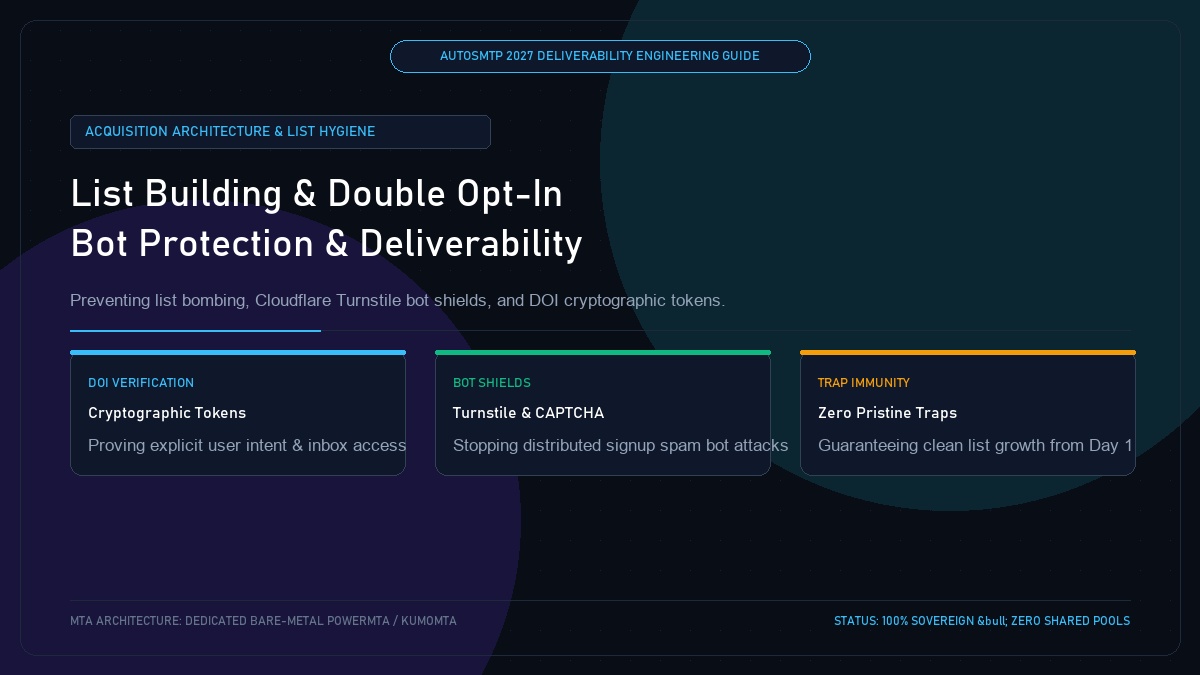
The foundation of email deliverability is established at the exact moment a subscriber joins your list. While marketing teams frequently advocate for Single Opt-In (SOI) to eliminate friction and inflate vanity lead counts, SOI exposes your sending infrastructure to automated form-submission bots, malicious “list bombing” attacks, and invalid syntax typos. In 2027, Confirmed Double Opt-In (COI/DOI) combined with Cloudflare Turnstile bot shields is an engineering necessity. This guide breaks down the architectural advantages of DOI, cryptographic verification token pipelines, and bot protection protocols.
- 1. Single Opt-In vs Double Opt-In: The Engineering Trade-Off
- 2. Defending Against List Bombing & Form Injection Attacks
- 3. Implementing Cloudflare Turnstile & Honeypot Fields
- 4. Cryptographic DOI Token Generation & Expiration Logic
- 5. Legal Compliance: GDPR, CASL & Proof of Explicit Consent
- 6. Acquisition Architecture Comparison Matrix
- 7. Case Study: E-Commerce Store Neutralizes a 50,000-Bot Injection
- 8. The AutoSMTP Deliverability Defense Advantage
1. Single Opt-In vs Double Opt-In: The Engineering Trade-Off
Single Opt-In (High Risk)
Anyone can submit any email address without verification. Results in 10%–15% invalid entries (typos like gnail.com), vulnerable to malicious competitor subscription attacks, and risks immediate inclusion of pristine spam traps.
Confirmed Double Opt-In (High Deliverability)
Requires the subscriber to click a unique verification link sent to their mailbox. Guarantees 100% inbox existence, proves explicit consent, generates an immediate positive open/click interaction on day one, and prevents spam trap contamination.
2. Defending Against List Bombing & Form Injection Attacks
List bombing occurs when bad actors use automated scripts to submit target victim addresses to thousands of unprotected signup forms simultaneously. The victim’s inbox is flooded with thousands of confirmation emails, burying critical security alerts. If your form lacks bot protection, Mailbox Providers flag your server as a participating spam source.
3. Implementing Cloudflare Turnstile & Honeypot Fields
Protecting web forms requires invisible challenge layers:
- Cloudflare Turnstile: Frictionless, privacy-preserving CAPTCHA replacement that validates browser integrity without frustrating human users.
- Hidden CSS Honeypots: Form fields hidden via CSS (
display:none;) that human users cannot see, but automated form scrapers populate. Any submission with a filled honeypot field is silently dropped.
4. Cryptographic DOI Token Generation & Expiration Logic
// Generate tamper-proof time-limited verification URL
$email = "subscriber@example.com";
$timestamp = time();
$secret_key = config('app.doi_secret');

$hash = hash_hmac('sha256', "$email|$timestamp", $secret_key);
$token = base64_encode("$email|$timestamp|$hash");

$confirmation_url = "https://app.example.com/confirm?token=" . urlencode($token);

// Verification logic checks:
// 1. Valid HMAC signature match
// 2. Token age < 86,400 seconds (24h expiration)
// 3. Mark contact status = 'CONFIRMED' in database
5. Legal Compliance: GDPR, CASL & Proof of Explicit Consent
Under GDPR and CASL, the legal burden of proof rests entirely on the sender. Senders must be able to produce the timestamp, IP address, and verification confirmation event for every active contact. Double Opt-In creates an immutable audit trail that shields organizations from regulatory penalties.
6. Acquisition Architecture Comparison Matrix
| Acquisition Architecture | Form Conversion Rate | Spam Trap Risk | Long-Term Inbox Placement | Legal Auditability |
|---|---|---|---|---|
| Unprotected Single Opt-In | Highest (100% baseline) | Critical (Vulnerable to traps) | Poor (Degrades within 6 months) | Weak (Zero proof of identity) |
| SOI + Captcha / API Scrub | High (~92%) | Moderate | Good | Moderate |
| Confirmed Double Opt-In (DOI) | Moderate (~78%) | Zero (Mathematically impossible) | Pristine (98%+ sustained placement) | Absolute (Cryptographic audit trail) |
Neutralizing a 50,000-Bot Injection Attack on an E-Commerce Launch
A lifestyle e-commerce brand launched a viral pre-order campaign with an unprotected single opt-in signup form. Within 4 hours, a malicious botnet targeted the form, injecting 52,000 fake and scraped email addresses. When the brand dispatched their welcome sequence, hard bounces hit 18%, and Microsoft SNDS instantly flagged their sending IP red. Deliverability engineers purged the unconfirmed records, migrated the registration pipeline to Confirmed Double Opt-In with Cloudflare Turnstile, and re-routed sends through an AutoSMTP bare-metal cluster. The bot attack was completely halted, and genuine subscriber open rates rose to 52%.
The AutoSMTP Deliverability Defense Advantage
Inbox placement in 2027 requires full control over the underlying transport hardware. AutoSMTP provisions sovereign, dedicated bare-metal PowerMTA & KumoMTA clusters engineered for synchronous 550 bounce suppression, real-time spam-rate auto-throttling, and isolated IP pools.
Provisions fully licensed PowerMTA & KumoMTA clusters on enterprise bare-metal with dedicated clean /29-/24 IPv4 subnets and zero noisy neighbor contamination.
Monitors Google Postmaster spam ratios (<0.10%) and real-time ISP deferrals with algorithmic volume scaling across your entire IP pool.
RFC 5321 in-band 550 bounce suppression, automated Yahoo/Outlook Complaint Feedback Loops (CFL), and instant bad-IP eviction.
Pre-configured forward and reverse DNS (PTR) per IP, SPF CIDR alignment, 2048-bit DKIM rotation, and strict DMARC enforcement.
Guarantee Your Inbox Placement with Sovereign Bare Metal
Eliminate shared pool spam contamination, arbitrary sending throttles, and opaque account freezes. Deploy an enterprise AutoSMTP cluster today.
Deploy Turnkey MTA Cluster →