

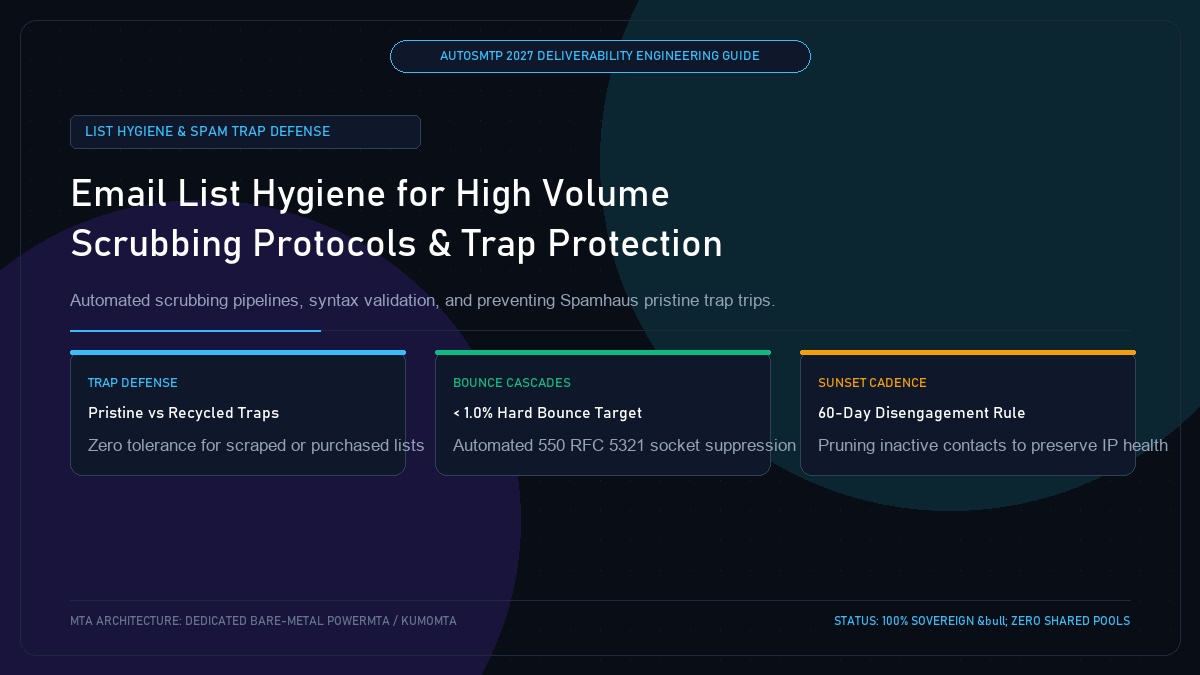
Email List Hygiene Guide for High-Volume Senders: Scrubbing Protocols, Syntax Audits & Trap Protection
Published by Fred Dawson • Senior Deliverability Systems Architect • 24 min read
For organizations sending 1 million to 50 million emails monthly, list hygiene is not an occasional maintenance task—it is an automated, real-time security pipeline. A database decays by roughly 22.5% every year as employees change jobs, consumer inboxes are abandoned, and spam trap networks repurpose expired addresses. In 2027, hitting a single pristine spam trap operated by Spamhaus or Invaluement can knock an entire enterprise bare-metal IP pool offline within hours. This engineering guide details the automated scrubbing protocols, real-time API verification layers, hard bounce suppression architectures, and sunset policies required to keep high-volume lists pristine.
- 1. The Mathematical Reality of Email List Decay
- 2. Understanding Spam Traps: Pristine vs Recycled vs Typo
- 3. Real-Time API Scrubbing at Point of Registration
- 4. Synchronous RFC 5321 In-Band 550 Bounce Suppression
- 5. The Automated 60-Day Inactive Sunset Policy
- 6. List Hygiene Error Classification & Action Matrix
- 7. Case Study: Rescuing a 3M Contact Database from Blacklisting
- 8. The AutoSMTP Deliverability Defense Advantage
1. The Mathematical Reality of Email List Decay
Enterprise databases naturally deteriorate at a rate of 2.0% to 2.5% per month. In B2B sectors, turnover is even higher: up to 35% of corporate email addresses become invalid annually due to employee departures. Sending to an unscrubbed database that has sat idle for 6 months guarantees hard bounce rates exceeding 10%, triggering immediate ISP connection blocks.
2. Understanding Spam Traps: Pristine vs Recycled vs Typo
Deliverability engineers classify spam traps into three distinct threat categories:
Pristine Spam Traps (Fatal Threat)
Created by security researchers (Spamhaus, SURBL) and published on hidden web pages. They have never opted into any service. Hitting a pristine trap indicates web scraping or purchased lists and results in immediate, network-wide DNSBL blacklisting.
Recycled Spam Traps (Hygiene Defect)
Addresses previously owned by real humans that were abandoned. After returning 550 User unknown bounces for 12 months, MBPs repurpose them as traps. Hitting recycled traps proves a failure of your bounce handling or sunset policy.
3. Real-Time API Scrubbing at Point of Registration
Hygiene begins at the signup form. Enterprise platforms integrate real-time verification APIs to reject invalid submissions before they ever enter the database:
- Syntax & Domain Validation: Verifies RFC 5322 compliance and checks authoritative MX record existence.
- Disposable Domain Blocking: Rejects temporary throwaway email services (e.g., GuerrillaMail, Mailinator).
- Role-Based Account Filtering: Flags generic shared inboxes (
admin@,info@,support@) that generate high complaint rates.
4. Synchronous RFC 5321 In-Band 550 Bounce Suppression
When an MTA receives a hard bounce response (e.g., 550 5.1.1 User unknown), the address must be suppressed immediately across all outbound clusters:
# Synchronous bounce extraction directive in PowerMTA:
<acct-file /var/log/pmta/bounces.csv>
    record-fields b,timeLogged,orig,rcpt,dsnStatus,dsnDiag,srcIp,vmta
    records b
</acct-file>

# Automated Python Worker suppresses 550s in real time:
# DSN Status 5.1.1 -> Immediate global database suppression
# Never retry hard bounces; retries accelerate IP reputation damage!
5. The Automated 60-Day Inactive Sunset Policy
Subscribers who have not opened or clicked an email in 60 days must be migrated into a re-engagement flow. If they remain inactive for 90 days, they must be permanently sunsetted (unsubscribed from active broadcast lists) to prevent them from becoming recycled spam traps.
6. List Hygiene Error Classification & Action Matrix
| Error Classification | SMTP Response Code | Severity Level | Automated Remediation |
|---|---|---|---|
| Hard Bounce (User Unknown) | 550 5.1.1 |
Critical | Immediate permanent suppression; zero retries |
| Mailbox Full (Soft Bounce) | 452 4.2.2 |
Low | Retry for 48 hours; suppress if full for > 14 days |
| Spam Trap Trip | Silent Acceptance (250 OK) | Catastrophic | Segment by acquisition source; purge aged inactive cohorts |
| Disposable Email Domain | N/A (Signup Stage) | High Risk | Block at signup form via real-time API check |
Scrubbing a 3M Database Rescues an Enterprise from Spamhaus Listing
An online media conglomerate with 3.2 million registered subscribers suffered a severe Spamhaus SBL listing on their primary /24 IP subnet, dropping email open rates from 28% to 2% overnight. The root cause was identified as an imported legacy contest list from 2024 containing 180,000 unscrubbed contacts. Deliverability engineers deployed AutoSMTP’s automated verification waterfall: they purged 420,000 inactive accounts (> 90 days inactive), removed 48,000 syntax errors and disposable addresses, and implemented real-time in-band 550 suppression. Following delisting, inbox placement rebounded to 99.1% across their entire publication fleet.
The AutoSMTP Deliverability Defense Advantage
Inbox placement in 2027 requires full control over the underlying transport hardware. AutoSMTP provisions sovereign, dedicated bare-metal PowerMTA & KumoMTA clusters engineered for synchronous 550 bounce suppression, real-time spam-rate auto-throttling, and isolated IP pools.
Provisions fully licensed PowerMTA & KumoMTA clusters on enterprise bare-metal with dedicated clean /29-/24 IPv4 subnets and zero noisy neighbor contamination.
Monitors Google Postmaster spam ratios (<0.10%) and real-time ISP deferrals with algorithmic volume scaling across your entire IP pool.
RFC 5321 in-band 550 bounce suppression, automated Yahoo/Outlook Complaint Feedback Loops (CFL), and instant bad-IP eviction.
Pre-configured forward and reverse DNS (PTR) per IP, SPF CIDR alignment, 2048-bit DKIM rotation, and strict DMARC enforcement.
Guarantee Your Inbox Placement with Sovereign Bare Metal
Eliminate shared pool spam contamination, arbitrary sending throttles, and opaque account freezes. Deploy an enterprise AutoSMTP cluster today.
Deploy Turnkey MTA Cluster →