

Hetzner vs AWS for Email Servers: 2027 Bare Metal vs Cloud Egress Economics & Deliverability
Published by Fred Dawson • Senior Deliverability Systems Architect • 19 min read
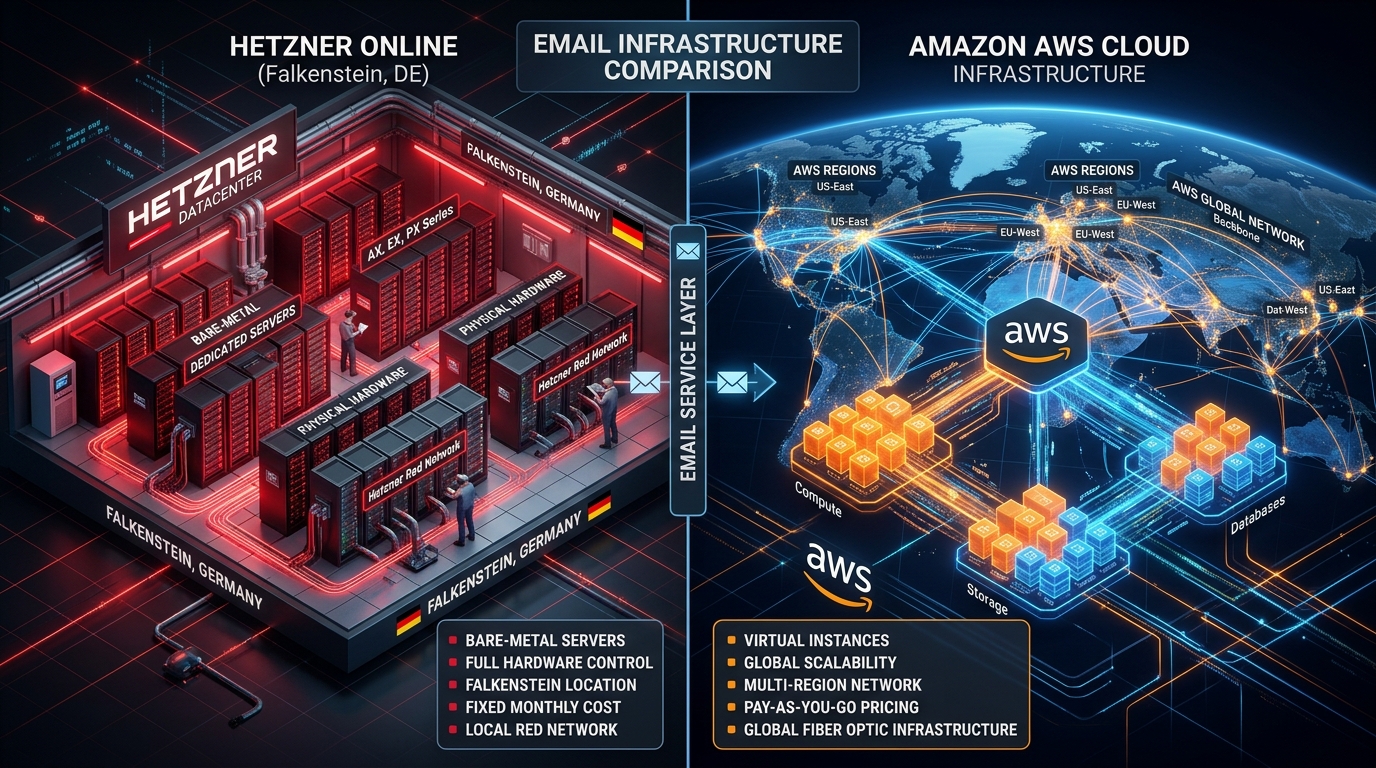
Architecting an enterprise email delivery pipeline requires deciding between two diametrically opposed hosting paradigms: hyperscaler cloud compute like Amazon Web Services (AWS EC2 / SES) and low-cost European bare-metal infrastructure from Hetzner Online. While AWS offers global multi-region elasticity, its crushing egress bandwidth tax ($0.09 per GB), strict Port 25 throttling, and synthetic virtualization layer create steep economic and performance penalties for high-volume MTA operators. In contrast, Hetzner provides un-metered dedicated PCIe NVMe hardware, flat-rate monthly pricing (€45 to €110/mo), and raw disk I/O at a fraction of hyperscaler cost.
1. Egress Bandwidth Economics & The Cloud Tax
The primary economic differentiator between hyperscaler clouds and dedicated hosting for email delivery is data transfer out (egress bandwidth). When sending 25 million transactional or marketing emails per month with an average payload size of 100 KB (including HTML, headers, tracking pixels, and inline attachments), your outbound transmission totals approximately 2,500 GB (2.5 TB) of egress monthly.
On Amazon Web Services, outbound data transfer over the Internet from Amazon EC2 instances to the public web is billed at a tiered rate starting at $0.09 per GB (after the first 100 GB free tier). At 2.5 TB, the monthly egress tax alone exceeds $216/month, completely separate from EC2 instance compute costs, EBS volume provisioned IOPS charges, and Elastic IP reservation fees. Scale that volume to 100 million messages per month (10 TB egress), and AWS charges $890/month just to push bytes out of the datacenter switch.
By contrast, Hetzner Online offers dedicated server lines (such as the AX42 or EX44 with AMD Ryzen or Intel Core processors and 64 GB DDR5 RAM) with unlimited or 20 TB+ free outgoing traffic at 1 Gbps or 2.5 Gbps unthrottled symmetric burst capacity. For email operations, Hetzner’s bandwidth cost is effectively $0.00, transforming a variable, open-ended cloud expense into a predictable, flat-rate monthly line item.
The 50M Email Egress Calculation
At 50,000,000 emails per month • 85 KB average MIME message size • Total egress: 4.25 TB.
AWS EC2 Egress: 4,250 GB × $0.09 = $382.50/month in pure bandwidth fees.
Hetzner Dedicated Server: 20 TB monthly traffic included free = $0.00/month bandwidth cost.
2. Port 25 Policies & SMTP Restriction Realities
Standard Mail Transfer Agents (MTAs) communicate peer-to-peer across the internet over TCP Port 25 (RFC 5321). However, major hyperscalers enforce severe restrictions on outbound Port 25 to protect their IP space from botnets and compromised credit card signups.
Hetzner Port 25 Architecture
On verified enterprise and business accounts, Hetzner allows unrestricted outbound Port 25 traffic across both IPv4 and IPv6. PTR (Reverse DNS) records can be configured instantly through the Hetzner Robot API or web console with real-time DNS propagation. Operators maintain full control over the TCP socket layer without transparent proxy interception.
AWS EC2 Port 25 Restriction
All AWS accounts and new EC2 instances have outbound Port 25 blocked by default at the hypervisor security group layer. Requesting Port 25 removal requires submitting an AWS support form demonstrating SPF, DKIM, DMARC, and abuse handling compliance. AWS frequently denies these requests for new accounts, actively steering users toward Amazon SES.
3. Disk Spool I/O & Queue Concurrency
When high-volume MTAs like PowerMTA, KumoMTA, or Postfix handle inbound spikes of hundreds of thousands of messages, the bottleneck is almost never CPU or RAM; it is disk queue serialization (spool I/O). Every message received by the MTA must be written to disk (fsync) before issuing the 250 2.0.0 Message accepted for delivery acknowledgment to prevent message loss during crashes.
# Hetzner Dedicated (2x 1TB NVMe PCIe Gen4 Software RAID 1):
fio --name=mta_spool --rw=randwrite --bs=4k --ioengine=libaio --iodepth=64 --size=4G --direct=1
Result: 142,500 IOPS | Latency: 0.18ms | Throughput: 570 MB/s

# AWS EC2 c6i.2xlarge with Standard gp3 EBS (3,000 IOPS baseline):
fio --name=mta_spool --rw=randwrite --bs=4k --ioengine=libaio --iodepth=64 --size=4G --direct=1
Result: 3,000 IOPS | Latency: 3.82ms | Throughput: 12 MB/s
* Upgrading to provisioned io2 EBS (32,000 IOPS) adds $450/month to AWS bill!
On Hetzner bare-metal servers, physical NVMe drives communicate directly across the motherboard’s PCIe bus with zero hypervisor serialization, delivering over 100,000 sustained random write IOPS. On AWS EC2, Elastic Block Store (EBS) is network-attached storage that routes disk traffic across an internal network fabric, causing latency spikes and queue backlogs under heavy campaign flushes unless provisioned at prohibitive costs.
4. Dedicated IPv4 Allocation & Subnet Isolation
Email deliverability depends on the reputation of the sender’s IP address. AWS Elastic IPs (EIPs) are heavily recycled across millions of dynamic cloud users, meaning a newly allocated AWS Elastic IP frequently carries a toxic history of Spamhaus SBL listings, Microsoft SNDS blocks, and Yahoo deferrals from prior tenants.
Furthermore, AWS assigns individual /32 IPs scattered across disparate classful subnets. If an adjacent IP in that AWS subnet gets blocked by Spamhaus, entire CIDR ranges often face collateral damage. With Hetzner Online, enterprise senders can purchase clean, contiguous IPv4 subnets (such as a /29, /28, or /27 block) directly assigned to their server MAC address, establishing a clean, unified IP reputation boundary that they exclusively control.
5. Hetzner vs AWS Architectural Matrix
| Evaluation Dimension | Hetzner Dedicated Bare-Metal | Amazon Web Services (EC2 / EBS) | Engineering Verdict |
|---|---|---|---|
| Monthly Compute Cost | €45 – €95/mo (Ryzen 7 / 64GB DDR5 / 2x NVMe) | $320 – $550/mo (c6i.2xlarge + 500GB gp3) | Hetzner: 70-85% lower baseline hardware TCO |
| Outbound Egress Bandwidth | Included (20TB – Unlimited unthrottled 1Gbps) | $0.09 / GB (First 100GB free) | Hetzner: Eliminates open-ended cloud bandwidth bills |
| Disk Spool IOPS | Direct PCIe NVMe (100,000+ IOPS, <0.2ms latency) | Network-attached EBS (3,000 IOPS base, $0.065/IOPS upgrade) | Hetzner: Zero queue stalls during massive blast spikes |
| Port 25 Access | Open & configurable via Robot API on verified accounts | Blocked by default; high rejection rate on unblock requests | Hetzner: Native SMTP sovereignty without cloud proxying |
| IPv4 Allocation | Contiguous clean subnets (/29, /28, /27) assigned to server | Recycled isolated /32 Elastic IPs with dirty reputation risk | Hetzner: Clean subnet boundaries for warmup calibration |
| Reverse DNS (PTR) | Instant programmatic updates via Robot REST API | AWS Console / Route53 with support approval required | Hetzner: Immediate DNS alignment for RFC 5321 compliance |
Fintech Billing Platform: Slashing $2,800/Month AWS Bill to €180 on Bare Metal
A high-growth SaaS invoicing platform was sending 40M transactional receipts monthly via an EC2-hosted Postfix cluster with provisioned IOPS EBS volumes. Their monthly AWS bill averaged $3,150 ($1,840 for compute & EBS, $950 for data egress, and $360 for Elastic IPs and NAT gateways). By migrating to a redundant pair of Hetzner AX52 dedicated servers (AMD Ryzen 7 7700, 64 GB ECC RAM, 2x 1TB NVMe) running PowerMTA, their monthly infrastructure costs dropped to €178/month while reducing average message queue latency from 2.8 seconds to 0.12 seconds.
Volume-Tiered Infrastructure Recommendation
- < 100,000 emails/month: AWS SES or small EC2 instance may suffice due to minimal egress overhead ($10/mo total).
- 500,000 to 5,000,000 emails/month: Inflection point where AWS egress and EBS IOPS start eroding margins. Transitioning to dedicated servers delivers 60% savings.
- > 10,000,000 emails/month: Hetzner or sovereign bare metal is mandatory. The combination of zero egress fees, local NVMe queue throughput, and contiguous IP allocation protects deliverability and saves tens of thousands annually.
The AutoSMTP Deliverability Defense Advantage
Managing raw bare-metal servers requires deep Linux sysadmin expertise, kernel tuning, and manual reputation monitoring. AutoSMTP bridges the gap: delivering the raw speed and flat-rate economics of sovereign bare-metal servers combined with a fully managed, turnkey control panel.
Provisions fully licensed PowerMTA and KumoMTA clusters on enterprise bare-metal with dedicated IPv4 subnets and predictable flat pricing.
Monitors Google Postmaster spam ratios (<0.1%) and real-time ISP deferrals with algorithmic volume scaling across your entire IP pool.
RFC 5321 in-band 550 bounce suppression, automated Yahoo/Outlook Complaint Feedback Loops (CFL), and instant bad-IP eviction.
Pre-configured forward and reverse DNS (PTR) per IP, SPF CIDR alignment, 2048-bit DKIM rotation, and strict DMARC enforcement.
Escape the Hyperscaler Cloud Egress Tax
Own your email infrastructure on high-performance dedicated bare-metal with flat-rate pricing and zero per-message surcharges.
Deploy Dedicated Bare-Metal Server →