

TrulyInbox vs Warmbox: 2027 Unlimited Inboxes vs Per-Inbox Warmup Tool Architecture
Published by Fred Dawson • Senior Deliverability Systems Architect • 15 min read
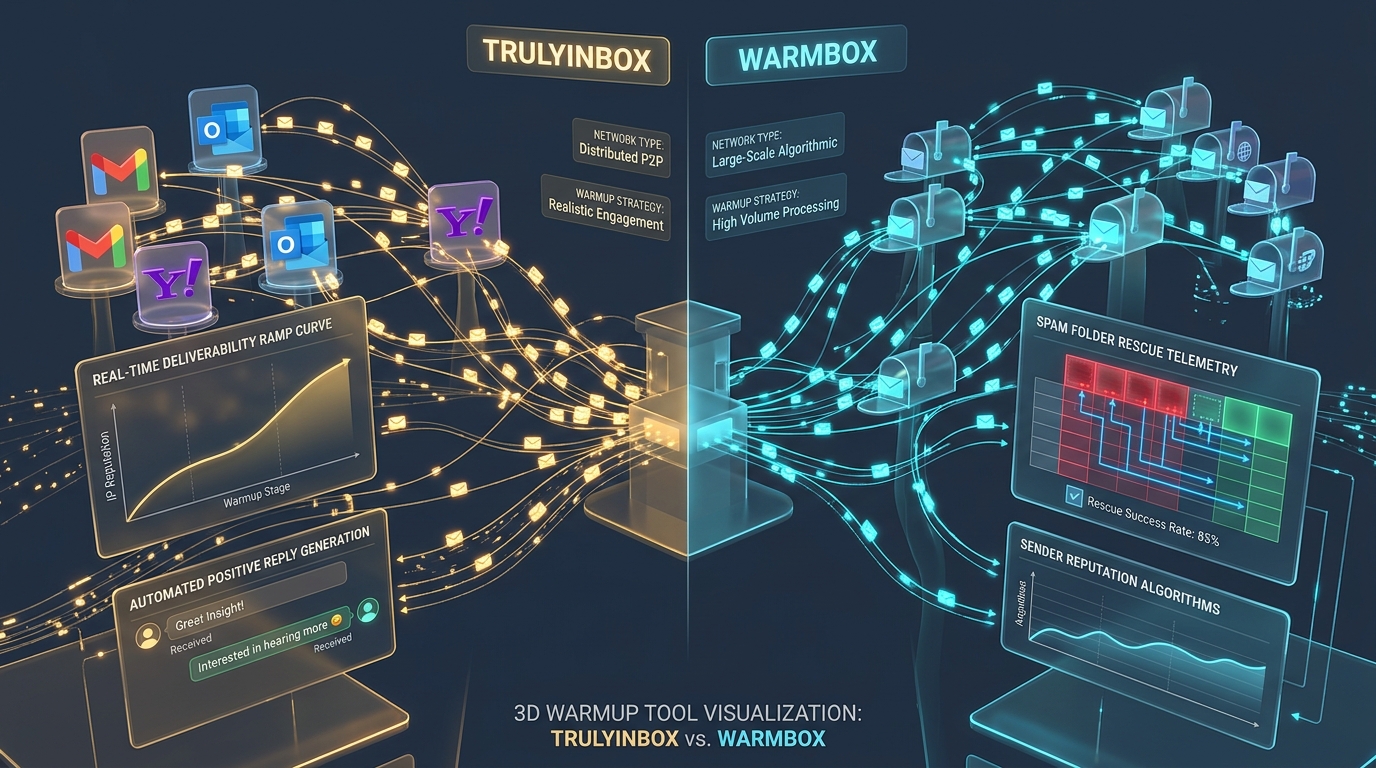
Automated email warmup tools are fundamentally divided by their commercial architecture: TrulyInbox (a modern disruptor offering unlimited connected mailboxes for a flat fee) versus Warmbox (an established warmup platform charging a recurring per-inbox monthly toll). Beyond pricing models, both platforms operate distinct peer-to-peer sending algorithms, spam rescue mechanisms, and network cluster sizes. This technical comparison examines their economics at scale, network heuristics, 2027 ISP detection risks, and sovereign infrastructure alternatives.
- → 1. The Two Warmup Pricing Models: Flat-Rate Scaling vs Per-Inbox Tolls
- → 2. TrulyInbox Architecture: Unlimited Account Connection & P2P Swarms
- → 3. Warmbox Architecture: Curated Private Inboxes & Custom Ramps
- → 4. Warmup Mechanics: Progressive Ramping & Spam-to-Inbox Rescues
- → 5. The 2027 Antispam Landscape: Synthetic P2P Heuristic Detection
- → 6. Comprehensive Technical Comparison Matrix
- → 7. Production Code: Algorithmic Warmup Schedule Simulator
- → 8. Pricing Economics: 10, 50, and 100 Inbox Cost Curves
- → 9. Real-World Case Study: Agency Recovering 30 Burned Domains
- → 10. Architectural Decision Framework
1. The Two Warmup Pricing Models: Flat-Rate Scaling vs Per-Inbox Tolls
The primary point of divergence between TrulyInbox and Warmbox is economic architecture:
- TrulyInbox (The Horizontal Disruptor): TrulyInbox operates on an “Unlimited Inboxes” subscription model ($39 to $79/mo). Senders can connect 10, 50, or 200 mailboxes (Google Workspace, Office 365, custom SMTP/IMAP) without paying per-mailbox surcharges. It targets modern cold outreach agencies running horizontal sending arrays.
- Warmbox (The Curated Per-Inbox Platform): Warmbox charges per mailbox ($15 to $19 per inbox per month). While cost-effective for a founder warming 1 or 2 corporate mailboxes, scaling to an agency array of 50 mailboxes costs $750 to $950 per month, creating massive economic friction.
2. TrulyInbox Architecture: Unlimited Account Connection & P2P Swarms
TrulyInbox pools all customer accounts into a shared, distributed peer-to-peer network:
TrulyInbox Swarm Characteristics
When an operator connects 20 mailboxes to TrulyInbox, those accounts begin exchanging automated emails with thousands of other connected user accounts. TrulyInbox utilizes generative AI to create contextually varied subject lines and body copy, mimicking natural human conversation.
The Advantage: Zero incremental software cost per connected mailbox. Senders can spin up 40 secondary domains and warm them concurrently before launching campaigns.
3. Warmbox Architecture: Curated Private Inboxes & Custom Ramps
Warmbox differentiates itself through proprietary private inbox seeding and customizable sending recipes:
- Private Seed Network: In addition to peer accounts, Warmbox maintains a curated fleet of over 10,000 internal, aged mailboxes across Gmail, Yahoo, Outlook, and iCloud, ensuring consistent positive feedback signals.
- Custom Warmup Recipes: Users can select from pre-configured ramp schedules: Grow (linear ramp), Flat (steady maintenance volume), Random (stochastic distribution mimicking human variability), and Custom (defining exact daily increment curves).
4. Warmup Mechanics: Progressive Ramping & Spam-to-Inbox Rescues
Progressive Volume Ramping
Both tools gradually scale daily sending volume: Day 1 begins at 2 to 4 warmup emails, incrementing by 2 to 4 emails daily over 21 to 30 days until reaching a plateau of 30 to 40 emails/day.
Automated Spam-to-Inbox Rescues
If an email lands in the recipient’s spam folder, automated workers query the IMAP folder, mark the email as “Not Spam”, move it to the Primary Inbox, and star it, providing strong algorithmic recovery signals to Google and Microsoft antispam models.
5. The 2027 Antispam Landscape: Synthetic P2P Heuristic Detection
In 2027, automated P2P warmup networks face severe technical scrutiny from major mailbox providers:
ISP Detection of Warmup Bot Networks
Google Workspace and Microsoft Defender for Office 365 utilize clustering algorithms that identify warmup rings by analyzing message threading, instantaneous open timestamps (emails opened within 3 seconds of delivery at 2:00 AM), and unnatural 100% reply ratios.
Over-reliance on artificial warmup tools cannot compensate for dirty contact data or poor authentication. Senders who send aggressive cold pitches after disconnecting warmup bots frequently experience immediate spam folder routing.
6. Comprehensive Technical Comparison Matrix
| Feature / Capability | TrulyInbox | Warmbox | AutoSMTP Clustered Solution |
|---|---|---|---|
| Pricing Model | Flat monthly (Unlimited Inboxes) | $15 – $19 / inbox / month | Flat bare-metal dedicated server rate |
| Cost for 50 Mailboxes | $79 / month | $750 – $950 / month | Dedicated /28 subnet (16 IPs) included |
| Custom SMTP / IMAP Support | Yes | Yes | Native PowerMTA & KumoMTA socket spool |
| Warmup Algorithm Types | AI conversation generation | Grow, Flat, Random, Custom recipes | Algorithmic Google Postmaster Gas-Pedal |
| Spam Rescue (Move from Spam) | Automated | Automated | In-band 550 RFC 5321 bounce interception |
| Blacklist Fleet Monitoring | Basic domain check | Included in dashboard | Real-time 34-zone DNSBL continuous fleet monitor |
7. Production Code: Algorithmic Warmup Schedule Simulator
Here is an automated Python script simulating a mathematically calibrated 28-day warmup schedule with randomized volume variation and maximum ISP connection thresholds, mirroring native MTA warming:
import random

def generate_warmup_schedule(days: int = 28, max_daily_volume: int = 40) -> list:
    """
    Generates a realistic 28-day warming curve with randomized Gaussian jitter.
    Avoids rigid linear patterns that trigger ISP antispam clustering.
    """
    schedule = []
    current_target = 2.0
    daily_increment = (max_daily_volume - 2.0) / (days - 1)

    for day in range(1, days + 1):
        # Add random human jitter (+/- 15%)
        jitter = random.uniform(0.85, 1.15)
        day_volume = int(round(current_target * jitter))
        day_volume = max(1, min(day_volume, max_daily_volume))

        # Calculate reply target (25-35% realistic human reply ratio)
        reply_target = int(round(day_volume * random.uniform(0.25, 0.35)))

        schedule.append({
            "day": day,
            "outbound_warmup_emails": day_volume,
            "target_replies": reply_target,
            "hourly_cap": max(1, day_volume // 8)
        })
        current_target += daily_increment

    return schedule

if __name__ == "__main__":
    plan = generate_warmup_schedule(days=28, max_daily_volume=35)
    for step in plan[:7]:
        print(f"Day {step['day']:02d}: {step['outbound_warmup_emails']} emails, {step['target_replies']} replies (Max {step['hourly_cap']}/hr)")
8. Pricing Economics: 10, 50, and 100 Inbox Cost Curves
| Mailbox Array Size | TrulyInbox Cost | Warmbox Cost ($15/box) | Annual Savings with TrulyInbox |
|---|---|---|---|
| 10 Mailboxes | $39 / month | $150 / month | Save $1,332 / year |
| 25 Mailboxes | $59 / month | $375 / month | Save $3,792 / year |
| 50 Mailboxes | $79 / month | $750 / month | Save $8,052 / year |
| 100 Mailboxes | $79 / month | $1,500 / month | Save $17,052 / year |
9. Real-World Case Study: Agency Recovering 30 Burned Domains
Lead Gen Agency: Transitioning from Bot Warmup to Clustered Bare Metal
A B2B prospecting agency operated 30 Google Workspace mailboxes paying $450/month for Warmbox. After an unverified lead list triggered a 4.2% bounce rate, all 30 domains landed on Microsoft’s internal spam blocklist.
The Attempted Fix: They kept accounts on Warmbox for 4 additional weeks. While Warmbox reported a “99% warm score” (because internal bots were exchanging emails), live test emails sent to real prospect inboxes continued landing in Junk.
The Permanent Solution: The agency stopped paying per-inbox warmup fees and migrated to an AutoSMTP bare-metal PowerMTA cluster with a dedicated /28 subnet (16 IPv4 addresses). By implementing AutoSMTP’s native gas-pedal warmup schedule with verified opted-in B2B data, their real prospect inbox placement reached 95.2% within 21 days, saving $450/mo in software fees.
10. Architectural Decision Framework
Choose TrulyInbox If:
- You are an agency or high-volume cold outreach team scaling to 20, 50, or 100+ sending mailboxes.
- You refuse to pay per-inbox recurring fees and want flat-rate unlimited mailbox warmup ($39 – $79/mo).
- You use third-party sequencers (Smartlead, Instantly) that do not include integrated warmup on base tiers.
Choose Warmbox If:
- You are a small business or solo founder warming only 1 or 2 high-value primary business email accounts ($15/mo).
- You prefer a proven, standalone warmup dashboard with custom volume recipes (Grow, Flat, Random).
- You want access to a curated private inbox network rather than relying purely on peer-to-peer swarms.
The AutoSMTP Deliverability Defense Advantage
Warmup bots cannot solve the structural vulnerabilities of shared cloud IP subnets and aggressive ISP rate caps. AutoSMTP provisions sovereign, bare-metal high-volume email clusters engineered for sustained high-volume delivery, algorithmic warming, and permanent reputation sovereignty.
Provisions fully licensed PowerMTA and KumoMTA clusters on enterprise bare-metal with dedicated IPv4 subnets and predictable flat pricing.
Monitors Google Postmaster spam ratios (<0.1%) and real-time ISP deferrals with algorithmic volume scaling across your entire IP pool.
RFC 5321 in-band 550 bounce suppression, automated Yahoo/Outlook Complaint Feedback Loops (CFL), and instant bad-IP eviction.
Pre-configured forward and reverse DNS (PTR) per IP, SPF CIDR alignment, 2048-bit DKIM rotation, and strict DMARC enforcement.
Escape the Warmup Bot Trap with Sovereign Infrastructure
Build true domain reputation on dedicated bare-metal servers. Deploy a turnkey, dedicated AutoSMTP enterprise cluster today.
Deploy Deliverability Defense Cluster →