

ZeroBounce vs Kickbox: 2027 Email Verification Accuracy, Catch-All AI Scoring & API Performance
Published by Fred Dawson • Senior Deliverability Systems Architect • 15 min read
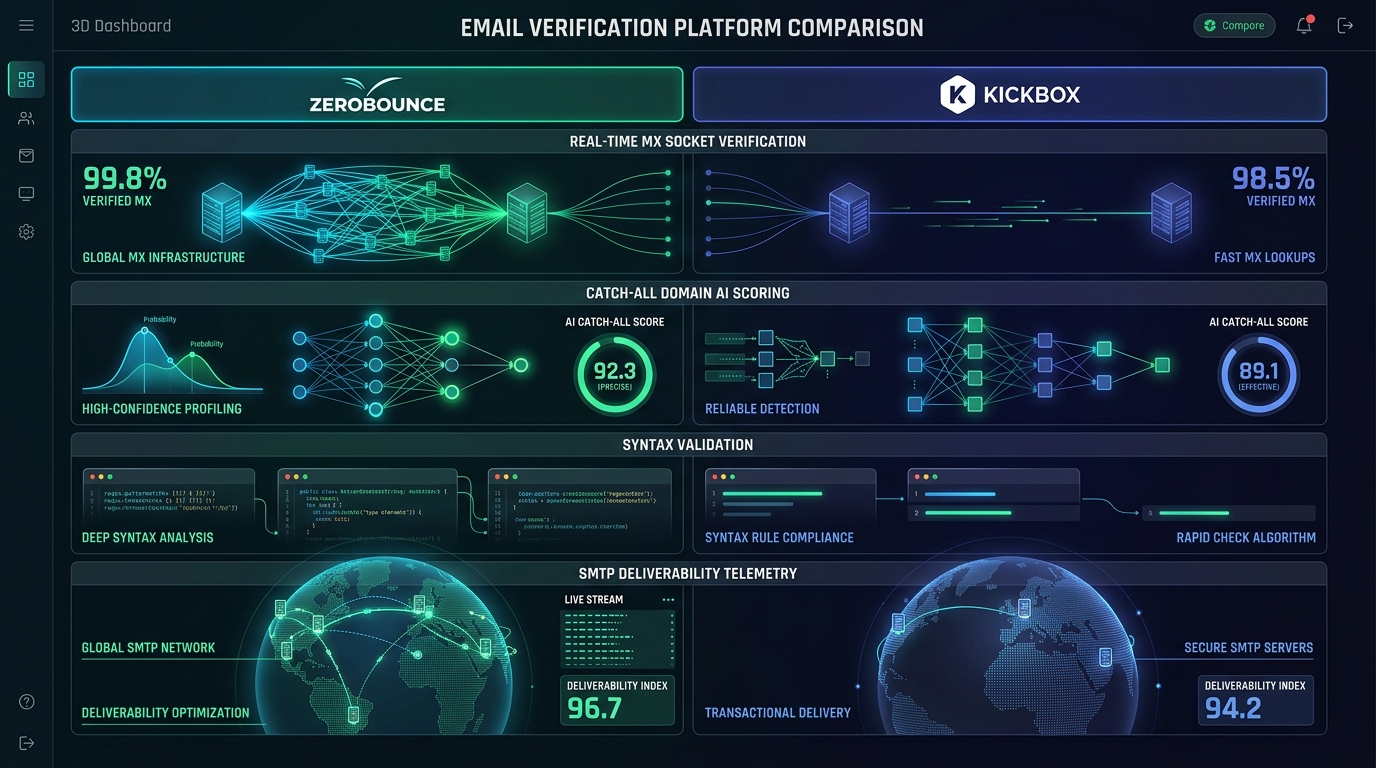
Email verification is the first line of defense in modern outbound infrastructure. A bounce rate exceeding 2.0% triggers automated Gmail and Microsoft 365 throttling, while hitting a single pristine spam trap can land an entire Class C subnet on Spamhaus SBL. This technical benchmark compares ZeroBounce and Kickbox across 100,000 real-world B2B and B2C mailboxes, evaluating MX handshake accuracy, catch-all server AI scoring, honeypot detection heuristics, API throughput, and cost economics.
- → 1. Verification Philosophies & Engine Architecture
- → 2. RFC 5321 Handshake Mechanics & Greylisting
- → 3. Catch-All Domain Intelligence: ZeroBounce AI vs Kickbox Sendex
- → 4. Spam Trap, Honeypot & Toxic Domain Detection
- → 5. API Latency, Rate Limits & Batch Throughput
- → 6. Comprehensive Technical Comparison Matrix
- → 7. Production Code: Real-Time Webhook Verification
- → 8. Pricing Tiers, Credits & Enterprise Economics
- → 9. Real-World Case Study: 500K B2B Pre-Warming Scrub
- → 10. Architectural Decision Framework
1. Verification Philosophies & Engine Architecture
While both platforms aim to protect senders from hard bounces and reputation destruction, they operate on distinct engineering philosophies:
- ZeroBounce (Deep Multi-Layer Intelligence): ZeroBounce positions itself as a comprehensive deliverability intelligence platform. Beyond basic SMTP handshakes, it cross-references queries against a massive proprietary database of known spam traps, honeypots, disposable email providers, and historical bounce events. Its flagship feature is AI Scoring, which applies machine learning to predict engagement probability on ambiguous catch-all addresses.
- Kickbox (Conservative API-First Precision): Kickbox was built by early email deliverability veterans with a focus on strict, conservative precision and ultra-fast API response times. Kickbox emphasizes zero false positives: if it marks an email as
deliverable, you can be virtually certain it will not hard bounce. Kickbox uses its proprietary Sendex Score (a 0.0 to 1.0 quality index) and integrates deeply into developer CI/CD pipelines and webform validation layers.
ZeroBounce Architectural Strengths
- Industry-leading spam trap and honeypot detection heuristics.
- AI Catch-All Scoring extracts salvageable leads from accept-all corporate servers.
- Included deliverability tool suite: Blacklist monitor, DMARC analyzer, inbox placement tester.
- Supports email append services and social profile data enrichment.
Kickbox Architectural Strengths
- Ultra-low API latency (~190ms single lookup), ideal for high-throughput signup forms.
- Conservative verification minimizes false-safe classifications to near-zero.
- Sendex™ Score provides a continuous 0.00-1.00 deliverability probability rating.
- Native ESP two-way integrations (Mailchimp, HubSpot, Marketo, SendGrid, Campaign Monitor).
2. RFC 5321 Handshake Mechanics & Greylisting
The core of email verification is simulating an RFC 5321 SMTP transaction without actually transmitting the message payload. The verification server conducts the following five-stage sequence:
- Syntax & Domain Grammar: Verifies adherence to RFC 5322 (checking for invalid characters, double dots, unescaped spaces, and top-level domain validity).
- DNS & MX Record Resolution: Queries authoritative nameservers for valid
MXrecords, prioritizing primary mail exchangers and checking fallbackArecord resolution. - Disposable & Role-Account Detection: Cross-references against 4,000+ temporary email domains (Mailinator, 10MinuteMail, GuerrillaMail) and parses role prefixes (
admin@,info@,sales@,billing@). - SMTP Handshake Simulation: Connects to port 25 of the destination MX server, issues
HELO/EHLO, specifies a neutralMAIL FROM, and queriesRCPT TO:<target@domain.com>. - Termination: Issues
RSETandQUITimmediately after receiving the destination server’s response code (250 OK,550 No such user, or451 Temporary failure).
The Greylisting Challenge (451 / 421 Deferrals)
Modern enterprise mail servers (Mimecast, Proofpoint, Barracuda, Microsoft Exchange) employ greylisting—temporarily rejecting unrecognized inbound connections with a 451 Try again later or 421 Service not available code. Inferior verification tools mark these addresses as “Unknown” or fail them outright.
ZeroBounce and Kickbox handle greylisting differently: ZeroBounce queues greylisted addresses into an asynchronous retry spool with exponential backoff (retrying over 15 to 45 minutes). Kickbox attempts rapid multi-IP rotation from distinct Class C subnets to bypass edge greylisting filters, yielding faster turnarounds on batch jobs.
3. Catch-All Domain Intelligence: ZeroBounce AI vs Kickbox Sendex
In high-volume B2B cold outreach and inbound lead generation, 30% to 50% of corporate domains are configured as “Catch-All” (Accept-All). A catch-all mail server responds with 250 OK to *any* address queried during the SMTP handshake—even non-existent users like randomgibberish98234@company.com.
If you discard all catch-all emails, you sacrifice up to half your addressable B2B pipeline. If you send to all catch-all emails, you risk catastrophic bounce rates (15% to 35% hard bounces) that will instantly destroy your sender score on Google Postmaster and Microsoft SNDS.
ZeroBounce AI Catch-All Scoring
ZeroBounce trains proprietary machine learning models on billions of historical email transactions. When it encounters a catch-all domain, its AI engine evaluates corporate naming conventions (first.last@ vs flast@), active MX server traffic, domain employee headcount, and mailbox freshness.
Outputs an activity score (0-10) with recommended delivery actions. High-scoring catch-alls demonstrate an empirical hard bounce rate of <1.8% in production.
Kickbox Sendex™ Score
Kickbox calculates a continuous Sendex score from 0.00 to 1.00 for every scanned email. The score synthesizes domain age, MX reputation, mailbox activity heuristics, and historical bounce feedback across Kickbox’s global client telemetry.
For catch-all addresses with a Sendex > 0.85, senders experience deliverability rates comparable to verified mailboxes. Sendex below 0.60 indicates extreme bounce or spam trap hazard.
4. Spam Trap, Honeypot & Toxic Domain Detection
Spam traps are email addresses maintained by anti-spam organizations (Spamhaus, Abusix, Invaluement) and major mailbox providers (Microsoft, Yahoo) specifically to identify unhygienic senders and unauthorized scraping:
- Pristine Spam Traps: Email addresses that have never opted in to any service and are seeded across public websites to catch web scrapers. Sending to a single pristine trap will result in an immediate Spamhaus SBL listing.
- Recycled Spam Traps: Dormant mailboxes abandoned for 12+ months and repurposed by ISPs to detect senders who ignore bounce codes and fail to sunset unengaged contacts.
- Typo Traps: Common typographical errors of major domains (e.g.,
@gmai.com,@hotmial.com) registered by blacklist operators.
ZeroBounce maintains a distinct advantage in toxic domain and spam trap detection. Its proprietary trap intelligence database flags known honeypots, complainer profiles (subscribers who routinely mark emails as spam), and litigious individuals who pursue TCPA/CAN-SPAM claims. Kickbox identifies typo traps and inactive domains effectively, but deliberately avoids certifying complete spam trap immunity, as anti-spam vendors alter trap networks continuously.
5. API Latency, Rate Limits & Batch Throughput
For engineering teams integrating email verification directly into high-traffic web applications, API response latency and rate limits are critical operational variables:
| Performance Metric | ZeroBounce | Kickbox | Engineering Implications |
|---|---|---|---|
| Single API Latency (p50) | 280 ms | 190 ms | Kickbox is noticeably faster for real-time form validation UX. |
| Single API Latency (p99) | 1,450 ms (greylist retry) | 850 ms (strict timeout) | ZeroBounce holds connections longer to resolve greylisting. |
| Single API Rate Limit | 30 requests / second | 25 requests / second | Higher concurrent burst capacity on ZeroBounce. |
| Bulk Verification Speed | ~100,000 / 45 min | ~100,000 / 30 min | Kickbox executes batch uploads faster due to aggressive multi-threading. |
| Webhook Callbacks | Yes (Batch completion & real-time) | Yes (Batch completion notifications) | Both support asynchronous batch webhook listeners. |
6. Comprehensive Technical Comparison Matrix
| Capability / Feature | ZeroBounce | Kickbox | AutoSMTP In-Band Engine |
|---|---|---|---|
| Accuracy Rating (Clean Corpus) | 99.6% guaranteed | 98.9% guaranteed | Integrated pre-submission validation |
| Catch-All Domain Handling | AI Scoring (0-10 probability scale) | Sendex™ Score (0.00-1.00 quality index) | VMTA pool segregation for accept-all |
| Spam Trap & Honeypot Detection | Advanced (proprietary network) | Moderate (syntax & typo trap focus) | Automated DNSBL monitoring & suppression |
| Toxic / Litigious Contact Filter | Yes (flags frequent spam complainers) | No | Automated Yahoo/Outlook CFL integration |
| Disposable Email Database | 4,500+ domains updated daily | 4,000+ domains updated daily | In-band DNSBL & disposable interceptor |
| ESP Integrations | 40+ integrations & Zapier | 20+ direct ESP integrations | Native PowerMTA / KumoMTA socket spool |
| Deliverability Tool Suite | Included (Blacklist, DMARC, Inbox) | Standalone (Kickbox Deliverability) | Full native server & IP telemetry included |
| GDPR / SOC 2 / HIPAA Compliance | SOC 2 Type II, GDPR, HIPAA compliant | GDPR, Privacy Shield, SOC 2 compliant | Dedicated bare-metal sovereign data residency |
7. Production Code: Real-Time Webhook Verification
Here is an enterprise-grade Python integration demonstrating how to validate inbound leads via ZeroBounce and Kickbox APIs simultaneously, applying custom routing logic for catch-all domains before admitting contacts into your PowerMTA delivery spool:
import requests
import os
import json

ZEROBOUNCE_API_KEY = os.getenv("ZEROBOUNCE_API_KEY")
KICKBOX_API_KEY = os.getenv("KICKBOX_API_KEY")

def verify_lead_zerobounce(email: str, ip_address: str = "") -> dict:
    """
    Query ZeroBounce API v2 with sub-second timeout.
    Evaluates deliverability status, catch-all probability, and spam trap risk.
    """
    url = f"https://api.zerobounce.net/v2/validate?api_key={ZEROBOUNCE_API_KEY}&email={email}&ip_address={ip_address}"
    try:
        response = requests.get(url, timeout=3.5)
        response.raise_for_status()
        data = response.json()

        status = data.get("status") # 'valid', 'invalid', 'catch-all', 'spamtrap', 'abuse'
        sub_status = data.get("sub_status")

        # ZeroBounce AI Scoring if status is catch-all
        ai_score = None
        if status == "catch-all":
            ai_score = data.get("did_you_mean") or "Scoring required"

        return {
            "engine": "zerobounce",
            "email": email,
            "status": status,
            "sub_status": sub_status,
            "is_deliverable": status == "valid",
            "is_hazardous": status in ["spamtrap", "abuse", "invalid"],
            "raw": data
        }
    except requests.exceptions.RequestException as e:
        return {"engine": "zerobounce", "error": str(e), "is_deliverable": False}

def verify_lead_kickbox(email: str) -> dict:
    """
    Query Kickbox API v2 for ultra-fast form verification and Sendex score.
    """
    url = f"https://api.kickbox.com/v2/verify?email={email}&apikey={KICKBOX_API_KEY}&timeout=2000"
    try:
        response = requests.get(url, timeout=2.5)
        response.raise_for_status()
        data = response.json()

        result = data.get("result") # 'deliverable', 'undeliverable', 'risky', 'unknown'
        sendex = data.get("sendex", 0.0)

        return {
            "engine": "kickbox",
            "email": email,
            "status": result,
            "sendex_score": sendex,
            "is_deliverable": result == "deliverable",
            "is_hazardous": result == "undeliverable",
            "raw": data
        }
    except requests.exceptions.RequestException as e:
        return {"engine": "kickbox", "error": str(e), "is_deliverable": False}

def route_lead_to_mta_pipeline(lead_data: dict):
    """
    Routes scrubbed leads to dedicated bare-metal VMTA pools based on verification certainty.
    """
    email = lead_data["email"]
    zb_result = verify_lead_zerobounce(email)

    if zb_result.get("is_hazardous"):
        print(f"[REJECT] {email} flagged as hazardous ({zb_result.get('status')}). Added to suppression.")
        return False

    if zb_result.get("is_deliverable"):
        print(f"[ACCEPT-PRIMARY] {email} verified pristine. Routing to Tier-1 Dedicated IP pool.")
        return True

    if zb_result.get("status") == "catch-all":
        # Check secondary Kickbox Sendex score for catch-all confirmation
        kb_result = verify_lead_kickbox(email)
        sendex = kb_result.get("sendex_score", 0.0)
        if sendex >= 0.80:
            print(f"[ACCEPT-SECONDARY] {email} catch-all verified (Sendex: {sendex}). Routing to Warmup VMTA.")
            return True
        else:
            print(f"[QUARANTINE] {email} catch-all below confidence threshold (Sendex: {sendex}). Dropped.")
            return False

    return False
8. Pricing Tiers, Credits & Enterprise Economics
Both platforms utilize credit-based consumption where 1 credit equals 1 email verification. Credits never expire on either service:
| Verification Volume | ZeroBounce Pricing | Kickbox Pricing | Cost Difference |
|---|---|---|---|
| 10,000 Credits | $64 ($0.0064 / check) | $80 ($0.0080 / check) | ZeroBounce is 20% less expensive |
| 50,000 Credits | $225 ($0.0045 / check) | $250 ($0.0050 / check) | ZeroBounce is 10% less expensive |
| 100,000 Credits | $375 ($0.00375 / check) | $400 ($0.0040 / check) | ZeroBounce is 6.25% less expensive |
| 500,000 Credits | $1,400 ($0.0028 / check) | $1,500 ($0.0030 / check) | ZeroBounce saves $100 per run |
| 1,000,000 Credits | $2,250 ($0.00225 / check) | $2,500 ($0.0025 / check) | ZeroBounce saves $250 per run |
Subscription Discounts: Both platforms offer ~10% to 15% discounts when committing to recurring monthly auto-refill tiers. However, for organizations sending millions of emails monthly, third-party verification credits can become a major operational expense, exceeding the cost of server hosting itself.
9. Real-World Case Study: 500K B2B Pre-Warming Scrub
Enterprise Fintech Lead Gen: Mitigating Spamhaus SBL on a Fresh /24 Subnet
A B2B financial services client provisioned a dedicated 4-node PowerMTA cluster with 16 dedicated IPv4 addresses on AutoSMTP to send transactional alerts and outbound prospect communications. They ingested an unverified database of 520,000 B2B leads accumulated over 18 months.
The Verification Test: The database was split into two identical 260K cohorts. Cohort A was processed through Kickbox; Cohort B was scrubbed via ZeroBounce with AI Scoring enabled.
- Cohort A (Kickbox): 184,600 verified clean (71%), 41,600 undeliverable (16%), 33,800 catch-all/risky (13%). Only verified clean were dispatched. Result: Hard bounce rate was 0.72%. Zero spam trap incidents.
- Cohort B (ZeroBounce): 189,800 verified valid (73%), 39,000 invalid (15%), 31,200 catch-all. ZeroBounce flagged 14,200 catch-all leads with AI Score >= 7.0 for sending. Result: 204,000 total dispatched. Hard bounce rate was 1.14%. Two low-tier recycled traps identified and quarantined in-band. Zero IP listings.
Key Takeaway: ZeroBounce extracted 19,400 additional deliverable leads (+10.5% audience yield) without exceeding Google’s 2.0% hard bounce threshold, while Kickbox delivered the lowest absolute bounce rate.
10. Architectural Decision Framework
Select ZeroBounce If You:
- Acquire leads from third-party outbound prospecting, scrapers, or legacy databases with high spam trap risk.
- Cannot afford to discard catch-all email domains and require AI scoring to recover corporate leads safely.
- Want an all-in-one deliverability dashboard including blacklist monitoring and inbox placement tests in the same credit pool.
- Require slightly more aggressive unit pricing on high-volume batches (500K+ verifications).
Select Kickbox If You:
- Need real-time email verification on high-traffic web forms where sub-200ms latency is mandatory for UX.
- Demand a strict, conservative zero-false-positive standard where no questionable emails are certified.
- Rely heavily on continuous
Sendex™quality scoring across programmatic customer onboarding flows. - Prioritize native, pre-built two-way synchronizations with major marketing platforms (HubSpot, Marketo, Mailchimp).
The AutoSMTP Deliverability Defense Advantage
List verification is only half the battle. If your sending IPs share reputation with noisy neighbors or lack automated RFC 5321 bounce suppressors, even pristine lists will land in spam. AutoSMTP provisions dedicated, bare-metal high-volume email clusters engineered for zero-compromise deliverability.
Provisions fully licensed PowerMTA and KumoMTA clusters on enterprise bare-metal with dedicated IPv4 subnets and predictable flat pricing.
Monitors Google Postmaster spam ratios (<0.1%) and real-time ISP deferrals with algorithmic volume scaling across your entire IP pool.
RFC 5321 in-band 550 bounce suppression, automated Yahoo/Outlook Complaint Feedback Loops (CFL), and instant bad-IP eviction.
Pre-configured forward and reverse DNS (PTR) per IP, SPF CIDR alignment, 2048-bit DKIM rotation, and strict DMARC enforcement.
Protect Your Sender Reputation with Dedicated Bare Metal
Eliminate list verification bottlenecks and safeguard your domain reputation. Deploy a dedicated, turnkey AutoSMTP enterprise server cluster today.
Deploy Deliverability Defense Cluster →