

Folderly vs Mailreach: 2027 Deliverability Suite vs Automated Warmup Network Comparison
Published by Fred Dawson • Senior Deliverability Systems Architect • 15 min read
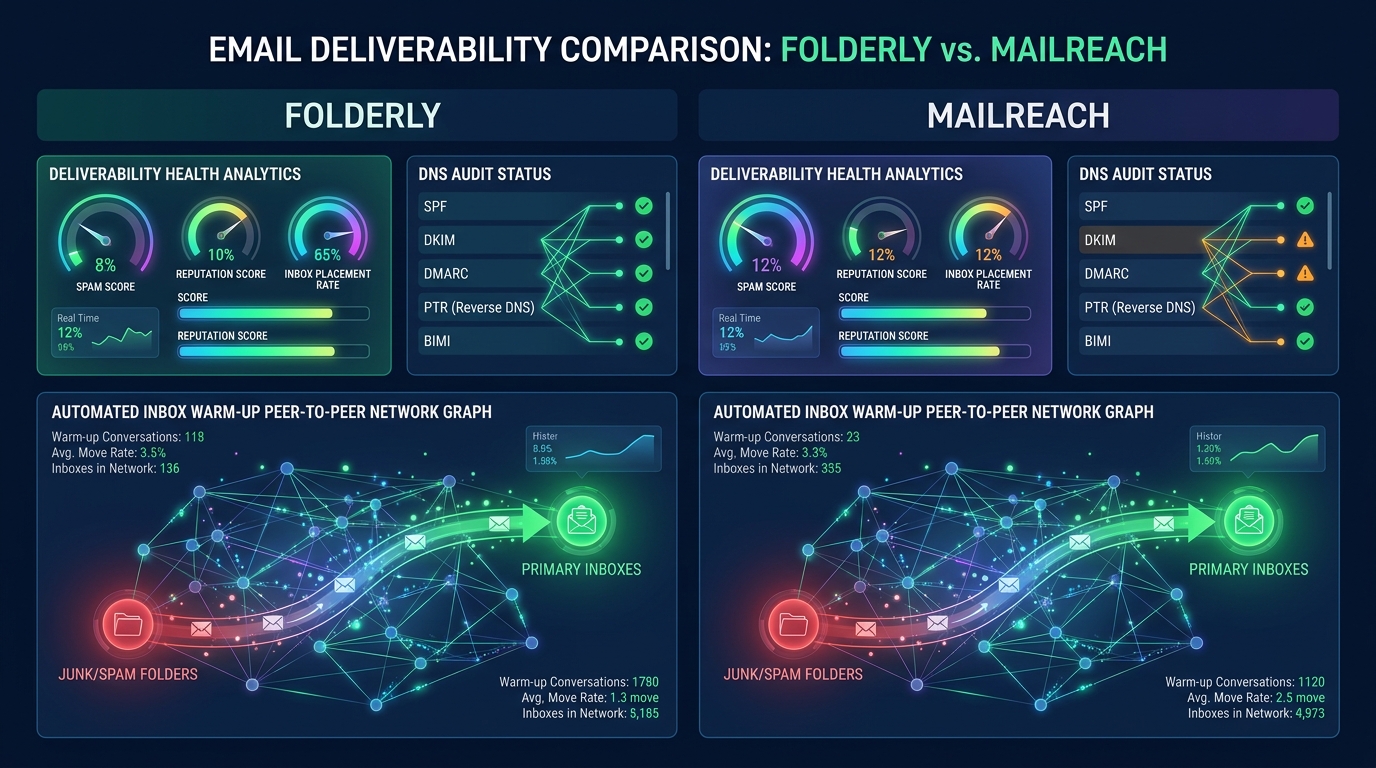
Deliverability optimization has split into two conflicting paradigms: high-touch enterprise diagnostic suites that audit content, DNS infrastructure, and spam filter triggers (Folderly) versus automated peer-to-peer (P2P) inbox warming networks designed to simulate positive engagement across thousands of dummy accounts (Mailreach). This technical teardown compares both platforms across their algorithmic foundations, ISP detection risks, diagnostic depth, pricing structures, and sovereign MTA alternatives.
- → 1. Two Tools, Two Market Tiers: Enterprise Audit vs SMB Warmup
- → 2. Folderly Architecture: Full-Stack Content & Spam Trigger Diagnostics
- → 3. Mailreach Architecture: The P2P Simulated Network & Spam Rescue
- → 4. The 2027 ISP Heuristics Reality: P2P Network Detection
- → 5. Diagnostic Depth: Spam Triggers, Link Tracking & Blacklists
- → 6. Comprehensive Technical Comparison Matrix
- → 7. Production Code: Deliverability Health & Blacklist Ingest
- → 8. Pricing Economics: $200/mo Retainers vs $25 Outbound Stacks
- → 9. Real-World Case Study: 40-Mailbox Cold Outbound Pipeline
- → 10. Architectural Decision Framework
1. Two Tools, Two Market Tiers: Enterprise Audit vs SMB Warmup
The core distinction between Folderly and Mailreach lies in their underlying technical philosophy and intended customer persona:
- Folderly (Enterprise Deliverability Platform): Built as an all-in-one deliverability intelligence suite. Folderly combines algorithmic email diagnostics with human deliverability consulting. It analyzes the entirety of an organization’s outbound email ecosystem: domain records (SPF, DKIM, DMARC, BIMI), message content triggers, link redirect latency, mailbox placement, and blacklist exposure. It charges a premium enterprise subscription ($160 to $200 per mailbox per month) and targets sales operations and high-ticket marketing teams.
- Mailreach (High-Volume Automated P2P Warmup): Built explicitly for modern SMB cold emailers and agency lead generation operators. Mailreach connects connected mailboxes (Google Workspace, Office 365, SMTP) into an automated peer-to-peer pool of 20,000+ real mailboxes. These accounts automatically exchange emails, open messages, mark emails as “Not Spam”, and reply with positive sentiment to inflate mailbox engagement metrics before cold campaigns begin. It costs ~$25 per inbox per month.
Folderly Core Capabilities
- Holistic domain health audits with root-cause troubleshooting.
- Advanced spam trigger analysis across HTML, text, and tracking links.
- Automated inbox placement tests without artificial bot engagement.
- Access to human deliverability engineers for complex remediation.
Mailreach Core Capabilities
- Self-service setup in under 5 minutes per mailbox via OAuth.
- Automated “Spam-to-Inbox” rescue moves messages out of junk folders.
- Multi-provider inbox pool (Gmail, Yahoo, Outlook, custom IMAP).
- Cost-effective scaling for multi-inbox agency outbound arrays.
2. Folderly Architecture: Full-Stack Content & Spam Trigger Diagnostics
Folderly operates on the premise that email deliverability problems are rooted in misconfigured DNS, damaged IP reputation, or spam-triggering content. Its platform runs a multi-layered diagnostic engine:
The Folderly Diagnostic Stack
1. DNS & Protocol Verification: Audits SPF syntax, evaluates 2048-bit DKIM key strength, inspects DMARC policy progression (none → quarantine → reject), and checks forward-confirmed reverse DNS (FCrDNS) alignment.
2. Spam Trigger Lexicon Analysis: Scans subject lines and body copy against natural language processing (NLP) models trained on ISP spam filter heuristics, identifying financial terms, urgency triggers, and overused cold-pitch patterns.
3. Tracking Link & Domain Hygiene: Evaluates the reputation of custom tracking domains, URL shorteners, and third-party redirect chains, warning if a shared click tracker is listed on SURBL or URIBL.
3. Mailreach Architecture: The P2P Simulated Network & Spam Rescue
Mailreach automates reputation warming by leveraging its user base as a distributed, peer-to-peer engagement network. When an operator connects a new domain (e.g., outbound.company.com):
- Automated Conversation Generation: Mailreach crafts contextually diverse email threads with varied subject lines and body copy generated via LLMs to avoid uniform text signatures.
- Simulated Positive Signals: Mailboxes in the network automatically open inbound warm-up emails, mark them as “Important” or star them, and generate natural-sounding multi-turn replies.
- The “Spam-to-Inbox” Rescuer: If an email lands in a recipient’s spam folder, Mailreach’s worker automatically moves the message into the Primary Inbox and tags it as “Not Spam”, providing a strong positive algorithmic signal to Google’s and Microsoft’s spam filtering models.
4. The 2027 ISP Heuristics Reality: P2P Network Detection
While automated warmup tools like Mailreach, Warmy, and Lemwarm experienced massive adoption between 2020 and 2024, the deliverability landscape in 2027 has evolved radically:
Algorithmic Detection of Synthetic Warm-Up Pools
Major mailbox providers (Google Workspace, Microsoft 365, Yahoo) now utilize graph analysis and behavioral clustering algorithms to identify automated warmup networks. Hallmarks of synthetic warmup include:
- Abnormal Engagement Ratios: Inboxes demonstrating 95%+ open rates and 80%+ reply rates across completely unknown domains, contrasting with normal human distributions.
- Closed Graph Cycles: Mailboxes exchanging high-frequency bidirectional traffic almost exclusively with other accounts participating in the same third-party OAuth app.
- Immediate Read Times: Messages opened and replied to within 2 to 5 seconds of delivery at 3:00 AM recipient local time.
When an ISP flags an account as participating in synthetic pool manipulation, it can result in silent domain-wide shadowbanning or abrupt Google Workspace workspace suspensions. This has driven enterprise operators toward Folderly’s diagnostic approach or native MTA volume scheduling on dedicated infrastructure.
5. Diagnostic Depth: Spam Triggers, Link Tracking & Blacklists
| Diagnostic Dimension | Folderly | Mailreach |
|---|---|---|
| DNS Record Auditing | Deep: SPF, DKIM 2048, DMARC, BIMI, MX, PTR | Basic: SPF, DKIM, DMARC pass/fail check |
| Spam Words & NLP Parsing | Yes: Lexical density, HTML-to-text ratio | Basic: Spam score calculated during test |
| Tracking Link Inspection | Yes: Redirect hops, SSL, domain age, URIBL | No: Focuses purely on mailbox traffic |
| Blacklist Monitoring | 50+ DNSBLs (Spamhaus, Barracuda, Invaluement) | Basic IP/domain blacklist check |
| Human Expert Advisory | Included in premium tiers (dedicated engineer) | Standard chat support only |
6. Comprehensive Technical Comparison Matrix
| Evaluation Dimension | Folderly | Mailreach | AutoSMTP Sovereign Cluster |
|---|---|---|---|
| Primary Mechanism | Auditing & placement diagnostics | Automated peer-to-peer simulated warmup | Dedicated bare-metal high-volume MTA |
| Pricing Model | $160 – $200 / mailbox / month | $25 / mailbox / month | Flat predictable monthly server rate |
| Detection / Ban Risk | Zero risk (pure diagnostic) | Moderate to High (synthetic pool heuristics) | Zero risk (RFC-compliant protocol ramp) |
| Warmup Methodology | Manual schedule recommendations | Automated bot-driven peer network | Automated algorithmic gas-pedal scaling |
| Volume Scalability | Prohibitive for 20+ mailboxes ($4,000+/mo) | Scales to 50+ mailboxes ($1,250/mo) | Scales to 50M+ emails/mo on dedicated bare metal |
7. Production Code: Deliverability Health & Blacklist Ingest
Here is an automated Python monitor that queries domain DNSBL status and checks DMARC aggregate compliance programmatically, replacing manual checks on Folderly or Mailreach:
import dns.resolver
import ipaddress

DNSBL_SERVERS = [
    "zen.spamhaus.org",
    "bl.spamcop.net",
    "b.barracudacentral.org",
    "dnsbl.sorbs.net"
]

def check_ip_blacklists(ip_str: str) -> dict:
    """
    Performs reverse DNS queries against authoritative DNSBL zones.
    """
    reversed_ip = ".".join(reversed(ip_str.split(".")))
    listings = []

    for server in DNSBL_SERVERS:
        query_zone = f"{reversed_ip}.{server}"
        try:
            answers = dns.resolver.resolve(query_zone, "A")
            for rdata in answers:
                listings.append({"dnsbl": server, "return_code": str(rdata)})
        except (dns.resolver.NXDOMAIN, dns.resolver.NoAnswer, dns.resolver.Timeout):
            pass # Clean - not listed

    return {"ip": ip_str, "listed": len(listings) > 0, "listings": listings}

def audit_dmarc_alignment(domain: str) -> dict:
    """
    Audits RFC 7489 DMARC record policy strength and reporting addresses.
    """
    try:
        answers = dns.resolver.resolve(f"_dmarc.{domain}", "TXT")
        for rdata in answers:
            txt = "".join([part.decode('utf-8') for part in rdata.strings])
            if txt.startswith("v=DMARC1"):
                is_strict = "p=reject" in txt or "p=quarantine" in txt
                return {"domain": domain, "valid": True, "record": txt, "is_strict": is_strict}
    except Exception as e:
        return {"domain": domain, "valid": False, "error": str(e)}

    return {"domain": domain, "valid": False, "record": "Missing"}

if __name__ == "__main__":
    test_ip = "46.105.72.90"
    test_domain = "app.autosmtp.io"
    print(f"Auditing IP {test_ip}:", check_ip_blacklists(test_ip))
    print(f"Auditing Domain {test_domain}:", audit_dmarc_alignment(test_domain))
8. Pricing Economics: $200/mo Retainers vs $25 Outbound Stacks
| Mailbox Array Size | Folderly Cost ($160/box) | Mailreach Cost ($25/box) | AutoSMTP Dedicated MTA |
|---|---|---|---|
| 1 Dedicated Mailbox | $160 / month | $25 / month | Single IP cluster options |
| 10 Outbound Mailboxes | $1,600 / month | $250 / month | Dedicated /29 subnet ($150 – $300/mo) |
| 25 Outbound Mailboxes | $4,000 / month | $625 / month | Dedicated /28 subnet bare metal |
| 50 Outbound Mailboxes | $8,000 / month | $1,250 / month | Turnkey high-volume PowerMTA cluster |
9. Real-World Case Study: 40-Mailbox Cold Outbound Pipeline
SaaS Lead Gen Agency: Eliminating Google Workspace Shadowbans
A B2B outbound agency operated 40 Google Workspace mailboxes across 8 secondary domains, utilizing Mailreach to warm each inbox before launching cold outbound sequences via Instantly and Smartlead.
The Incident: Following a Google Workspace antispam update, 14 mailboxes experienced a sudden drop in reply rates from 6.8% to 0.4%. Testing in GlockApps revealed that 100% of outbound cold emails to Google recipients were being routed directly to Spam. While Mailreach showed a “98% deliverability score” (because peer mailboxes were moving emails out of spam), real human prospects never saw the emails.
The Remediation: The agency phased out automated P2P warmup networks. They provisioned a dedicated bare-metal AutoSMTP server cluster with a dedicated /28 subnet (16 IPs). Using AutoSMTP’s native gas-pedal warmup schedule with strict recipient throttling (<50 emails/day/IP initial floor) and verified opted-in B2B data, their inbox placement rate recovered to 94.2% within 28 days, cutting monthly software overhead by $750.
10. Architectural Decision Framework
Deploy Folderly When:
- You are an enterprise sales team with a limited number of high-value primary business domains ($160/mo is justifiable per seat).
- You require a complete diagnostic audit of content, DNS, and deliverability health without running artificial bot warmup.
- You need access to deliverability consultants to help resolve severe domain reputation damage or Microsoft 365 throttling.
Deploy Mailreach When:
- You are an outbound agency or SDR team operating tens or hundreds of disposable secondary domains for cold outreach.
- You need an automated, low-cost ($25/mo) tool to generate initial activity on fresh Google Workspace or Microsoft 365 accounts.
- You accept the calculated risk of synthetic warmup detection and maintain aggressive domain rotation protocols.
The AutoSMTP Deliverability Defense Advantage
Synthetic warmup tricks cannot compensate for shared IP contamination or hostile cloud firewall throttling. AutoSMTP delivers sovereign, dedicated bare-metal MTA infrastructure engineered for sustained high-volume delivery, algorithmic warming, and permanent reputation control.
Provisions fully licensed PowerMTA and KumoMTA clusters on enterprise bare-metal with dedicated IPv4 subnets and predictable flat pricing.
Monitors Google Postmaster spam ratios (<0.1%) and real-time ISP deferrals with algorithmic volume scaling across your entire IP pool.
RFC 5321 in-band 550 bounce suppression, automated Yahoo/Outlook Complaint Feedback Loops (CFL), and instant bad-IP eviction.
Pre-configured forward and reverse DNS (PTR) per IP, SPF CIDR alignment, 2048-bit DKIM rotation, and strict DMARC enforcement.
Escape the Warmup Bot Trap with Sovereign Infrastructure
Build true domain reputation on dedicated bare-metal servers. Deploy a turnkey, dedicated AutoSMTP enterprise cluster today.
Deploy Deliverability Defense Cluster →