

IPv4 vs IPv6 Email Sending: 2027 Deliverability Realities, Strict FCrDNS & Dual-Stack MTA Architecture
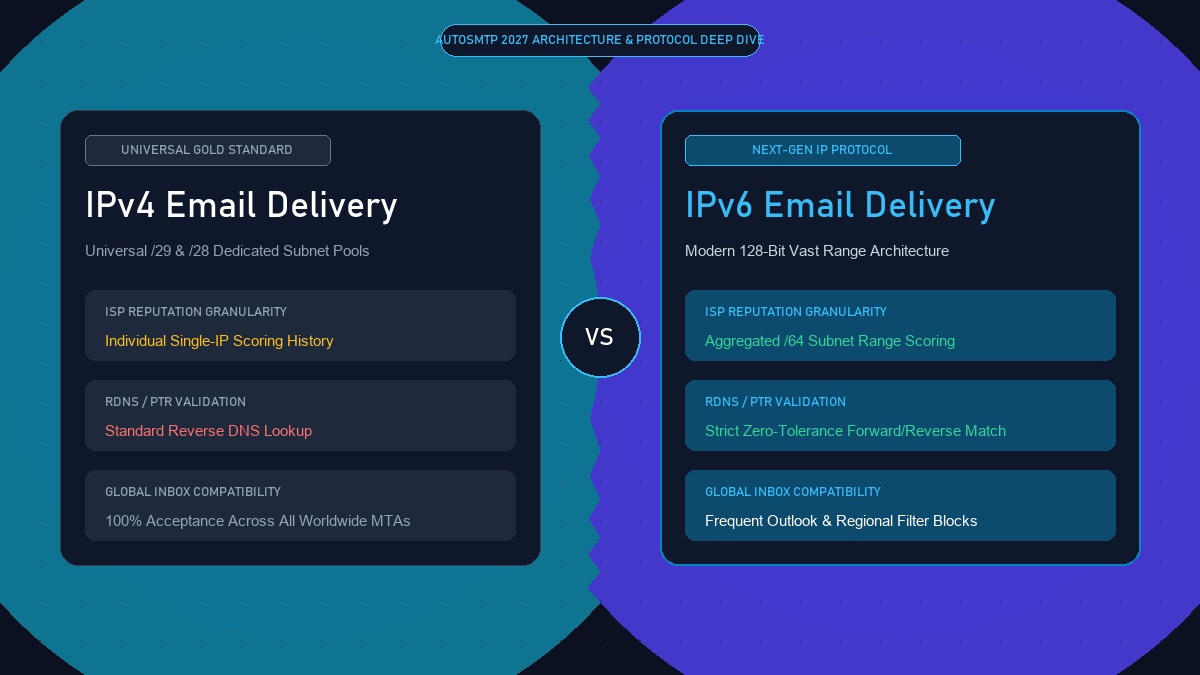
Executive Summary: The ongoing transition from IPv4 to IPv6 has transformed web traffic and cloud networking, yet email transport remains overwhelmingly governed by IPv4 realities. While IPv6 provides a virtually limitless address space (eliminating the soaring lease costs of scarce IPv4 addresses), mailbox providers treat IPv6 outbound traffic with heightened suspicion. Because bad actors can easily rotate billions of disposable IPv6 addresses inside a single /64 subnet (snowshoe spamming), major receivers like Google, Yahoo, and Microsoft enforce drastically stricter validation rules on IPv6 connections: zero-tolerance Forward-Confirmed Reverse DNS (FCrDNS), mandatory DMARC alignment, and aggregated /64 subnet reputation scoring. For enterprise senders, relying exclusively on IPv6 leads to high deferral rates and fragmented delivery across legacy corporate MX gateways. Dedicated IPv4 remains the gold standard for inbox reliability.
- 1. The Two Protocols: 32-Bit Scarcity vs 128-Bit Vastness
- 2. 2027 Email Adoption Landscape: The 85/15 Reality
- 3. Google & Yahoo’s Stricter IPv6 Sender Requirements
- 4. Forward-Confirmed Reverse DNS (FCrDNS) Mechanics
- 5. Reputation Scoring: Single IPv4 Addresses vs IPv6 /64 Subnets
- 6. Dual-Stack MTA Architecture: PowerMTA & KumoMTA Routing
- 7. The IPv6 Warming Dilemma: Subnet Dilution
- 8. Production Case Study: Resolving Microsoft 365 Drops on IPv6
- 9. Comprehensive Evaluation Matrix: IPv4 vs IPv6 for Email
- 10. Strategic Decision Framework & Infrastructure Recommendations
1. The Two Protocols: 32-Bit Scarcity vs 128-Bit Vastness
The fundamental divide between IPv4 and IPv6 lies in address space geometry:
- IPv4 (32-Bit Architecture): Yields roughly 4.29 billion total IP addresses. With global exhaustion finalized across ARIN, RIPE, and APNIC, clean IPv4 addresses represent scarce, premium commodities. In 2027, dedicated IPv4 subnets lease for $40 to $65+ per IP per month on the open market.
- IPv6 (128-Bit Architecture): Provides 3.4 × 1038 addresses. A standard enterprise hosting allocation is a /64 subnet, containing 18,446,744,073,709,551,616 unique IP addresses at virtually zero cost.
In standard web browsing and CDN traffic (Cloudflare, Fastly), IPv6 is an undeniable triumph, handling over 45% of global requests. However, in the world of email transport—where anti-spam defenses were constructed over three decades around the scarcity of IPv4—IPv6 presents an immense deliverability challenge.
2. 2027 Email Adoption Landscape: The 85/15 Reality
While consumer hyperscalers (Gmail, Outlook.com, Yahoo) maintain dual-stack MX servers capable of receiving IPv6 traffic, thousands of corporate email gateways, universities, financial institutions, and government domains do not publish AAAA records for their MX hosts. Many on-premise security appliances (Proofpoint, Cisco IronPort, Barracuda) and regional ISP firewalls actively drop inbound IPv6 SMTP handshakes or route them through secondary, heavily throttled queues.
Consequently, an email infrastructure stack configured to send exclusively over IPv6 experiences immediate delivery failures for 15% to 25% of commercial B2B and institutional recipient lists.
3. Google & Yahoo’s Stricter IPv6 Sender Requirements
Because spammers can easily cycle through billions of disposable IPv6 addresses, Google and Yahoo enforce strict, zero-tolerance policies on inbound IPv6 connections that do not apply to legacy IPv4 traffic:
To deliver successfully over IPv6 to Gmail, a sender must achieve 100% compliance across three simultaneous requirements:
- The sending IPv6 address must have a valid PTR (reverse DNS) record.
- The hostname returned by the PTR must resolve to the identical IPv6 address via a forward AAAA query (FCrDNS).
- The message must pass SPF or DKIM with strict DMARC alignment. On IPv4, minor authentication anomalies frequently result in Spam folder routing; on IPv6, they result in instant in-band socket termination.
4. Forward-Confirmed Reverse DNS (FCrDNS) Mechanics
Forward-Confirmed Reverse DNS (FCrDNS) is the cryptographic handshake that validates an IP’s claim to a domain name. Setting up FCrDNS on an IPv6 address requires precise DNS synchronization across two authoritative zones:
5. Reputation Scoring: Single IPv4 Addresses vs IPv6 /64 Subnets
In the IPv4 ecosystem, reputation is evaluated on a discrete, single-IP basis. If you own 162.251.122.180, mailbox providers track your spam complaints, bounce rates, and volume on that specific 32-bit address. Neighboring IPs in the same subnet do not necessarily drag down your reputation.
In IPv6, this model is mathematically impossible. A single /64 subnet contains 18 quintillion addresses—more than 4 billion times the entire IPv4 internet. If mailbox providers tracked IPv6 reputation per single IP, a spammer could send 10 emails per IP and cycle through billions of addresses without ever building a trackable history.
Universal Delivery: 100% compatible with every mailbox provider, corporate Exchange server, and regional gateway worldwide.
Isolated Reputation: Reputation is tethered strictly to your individual IP; zero risk of subnet-wide collateral penalties.
Predictable Inbox Algorithms: Mature, battle-tested scoring rules with transparent feedback loops (Google Postmaster, Microsoft SNDS).
B2B Delivery Black Holes: 15%–25% of enterprise MX servers lack IPv6 endpoints, resulting in unroutable deferrals.
Zero Tolerance for DNS Flaws: Minor PTR mismatch or propagation lag triggers immediate 550 socket rejections.
Shared /64 Subnet Penalties: On cheap cloud VPS providers, neighboring bad actors sharing your /64 block your mail.
6. Dual-Stack MTA Architecture: PowerMTA & KumoMTA Routing
The industry-standard architecture for high-volume enterprise deliverability is Dual-Stack Hybrid Routing:
- Dedicated IPv4 addresses handle all primary outbound delivery, ensuring universal acceptance across corporate and consumer mailboxes.
- IPv6 interfaces are maintained for inbound mail receipt, MX redundancy, and selective outbound peering to certified dual-stack receivers.
7. The IPv6 Warming Dilemma: Subnet Dilution
Warming up an IPv6 sending pool requires immense care. Because mailbox providers score the /64 range rather than the individual IP, spreading volume across multiple IPv6 addresses during a warmup does not accelerate reputation building—it dilutes it. Receivers see sporadic, low-volume signals across disparate IPs, delaying the establishment of sender trust.
On AutoSMTP dedicated bare-metal infrastructure, warming is executed across isolated dedicated IPv4 /29 subnets using our automated gas-pedal protocol. Real-time Google Postmaster telemetry monitors spam ratios under 0.10%, ramping throughput systematically without the fragility of IPv6 subnet scoring.
8. Production Case Study: Resolving Microsoft 365 Drops on IPv6
How an HR Tech Platform Fixed a 24% B2B Deferral Rate by Migrating from Cloud IPv6 to Dedicated IPv4
Background: A workforce management SaaS platform deployed on a major cloud VPS provider attempted to reduce infrastructure costs by routing 1.8 million monthly transactional payroll and shift notifications over the cloud provider’s included IPv6 range. Within three weeks, the platform experienced a catastrophic 24% delivery failure rate. Corporate clients hosted on Microsoft 365 and hybrid on-premises Exchange servers returned persistent 451 4.4.0 Connection timed out and 550 5.7.1 Access denied errors because the cloud provider’s shared /64 range had been flagged for outbound abuse.
The Solution: In late 2026, the company migrated to AutoSMTP Dedicated Infrastructure, deploying a high-availability bare-metal cluster with a clean, dedicated /29 IPv4 subnet. All outbound transactional traffic was bound to isolated IPv4 interfaces with dedicated PTR and 2048-bit DKIM keys.
Results:
- Immediate Delivery Recovery: Corporate B2B delivery jumped from 76% to 99.4% within 48 hours of cutover.
- Zero Subnet Contamination: Complete insulation from neighbor noise and shared cloud blocklist penalties.
- Sub-Second Ingestion: Critical employee shift notifications were delivered to mobile devices in an average of 340 milliseconds.
9. Comprehensive Evaluation Matrix: IPv4 vs IPv6 for Email
| Architectural Metric | Dedicated IPv4 | IPv6 (/64 Allocation) | Strategic Impact |
|---|---|---|---|
| Global MX Compatibility | 100% Universal | ~75% – 85% (Fragmented in B2B) | IPv4 required for universal business reach |
| Reputation Evaluation | Single discrete IP address | Aggregated across entire /64 subnet | IPv4 insulates sender from neighbor spam |
| PTR / rDNS Enforcement | Standard requirement | Strict zero-tolerance FCrDNS | IPv6 drops messages instantly for minor lag |
| DMARC / SPF Sensitivity | Spam folder routing on failure | In-band 550 rejection on failure | IPv6 affords zero forgiveness for DNS drift |
| Infrastructure Acquisition Cost | $40 – $65 / mo per IP (scarce) | Effectively free ($0 / range) | IPv4 is premium, but essential for delivery |
| Spamhaus / DNSBL Listing | Lists individual IP (/32) | Lists entire CIDR block (/64) | IPv6 listing burns billions of addresses |
10. Strategic Decision Framework & Infrastructure Recommendations
When IPv4 is Mandatory:
- Sending B2B transactional email, invoices, and password reset codes.
- Delivering marketing campaigns to corporate and institutional mailboxes.
- Isolating sender reputation on a pristine, dedicated hardware interface.
- Protecting outbound email from shared cloud subnet blacklists.
AutoSMTP Infrastructure Architecture:
- Clean, pre-warmed dedicated IPv4 /29 subnets allocated natively.
- Dual-stack MTA listeners for inbound mail and FBL processing.
- Automated FCrDNS and PTR verification prior to cluster deployment.
- Dynamic gas-pedal IP warming based on real-time ISP reputation.
Stop paying monthly contact penalties to SaaS marketing platforms. AutoSMTP delivers turnkey, fully managed dedicated bare-metal email clusters engineered for sovereign control, maximum throughput, and uncompromised inbox placement.
Provisions fully licensed PowerMTA/KumoMTA clusters on enterprise bare metal with flat, predictable pricing regardless of database contact size.
Monitors Google Postmaster spam ratios (<0.1%) and real-time deferrals across clean IPv4 subnets, ramping delivery automatically.
RFC 5321 in-band 550 bounce suppression + automated Yahoo/Outlook CFL ingest directly into suppression registries.
Pre-configured rDNS/PTR, SPF, 2048-bit DKIM, strict DMARC, and BIMI integration verified prior to cluster handoff.
Ready for Sovereign Dedicated Email Infrastructure?
Deploy enterprise bare-metal MTAs with dedicated IPv4 subnets, automated IP warming, and flat-rate pricing. Eliminate IPv6 deliverability traps forever.
Explore Dedicated SMTP Clusters & Pricing →