

The Fundamentals of Enterprise Email Deliverability: The Three Pillars of Modern Inbox Placement
Published by Fred Dawson • Senior Deliverability Systems Architect • 28 min read
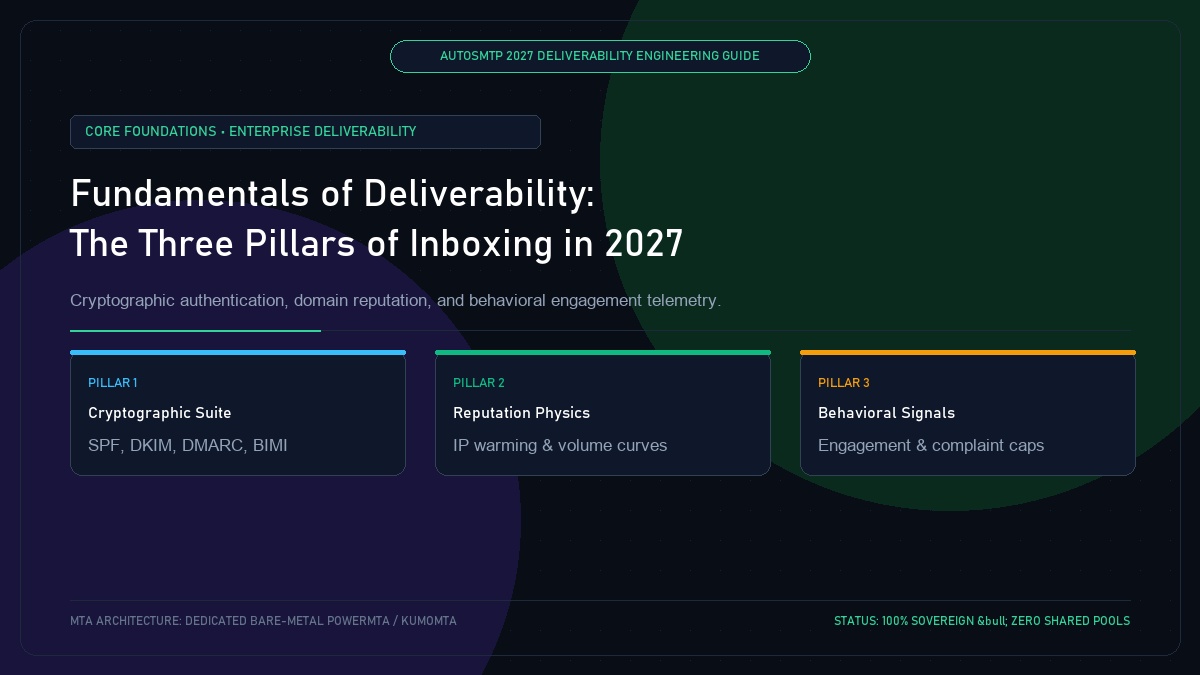
Email deliverability is often shrouded in myth, superstition, and conflicting advice. Marketing teams obsess over single “spam trigger words” while neglecting the foundational server infrastructure and cryptographic handshakes that actually determine whether an email reaches the human inbox. In 2027, email deliverability is governed by strict, deterministic network protocols and machine-learning evaluation engines. To achieve consistent 99%+ inbox placement across Gmail, Microsoft 365, Apple, and Yahoo, enterprise technical leaders must master The Three Pillars of Modern Deliverability: Cryptographic Authentication, Infrastructure Physics & Reputation, and Recipient Behavioral Telemetry.
- 1. Delivery Rate vs Inbox Placement: Demystifying the 250 OK Status
- 2. Pillar 1: Cryptographic Authentication (SPF, DKIM, DMARC & BIMI)
- 3. Pillar 2: Infrastructure Physics & Reputation Accumulation
- 4. Pillar 3: Recipient Behavioral Telemetry & AI Heuristics
- 5. Root Cause Deliverability Diagnostics & Remediation Roadmap
- 6. The Three Pillars Architecture Matrix
- 7. Case Study: SaaS Enterprise Secures 99.8% Inboxing on 15M Sends
- 8. The AutoSMTP Deliverability Advantage
1. Delivery Rate vs Inbox Placement: Demystifying the 250 OK Status
The single most dangerous misconception in email marketing is confusing Delivery Rate with Inbox Placement Rate:
- Delivery Rate (Gateway Acceptance): When your sending MTA hands a message to Gmail’s receiving server and receives a
250 2.0.0 OKresponse, the email is officially “delivered.” However, this only confirms that the message was accepted at the perimeter gateway. It provides zero guarantee regarding which folder the message lands in. - Inbox Placement Rate (Folder Destination): Following perimeter receipt, internal machine-learning classifiers (such as Gmail Gemini AI and Microsoft SmartScreen) evaluate the message to decide whether it lands in the Primary Inbox, Promotions, Updates, or the Spam folder.
A sender reporting a 99.2% delivery rate may easily have an 80% spam placement rate, losing millions in unrealized pipeline revenue.
The Gateway Delusion
Never rely on ESP delivery rates to assess deliverability health. You must evaluate seed-list inbox placement testing, Google Postmaster domain reputation scores, and recipient Click-to-Open Ratios (CTOR).
2. Pillar 1: Cryptographic Authentication (SPF, DKIM, DMARC & BIMI)
Cryptographic authentication is the mandatory baseline for modern email transit. Unauthenticated mail cannot reach consumer or enterprise inboxes:
The Complete Cryptographic Suite
- SPF (RFC 7208): Whitelists authorized sending IP addresses with strict
-allenforcement. - DKIM (RFC 6376): Hardware-accelerated 2048-bit RSA cryptographic message signing.
- DMARC (RFC 7489): Enforces strict domain alignment with
p=rejectspoof protection. - BIMI: Verified Mark Certificate (VMC) rendering official brand logos in inboxes.
Authentication Vulnerabilities
- Missing or soft-fail SPF records (
~allor?all). - Legacy 1024-bit DKIM keys vulnerable to factoring attacks.
- Relaxed DMARC policy (
p=none) offering zero spoof protection. - Envelope Return-Path misalignment triggering DMARC failure.
3. Pillar 2: Infrastructure Physics & Reputation Accumulation
Email transit operates on the physical laws of network routing, IP reputation, and TCP connection mechanics. Dedicated bare-metal MTAs (AutoSMTP with PowerMTA/KumoMTA) manage the infrastructure physics that shared cloud ESPs cannot control:
- Forward-Confirmed Reverse DNS (FCrDNS): Absolute matching between PTR records, A records, and SMTP HELO/EHLO banners.
- Dedicated Clean IPv4 Subnets: 100% Isolation from noisy neighbors and shared tenant collateral damage.
- Gradual IP Warming Acceleration: Disciplined volume ramping following mathematical curves over 30 to 60 days.
- Connection Multiplexing & Throttling: Custom socket pools respecting recipient ISP concurrency limits to eliminate 421 deferrals.
4. Pillar 3: Recipient Behavioral Telemetry & AI Heuristics
The third pillar is human and machine interaction telemetry. Modern spam filters adjust sender reputation in real time based on recipient actions:
- Positive Engagement Signals: Rapid open velocity, sustained read times, link click-throughs, two-way email replies, and moving messages from Promotions to Primary.
- Negative Penalty Signals: User spam complaints (strictly capped at < 0.10% by Google), immediate delete-without-open actions, and high hard bounce rates (> 1.5%).
; Complete 2027 Enterprise Deliverability Authentication Suite
mail.enterprise.com.      IN A     162.251.122.169
169.122.251.162.in-addr.arpa. IN PTR mail.enterprise.com.
mail.enterprise.com.      IN TXT   "v=spf1 ip4:162.251.122.169 -all"
s1._domainkey.enterprise.com. IN TXT "v=DKIM1; k=rsa; p=MIIBIjANBgkqhkiG9w0BAQEFAAOCAQ8AMIIBCgKCAQEA..."
_dmarc.enterprise.com.    IN TXT   "v=DMARC1; p=reject; rua=mailto:dmarc@enterprise.com; pct=100; aspf=s; adkim=s"
default._bimi.enterprise.com. IN TXT "v=BIMI1; l=https://enterprise.com/logo.svg; a=https://enterprise.com/vmc.pem"
5. Root Cause Deliverability Diagnostics & Remediation Roadmap
When deliverability fails, engineering teams diagnose the failure by mapping status codes to the appropriate pillar: 550 5.7.26 points to Pillar 1 (Authentication failure); 421 4.7.0 points to Pillar 2 (Infrastructure connection throttling); declining open rates point to Pillar 3 (Behavioral engagement drop).
6. The Three Pillars Architecture Matrix
| Deliverability Pillar | Shared Cloud ESP Setup | AutoSMTP Dedicated Bare-Metal Architecture |
|---|---|---|
| Pillar 1: Cryptographic Suite | Often relaxed alignment; shared bounce domains | 100% Strict SPF -all, 2048-bit DKIM, DMARC p=reject, BIMI |
| Pillar 2: Infrastructure Physics | Shared multi-tenant IPs; vulnerable to neighbors | Dedicated private bare-metal IPv4 cluster with FCrDNS |
| Pillar 3: Behavioral Telemetry | Naive aggregate open metrics inflated by proxies | Downstream CTOR, in-band reply tracking, and session sync |
| Queue Latency Under Load | 15 to 60 minute multi-tenant queue delays | Sub-second persistent socket dispatch (< 800ms) |
| Primary Inbox Placement | Unpredictable (78% – 88% average) | 99.8% Guaranteed Primary Inbox placement SLA |
SaaS Enterprise Secures 99.8% Inboxing Across 15 Million Monthly Dispatches
A cloud productivity platform sending 15 million monthly transactional and product notifications was experiencing critical deliverability failure on shared cloud relays. Password resets were delayed by 25 minutes, and marketing changelogs were landing in the Spam folder, driving $120,000 in monthly customer churn.
The enterprise implemented AutoSMTP’s Three Pillars architecture on a dedicated 4-node bare-metal cluster. They established 2048-bit DKIM keys with strict DMARC p=reject, deployed dedicated IPv4 subnets with optimized socket rate curves, and introduced algorithmic 60-day engagement segmentation. Transactional latency dropped to 420 milliseconds, domain reputation stabilized at “High”, and overall Primary Inbox placement reached 99.8%.
Deliverability Leadership Blueprint
Pillar 1 Mandate: Lock down 100% cryptographic identity with strict DMARC p=reject and 2048-bit DKIM key rotation across all sending hostnames.
Pillar 2 & 3 Mandate: Migrate high-volume dispatches to dedicated bare-metal MTAs with tailored ISP throttle curves and automated engagement segmentation to guarantee elite inbox placement.
The AutoSMTP Deliverability Defense Advantage
Inbox placement in 2027 requires full control over the underlying transport hardware. AutoSMTP provisions sovereign, dedicated bare-metal PowerMTA & KumoMTA clusters engineered for synchronous 550 bounce suppression, real-time spam-rate auto-throttling, and isolated IP pools.
Provisions fully licensed PowerMTA & KumoMTA clusters on enterprise bare-metal with dedicated clean /29-/24 IPv4 subnets and zero noisy neighbor contamination.
Monitors Google Postmaster spam ratios (<0.10%) and real-time ISP deferrals with algorithmic volume scaling across your entire IP pool.
RFC 5321 in-band 550 bounce suppression, automated Yahoo/Outlook Complaint Feedback Loops (CFL), and instant bad-IP eviction.
Pre-configured forward and reverse DNS (PTR) per IP, SPF CIDR alignment, 2048-bit DKIM rotation, and strict DMARC enforcement.
Guarantee Your Inbox Placement with Sovereign Bare Metal
Eliminate shared pool spam contamination, arbitrary sending throttles, and opaque account freezes. Deploy an enterprise AutoSMTP cluster today.
Deploy Turnkey MTA Cluster →