

SendGrid vs Mailgun: 2027 Email API Comparison, Pricing, Deliverability, and Developer Experience
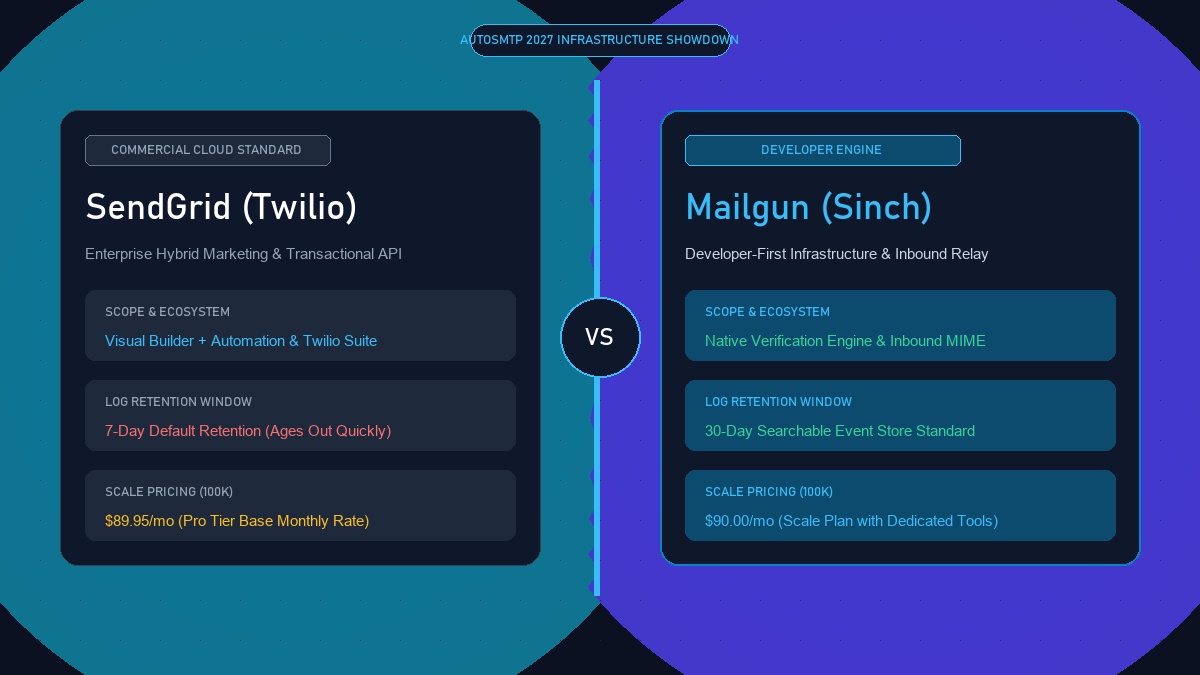
The enterprise rivalry between Twilio SendGrid and Sinch Mailgun anchors the commercial cloud email industry. SendGrid operates as a hybrid marketing and transactional juggernaut, processing over 80 billion emails monthly with visual campaign builders, drag-and-drop workflow automations, and tight Twilio telephony integration. Mailgun functions as a developer-first delivery engine, processing over 400 billion emails annually with native email address verification, inbound MIME parsing webhooks, 30-day default log retention, and robust multi-domain credential isolation. However, both multi-tenant giants suffer from escalating pricing tiers, restrictive 7-to-30 day log expiration windows, and unpredictable shared IP reputation dips—forcing high-volume senders toward dedicated bare-metal MTA infrastructure.
- 1. The Architectural Divide: Hybrid vs Developer-First
- 2. SendGrid vs Mailgun Feature Showdown
- 3. Comprehensive Pricing Economics & Add-On Taxes
- 4. Developer Experience: APIs, Webhooks, and Logging
- 5. Deliverability, Warmup, and ISP Throttling
- 6. REST API Implementation (cURL & Python)
- 7. Enterprise Production Case Study
- 8. Tactical Decision Framework
- 9. The AutoSMTP Dedicated MTA Solution
1. The Architectural Divide: Hybrid vs Developer-First
Choosing between SendGrid and Mailgun requires evaluating team composition and technical workflow.
Twilio SendGrid has evolved into a horizontal communications platform. While it remains one of the largest transactional mail relays in existence, SendGrid heavily prioritizes its Marketing Campaigns suite. Non-technical marketing staff can design responsive drag-and-drop newsletters, manage contact lists, configure drip automations, and run multi-variant A/B tests within the same portal that engineers use to generate API keys. For cross-functional teams that want a single invoice for marketing newsletters, transactional password resets, and Twilio SMS notifications, SendGrid provides unmatched breadth.
Sinch Mailgun remains fiercely loyal to engineering and systems architecture. Rather than building competing visual campaign builders, Mailgun optimizes the core delivery pipe. Mailgun provides advanced inbound email routing with regex-based recipient rules, automatic multipart MIME parsing into structured JSON webhooks, native real-time email list verification, and 30-day searchable event storage. Mailgun is designed for developers who build their own internal campaign tooling, rely on customer data platforms (CDPs), or require headless multi-tenant SMTP relaying for third-party client domains.
2. SendGrid vs Mailgun Feature Showdown
- Unified Marketing & Transactional: Visual drag-and-drop email designer, contact segmentation, and automated drip sequences.
- Twilio Telephony Synergies: Single vendor relationship for unified SMS, voice, WhatsApp, and email delivery.
- Massive Delivery Scale: Delivers 80+ billion emails monthly with redundant data centers across the United States.
- Subuser Tenant Isolation: Clean subuser provisioning with individual sending allocations and dedicated IP pool assignment.
- 1 Dedicated IP on Pro: The Pro 100K plan ($89.95/mo) includes 1 dedicated IPv4 address standard.
- Native Email Verification: Validates syntax, DNS MX records, and mailbox existence without paying for external scrubbing services.
- Superior Inbound Routing: Converts incoming emails, attachments, and headers into structured JSON webhooks effortlessly.
- 30-Day Searchable Log Retention: Search full event metadata and bounce transcripts for 30 days (vs SendGrid’s 7 days).
- EU Data Residency: Fully compliant European sending cluster hosted in Frankfurt for strict GDPR requirements.
- Multi-Domain Credential Flexibility: Manage separate SMTP credentials and DKIM keys across dozens of client domains easily.
3. Comprehensive Pricing Economics & Add-On Taxes
Pricing structures between SendGrid and Mailgun appear similar at 100,000 emails, but diverge significantly as monthly volumes scale into the millions.
| Monthly Volume | SendGrid Tier | Mailgun Tier | Cost Difference & Notes |
|---|---|---|---|
| Free Tier | 100 emails / day (Permanent) | 100 emails / day (30-day Trial only) | SendGrid wins for permanent hobby/dev use |
| 50,000 emails | $19.95 / mo (Essentials) | $35.00 / mo (Foundation) | SendGrid is 43% cheaper |
| 100,000 emails | $89.95 / mo (Pro 100k, 1 IP) | $90.00 / mo (Scale 100k, 1 IP) | Virtual parity (~$90/mo with 1 Dedicated IP) |
| 250,000 emails | $249.00 / mo (Pro 250k) | $195.00 / mo (Scale 250k) | Mailgun is 22% cheaper ($54/mo savings) |
| 500,000 emails | $449.00 / mo (Pro 500k) | $405.00 / mo (Scale 500k) | Mailgun is 10% cheaper ($44/mo savings) |
| 1,000,000 emails | $749.00 / mo (Pro 1M) | $720.00 / mo (Custom) | Mailgun is 4% cheaper |
SendGrid’s 7-day default log retention is one of the most painful operational traps for site reliability engineers. If an enterprise customer reports a missing billing confirmation from 10 days ago, SendGrid’s logs have completely discarded the delivery record unless you purchase an expensive add-on. Mailgun includes 30 days of retention standard. Conversely, Mailgun’s Flex pay-as-you-go rate doubled in December 2025, penalizing senders with volatile month-over-month sending volumes.
4. Developer Experience: APIs, Webhooks, and Logging
Both platforms provide high-quality developer toolkits, but their API design reflects contrasting architectural philosophies:
Webhook Security & Reliability: Mailgun signs every outgoing webhook with an HMAC-SHA256 signature containing a timestamp, token, and cryptographic hash, allowing developers to immediately reject replay attacks. SendGrid uses an Event Webhook that bundles batches of events into single array POST payloads signed with ECDSA public keys.
Inbound Email Handling: Mailgun is the undisputed industry leader for programmatic inbound parsing. It automatically strips quoted replies, extracts inline image attachments, and POSTs structured JSON payloads to user endpoints. SendGrid’s Inbound Parse Webhook is capable but forwards raw MIME multipart data, forcing developers to manage their own MIME decoding libraries.
5. Deliverability, Warmup, and ISP Throttling
| Deliverability Metric | SendGrid (Twilio) | Mailgun (Sinch) | Real-World Performance |
|---|---|---|---|
| Shared IP Pool Quality | Variable (High Marketing Churn) | Moderate (Tightly Monitored) | Shared pools experience periodic Yahoo/Outlook deferral spikes |
| Dedicated IP Inclusion | Included on Pro 100K+ | Included on Scale 100K+ | Both include 1 dedicated IP; additional IPs cost $30–$35/mo |
| Automated IP Warmup | Yes (Automated Hourly Ramp) | Yes (Step Pacing Tooling) | SendGrid offers smoother automated daily volume transitions |
| Spam Complaint Thresholds | Strict Suspension at >0.08% | Quarantine Warning at >0.10% | SendGrid automated risk systems suspend accounts aggressively |
6. REST API Implementation (cURL & Python)
curl --request POST   --url https://api.sendgrid.com/v3/mail/send   --header 'Authorization: Bearer SG.your_api_key'   --header 'Content-Type: application/json'   --data '{
    "personalizations": [{
      "to": [{"email": "recipient@enterprise.com"}]
    }],
    "from": {"email": "notifications@domain.com"},
    "subject": "System Security Alert",
    "content": [{
      "type": "text/plain",
      "value": "Suspicious login detected from IP 192.0.2.1."
    }]
}'curl -s --user 'api:key-mailgun-prod-2027' https://api.mailgun.net/v3/mg.domain.com/messages -F from='Security <notifications@domain.com>' -F to='recipient@enterprise.com' -F subject='System Security Alert' -F text='Suspicious login detected from IP 192.0.2.1.' -F o:tracking=false -F o:tag='security-alert'7. Enterprise Production Case Study
B2B Logistics Platform (850,000 sends/month): Operating on SendGrid Pro, the engineering team faced recurrent 7-day log truncation issues, preventing support from resolving lost carrier dispatch notifications. Concurrently, marketing blasts sharing the subuser IP pool triggered Gmail rate limits during morning surges. After migrating developer transactional notifications to Mailgun with 30-day logs and distinct sending domains, carrier notification latency dropped from 4 minutes to 3.2 seconds.
8. Tactical Decision Framework
- Marketing teams need a visual template editor and campaign builder without engineering assistance.
- Your infrastructure already utilizes Twilio SMS, Voice, or Segment CDP for customer communications.
- You require a permanent free tier for testing or low-volume staging environments (100 emails/day).
- You want an automated IP warming feature that steps up hourly throughput automatically.
- Your engineering team requires deep inbound parsing to ingest incoming emails into application webhooks.
- You need 30 days of searchable event logs out-of-the-box for compliance or customer support audits.
- You operate a SaaS platform managing multi-domain SMTP relaying and distinct client DKIM keys.
- You require European data sovereignty hosted in Frankfurt under strict GDPR guidelines.
Deploy Dedicated Bare-Metal MTA Clusters
At 500,000 to 1,000,000+ monthly emails, paying $400 to $750+ every month to SendGrid or Mailgun for shared cloud capacity is economically inefficient. AutoSMTP replaces metered API tolls with turnkey bare-metal PowerMTA or KumoMTA clusters on enterprise hardware, giving you 100% private IPv4 subnets, zero message surcharges, and automated 24/7 deliverability management.
Dedicated enterprise MTA engines on bare-metal NVMe servers with 100% private IPv4 subnets and zero shared resource contention.
Intelligent warmup pacing monitoring Google Postmaster spam ratios (<0.1%) and real-time deferrals across clean IPv4 subnets.
RFC 5321 in-band 550 bounce suppression and automated Yahoo/Outlook Complaint Feedback Loop processing directly into your sending queues.
Pre-configured rDNS/PTR, SPF, 2048-bit DKIM, strict DMARC, and BIMI SVG certificates managed 24/7 by deliverability specialists.
Stop paying cloud volume markups. Scale your email sending with dedicated bare-metal MTA power today.