

Mailgun vs Postmark: 2027 Flexible Developer Platform vs Laser-Focused Transactional API Comparison
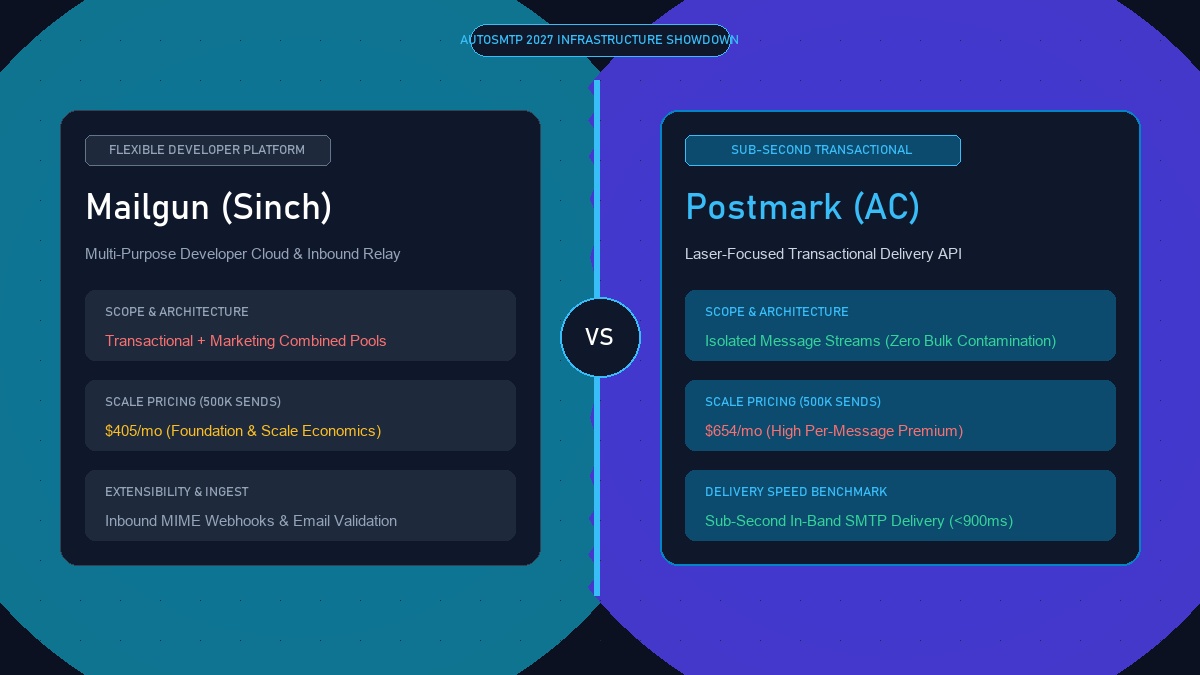
The technical divide between Mailgun (by Sinch) and Postmark (by ActiveCampaign) represents two opposite schools of thought in cloud email delivery. Mailgun functions as a comprehensive, Swiss-army-knife email infrastructure engine supporting combined transactional and marketing sending, multi-domain SMTP relaying, inbound MIME parsing via webhooks, and built-in email verification. Postmark, by contrast, operates as an uncompromising, opinionated transactional specialist enforcing architectural traffic isolation through Message Streams, refusing promotional bulk campaigns on transactional pools, and maintaining published sub-second delivery latency benchmarks (<900ms). While Postmark offers superior out-of-the-box deliverability for low-volume SaaS alerts, Mailgun provides volume discounts at scale—yet both platforms encounter severe cost escalation when scaling beyond 500,000 monthly messages compared to dedicated bare-metal MTA clusters.
- 1. Two Opposing Developer Philosophies
- 2. Mailgun vs Postmark Architectural Profiles
- 3. Ownership Transitions: Sinch vs ActiveCampaign
- 4. Granular Pricing & Crossover Dynamics
- 5. Deep Technical Feature Matrix
- 6. Deliverability & Message Streams Separation
- 7. REST API & Webhook Integration Benchmarks
- 8. Hybrid Enterprise Deployment Patterns
- 9. The AutoSMTP Dedicated Alternative
1. Two Opposing Developer Philosophies
Although Mailgun and Postmark both cater to engineering teams, their operational paradigms diverge fundamentally. Mailgun positions itself as a broad email infrastructure platform designed to handle every facet of an organization’s email lifecycle. Whether an application needs to send high-frequency password resets, blast a 200,000-subscriber marketing newsletter, parse incoming support tickets via inbound webhooks, or verify email syntax in real time, Mailgun provides the API endpoints and routing tables to do it all within a single umbrella dashboard.
Postmark, on the other hand, embraces an opinionated, laser-focused transactional specialty. Built originally by Wildbit and acquired by ActiveCampaign, Postmark enforces an architectural separation between transactional messages (order receipts, multi-factor authentication codes, password resets) and promotional broadcasts. Postmark actively polices its sending pools, refusing bulk cold outreach or unsegmented marketing broadcasts on its core transactional infrastructure. The result is unparalleled sub-second inbox placement and zero risk that a rogue marketing blast will delay a customer’s time-critical verification pin.
Mailgun: The “kitchen-sink” cloud communications engine. Prioritizes API versatility, multi-domain SMTP relaying, inbound parsing, and cost efficiency at scale across combined marketing and transactional workflows.
Postmark: The transactional purity specialist. Prioritizes sub-second delivery latency, public delivery transparency, 45-day raw message log retention, and strict sender reputation insulation via Message Streams.
2. Mailgun vs Postmark Architectural Profiles
- Multi-Purpose REST API: Supports transactional and marketing payloads over identical endpoints with batch recipient variables.
- Inbound Email Routing: Industrial-strength MIME parser converting incoming multipart emails into structured JSON webhooks.
- Multi-Domain SMTP Management: Create distinct SMTP credentials and rate limits across unlimited subdomains from a single parent account.
- Built-In List Hygiene: Real-time and batch address verification checking MX records, disposable providers, and mailbox existence.
- EU Data Residency: Opt-in European infrastructure cluster hosted in Frankfurt for strict GDPR compliance.
- Isolated Message Streams: Hard-coded separation separating Transactional, Broadcast, and Inbound traffic onto distinct IP pools.
- Sub-Second In-Band Delivery: Mean delivery times to Gmail, Yahoo, and Microsoft 365 frequently clock in under 900 milliseconds.
- 45-Day Full Message Body History: View the exact HTML/plaintext body, raw headers, and bounce transcripts directly in the UI for 45 days.
- Universal Deliverability: Shared IP pools deliver near-perfect placement without forcing users to purchase $50/mo dedicated IPs.
- Transparent Status Dashboards: Publicly visible, real-time ISP delivery metrics updated every minute.
3. Ownership Transitions: Sinch vs ActiveCampaign
Both Mailgun and Postmark have transitioned from founder-led developer startups into subsidiaries of massive enterprise communications conglomerates. Analyzing the ripple effects of these acquisitions provides vital context for long-term infrastructure planning.
The Mailgun Trajectory Under Sinch
Following its initial acquisition by Rackspace in 2012 and subsequent spinoff, Mailgun was acquired by Swedish telecommunications giant Sinch in 2021. Sinch consolidated Mailgun alongside email deliverability suite Pathwire (Mailjet and Email on Acid). While this created cross-channel synergy with SMS and voice APIs, practitioner consensus notes that product release velocity on the core MTA has moderated. Furthermore, Sinch doubled Mailgun’s pay-as-you-go Flex plan pricing in late 2025, eliminating low-volume cost predictability and forcing small senders into minimum $35/month commitments.
The Postmark Trajectory Under ActiveCampaign
In 2022, ActiveCampaign acquired Wildbit, the creator of Postmark. ActiveCampaign made explicit commitments to preserve Postmark’s engineering team, independent brand, and laser focus on transactional email. To date, Postmark has maintained its core delivery architecture and transparent public metrics. However, ActiveCampaign has gradually integrated Postmark into its broader marketing automation ecosystem, and pricing updates have introduced higher overage premiums at volume tiers above 250,000 monthly emails.
4. Granular Pricing & Crossover Dynamics
Pricing structures between Mailgun and Postmark illustrate a classic developer platform crossover. At entry-level and moderate volumes (under 50,000 emails per month), Postmark is significantly more economical due to its $15 Starter tier. However, as an application scales past 100,000 monthly sends, Mailgun’s volume tiers deliver significant savings, widening to a nearly 40% discount at 500,000 monthly sends.
| Monthly Email Volume | Postmark Base Tier | Mailgun Base Tier | Cost Variance & Crossover |
|---|---|---|---|
| 10,000 emails | $15 / mo (Starter) | $35 / mo (Foundation) | Postmark is 57% cheaper |
| 25,000 emails | ~$35 / mo | $35 / mo (Foundation) | Parity ($35/mo) |
| 50,000 emails | ~$55 / mo | $75 / mo (Foundation 50k) | Postmark is 27% cheaper |
| 100,000 emails | ~$115 / mo | $90 / mo (Scale Tier) | Mailgun is 22% cheaper (Crossover Point) |
| 250,000 emails | ~$310 / mo | $195 / mo (Scale Tier) | Mailgun is 37% cheaper |
| 500,000 emails | ~$654 / mo | $405 / mo (Scale Tier) | Mailgun is 38% cheaper ($249/mo savings) |
| 1,000,000 emails | ~$1,250 / mo (Custom) | $720 / mo (Custom) | Mailgun is 42% cheaper ($530/mo savings) |
While Mailgun looks cheaper on paper at scale, add-on costs compound rapidly. Dedicated IP addresses cost an additional $34.95/month on Mailgun (vs $50/month on Postmark). Email validations on Mailgun cost $1.20 per 1,000 checks. Inbound route processing beyond basic volume quotas incurs overage fees. On Postmark, full 45-day history and exceptional shared delivery are bundled into the base rate, but dedicated IPs and DMARC monitoring add significant line-item costs.
5. Deep Technical Feature Matrix
| Technical Capability | Mailgun (Sinch) | Postmark (ActiveCampaign) | Architectural Analysis |
|---|---|---|---|
| Primary Focus | Comprehensive Infrastructure | Pure Transactional Delivery | Postmark protects transactional integrity by refusing bulk |
| Message Streams Isolation | Manual Domain Separation | Native Architectural Enforced | Postmark physically isolates broadcast and transactional queues |
| Mean Delivery Latency | 1.8s – 5.4s (Shared Pools) | < 900ms (Sub-second) | Postmark prioritizes synchronous in-band SMTP handshakes |
| Inbound Email Parsing | Deep Regex & MIME Webhooks | JSON Webhook Parser | Mailgun provides superior attachment routing & spam filtering |
| Email Verification Engine | Native (Bulk + Real-Time) | None (Requires 3rd Party) | Mailgun verifies MX, disposable domains, and mailbox ping |
| Log Retention Window | 3 to 30 Days (Tier Dependent) | 45 Days (Full Body & Headers) | Postmark enables extensive debugging without log export pipelines |
| Multi-Domain Subaccounts | Native Subusers & Domain Keys | Server Tokens & Workspaces | Mailgun offers superior tenancy isolation for SaaS platforms |
| EU Data Center Option | Yes (Frankfurt AWS Cluster) | Yes (European Storage) | Both satisfy GDPR; Mailgun provides regional routing controls |
6. Deliverability & Message Streams Separation
The most substantial operational difference between Mailgun and Postmark lies in how they manage sending IP pools and domain reputation.
Mailgun’s Shared Pool Dynamics: By default, Mailgun pools transactional emails and marketing campaigns onto common shared egress IP clusters unless an operator provisions a dedicated IP address on the Scale tier. While Mailgun’s automated reputation algorithms move toxic senders to quarantine pools, a spike in spam complaints from a neighboring tenant can temporarily depress inbox placement or induce 421 deferral throttling from Yahoo or Outlook.
Postmark’s Message Streams Philosophy: Postmark was the pioneer of Message Streams. When you set up a Postmark server, you must designate each stream as either Transactional, Broadcast, or Inbound. Transactional streams are routed exclusively over high-reputation, meticulously warmed IP addresses reserved solely for single-recipient triggered emails. Even if an organization’s marketing team blasts an unsegmented promotional newsletter over the Broadcast stream that receives high spam complaints, the Transactional stream remains 100% unaffected.
7. REST API & Webhook Integration Benchmarks
Both platforms expose modern RESTful endpoints, but their payload structures reflect their philosophical design. Below is a side-by-side comparison of dispatching an authenticated transactional payload.
curl -s --user 'api:key-mailgun-prod-2027' https://api.mailgun.net/v3/mg.domain.com/messages -F from='Security <security@domain.com>' -F to='client@enterprise.com' -F subject='Your 2FA Verification Code' -F text='Your verification pin is 849201.' -F o:tag='auth-2fa' -F o:tracking=false -F o:deliverytime-optimize-period=24hcurl "https://api.postmarkapp.com/email" -X POST -H "Accept: application/json" -H "Content-Type: application/json" -H "X-Postmark-Server-Token: pm-server-token" -d '{
"From": "security@domain.com",
"To": "client@enterprise.com",
"Subject": "Your 2FA Verification Code",
"TextBody": "Your verification pin is 849201.",
"MessageStream": "outbound",
"TrackOpens": false
}'8. Hybrid Enterprise Deployment Patterns
Recognizing the respective strengths of both platforms, many high-growth SaaS engineering teams implement a Dual-ESP Hybrid Architecture:
- Critical Tier (Postmark): Password resets, email confirmations, billing receipts, and security alerts (10,000 to 50,000 sends/month) are routed via Postmark to guarantee sub-second delivery and 99.5%+ inbox placement.
- Bulk & Notifications Tier (Mailgun): Daily digests, product notifications, onboarding sequences, and marketing newsletters (200,000 to 1,000,000 sends/month) are routed via Mailgun to capitalize on lower per-thousand pricing.
Fintech SaaS Platform: Prior to adopting a multi-tier strategy, a fintech scale-up routed all transactional and product activity through Mailgun. During peak Black Friday promotional sending, password reset emails experienced 4-to-12 minute deferrals at Microsoft 365 and Yahoo due to shared pool throttle limits. By decoupling MFA and transactional password resets to Postmark Message Streams while offloading high-volume bulk event notifications to Mailgun, login drop-offs dropped to zero.
9. Decision Framework: When to Choose Which?
- You are building a SaaS product where transactional delivery speed is mission-critical (users actively wait on the screen for a verification code).
- Monthly volume is under 75,000 messages, where Postmark’s $15–$55 pricing is directly cost-competitive.
- You require 45-day searchable message body logs for regulatory compliance or intensive customer support debugging.
- You refuse to manage IP warming schedules, reputation monitoring, or dedicated IP overhead.
- You need to unify transactional emails, bulk marketing campaigns, and inbound ticket parsing within a single platform.
- Your monthly volume exceeds 250,000 messages, where Mailgun’s tier discounts yield hundreds of dollars in monthly savings.
- You operate a multi-tenant platform (like a CRM or agency management tool) requiring automated sub-account provisioning and distinct SMTP credentials per customer.
- You require built-in email verification to clean contact lists before firing automated campaigns.
Break Free From SaaS API Metering & Volume Penalties
Whether you choose Mailgun or Postmark, scaling past 500,000 monthly emails means paying severe SaaS markups—frequently surpassing $400 to $650 every single month for metered API requests. AutoSMTP replaces shared cloud throttles with dedicated bare-metal MTA clusters powered by PowerMTA or KumoMTA, delivering enterprise throughput with zero per-message surcharges.
Dedicated enterprise MTA engines on bare-metal NVMe servers with 100% private IPv4 subnets and zero shared resource contention.
Intelligent warmup pacing monitoring Google Postmaster spam ratios (<0.1%) and real-time deferrals across clean IPv4 subnets.
RFC 5321 in-band 550 bounce suppression and automated Yahoo/Outlook Complaint Feedback Loop processing directly into your sending queues.
Pre-configured rDNS/PTR, SPF, 2048-bit DKIM, strict DMARC, and BIMI SVG certificates managed 24/7 by deliverability specialists.
Stop paying cloud volume markups. Scale your email sending with dedicated bare-metal MTA power today.